The post How to Build a Marketplace for Kitchen and Home Appliances appeared first on YoKart Blog.
]]>In an era defined by convenience and connectivity, the way we shop for household essentials has fundamentally changed. The once traditional market for kitchen and home appliances, including refrigerators, washing machines, blenders, smart ovens, and more, has now rapidly migrated online. Consumers now demand not just competitive pricing but also a wide variety, rich product information, and a seamless shopping experience.
This dramatic shift has opened up a unique and highly lucrative opportunity: the Kitchen and Home Appliance Marketplace. By moving beyond the limitations of a single-brand or single-retailer eCommerce store, a multi-vendor marketplace offers scalability, choice, and convenience that today’s consumers demand.
If you are an entrepreneur, a traditional retailer looking to go online, or a business owner seeking the next high-growth niche, now is the perfect time to build a marketplace for kitchen and home appliances. This comprehensive blog will walk you through everything you need to know, from understanding the market dynamics and essential features to selecting the right development approach to ensure your long-term success.
Table of Contents
- What is a Kitchen and Home Appliance Marketplace?
- Why Build a Kitchen and Home Appliance Marketplace in 2026
- Building a Home Appliance Marketplace: Best Types to Consider
- Must-Have Features For Your Kitchen and Home Appliance Marketplace
- Understanding Development Approaches: Custom vs Ready-Made Software
- Which Marketplace Development Approach is Best?
- Yo!Kart- Best eCommerce Marketplace Solution to Build Kitchen and Home Appliance Marketplace
- Conclusion
- FAQs
What is a Kitchen and Home Appliance Marketplace?
The Kitchen and Home Appliance Marketplace is a specialized type of multi-vendor eCommerce platform. Unlike a standard online store, which sells products from a single company’s inventory, a marketplace acts as an intermediary. It allows multiple independent sellers, including major manufacturers, authorized distributors, small local retailers, and specialized gadget makers, to register, list, and sell their products to a unified customer base, creating a diverse and competitive environment between sellers.
Key Characteristics:
- Multi-Vendor Model: Multiple sellers can list their products, including refrigerators, washing machines, ovens, blenders, etc., on the platform, offering customers a wide variety of brands, models, and price points.
- Centralized Platform: The marketplace owner (the admin) manages the overall platform, marketing, payments (commissions), and customer experience, while sellers manage their own inventory, shipping, and product listings.
- Specialized Niche: By focusing solely on kitchen and home appliances, it caters to specific customer needs, offering better filtering, comparison tools, and more. It includes products ranging from white goods (refrigerators, washing machines) to small kitchen appliances (mixers, coffee makers) and smart home technology (IoT devices, smart security).
In essence, a Kitchen and Home Appliance Marketplace simplifies the appliance shopping process by providing a one-stop shop for a broad range of products and services, while allowing sellers to reach a wider audience.
Why Build a Kitchen and Home Appliance Marketplace in 2026?
Launching a new venture begins with identifying a clear market opportunity. With consumer expectations changing and new technologies reshaping the industry, the home appliance sector presents a lucrative opportunity for a kitchen and home appliance marketplace.
1. Market Growth and Digital Acceleration
The global home and kitchen appliances market is experiencing significant growth, driven by increasing disposable incomes, urbanization, and a high replacement rate for older models. Moreover, a report by Grand View Research states that the global kitchen appliances market size will reach $356.47 billion by 2030, growing at a CAGR of 5.9% from 2023 to 2030. Crucially, a massive portion of this growth is happening online. Consumers are now comfortable buying large, high-value items like refrigerators and washing machines over the internet, provided the platform offers transparency and trust.
2. High Average Order Value (AOV)
Home and kitchen appliances, especially large ones, carry a naturally high price tag. This translates to a significantly higher Average Order Value (AOV) compared to general retail. For a marketplace owner, this means higher commission revenues per transaction, making the business model highly profitable even with lower transaction volumes than, say, a fashion marketplace.
3. The Shift to ‘Smart’ and Specialization
The rise of the ‘Smart Home is a game-changer. Consumers are actively seeking integrated (Internet of Things) IoT-enabled appliances. Hence, a specialized marketplace can become the central hub for discovering and comparing these complex, feature-rich products from different brands, which is often difficult on general eCommerce sites. Thus, a niche focus marketplace allows you to capture the high-value segment of tech-savvy buyers.
4. Overcoming Brick-and-Mortar Limitations
Traditional appliance retail is limited by physical store space, making it impossible to showcase every model from every brand. Comparatively, an online marketplace offers infinite shelf space, allowing vendors to list their entire catalogue, including obscure models and new product lines. Thus offering an unparalleled selection to the customer.
Start Your Home Appliance Marketplace to Capitalize on Market Growth!
Building a Home Appliance Marketplace: Best Types to Consider
The multi-vendor model lets you build a marketplace that really stands out. Moreover, its flexibility makes it easy to tailor your platform to cater to different customer needs, whether that’s major appliances, smart home gadgets, or niche kitchen tools. This approach helps you focus on high-demand segments and position your business for strong growth in the home appliance market. Additionally, you can target the appliance sector with several specific marketplace types, including:
| Marketplace Type | Description | Target Audience | Revenue Model |
| B2C (Business-to-Consumer) | The most common type. Multiple brands/retailers sell new appliances directly to end -consumers. | Households, individuals, and new homeowners. | Commissions on sales, featured listings, and ads. |
| B2B (Business-to-Business) | Connects appliance manufacturers/wholesalers with businesses like hotels, property developers, commercial kitchens, or service providers. | Real estate developers, construction companies, bulk buyers. | Commissions, subscription tiers, volume discounts. |
| Rental/Leasing | A platform for renting or leasing appliances (e.g., furniture rental for temporary housing, student accommodation, or commercial events). | Students, short-term renters, and event organizers. | Monthly subscription fees, commissions on contracts. |
| Refurbished/Second-hand | A specialized platform for certified pre-owned, refurbished, or open-box appliances. Focus on inspection and warranty is key to trust. | Budget-conscious consumers, eco-conscious buyers. | Commissions, inspection/certification fees. |
| Service Marketplace | Connects buyers with certified technicians for installation, repair, and maintenance services for appliances. | Homeowners needing post-purchase support. | Lead generation fees, service commissions. |
Expert Recommendation: For a first-time launch, the B2C model offers the broadest market reach and the most straightforward path to profitability. You can integrate service booking or refurbished sales as niche add-ons later.
Must-Have Features For Your Kitchen and Home Appliance Marketplace
A successful marketplace requires a robust feature set that caters to the specific needs of high-value, research-intensive appliance shopping. Therefore, your platform must include three distinct interfaces: Admin Panel, Seller Panel, and Buyer Interface. Let’s have a look at them:
1. Essential Buyer Interface Features
- Advanced Search & Filtering: Beyond basic filters, customers need to filter by highly technical specifications like:
- Energy Star Rating / Energy Efficiency
- Capacity (e.g., refrigerator volume, washing machine load)
- Installation Type (e.g., built-in, freestanding)
- Smart Features (e.g., Wi-Fi connectivity, voice assistant compatibility)
- Brand, Colour, Price Range.
- Detailed Product Comparisons: Your platform must allows buyers to select 2-4 products and view a side-by-side comparison of all key specs.
- High-Fidelity Media: Support for 360-degree product views, high-resolution zoomable images, and product demonstration videos.
- Geo-Location & Delivery Slot Booking: Since appliances require specialized shipping, the platform must accurately calculate shipping costs and estimated delivery times based on the buyer’s location. Additionally, it should offer flexible delivery/installation slot options at checkout.
- Reviews and Ratings (Parameter-Based): Allow buyers to rate not just the product, but also the seller’s service (packaging, delivery speed, installation).
2. Powerful Seller Panel Features
- Intuitive Product Management: An easy-to-use dashboard for bulk product uploads, managing inventory, updating prices, and running promotions specific to their shop.
- Order and Shipping Management: Tools for sellers to process orders, generate shipping labels (often integrated with third-party logistics/LTL (Less Than Truckloads) carriers), and update order status for real-time customer tracking.
- Sales and Analytics Dashboard: Real-time reports on sales performance, top-selling products, commission statements, and customer feedback.
- Flexible Commission Management: The platform must allow the admin to set different commission rates for different product categories or individual sellers.
3. Comprehensive Admin Panel Features
- Multi-Vendor Management: A central system for approving new sellers, managing their accounts, reviewing their performance, and setting commission structures.
- Tax Management: An in-built or integrated module to handle complex taxes, such as VAT, GST, etc., based on the buyer/seller locations, which is critical for high-ticket items.
- Dispute and Return Management: A streamlined workflow for handling customer returns, refunds, and resolving disputes between buyers and sellers.
- CMS (Content Management System): Tools to easily update website content, run promotional banners, and manage SEO for category pages to target keywords like “build kitchen appliance marketplace” and “create home appliance marketplace.”
- Payment Gateway Integration: Secure integration with multiple payment providers, including Stripe, PayPal, etc., to facilitate split payments, allowing the platform to take its commission before transferring the rest to the seller.
Create a Feature-Rich Marketplace for Kitchen and Home Appliances
Understanding Development Approaches: Custom vs Ready-Made Software
The path you choose for development determines your time-to-market, initial investment, and long-term flexibility. However, there are two primary approaches for building a multi-vendor marketplace. Let’s explore both of them:
Custom Development
Custom development involves building the entire platform from the ground up using a dedicated team of software engineers, designers, and project managers. You start with a basic framework and carefully code every feature, workflow, and integration to meet your exact specifications.
Pros:
- Absolute Control: Complete ownership and control over the source code, logic, and future direction.
- Perfect Fit: The final product is a perfect match for a highly unique or complex business model.
- Seamless Integration: Can be designed to integrate perfectly with existing proprietary systems (e.g., legacy inventory software).
Cons:
- Time-Consuming: The process typically takes 6 to 12 months or even more, depending on the complexity, delaying your entry into the market.
- High Initial Cost: Requires a significant upfront investment in design, development, and quality assurance.
- Ongoing Overhead: You are responsible for all maintenance, security patches, bug fixes, and continuous feature development.
Ready-made Solution
A ready-made ecommerce solution is a pre-built, robust platform designed specifically for the multi-vendor marketplace model (e.g., Yo!Kart eCommerce Marketplace Software). These solutions come with the core features (Admin, Seller, Buyer panels, payment gateways, etc.) already developed, tested, and ready to deploy.
Pros:
- Rapid Launch: You can go live in a matter of weeks, allowing you to validate your business idea quickly.
- Cost-Effective: The upfront cost is dramatically lower than custom development, as the cost is distributed across multiple users.
- Proven Reliability: The software has been tested in real-world scenarios across various industries.
- Dedicated Support: The vendor is responsible for continuous development, updates, and providing technical support.
Cons:
- Minimum Server Requirements: You need to meet the minimum server requirements to run the marketplace efficiently.
Which Marketplace Development Approach is Best?
For a high-stakes, specialized market like home appliances, a clear choice emerges based on resource constraints and urgency. Have a look at the comparison of both approaches:
| Criteria | Custom Development | Ready-made Solution |
| Time to Market | 6-12 months | 1-4 weeks |
| Development Cost | Very High | Budget-Friendly |
| Customization | Fully Customizable | Customizable to some extent |
| Technical Expertise | Required | Minimal Required |
| Mobile Apps | Extra Cost and Time | Included (iOS & Android) |
| Support | Self-managed | Technical support up to 12 months |
| Scalability | High | High (Built on modern, robust architecture) |
Recommendation: For 9 out of 10 entrepreneurs and businesses looking to launch a home appliance marketplace, the Ready-made solution provides the fastest, most cost-effective, and lowest-risk path to market, offering high scalability and customization that rivals custom builds.
Yo!Kart- Best eCommerce Marketplace Solution to Build Kitchen and Home Appliance Marketplace
When selecting a ready-made solution, it is essential to choose a solution that is robust, scalable, and specifically designed for a multi-vendor marketplace. One such solution is Yo!Kart, a purpose-built, licensed eCommerce marketplace software that has emerged as a leader for niche marketplaces, offering a comprehensive suite of tools perfectly suited for the home appliance sector.
Furthermore, its scalable architecture allows marketplaces to grow seamlessly, accommodating more vendors, expanding product categories, and handling increasing traffic without performance issues. This allows marketplace owners to focus on strategic priorities, such as onboarding reputable appliance brands, marketing to their target audience, and optimizing sales.
Why Yo!Kart is Ideal for the Appliance Niche:
1. Multi-Cart/Multi-Vendor Checkout: A crucial feature where a buyer can purchase products from multiple sellers in a single transaction, streamlining the high-AOV checkout process.
2. Product Catalogue System: This allows the admin to maintain quality control over product data. In the appliance sector, this ensures all sellers use standardized, accurate specifications (e.g., standardizing the measurement for ‘capacity’ across all refrigerator listings).
3. Dedicated Mobile Apps (iOS & Android): These are essential for modern shopping, providing a seamless mobile experience for buyers and a robust management tool for sellers.
4. Advanced Commission Management: The platform provides fine-grained control for the admin to set percentage-based, flat-rate, or category-specific commissions, maximizing revenue channels.
5. Multi-Language and Multi-Currency Support: Essential for scaling into new regions or serving diverse communities, allowing you to target a broader audience.
6. PWA Compliant: The platform supports Progressive Web Apps (PWAs), ensuring a fast, app-like experience on all devices, which is critical for reducing abandonment during the often long research phase of appliance shopping.
7. In-Built Marketing & SEO Tools: It offers features like banner management, discount coupon creation, and SEO-friendly URLs, helping you target competitive keywords and drive organic traffic.
8. Source Code Ownership: Unlike SaaS models, Yo!Kart is a one-time license purchase that grants you full source code ownership. This provides the core advantage of custom development, unlimited customization, without the initial time and cost burden.
Hence, by leveraging a solution like Yo!Kart, you are immediately equipped with an enterprise-grade platform, allowing you to focus your resources on acquiring quality vendors (major appliance brands/distributors) and marketing to your target audience, rather than on complex coding and maintenance.
Unlock Yo!Kart’s Full Potential
Conclusion
The market for kitchen and home appliances is entering a digital transformation, and the multi-vendor marketplace model is an ideal choice for that change. Moreover, by aggregating fragmented inventory, offering unparalleled selection, and providing advanced, niche-specific features, you can quickly build a position of authority and trust.
However, the key to a successful launch in 2026 lies in choosing the right foundational technology. While custom development offers ultimate flexibility, the cost, time, and resource demands are often prohibitive for a new venture. A powerful, customizable, readymade solution, such as Yo!Kart, significantly reduce the risks to launch, providing a proven, scalable platform that allows you to start generating revenue in weeks, not months or years. Additionally, it allows you to focus on building a strong community of vendors and delivering a flawless customer experience.
FAQs
Q 1. How much time does it take to build a marketplace with Yo!Kart?
Ans. Building a marketplace with Yo!Kart typically takes between 1 to 4 weeks. This timeline covers the entire setup process, including branding, configuring core features, and onboarding initial sellers and products. Further, the platform is designed for rapid deployment, allowing you to go live much faster compared to custom development, which can take 6 to 12 months.
Q 2. Do I need technical knowledge to set up my marketplace with Yo!Kart?
Ans. No, you don’t need technical knowledge to set up your marketplace with Yo!Kart. The platform is designed to be user-friendly, which allows non-technical users to manage products, sellers, commissions, and content. While you may need minor technical support for hosting or advanced integrations, the vendor typically offers excellent setup assistance, minimizing the need for in-house technical expertise.
Q 3. Does Yo!Kart offer post-launch support?
Ans. Yo!Kart offers dedicated post-launch support for the initial launch period. This includes technical assistance, bug fixes, and help with performance issues. Additionally, you’ll have access to ongoing updates and feature improvements. In contrast, with custom development, all post-launch maintenance and bug fixing fall entirely on your own team or hired agency, incurring continuous cost.
Q 4. How much cost difference is there between custom development and launching a home appliance marketplace with a ready-made solution?
Ans. The cost difference between custom development and a ready-made solution (like Yo!Kart) is significant:
- Custom Development: Building a fully custom marketplace from scratch typically costs between $50,000 and $200,000+ (or more), with a development timeline of 6-12 months. Additionally, you also need to account for ongoing maintenance costs, bug fixes, and additional feature development.
- Ready-Made Solution (Yo!Kart): A ready-made solution like Yo!Kart comes with a one-time licensing fee, which is generally far more affordable than custom development. Furthermore, the pricing packages offered by Yo!Kart starts at just $499, and this solution allows you to go live in 1 to 4 weeks.
The post How to Build a Marketplace for Kitchen and Home Appliances appeared first on YoKart Blog.
]]>The post Which is the Best Marketplace Software to Launch an Online Marketplace? appeared first on YoKart Blog.
]]>However, while marketplace opportunities are expanding, launching one requires thoughtful planning, a clear strategy, and most importantly, the right marketplace software. Moreover, the software you choose will determine your speed to market, scalability, vendor management workflow, customer experience, operating costs, and more.
This comprehensive blog deep-dives into everything you need to know, including marketplace basics, benefits of white-label marketplace software, top solutions in the market, their comparisons, pricing, and final recommendations for getting started.
Table of Contents
- What Is an Online Marketplace?
- What Is Online Marketplace Software?
- Benefits of Launching an Online Marketplace Using White-Label Marketplace Software
- Top Marketplace Software to Launch an eCommerce Marketplace
- Comparison of the Best Marketplace Software
- Yo!Kart Clients: Case Studies
- Conclusion
- FAQs
What Is an Online Marketplace?
An online marketplace is a digital platform where multiple independent sellers can list, sell, and manage their products or services while the platform owner operates as the mediator between sellers and buyers. Unlike single-vendor eCommerce stores, marketplaces bring together multiple sellers, offering customers more variety, competitive pricing, and a more convenient shopping experience.
Some common marketplace types include:
| Marketplace Type | Examples | Description |
| Product Marketplaces | Amazon, eBay, Etsy, Flipkart | Multi-vendor platforms with large product catalogues |
| Service Marketplaces | Urban Company, Upwork, Fiverr | Platforms connecting professionals with service seekers |
| Rental Marketplaces | Airbnb, Turo | Platforms that enable asset or property sharing |
| B2B Marketplaces | Alibaba, IndiaMART | Marketplaces that facilitate large-scale business-to-business trade |
| Hyperlocal Marketplaces | Food, grocery & pharmacy delivery apps | Location-based platforms offering rapid local delivery |
In every model, the fundamental structure remains:
Vendors supply → Marketplace facilitates → Buyers purchase
The success of this structure relies heavily on how well the software supports vendors’ onboarding, catalogue management, payments, commission rules, logistics, and customer experience.
What Is Online Marketplace Software?
Online marketplace software is a ready-made digital solution that enables entrepreneurs to build and manage multi-vendor platforms without coding everything from scratch. It includes the essential features required for running a marketplace, such as:
- Vendor dashboards
- Catalogue management tools
- Automated commission systems
- Order management
- Shipping integrations
- Payment and payout systems
- Review and rating mechanisms
- Return and dispute workflows
- SEO, analytics, and admin controls
Depending on the type of solution, marketplace software can be:
| SaaS-Based Marketplace Software | Self-Hosted, White-Label Licensed Marketplace Software | Fully Custom Software |
| Hosted and managed by the provider | One-time purchase or lifetime license | Expensive and time-consuming to develop |
| Monthly subscription fees | Full source-code access | Requires a dedicated development team |
| Beginner-friendly, quick setup | Highly customizable | Best for complex, enterprise-level needs |
| Limited customization, no ownership | Better long-term control & scalability | Full freedom but high cost and long timelines |
- Most entrepreneurs start with self-hosted, white-label marketplace software, which provides speed, affordability, and flexibility.
Explore the Right Marketplace Solution for Your Business
Benefits of Launching an Online Marketplace Using White-Label Marketplace Software
Launching an online marketplace with white-label software offers entrepreneurs a strategic advantage by providing a foundation that can be tailored to their unique business vision. This approach allows businesses to focus on growth, branding, and market differentiation while relying on a proven, market-tested technology. Thus, it’s an ideal way to enter the marketplace industry with flexibility and a clear path for future expansion. Key benefits include:
1. Faster Time to Market
White-label software comes with already built essential marketplace features. Hence, they allow you to launch your MVP in weeks, not months, and start validating your business model early.
2. Lower Development and Maintenance Costs
A white-label marketplace software eliminates the need for expensive custom development or recurring SaaS fees by:
- Significantly reducing development costs
- Lowers long-term maintenance
- Offers predictable budgeting to manage your marketplace
3. Source-Code Access & Customization
Most white-label marketplace platforms provide full or partial source-code access, giving you the flexibility to tailor the platform to your specific business needs. Key features often include:
- Modular architecture
- API integration
- Customizable features
- Brand-specific UI/UX
This level of control ensures your marketplace can grow and adapt alongside changing customer expectations, market trends, or business strategies.
4. Built for Multi-Vendor Ecosystems
White-label solutions include robust vendor management tools, such as:
- Seller onboarding
- Catalog controls
- Analytics
- Payout management
- Commission settings
5. Scalable, Secure & Reliable
A robust white-label marketplace ensures your platform can handle growth while maintaining security and reliability. Furthermore, it supports:
- Secure transactions
- High performance under load
- Scalability for thousands of vendors
- Compliance options
This foundation gives both entrepreneurs and customers confidence in the platform’s stability and trustworthiness.
6. Optimized for SEO & Performance
White-label marketplace software is built with SEO challenges in mind. Hence, it includes:
- Structured URLs
- Product schema
- Mobile optimization
- Page load optimization
By addressing these critical SEO and performance factors, your marketplace can attract more traffic, convert visitors into buyers, and drive sustainable growth.
Top Marketplace Software to Launch an eCommerce Marketplace
Selecting the right marketplace software is a critical step for an entrepreneur looking to launch a successful eCommerce marketplace. With a wide range of options available, from white-label solutions to fully custom platforms, it becomes difficult for entrepreneurs to find software that fits their business goals, budget, and technical expertise.
Hence, below you will explore some of the top marketplace software solutions that empower businesses to build scalable, feature-rich, and customer-friendly eCommerce marketplaces.
1. Yo!Kart
Yo!Kart is a fully customizable, self-hosted multi-vendor marketplace software built for entrepreneurs seeking long-term scalability and complete ownership. It offers strong eCommerce capabilities, including in-built vendor management tools, advanced product management, secure payment gateways, and more. Additionally, it supports diverse marketplace models, from product and service marketplaces to niche and hyperlocal platforms. Moreover, the platform is known for performance, flexibility, and one-time pricing. Known for its high performance, reliability, and one-time pricing model, Yo!Kart empowers businesses to scale efficiently without recurring subscription costs, while retaining full control over features, design, and future enhancements.
Pros of Yo!Kart
1. One-Time Licensing: Yo!Kart uses a one-time license model, which reduces long-term costs compared to monthly SaaS fees. Hence, for entrepreneurs who plan to scale, this solution is financially advantageous.
2. Source-Code Access: Unlike many hosted platforms, Yo!Kart provides source-code access. This allows full customization of vendor dashboards, workflows, UI/UX, and integrations, important for scaling or creating niche-specific features.
3. Marketplace-Built Features: Yo!Kart includes built-in multi-vendor capabilities that reduce dependency on external plugins. These features include:
- Vendor onboarding
- Product approvals
- Escrow-like commission structure
- Multi-currency support
- Marketing tools
This gives founders a more complete starting point.
4. Scalability: The solution handles high-volume product catalogues and multiple vendors, making it suitable for businesses expecting gradual or rapid growth.
5. Mobile App Support: Android and iOS apps are available as add-ons, helping marketplaces establish a mobile presence early.
Cons of Yo!Kart
1. Requires Some Technical Setup: Since it’s self-hosted, users must handle hosting and server management but a dedicated project manager will be assigned to handle th same.
Key Highlights of Yo!Kart
- One-time payment + lifetime ownership
- Self-hosted, with complete control
- Scalable vendor and product management
- Multi-language and multi-currency support
- Advanced SEO controls
- Integrated marketing and reporting tools
- Customizable codebase
- Designed specifically for the eCommerce marketplaces
Launch Smarter with Yo!Kart
2. Sharetribe
Sharetribe provides two versions: Go for quick launches and Flex for custom marketplace development. It is ideal for niche, service-based, or rental marketplaces, but transaction-based pricing may increase expenses as revenue grows.
Furthermore, Sharetribe Go allows entrepreneurs to launch an MVP quickly without technical expertise, while Sharetribe Flex provides full API access and customization options for scaling or unique workflows.
Best for: Service marketplaces, rentals, niche MVPs
Pros:
- Extremely easy to use
- Fast deployment
- Good for early startups
Cons:
- Limited customizability
- Cost increases as traffic grows
- Not ideal for product-based multi-vendor marketplaces
3. CS-Cart Multi-Vendor
CS-Cart is a multi-vendor solution that offers a comprehensive set of features and a strong admin interface. It allows deep customization of both front-end and back-end, although it may require technical support or development expertise for advanced modifications or technical support.
Best for: Mid-sized marketplaces
Pros:
- Mature marketplace system
- Affordable entry pricing
- Good vendor tools
Cons:
- UI/UX requires heavy customization
- Add-ons often necessary
- Scalability challenges beyond mid-level traffic
4. Magento + Marketplace Extensions
Magento, paired with marketplace extensions, offers enterprise-level customization and robust eCommerce capabilities. It is highly customizable and suitable for businesses with dedicated developer teams, offering robust tools for inventory, payment, shipping, and order management. However, development complexity, ongoing maintenance, and cost make it more suitable for mid-to-large-scale businesses with technical resources.
Best for: Enterprises with strong developer teams
Pros:
- Highly flexible
- Large developer ecosystem
Cons:
- Expensive to maintain
- Requires extensive technical expertise
- Longer development times
5. WooCommerce + Dokan
Dokan is a plugin that transforms WooCommerce sites into multi-vendor marketplaces. It works well for small marketplaces and entrepreneurs familiar with WordPress, offering simple vendor management, commissions, and storefronts. However, performance and scalability limitations can appear for large-scale marketplaces with thousands of products or vendors.
Best for: Small multi-vendor marketplaces
Pros:
- Very affordable
- Ideal for WordPress users
Cons:
- Plugin-heavy setup
- Security risks
- Not recommended for large or complex marketplaces
Comparison of the Best Marketplace Software
The comparison table highlights how each marketplace software differs in scalability, customization, pricing model, and ease of use. While all platforms offer essential multi-vendor capabilities, their suitability depends on your business size, technical resources, and long-term goals. Moreover, the table helps you quickly evaluate which solution aligns best with your marketplace vision.
| Feature / Platform | Yo!Kart | Sharetribe | CS-Cart | Magento | WooCommerce + Dokan |
| Ownership | Lifetime | No | Licensed | Open-source | Plugin-based |
| Customization | High | Low | Moderate | Very High | Moderate |
| Hosting | Self-hosted | SaaS hosted | Self-hosted | Self-hosted | Self-hosted |
| Multi-vendor Features | Comprehensive | Limited | Good | Add-ons required | Plugin dependent |
| Scalability | High | Medium | Medium | High | Low |
| Best For | Product marketplaces | Service marketplaces | Mid-size eCommerce | Enterprise custom projects | Small beginners |
Recommended Choice: Yo!Kart
After evaluating all major options available, Yo!Kart stands out as the most balanced, high-value, and scalable choice for founders who want both power and ownership.
Here’s why:
- No recurring costs
- Marketplace-ready features
- Flexible and customizable
- Future-proof architecture
- Proven real-world success
- Suitable for startups to mid-large marketplaces
It delivers a strong blend of affordability, scalability, and long-term control, something very few marketplace platforms can match.
Yo!Kart in Action: Client Marketplaces That Thrive
1. Uni Diamonds
Uni Diamonds is a leading B2B diamond trading marketplace that requires:
- High-value transaction support
- Multi-layer vendor verification
- Global scalability
- Secure architecture
Yo!Kart’s customizable infrastructure helped Uni Diamonds build a robust and secure diamond trading platform trusted by global suppliers and buyers.
2. Voyij
Voyij is an Alaska-based marketplace serving local vendors across tourist destinations.
Key Features:
- Multi-vendor onboarding
- Localized product listings
- Mobile responsiveness
- Seamless product management
With Yo!Kart, Voyij successfully digitized the local shopping experience for travellers, streamlining vendor operations and improving customer engagement.
3. WaterSorted
WaterSorted specializes in niche water-related products, requiring:
- Tailored vendor dashboards
- Product filters
- Custom workflows
Yo!Kart enabled WaterSorted to scale efficiently without relying on plugins, dependent solutions, and supporting a smooth marketplace experience for both vendors and buyers.
4. Tajer
Tajer Marketplace needed a robust multi-vendor solution with:
- Payment integrations
- Arabic language support
- Regional customization
Yo!Kart allowed Tajer to launch quickly and establish a trusted regional eCommerce destination, providing a seamless experience for local users.
5. Customize Your Truck LLC
This automotive accessories marketplace needed:
- Custom product configurations
- Vendor-specific catalogs
- High-performance pages
Yo!Kart empowered Customize Your Truck LLC to operate a specialized automotive marketplace efficiently, delivering smooth performance for vendors and customers alike.
Conclusion
Choosing the best marketplace software is not about picking the most expensive or popular tool. It’s about selecting a platform that aligns with your requirements, scalability goals, and business model.
While SaaS tools may work for early MVPs, they are not ideal for entrepreneurs who want long-term control, scalability, ownership, and strong eCommerce features. That is where, Yo!Kart, a consistently proven, reliable and value-driven solution, stands out. Its balance of features, cost-effectiveness, customizability, and real-world success makes it an exceptional solution among modern marketplace builders.
Whether you’re launching a niche marketplace or planning to scale globally, choosing the right marketplace software will determine how fast and efficiently you reach your goals. Moreover, Yo!Kart delivers the flexibility, functionality, and foundation required to build a powerful, future-ready online marketplace.
FAQs
Q 1. What is the best marketplace software for eCommerce?
Ans. For most businesses, Yo!Kart offers the best balance of cost, customization, and ownership. Purpose-built for multi-vendor marketplaces, it enables entrepreneurs to launch a scalable, secure, and feature-rich platform without the complexity of building the marketplace from scratch.
Q 2. How much does it cost to build a marketplace from scratch?
Ans. Custom development can range anywhere from $80,000-$500,000 or even more, depending on complexity and requirements. Whereas, using marketplace software like Yo!Kart reduces the cost significantly.
Q 3. Is Yo!Kart suitable for large marketplaces?
Ans. Yes, Yo!kart is suitable for large marketplaces. Its scalable architecture and performance optimization make it a trusted solution for growing marketplaces handling thousands of users and transactions simultaneously. Moreover, many existing large marketplaces use this robust solution.
Q 4. Which marketplace type can I build with Yo!Kart?
Ans. Yo!Kart supports multiple types of business models, such as B2C, B2B, and niche marketplaces, including fashion, electronics, automobile parts, and more. Its flexible features allow you to customize workflows, pricing, and vendor management for virtually any industry.
Q 5. Do I get source-code access with Yo!Kart?
Ans. Yes, with Yo!kart, you get the source code access. Its licensed version provides complete ownership, allowing you to customize, integrate, and control your marketplace platform for long-term growth.
Q 6. Are mobile apps available with Yo!Kart?
Ans. Yes, Yo!Kart offers native Android and iOS mobile apps with seamless integration to your marketplace, ensuring vendors and buyers can access your platform anytime and anywhere.
The post Which is the Best Marketplace Software to Launch an Online Marketplace? appeared first on YoKart Blog.
]]>The post The Ultimate Guide to Smart Shopping Features: Personalization & Search Filters appeared first on YoKart Blog.
]]>In this digitally growing era, online marketplaces have grown rapidly, becoming the preferred choice for millions of shoppers. With a wide variety of products available at their fingertips, consumers now expect more than just variety and convenience. They look for shopping experiences that are fast, simple, and tailored to their preferences. Additionally, features like personalized recommendations and advanced search filters have become essential to meet these expectations.
This blog will explain to you how these smart shopping tools work and why they matter. Further, you will explore how personalized suggestions can increase engagement and sales, and how advanced filters help buyers find exactly what they want quickly. By understanding these features, marketplace owners can create a more satisfying and efficient shopping experience for their users.
Table of Contents
- Understanding Modern Buyer Expectations
- Role of Personalized Recommendations in Creating Meaningful Shopping Experiences
- How Intelligent Search Filters Simplify Product Discovery and Boost Conversion Rates?
- How Yo!Kart Empowers Marketplaces to Deliver Intelligent Shopping Experiences?
- Conclusion
- FAQs
Understanding Modern Buyer Expectations
The way people shop online has changed dramatically in recent years. Modern buyers are no longer satisfied with generic product listings or slow, complicated searches. They expect platforms to understand their preferences, provide relevant suggestions, and make shopping fast and easy. Meeting these expectations is crucial for online marketplaces to increase engagement, build loyalty, and drive sales.
1. Personalized Recommendations That Match Shopper Preferences
Shoppers now expect suggestions tailored to their tastes and previous purchases. Personalized product lists help buyers discover items they are more likely to purchase, increasing both conversion rates and overall satisfaction.
2. Advanced Search Filters for Faster Product Discovery
Buyers want to find products quickly without endless scrolling. Thus, integrating filters based on size, color, brand, price, and ratings becomes crucial as it makes searching easier and more efficient. Moreover, advanced search features enhance user experience and reduce bounce rates.
3. Fast and Convenient Shopping Experience
Quick-loading pages, simple navigation, and streamlined checkout processes are the key to retaining users on your platform. Mobile-friendly interfaces and smooth browsing make shopping convenient and enjoyable.
4. Building Trust Through Transparency
Clear product descriptions, reviews, and ratings help buyers make informed decisions. Other than that, transparent pricing, detailed policies, and easy returns build confidence in the platform.
5. Seamless Shopping Across Multiple Channels
Shoppers expect a consistent experience across web, mobile, and app platforms. Thus, integrating personalized recommendations and search filters across all channels ensures a unified and frictionless shopping journey.
Ready to Deliver Personalized Shopping Experiences?
Role of Personalized Recommendations in Creating Meaningful Shopping Experiences
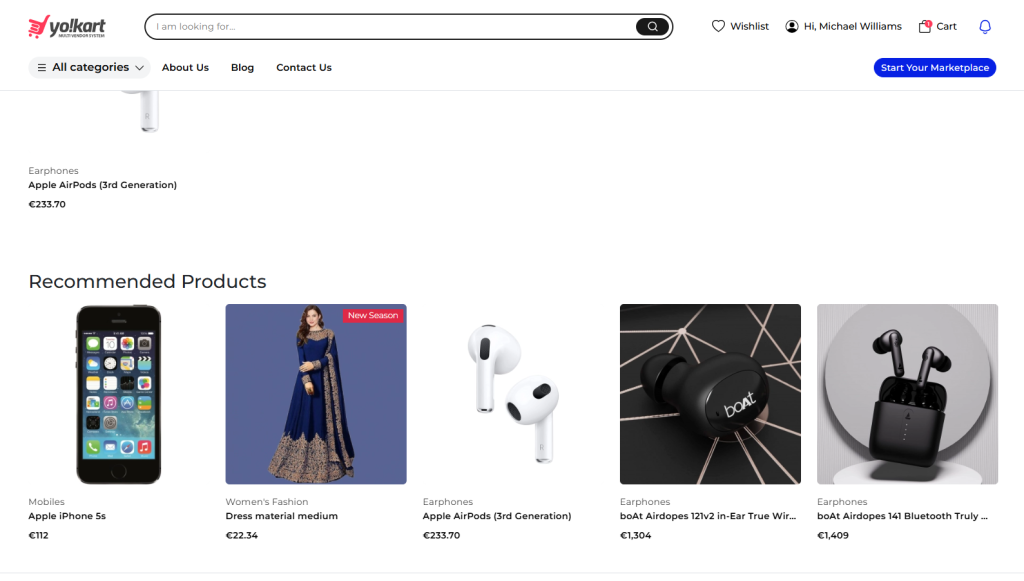
Personalized recommendations are tailored product suggestions presented to users based on their behavior, preferences, and purchase history. Most of the marketplaces use AI and machine learning algorithms to analyze user interactions, browsing patterns, and past transactions. Moreover, by predicting what products a buyer is likely to be interested in, these recommendations make the shopping experience more relevant and engaging.
1. Impact on User Experience
Personalized recommendations reduce the time and effort users spend searching for products. They make the shopping journey intuitive, relevant, and frictionless, increasing engagement and encouraging repeat visits. Additionally, users feel understood and valued when platforms offer suggestions that match their preferences.
2. Business Advantages
For marketplaces, personalized recommendations drive higher conversion rates, increase average order value, and improve customer retention. By showcasing products that resonate with individual buyers, businesses can maximize sales without relying solely on broad marketing campaigns.
How Intelligent Search Filters Simplify Product Discovery and Boost Conversion Rates?
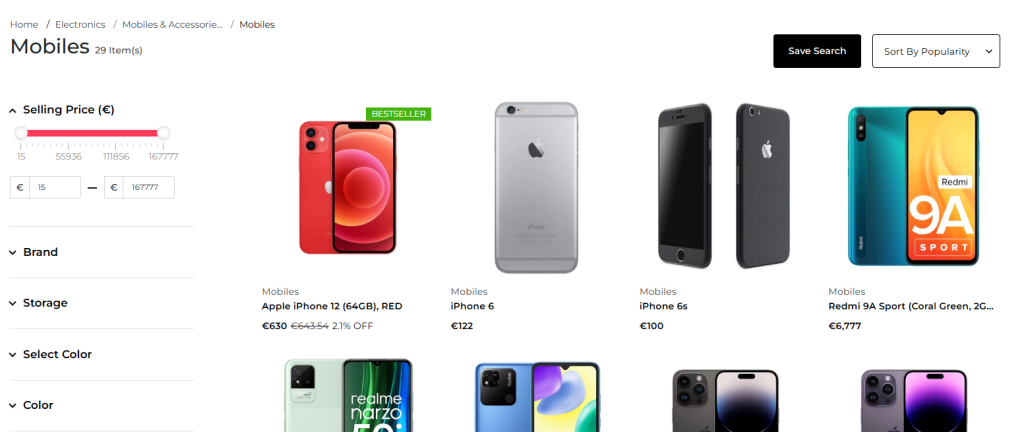
Advanced search filters are designed to help users quickly narrow down large product catalogs and find exactly what they need. By allowing buyers to refine results based on specific criteria, marketplaces reduce decision fatigue and make the shopping journey faster and more efficient. This clarity builds buyer confidence and encourages timely purchasing decisions.
1. Key Attributes
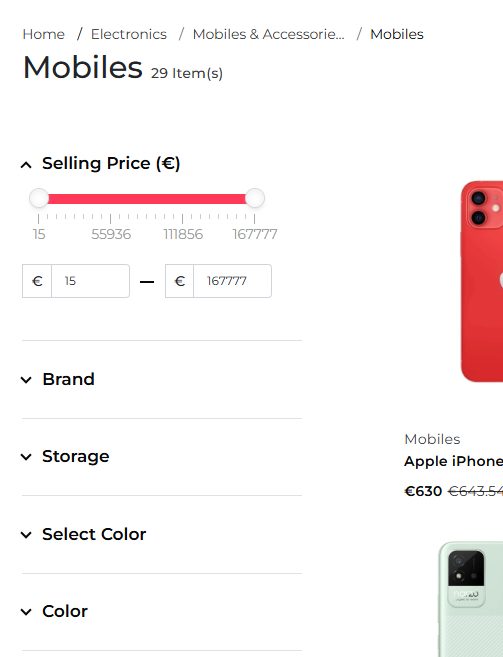
Effective search filters include options like price range, customer ratings, color, size, brand, and category. Marketplaces can also implement dynamic filters that adapt based on inventory and user behavior. Such granular options ensure users can pinpoint relevant products without scrolling endlessly through irrelevant items.
2. Seamless Navigation
Intelligent filters enhance usability by reducing friction and improving navigation. Users can quickly compare products, evaluate alternatives, and make informed choices. A smooth filtering experience also increases engagement, reduces bounce rates, and boosts conversion.
3. Efficient Filter Setup
For maximum impact, filters should be simple to use, responsive, and fully optimized for mobile devices. Clear labeling, multi-select options, and real-time updates improve efficiency. Testing filter placement and behavior on various devices ensures consistent performance and fosters a professional, user-friendly shopping environment.
How Yo!Kart Empowers Marketplaces to Deliver Intelligent Shopping Experiences?
Yo!Kart is a robust multi‑vendor eCommerce platform designed to help businesses launch, manage, and scale online marketplaces with ease. With its white‑label architecture, source code ownership, and deep feature set, it enables marketplace operators to deliver rich and seamless shopping experiences without building everything from scratch. Additionally, the platform is engineered to serve buyers, sellers, and admins with performance‑optimised workflows, advanced search and personalization modules, and global readiness-making it an ideal foundation for today’s marketplace‑driven business models.
Key Features:
- Smart Recommendations: Yo!Kart includes modules for intelligent product suggestions that boost relevance and average order value.
- Advanced Search with Elastic Search Integration: The platform supports high‑performance indexing and retrieval of products, brands, and categories, enabling buyers to find what they want in milliseconds.
- Robust Filter & Attribute‑based Browsing: Buyers can refine search results by brand, price, size, colour, material, ratings, and streamlining discovery and decision‑making.
- Multi‑Currency and Multi‑Language Support: Yo!Kart supports localisation and responsive design so marketplaces can serve global audiences seamlessly.
- Vendor & Admin Dashboards with Analytics: Both sellers and platform admins access real‑time insights on search trends, conversion, inventory, and buyer behaviour-enabling data‑driven optimisation.
Additional Benefits of Leveraging Yo!Kart
- One‑time license, lifetime ownership
- Scalable and high‑performance architecture
- 100% white‑label
- Fully customizable
- No hidden or recurring fee
- Free technical support
- Mobile‑first & PWA support
- Supports various niches and business models
Start Your eCommerce Journey with Yo!Kart
Case Studies
1. UNI Diamonds (Israel)
This B2B diamond‑trading marketplace was built on Yo!Kart. It introduced over 50 search filters specific to diamond attributes, 360‑degree product views, bid/auction functionality and a machine‑learning‑based price‑calculator tool. Furthermore, the platform transformed buyer‑seller transparency, enabled detailed comparison of diamond lots and delivered a powerful niche shopping experience in a highly specialized vertical.
2. 4GoodVibes (Ethiopia)
A marketplace for handmade items, launched with Yo!Kart. It leveraged advanced search filters, quick‑listing modules and flexible discount management to connect artisans with buyers. The customisation enabled a niche‑focused UX and efficient vendor onboarding, helping the platform carve out a unique position in its market.
3. Regake (Global)
A digital‑products marketplace powered by yo!kart for video games, in‑game items and gift cards. It required fast search, multi‑currency payment support and automated vendor payments. The platform supports thousands of SKUs, enables cross‑border transactions, and allows buyers to find rare digital items quickly-demonstrating the platform’s versatility across physical and digital goods.
With Yo!Kart’s rich feature set, marketplace owners can build platforms that go beyond simple listing engines, offering intelligent, streamlined shopping experiences that meet modern buyer expectations and support sellers.
Conclusion
In today’s competitive eCommerce landscape, providing an intelligent and seamless shopping experience is no longer optional. Buyers expect fast, relevant, and personalized product discovery, and marketplaces that fail to meet these expectations risk losing engagement and revenue. Moreover, features like personalized recommendations, advanced search filters, and intuitive product discovery are essential for keeping users satisfied and driving conversions. By leveraging these tools, marketplaces can deliver meaningful experiences that encourage repeat purchases and foster customer loyalty.
Yo!Kart empowers marketplace owners to achieve these goals with its comprehensive multi-vendor platform. Its robust personalization modules, advanced search capabilities, and mobile-ready design ensure buyers can find exactly what they need quickly and efficiently.
FAQs
Q 1. How do personalized recommendations influence purchase decisions?
Ans. Personalized recommendations guide users toward products that match their preferences, browsing history, and purchase patterns. By presenting relevant items, they enhance user engagement, reduce decision fatigue, and increase the likelihood of conversion, ultimately boosting sales and customer satisfaction on the marketplace.
Q 2. Does Yo!Kart supports third-party personalization or analytics tools?
Ans. Yes, Yo!Kart supports seamless integration with popular third-party personalization, recommendation, and analytics tools. This enables marketplaces to leverage advanced insights, track user behavior, and implement targeted product suggestions for a more data-driven and customized shopping experience.
Q 3. How does Yo!Kart ensure a smooth and responsive search experience across devices?
Ans. Yo!Kart features advanced, mobile-optimized search functionality with filters, auto-suggestions, and quick load times. Its responsive design ensures users enjoy consistent, fast, and intuitive search experiences across desktops, tablets, and smartphones, improving usability and engagement.
Q 4. Does Yo!Kart support multi-language and multi-currency personalization?
Ans. Yes, Yo!Kart supports multi-language and multi-currency support, allowing marketplaces to tailor the shopping experience for different regions. Users can browse in their preferred language, view prices in local currency, and receive personalized recommendations, enhancing accessibility and global reach.
Q 5. Is Yo!Kart suitable for both B2C and B2B marketplaces?
Ans. Yes, Yo!Kart is suitable for both B2C and B2B models, offering flexible catalog management, tiered pricing, bulk ordering, and advanced user segmentation. It enables marketplaces to cater to diverse buyer groups while delivering personalized and efficient shopping experiences for all business types.
The post The Ultimate Guide to Smart Shopping Features: Personalization & Search Filters appeared first on YoKart Blog.
]]>The post How to Create a Marketplace For Gardening and Outdoor Supplies? appeared first on YoKart Blog.
]]>Gardening is not just one of the oldest and most rewarding hobbies in the world, but also a multi-billion-dollar industry. With people increasingly turning to their yards and outdoor spaces for relaxation, beauty, and sustainability, this industry is growing rapidly. According to Statista, the global gardening equipment market size is projected to reach USD 138.90 billion by 2030, growing at a CAGR of 6.3% from 2025 to 2030. It depicts that, as the interest in gardening grows, so does the potential for businesses catering to this market.
Whether you’re an experienced gardener or someone with a passion for green spaces, starting a gardening business can be both fulfilling and profitable. This blog will take you through the essential steps to establish a successful gardening business, from setting up shop to marketing your products and services.
Table of Contents
- How Profitable is Starting a Gardening and Outdoor Supplies Marketplace?
- Top Gardening and Outdoor Equipment Supplies to Sell and Rent Online
- Step-by-Step Guide to Building a Gardening and Outdoor Supplies Marketplace
- Major Challenges in Launching a Gardening Marketplace
- How Yo!Kart Can Help you Build Your Gardening Marketplace
- Conclusion
- FAQs
How Profitable is Starting a Gardening and Outdoor Supplies Marketplace?
Starting a gardening business taps into a market characterized by evergreen demand. Whether it’s lawn care, landscape design, or selling essential equipment, the need for these services and products is constant, often recurring, and recession-resistant.
The Profit Potential
Yes, a gardening business is definitely profitable when structured and managed correctly. However, profitability can vary significantly based on your business model, specialization, and operational efficiency.
- Service-Based Profitability: Businesses focusing on high-value services like custom landscape design, specialized pruning, or year-round subscription maintenance plans often achieve higher profit margins, sometimes ranging from 15% to over 30% net profit. The cost of goods sold (COGS) is primarily labor, which, when managed efficiently through optimized scheduling and client density, leads to robust earnings.
- Product-Based Profitability: Selling gardening supplies, seeds, tools, and accessories online can be highly scalable. The key is sourcing quality products at competitive wholesale prices. eCommerce models can see gross profit margins of 40% to 60% on high-demand, niche, or branded products.
The industry’s strong average annual turnover for landscaping businesses (2030 Projected Market Size: USD 138.90 Billion) underscores the significant earning potential. The shift toward sustainable, eco-friendly, and tech-enabled gardening further provides opportunities for premium pricing and differentiation.
Top Gardening and Outdoor Equipment Supplies to Sell and Rent Online
Whether you’re offering gardening tools, supplies, or rental equipment, knowing which products to sell or rent can significantly impact your business success. Here are some of the most popular gardening equipment and supplies to consider:
- Gardening Tools: The backbone of any gardening business is a solid range of tools. Some essential gardening tools include shovels, hoes, rakes, shears, and pruners. High-quality tools have long-lasting appeal and are always in demand.
- Planters and Pots: Indoor and outdoor planters are always needed, especially as container gardening becomes more popular. Thus, offering a variety of sizes, shapes, and materials (ceramic, plastic, terracotta) can attract a wide range of customers.
- Soil and Fertilizers: Organic gardening and sustainable practices have sparked a demand for high-quality soil, compost, and fertilizers. Hence, you can create packages tailored to different gardening needs, such as vegetable gardening, flower beds, or lawn care.
- Seeds and Plants: Selling a variety of seeds, including vegetables, flowers, herbs, and even trees, can be a profitable part of your business. You can also partner with nurseries to sell plants or even provide garden design services.
- Lawn Mowers and Trimmers: Larger equipment, such as lawn mowers, weed eaters, and hedge trimmers, is essential for customers with big yards. Renting this equipment instead of selling can be an attractive option for customers who only need them occasionally.
- Irrigation Systems: Watering is crucial for any garden, and offering products like irrigation kits, sprinklers, and rain barrels can help meet the needs of eco-conscious gardeners who want to conserve water.
- Gardening Furniture and Accessories: Items like garden benches, chairs, garden lights, and outdoor storage solutions are an attractive addition to any gardening business. These products can complement other offerings and help create a full-fledged outdoor experience for your customers.
Looking to build a digital hub for gardening products and services?
Step-by-Step Guide to Building a Gardening and Outdoor Supplies Marketplace
Launching a successful gardening venture requires a methodical approach, transitioning from a great idea to a fully operational enterprise.
1. Define Your Service & Product Offerings
The first critical step is deciding on the niche and scope of your business. This choice will dictate everything from your startup costs to your marketing strategy.
Decide on Services You Want to Provide
- Lawn and Garden Maintenance: This is the most common entry point. Services include mowing, weeding, pruning, seasonal clean-ups, and general upkeep. This offers reliable, recurring revenue.
- Landscape Design and Installation: A high-value niche requiring horticultural knowledge and design skills. Focuses on creating and building entirely new outdoor spaces (patios, planting, water features).
- Specialized Services: Arboriculture (Tree Care), Pest and Disease Management (Organic focus is a major trend), Garden Consulting (teaching clients to garden), or Urban/Container Gardening (catering to small spaces). Specialization allows for premium pricing and creates a distinct competitive advantage.
- eCommerce and Supply Sales: Selling physical gardening products and supplies (tools, seeds, soil) through an online platform. This is highly scalable but requires strong logistics.
- Equipment Rental: A lucrative model for high-cost items that homeowners or small-scale gardeners don’t want to purchase outright.
2. Decide Revenue Model
Your revenue model determines how your business makes money. A diversified model can mitigate seasonal risks and maximize market reach.
| Revenue Model | Description |
| Fixed Price/Contract | A single price for a defined project (e.g., installing a new patio, an annual garden design). |
| Hourly Rate/Time & Materials | Billing is based on the time spent and the cost of materials used. |
| Subscription/Retainer | Clients pay a recurring fee (weekly, monthly, seasonally) for guaranteed, ongoing maintenance. |
| eCommerce/Retail | Selling physical goods online or through a retail outlet. Revenue is the selling price minus COGS. |
| Rental Fees | Charging clients daily or weekly fees for the use of heavy equipment. |
| Commission/Marketplace | Taking a percentage cut of sales made by third-party vendors on your platform. |
3. Legal Setup, Insurance, and Equipment
Formalizing your business lends credibility and provides essential protection.
- Business Structure: Choose a legal structure (Sole Proprietorship, LLC, Corporation) to define liability and taxation.
- Licensing & Permits: Check local and state requirements for operating a business, especially for handling chemicals (pesticides, herbicides) or waste disposal.
- Insurance: Critical for a gardening business. You absolutely need Public Liability Insurance to cover property damage or injury that occurs while working. Consider Tools and Equipment Cover and, if you hire staff, Employers’ Liability Insurance.
- Essential Equipment: Start lean, but ensure quality. For service-based work: a reliable vehicle/trailer for transport, a professional-grade mower, trimmer, blower, and high-quality hand tools. For e-commerce, invest in quality packaging and logistics setup.
4. Select Development Approach
A true eCommerce marketplace is a multi-vendor platform. It allows independent sellers (local nurseries, organic seed companies, equipment manufacturers) to register, list, and sell their products or services under your brand. This dramatically increases your product diversity and scale without requiring you to hold physical inventory.
Developing this platform involves a fundamental decision: Custom Build vs. Specialized Software.
1. The Custom Development Approach
This involves hiring a team of developers, designers, and project managers to build the platform from the ground up using code frameworks (like Laravel, Python/Django, or NodeJS).
- Pros (The Control Advantage): You get absolute control over every single feature, UI/UX, and complex business logic. It’s perfectly tailored to your unique niche requirements (e.g., building a highly specific plant hardiness zone filter).
- Cons (The Cost and Time Burden): This is the most expensive and time-consuming path. The initial investment often runs into six figures, and the time-to-market can be 12 to 18 months. Furthermore, you are responsible for testing, maintenance, security, and fixing all bugs, introducing a high long-term technical risk.
2. Readymade eCommerce Marketplace Software Solution:
This involves utilizing a ready-to-launch, commercially available multi-vendor platform solution that is specifically designed to handle the complexity of the marketplace model.
- Pros (The Speed and Reliability Advantage):
- Market-Tested Functionality: These platforms already have the core features necessary for a marketplace (vendor sign-up, commission splits, multi-level catalogs) that have been tested and refined across hundreds of businesses.
- Faster Launch: You can launch a fully functional platform in weeks or a few months, allowing you to validate your business model quickly.
- Cost-Effective Scalability: The upfront cost is significantly lower than custom development, and the platform is built to handle high transactional volume and massive vendor growth.
- Cons:
- Learning Curve: As these platforms are extensive and feature-rich, there is a required learning curve for the marketplace owner and the vendors.
Launch your gardening marketplace with a ready-made solution
5. Launch and Promote
A great platform is nothing without an audience. Thus, you should:
- Soft Launch (Friends & Family/Local Community): Test your platform’s usability, service delivery, and logistics with a small group. Gather feedback and refine.
- Vendor Onboarding Promotion: Offer the first 3-6 months commission-free or at a reduced rate to attract high-quality, diverse vendors for your marketplace.
- Grand Launch Marketing Blitz:
- Local Press & Bloggers: Announce your arrival, focusing on your unique value proposition (e.g., “The one-stop hub for all local, organic gardening needs”).
- PPC/Paid Ads: Target hyper-local searches for services and specific product keywords (e.g., Google Ads, Facebook Ads targeted to local gardening groups).
- Launch Discount/Free Consultation: Offer a compelling incentive for the first 100 customers to drive initial sales and reviews.
Major Challenges in Launching a Gardening Marketplace
1. Attracting Skilled Gardeners & Service Providers
Building a reliable supply side is tough. Experienced gardeners, landscapers, and horticulture experts often rely on offline referrals, making it difficult to convince them to join a new platform.
2. Ensuring Service Quality & Standardization
Gardening services vary widely in technique, tools, and execution. Maintaining consistent service quality across different providers can be challenging without strict guidelines and reviews.
3. Seasonal Demand Fluctuations
Gardening is heavily affected by seasons. Demand peaks in spring and monsoon, but significantly drops during off-seasons. Balancing supply-demand during low-activity months becomes a major obstacle.
4. Managing Logistics & Service Coverage
Gardening is location-based and requires physical presence. Coordinating service availability, travel radius, and time slots can be complex, especially in large cities or rural areas.
5. Building Trust & Credibility
Customers often hesitate to book gardeners online due to lack of trust. They want background-verified professionals, genuine reviews, and transparent pricing—making trust-building a long-term task.
6. Pricing Complexity
Gardening services differ by yard size, plant type, service duration, equipment required, and more. Creating a transparent yet flexible pricing model is a significant challenge.
7. Onboarding Users Who Prefer Offline Methods
Many gardeners and customers still prefer local offline hiring. Converting them into digital users requires strong onboarding support, training, and user-friendly workflows.
8. Handling Equipment & Tool Requirements
Some services need specialized tools (hedge trimmers, leaf blowers, lawn mowers), and not all gardeners carry them. The marketplace must clarify responsibilities and avoid service failures.
9. High Customer Expectations for Timeliness
Gardening tasks are time-sensitive (e.g., pruning, pest control). Delays can affect plant health, leading to customer dissatisfaction and bad reviews.
10. Competition with Local Vendors & Aggregators
Local gardening shops, freelancers, and neighborhood service providers often offer cheaper rates. Differentiating your platform through convenience, quality, and reliability is essential.
How Yo!Kart Can Help You Build Your Gardening Marketplace
If your vision includes building a dominant online presence that unifies the gardening community, connecting growers, suppliers, and service professionals, a purpose-built platform is your most critical asset. For that, you can leverage Yo!Kart, a powerful, self-hosted, multi-vendor eCommerce platform that can serve as the backbone for your ambitious gardening marketplace. Whether you’re looking to sell gardening tools, plants, or services, Yo!Kart offers a comprehensive, scalable solution that can easily accommodate a wide range of products, services, and vendors. With features like customizable storefronts for vendors, real-time inventory management, seamless payment processing, and advanced shipping logistics, Yo!Kart ensures that your marketplace operates smoothly and efficiently.
Here is how Yo!Kart directly addresses the needs of a sophisticated gardening and supply marketplace:
1. Multi-Vendor Functionality
Yo!Kart is architected from the ground up to support a true marketplace model, not just a single store. It has:
- Dedicated Vendor Dashboard: Each nursery, tool supplier, or landscape architect gets their own professional dashboard to manage their listings, inventory, pricing, and orders independently. This is crucial for seamless vendor management and scalability.
- Commission Management: The system automatically calculates and splits payments. You can set varied commission structures (e.g., higher commission for a service booking vs. a product sale), ensuring a profitable revenue stream from day one.
- Vendor Onboarding Tools: Simple, guided registration processes allow you to rapidly grow your vendor base with minimal administrative overhead.
2. All-in-One Gardening Marketplace
The gardening world is a mix of physical goods and skilled services. Yo!Kart can manage both simultaneously:
- Physical Product Catalog: Handles all the complexities of seeds, soil, tools, and heavy equipment with features like advanced inventory tracking and variant management (e.g., different sizes of potting soil).
- Service/Booking Integration: Its customizable nature allows for integrating modules to handle time-slot bookings, scheduling, and service quotes for landscape design or maintenance professionals.
3. Advanced Features
For a niche like gardening, location is everything, from climate zones to local service availability.
- Advanced Geo-Location & Shipping: The platform can handle complex shipping logic, differentiating between standard carrier shipping for small tools and local, zone-based delivery fees for bulk materials or fragile plants, which is essential for vendor sales.
- Multi-Currency and Multi-Language: Prepare your platform for future expansion, allowing you to onboard international vendors or target different linguistic communities.
4. Customization and Scalability
Yo!Kart is a flexible solution designed to grow with your business.
- Source Code Ownership: Unlike SaaS models, you own the source code, giving you the ultimate flexibility to customize every feature to your unique gardening niche, from creating a specific “Plant Hardiness Zone” filter to integrating a custom plant recommendation engine.
- Scalability: Built to handle high traffic and thousands of concurrent transactions, ensuring your platform can support massive growth during peak seasonal demand without crashing.
Thus, leveraging a platform like Yo!Kart, eliminates the need for a multi-million-dollar custom development effort and lets you focus your capital and energy on marketing and vendor acquisition, accelerating your path to market dominance.
See How Yo!Kart Can Power Your Gardening Marketplace
Conclusion
The gardening industry offers a compelling blend of passion, practicality, and undeniable profit potential. By moving beyond the traditional solo-gardener model and embracing the digital landscape, you can tap into a much larger, highly scalable market.
However, the key to unlocking exponential growth lies in creating a unified digital hub. By strategically choosing your niche, adopting a multi-faceted revenue model, and leveraging dedicated eCommerce marketplace software like Yo!Kart, you are not just starting a gardening business; you are cultivating a digital ecosystem. You become the essential connection point for enthusiasts, suppliers, and professionals, effectively positioning your brand as the definitive authority in the blossoming world of horticulture.
FAQs
Q 1. How much time does it take to launch a marketplace for gardening and Outdoor supplies?
Ans. The time taken to launch a marketplace for gardening and Outdoor supplies depends on the development approach and complexity level of the marketplace. With custom development, launching a gardening marketplace typically takes 3 to 6 months, depending on the features and customization required. Whereas pre-built solutions speed up development and allow you to launch the marketplace in a few days to a few weeks.
Q 2. How much does it cost to start a Marketplace For Gardening And Outdoor Supplies?
Ans. The cost to start a marketplace for gardening and outdoor supplies can vary widely. However, if you opt for custom development, it can range anywhere from $10,000 to $250,000+, depending on the scale, features, and complexities. On the other hand, a readymade solution such as Yo!Kart offers you packages starting at just $499.
Q 3. Is a gardening marketplace more profitable than selling gardening equipment as a single vendor?
Ans. Yes, a gardening marketplace can be more profitable than selling gardening equipment as a single vendor. A marketplace allows you to scale quickly by connecting multiple suppliers, diversifying product offerings, and generating revenue from commissions. Moreover, it offers long-term growth potential compared to the limited reach of a single vendor model.
The post How to Create a Marketplace For Gardening and Outdoor Supplies? appeared first on YoKart Blog.
]]>The post A Complete Guide to Subscription-Based Models for Multi-Vendor Platforms appeared first on YoKart Blog.
]]>The multi-vendor eCommerce market is advancing at a mindboggling momentum, reflecting a spectacular growth at a CAGR of 18.9% from 2025-2030, while expecting to reach a splendid $83.26 trillion by 2030.
However, the real competitive edge no longer lies entirely in onboarding more vendors or expanding product catalogs. Today, the key distinguisher is the economic architecture behind the platform. This shift is prompting a deeper evaluation of business models, and thus subscription-based pricing models are swiftly moving to the forefront. Marketplaces seeking financial predictability and greater operational control are increasingly gravitating towards subscription-based models.
But, with this transition comes a critical question that if these subscription-based models are genuinely profitable in multi-vendor platforms.
Hence, this blog examines the strategic relevance of subscription-based models in multi-vendor platforms, how they operate and whether they’re really profitable in multi-vendor environments.
Table of Contents
- What is a Subscription-Based Model?
- How Does a Subscription-Based Model Work?
- Leading Players of Subscription-Based Marketplaces
- Key Features of a Subscription-Based eCommerce Marketplace
- Benefits of Adopting Subscription-Based Models
- Drawbacks of Recurring Revenue Models in Multi-Vendor Platforms
- Are Subscription-Based Models Profitable in Multi-Vendor Platforms?
- Top Alternative Monetization Models
- Best Software to Build a Subscription-Based Multi-Vendor Marketplace
- Conclusion
- FAQs
What is a Subscription-Based Model?
Recurring subscription-based eCommerce marketplace models offer a versatile revenue model in which users pay a fixed, recurring fee, typically on a monthly, quarterly or annual basis, to access the multi-vendor platform. Instead of charging per transaction or per sale, users are made to purchase a membership plan to access the products or services on the platform.
While the vendors benefit from specialized offers and advanced features, buyers benefit from exclusive perks, specialized delivery services and more. Additionally, these models shift the users’ mindset from reactive cost payments to proactive value investment. Moreover, users commit to a definite cost structure that aligns with the perceived value.
How do Subscription-Based Models Differ From Traditional Business Models?
A subscription-based model deviates fundamentally from conventional revenue structures by replacing unpredictable, transaction-led earnings with a stable, recurring income stream. Unlike commission-based models where earnings depend solely on transaction volume, subscription costs monetize continued access and specialized benefits.
Moreover, subscription-based revenue structures can be influential for both sellers and customers in many ways. Additionally, this dual-sided structure strengthens revenue predictability for marketplace owners. Compared with listing fees or pay-per-sale model, subscription-based models consolidate a unified, value-driven offering that enhances the long-term growth of a multi-vendor platform.
| Parameters | Subscription-based Models | Traditional Business Models |
| Explanation | Users pay a fixed, recurring fee to access the platform and offerings | Users pay only for the items they purchase |
| Revenue Stream | Recurring & predictable due to ongoing costs | Fluctuating & unpredictable due to one-time transactions |
| Value Delivery | Essential to deliver continuous value to engage and retain users | Delivered at the time of purchase |
| Demand Forecasting | Generally simpler due to recurring subscription revenue | Comparatively difficult as the customer demands, expectations & seasonal patterns keep fluctuating |
| Customer Relationship | Focuses on prolonged & continuous customer retention | Focused essentially on one-time transactions |
How Does a Subscription-Based Model Work?
Unlike long-established marketplace revenue models, subscription-based models create a predictable recurring revenue stream for marketplace owners, ensuring long-term marketplace growth. Here’s how subscription-based models work:
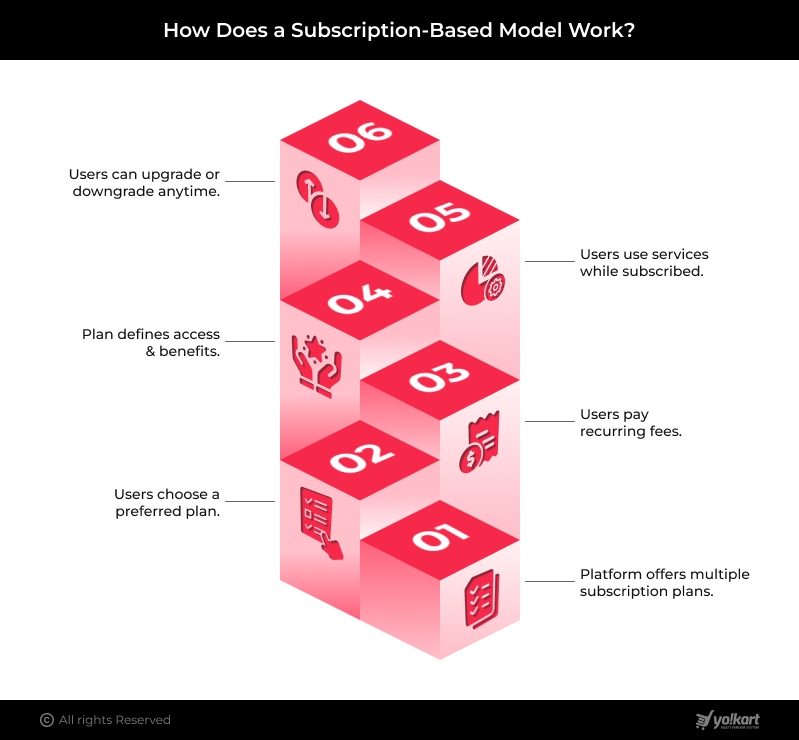
- The platform offers diverse subscription plans, each designed with different levels of functionalities and offerings.
- Users choose a subscription tier that they prefer.
- They pay a recurring fee, be it on a monthly, quarterly or an annual basis, to stay active on the platform.
- The chosen subscription tier determines the user’s operational capabilities and benefits.
- Users use the platform and obtain products/services for as long as their subscription remains active.
- Users can change their subscription tier to either higher or lower plans as per their requirements in the future.
Leading Players of Subscription-Based eCommerce Marketplaces
Subscription led marketplaces have earned a considerable amount of traction across both B2C and B2B environments. These platforms generate predictable recurring revenue while delivering sustained value to the users, modernizing traditional marketplace dynamics by replacing transactional uncertainty.
Here are some of the prominent marketplaces that deploy subscription models at scale:
1. Amazon:
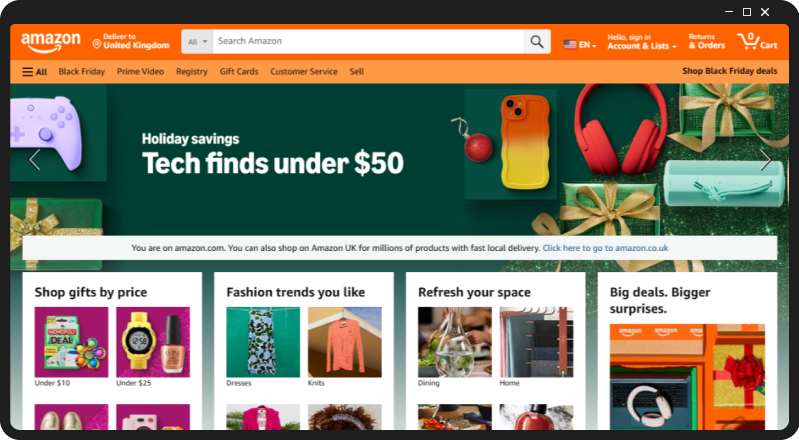
Amazon is a globally recognized eCommerce marketplace launched in 1995. While primarily known for selling books online, the platform has now progressed in diverse regions such as eCommerce, digital streaming, online advertising, artificial intelligence and cloud computing. Similarly, its subscription-based models include exclusive benefits for both its sellers and customers, known as:
- Amazon Professional Seller Plans: Amazon’s Professional Seller tier exemplifies a high-performing subscription framework within a global marketplace. Rather than paying per item sold, sellers subscribe to a fixed monthly fee, offering advanced operational capabilities. This allows Amazon to maintain reliable recurring revenue while offering sellers a scalable cost structure.
- Amazon Prime Membership: Amazon Prime is a flagship example of subscription-based value creation. The membership’s bundled benefits, such as expedited delivery, digital media and exclusive deals, fuel a high-velocity purchasing ecosystem that benefits customers, sellers and marketplace operators as well.
2. Etsy Plus:

Etsy Plus, an American eCommerce marketplace for handmade or vintage products, represents a refined, value-driven subscription tier tailored for ambitious vendors seeking greater visibility and brand distinction. This subscription offers enhanced storefront customization, priority access to merchandising tools and discounted listing & advertising credits. Thus, by offering advanced capabilities into a monthly plan, Etsy cultivates a professional seller segment while maintaining a steady, recurring income channel.
3. Audible:

Audible is a US-based audiobook and podcast service eCommerce marketplace is fundamentally designed around a consumer subscription model. Members pay a recurring monthly fee in exchange for monthly credits and exclusive access to premium audio content. For creators and publishers, this model ensures consistent demand and predictable payouts, while customers benefit from curated listening experiences, creating a high-retention environment.
4. Thumbtack:
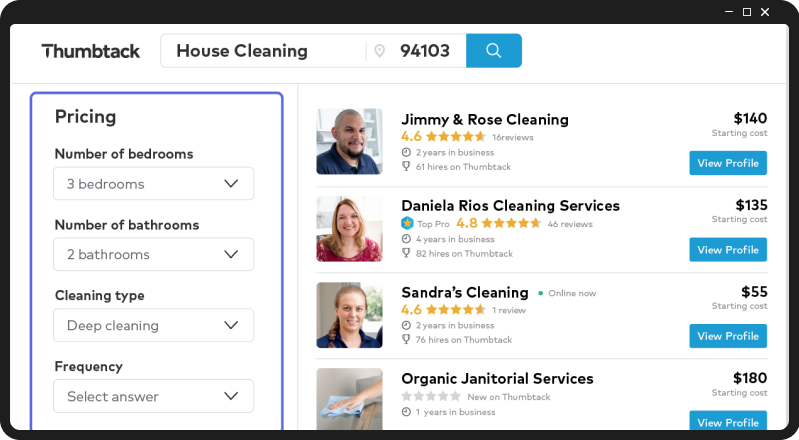
Thumbtack operates on a subscription-centric model for service professionals, offering them systematic access to high-intent customer leads. Instead of relying exclusively on commissions, Thumbtack employs recurring plans, ensuring predictable lead flow, positioning it as a dependable acquisition channel while securing robust, steady monthly revenue for the platform.
5. Envato Elements & StockX:
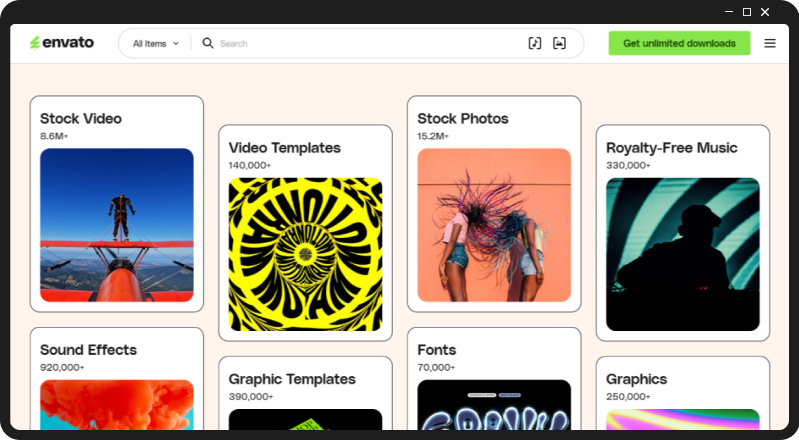
- Envato Elements epitomizes a subscription-first digital marketplace that offers customers unlimited access to curated creative assets under a monthly recurring payment.
- Conversely, StockX offers a Flex membership tier for its premium sellers to list and sell products at lower commissions.
Both these platforms demonstrate how subscriptions can be layered to amplify value while ensuring predictable, recurring revenue.
Planning to Build a Similar Multi-Vendor eCommerce Marketplace?
Essential Features to Launch a Subscription-Based eCommerce Marketplace
To build a multi-vendor eCommerce marketplace, the platform must integrate a robust suite of features specific to eCommerce operations. Hence, here’s a curated list of essential features required to launch a subscription-based eCommerce platform:
- Subscription Plan Management: Create flexible, multi-tiered subscription plans, reflecting clear differentiation in pricing, access privileges and benefits to support diverse monetization and engagement strategies.
- Role-based Access Controls: Assign platform permissions based on subscription tiers, enabling strategic feature gating that elevates premium value perception and naturally incentivizes tier upgrades.
- Vendor Onboarding & Verification: Streamline vendor registration with guided steps, compliance checks and seamless verification to establish a trustworthy, policy-aligned seller ecosystem on the platform.
- Automated Recurring Billing: Implement secure, automated billing cycles with multiple payment options, ensuring predictable, uninterrupted revenue flow while minimizing administrative overhead and enhancing payment reliability across global subscriber bases.
- Dedicated, Advanced Vendor Dashboards: Equip sellers with advanced dashboards featuring performance insights, product controls, subscription status and revenue analytics to drive operational clarity and data-led business growth.
- Products Listing Limits by Subscription Tiers: Define product upload caps, category access and listing privileges per tier, creating structured value differentiation that encourages sellers to upgrade for broader reach and more extensive selling capabilities.
- Buyer Subscription Tiers: Introduce structured customer memberships with clearly articulated benefits such as exclusive pricing, bonus rewards, priority service or faster delivery to strengthen loyalty and improve repeat purchase frequency.
- Exclusive Access & Early Access Features: Provide premium customers early access to discounts, collections, gated experiences or curated exclusives, strengthening perceived value and driving higher adoption of elevated membership plans.
- Marketing & Promotional Tools: Offer tactical promotional capabilities such as coupons, discounts, featured listings and outreach tools to empower sellers to enhance visibility and maximize returns from premium subscription tiers.
- Advanced Reports & Analytics: Deliver deep analytical visibility into subscription performance, user behavior, churn patterns, lifecycle metrics and platform earnings, enabling data-backed optimization of marketing campaigns and growth strategies.
- Integrated Payment Gateways: Ensure reliable, multi-currency payment processing with secure, global payment gateway compatibility, enabling smooth subscription purchases, renewals and upgrades across diverse customer & seller segments.
- Push Notifications: Send automated, timely alerts for subscription renewals, expirations, payment failures and upgrades, enhancing transparency while significantly reducing involuntary churn across the platform.
- Scalable, High-Performance Architecture: Deploy a performance-optimized, scalable infrastructure capable of handling large user bases, multiple locations, heavy subscription traffic and high transaction loads without compromising speed or user experience.
Key Benefits of Adopting Subscription-Based Models in Multi-Vendor Platforms
A subscription-based model delivers substantial benefits for multi-vendor platforms, especially those aiming for predictable growth, stronger vendor engagement and long-term customer loyalty. If executed properly, these subscriptions not only stabilize revenue but also enhance platform efficiency and user experience. Hence, here are the key benefits of adopting subscription-based models in multi-vendor platforms:
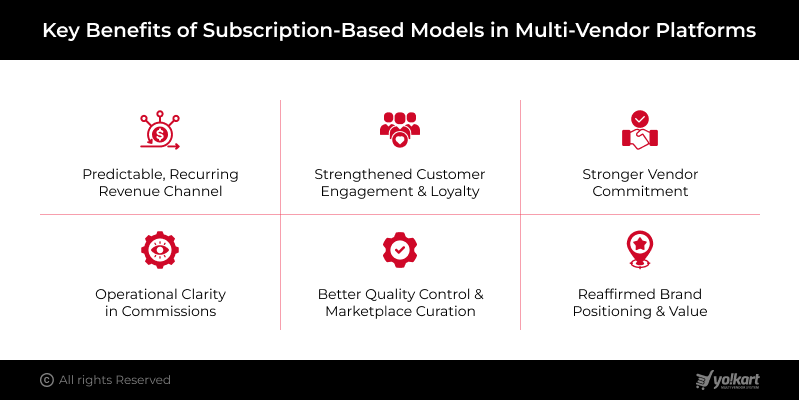
1. Predictable, Recurring Revenue Channel:
Subscription channels create a steady revenue stream that is largely independent of transactional volatility. This predictability enables more accurate financial forecasting, stronger cash-flow management and enhances the platform’s capacity to allocate resources with confidence. For marketplaces scaling globally or expanding into new verticals, a recurring revenue stream can become instrumental in supporting long-term growth and investment cycles.
2. Strengthened Customer Engagement & Loyalty:
Recurring plans, such as Amazon Prime’s membership tier, encourage repeat usage and reinforce brand affinity. Members are more likely to consolidate their purchases within the platform, increasing customer lifetime value. Moreover, curated benefits such as expedited delivery and exclusive discounts further create clear competitive differentiation, cultivating customer loyalty.
3. Stronger Vendor Commitment:
Sellers who pay a recurring subscription fee tend to demonstrate a higher degree of commitment to the platform. Subscription fees signal intentional investment, resulting in:
- More consistent product listings
- Improved service and fulfillment standards
- Proactive participation on the platform
This heightened commitment strengthens the marketplace’s overall supply-side stability and thus contributes to a more predictable, high-quality marketplace environment.
4. Operational Clarity in Contrast to Commissions:
In comparison to commission-based models, subscription plans offer simplicity and transparency, particularly attractive for high-volume or experienced sellers. Sellers benefit from transparent, fixed costs without concerns about diminishing margins as business scales, while customers benefit from exclusive perks, streamlined deliveries and more. Additionally, for the marketplace, this eliminates administrative overhead costs, streamlining operations and improving overall efficiency.
5. Better Quality Control & Marketplace Curation:
Subscription packages inherently filter out low-effort or low-quality sellers who are less likely to invest in maintaining platform standards, resulting in a more curated, trustworthy marketplace. This enhances buyer confidence and contributes to a more premium & professional ecosystem. Additionally, member-only access can help maintain higher engagement quality and reduce spam or fraudulent activities.
6. Reaffirmed Brand Positioning & Perceived Value:
A subscription proposition communicates enduring value, positioning the marketplace as a growth enabler rather than a transactional intermediary. Consistent delivery of premium features, exclusive tools or customer benefits strengthens the platform’s brand equity and frames the subscription as a strategic partnership.
Potential Drawbacks of Recurring Revenue Models in Multi-Vendor Platforms
Despite their ability to generate predictable recurring revenue, subscription-based models come with nuanced challenges that marketplace owners must weigh carefully. In multi-vendor ecosystems, an obstinate subscription strategy can introduce friction and operational risk.
Here are some of the common challenges that businesses must outweigh:
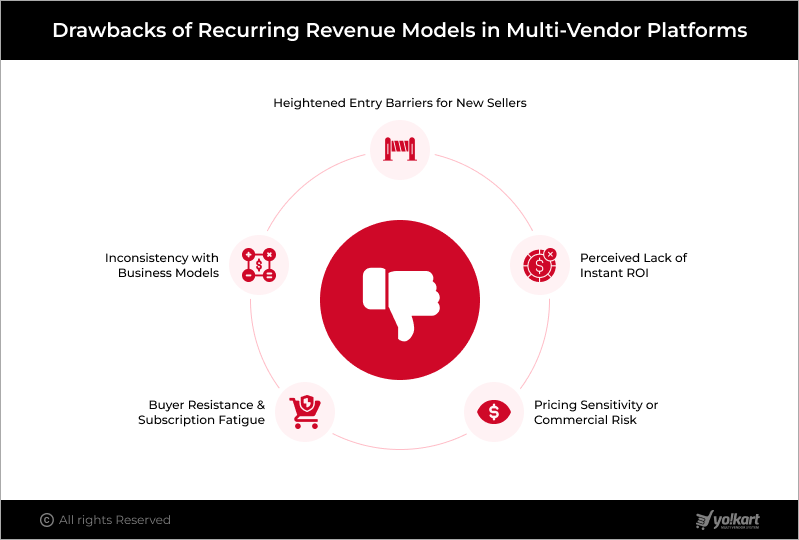
1. Heightened Entry Barriers for New Sellers:
A mandatory recurring fee can discourage new, small-scale sellers with limited budgets from onboarding. Unlike commission-based models that charge only when a sale is made, a subscription fee requires upfront financial commitment that can limit marketplace diversity and slows down early-stage seller acquisition.
2. Perceived Lack of Instant ROI:
Sellers often expect rapid and measurable returns, which is why, if the subscription does not translate into visibility, quality leads and incremental sales quickly, sellers may thus experience dissatisfaction. This can result in higher churn and negative sentiment that might compromise marketplace performance and reputation.
3. Inconsistency with Low-Volume or Seasonal Business Models:
Sellers with cyclical or inconsistent sales patterns may perceive subscription-based models as rigid and financially inefficient. Without a variable cost structure that mirrors their requirements, these sellers may opt for other competing platforms with more flexible pricing frameworks.
4. Pricing Sensitivity or Commercial Risk:
Determining an optimal subscription price is a delicate balancing act, because:
- Underpricing can erode profitability and dilute perceived value, struggling to cover operational costs
- On the contrary, overpricing can suppress user adoption and thus limit platform scalability
Price alignment is particularly risky in multi-vendor ecosystems where seller categories differ widely in margins, order value and sales value. Hence, implementing these costs demands higher precision and understanding.
5. Buyer Resistance and Subscription Fatigue:
On the consumer side, subscription fatigue is an increasingly notable trend nowadays. A customer who already pays for multiple streaming, shopping or delivery services may hesitate to adopt another subscription simply to access a marketplace. Hence, if not placed correctly, such fees can limit user acquisition and reduce marketplace traffic.
Adopt a Powerful Multi-Vendor Marketplace Software that Supports Diverse Monetization Models
Are Subscription-Based Models Profitable in Multi-Vendor Platforms?
A subscription-based model undeniably offers several operational and financial advantages, as highlighted in the earlier sections. It offers predictable revenue, stronger seller commitment and steadier financial planning. Yet, when these advantages are weighed against the broader landscape of marketplace dynamics, it becomes evident that relying solely on a single monetization model can create constraints over time.
A single business model, no matter how efficient, often performs well at the initial stages, but:
- It may restrict the platform’s flexibility as the marketplace matures. Different sellers incline toward different value propositions, and relying solely on a single revenue stream can thus leave potential earnings untapped.
- Competitive differentiation becomes hard to achieve when monetization lacks flexibility.
- Plus, certain product categories or seasonal sellers may find a single monetization model misaligned.
Hence, a diversified monetization structure creates a more balanced revenue mix and strengthens long-term profitability. In essence, while a subscription-based model is a strong strategic foundation, a multi-layered monetization strategy generally positions a multi-vendor platform for more resilient long-term profitability.
Top Alternative Monetization Models in Multi-Vendor Platforms
While subscription-based pricing delivers predictable recurring revenue, multi-vendor eCommerce platforms often benefit from diversifying their monetization channels. Broadening the revenue channels not only enhances financial resilience but also empowers the marketplace to serve a broad spectrum of users. Thus, the following models represent the most strategically relevant alternatives or complements to subscription-based monetization:
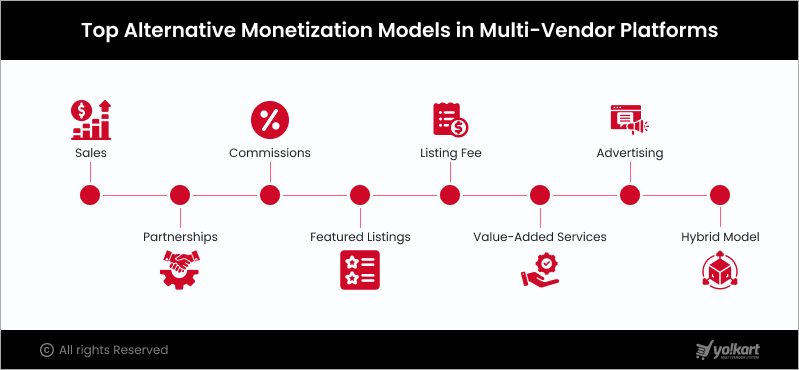
- Sales: It is the most straightforward model in which the platform generates revenue directly from sales of goods and services itself, getting the entire rental fee.
- Commissions: A foundational model for many marketplaces that allows admins to levy commissions per transaction made through the platform as a platform commission.
- Listing Fee: This allows marketplace owners to charge vendors a fixed cost to publish products or services on the platform to make sure only the serious and dedicated sellers join, discouraging spam and low-value listings.
- Advertising: Generate substantial income by offering paid advertising slots to third-party businesses on your marketplace, generating an additional revenue stream from clicks or conversions.
- Partnerships: Partner with local businesses for cross-promotions and exclusive brand visibility, unlocking co-branded offerings, revenue sharing and expanding distribution channels.
- Featured Listings: Premium visibility packages allow vendors to pay for prioritized visibility on premium pages of the marketplace such as top sections, curated collections or spotlight placements.
- Value-Added Services: Offer premium services or complementary products with the main products to increase the overall cart value, catering to customers seeking special services.
- Hybrid Model: Most leading multi-vendor eCommerce marketplaces adopt a hybrid monetization strategy, strategically blending the above-mentioned revenue streams, ensuring revenue stability.
Yo!Kart — Best Software to Build a Subscription-Based Multi-Vendor eCommerce Marketplace
Yo!Kart, a product of FATbit Technologies, stands out as an enterprise-grade multi-vendor eCommerce marketplace software engineered specifically for multi-vendor eCommerce platforms seeking scalable monetization. Meticulously crafted with precision, the software offers a powerful combination of flexibility, performance and scalability.
At its core, Yo!Kart provides a highly configurable framework that allows businesses to adapt to varied business models and requirements. The software provides advanced vendor management capabilities, automated billing & invoicing, granular access controls, integrated marketing tools and analytics that unveil profitability at every step. Additionally, Yo!Kart is built to support businesses of all sizes from startups and small businesses to mid-sized businesses and large enterprises, accommodating large vendor bases and increasing transactions without compromising performance.
Besides, with lifetime ownership, extensive customization capabilities, robust security frameworks and proven performance across marketplaces at scale, Yo!Kart enables businesses to launch and expand multi-vendor marketplaces confidently.
Additional Benefits of Yo!Kart:
- 100% white label software
- Self-hosted solution with one-time upfront pricing
- Lifetime license, no recurring charges
- Over 10 years of industry expertise
- Extensively scalable and secure
- Highly customizable, modular framework
- Expansive suite of multi-vendor marketplace features
- Adaptable, API-driven infrastructure
- 1 year free technical support post-purchase
Yo!Kart Supported Business Models & Marketplaces Built in that Space:
| Business Models | Industry Giants | Yo!Kart Powered Marketplaces |
| Subscription-based | Amazon Prime, Etsy Plus | All marketplaces built with Yo!Kart support a subscription-based revenue model |
| B2C (Business-to-Consumer) | Amazon, Walmart, eBay | Voyij, Tajer, 4GoodVibes, RxAll, etc. |
| B2B (Business-to-Business) | Alibaba, Amazon Business, Global Sources | UNI Diamonds, WaterSorted, Bozinga, Anyflexo, etc. |
| P2P (Peer-to-Peer) | Etsy, Poshmark, eBay | WeDIY, Iconic Motorbikes |
| Hyperlocal Platforms(connects buyers with local sellers) | OLX, OfferUp, InstaCart | Little Local, Shop American Sellers, Glocal Store, DotDune |
| Commission-Based | Amazon, Etsy, eBay | All marketplaces built with Yo!Kart support a commission-based model |
| Niche/Vertical Marketplaces | Newegg, ASOS, Zalando, GNC | Clic & Pick, Party Without Plastic, TransporTECO, Sandhai, Canna Market, CBD Supplements, etc. |
Navigate the Yo!Kart’s clients page to get more information about the marketplaces built with Yo!kart.
Book a Free Personalized Demo Session to Explore Yo!Kart Firsthand
Conclusion
Subscription-based models have today evolved from optional revenue add-ons to strategic growth levers for modern multi-vendor eCommerce platforms. As consumer behavior shifts towards convenience and predictable value, and sellers increasingly seek stability and enhanced platform services, subscriptions offer marketplaces a strong passage to recurring revenue and deeper engagement. However, profitability rarely lies in counting on a single monetization model. Hence, the most resilient, future-ready multi-vendor eCommerce platforms must blend subscriptions with complementary monetization strategies such as commissions, sales, advertisements or hybrid structures to create a balance and build a scalable multi-vendor eCommerce marketplace.
FAQs
Q 1. What are subscription-based models?
Ans. Subscription-based models are monetization models that involve a recurring subscription fee for users to access the marketplaces and get exclusive benefits. These models create a predictable revenue stream for marketplace owners while strengthening the platform engagement and loyalty.
Q 2. Are subscription-based models profitable in multi-vendor marketplaces?
Ans. Subscription-based revenue models offer a stable and predictable revenue channel for marketplaces, improving vendor retention and elevating customer lifetime value. However, relying solely on a single monetization model may limit growth potential. Thus, combining multiple business models offers a more strategic foundation for sustainable growth.
Q 3. Does Yo!Kart support subscription-based marketplaces?
Ans. Absolutely. Yo!Kart offers in-built capabilities for tiered subscription plans, recurring fee renewals, feature-based access controls, value-based privileges and robust analytics tools, allowing marketplace owners to manage and optimize subscription monetization easily.
Q 4. Can I customize Yo!Kart to support my unique business model?
Ans. Yes. Yo!Kart is built with a modular, highly customizable architecture that allows extensive customization to perfectly align with diverse business models, operational requirements, industry-specific demands and business vision. It offers the flexibility to tailor UI/UX, features and workflows to reflect your unique brand identity.
The post A Complete Guide to Subscription-Based Models for Multi-Vendor Platforms appeared first on YoKart Blog.
]]>The post Build a B2B Marketplace for Office Supplies and Services appeared first on YoKart Blog.
]]>The digital revolution has completely reshaped how businesses operate, especially when it comes to sourcing essential resources. Companies are no longer bound by local distributors or fragmented catalogs. Furthermore, the rise of the Business-to-Business (B2B) marketplace has introduced an era of efficiency, transparency, and choice, particularly in the multi-billion-dollar sector of office supplies and services.
This blog will provide you with a comprehensive, expert-level guide to understanding, planning, developing, and launching a successful B2B marketplace specifically tailored for the office environment. Further, you will explore how B2B differs from B2C, essential features, revenue strategies, and compare the most viable development paths.
Table of Contents
- What is a B2B Marketplace for Office Supplies & Services?
- Top B2B Marketplaces for Office Supplies
- Types of B2B Marketplaces for Office Supplies and Services
- How to Build Your B2B Marketplace for Office Supplies & Services
- Yo!Kart: A Readymade Software to Build a B2B Marketplace for Office Supplies in a Week
- Conclusion
- FAQs
What is a B2B Marketplace for Office Supplies & Services?
A B2B marketplace is an online platform where multiple businesses (suppliers/sellers) transact with other businesses (buyers/procurement teams) on a single, aggregated digital channel.
Specifically, a B2B Marketplace for office supplies and services acts as a central digital hub connecting manufacturers, wholesalers, and specialized service providers, such as IT support, cleaning services, and office coffee/snack delivery, directly with corporate buyers, small and medium enterprises (SMEs), and educational institutions.
Key Differentiators of B2B and B2C Marketplaces
B2B and B2C marketplaces operate on different business models and have unique features tailored to their target audiences. Understanding these key differentiators helps entrepreneurs and businesses build platforms that effectively cater to the specific needs of corporate buyers or individual consumers.
| Aspect | B2B Marketplace | B2C Marketplace |
| Transaction Size | Large-volume orders, bulk pricing | Small-volume, individual purchases |
| Pricing Structure | Custom quotes, tiered pricing, negotiated contracts | Fixed retail prices |
| Buyer Structure | Multiple users, approval workflows, and company roles | A single user makes purchase decisions |
| Payment Methods | Purchase Orders (PO), credit accounts, and custom terms | Instant payment (credit card, digital wallets) |
| Product Range | Specialized products and services (e.g., MRO, office furniture, IT services) | Standard consumer products (e.g., clothing, electronics) |
| Order Process | Multi-step process with approvals and negotiations | Quick, direct purchasing |
| Customer Support | Dedicated account management, personalized service | Standard customer service channels |
Top B2B Marketplaces for Office Supplies
While many of the world’s largest B2B marketplaces are horizontal, covering a vast range of industries, they often feature a strong office supplies segment. Notable players include:
- Amazon Business: A leading platform, leveraging its B2C logistics and tech stack to offer B2B-specific features like quantity discounts, tax exemption programs, and multi-user accounts for streamlined purchasing.
- Alibaba/1688 (Global/China Focus): Known for connecting international buyers directly with manufacturers, Alibaba offers extreme bulk pricing and sourcing capabilities, including for office supplies, furniture, and more, making it a go-to platform for large-scale procurement.
- Specialized Vertical Players: Platforms focused purely on specific B2B categories like industrial MRO (Maintenance, Repair, and Operations) or managed print services, which can include office-adjacent supplies.
Ready to Create a Global Marketplace like Amazon Business or Alibaba
Different Types of B2B Marketplaces for Office Supplies and Services
The market landscape allows for several strategic models when building your B2B platform. However, it becomes essential to align the chosen model with your business objectives, operational capabilities, market demands, and customer expectations. Hence, below are several strategic marketplace models you can consider, each offering distinct advantages and catering to different business needs and goals :
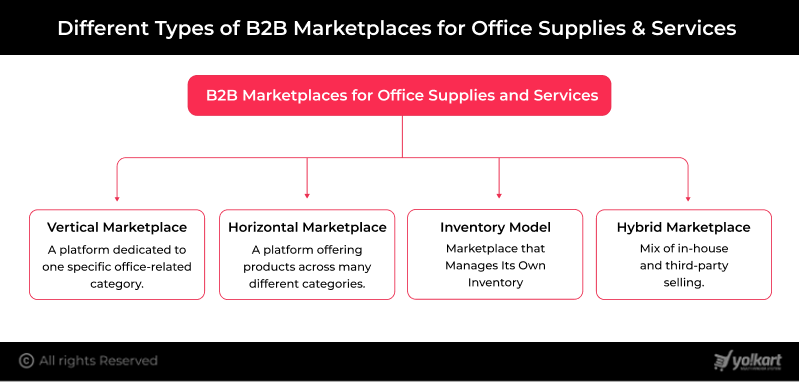
- Vertical Marketplace: Focuses on a single industry or category. For a B2B office supplies and services marketplace, this would mean exclusively listing products, such as paper, pens, furniture, and services, like cleaning, IT support for office consumption.
- Horizontal Marketplace: Offers a wide range of products across multiple industries. Two popular examples are Alibaba and Amazon Business. Your platform might start with office supplies and then expand into general industrial MRO or professional services.
- Inventory Model (First-Party): The marketplace owns and manages the inventory and logistics, like a traditional eCommerce store (e.g., Staples online). However, it requires significant capital for warehousing and stock.
Non-Inventory/Pure Marketplace (Third-Party): The marketplace only connects buyers and sellers; it never takes ownership of the goods. It facilitates the transaction and communication (e.g., a pure service-based marketplace or a platform connecting large distributors). Lower capital cost, greater scalability, but lower control over seller quality.
- Hybrid Marketplace: Combines the inventory and pure marketplace models. This is the most common and often most effective B2B model. The platform can sell its own high-margin/high-demand items, such as proprietary office furniture, while allowing third-party sellers to list their specialized catalogs (e.g., niche ergonomic supplies).
How to Build Your B2B Marketplace for Office Supplies & Services
Launching a successful B2B marketplace requires a structured approach that prioritizes market fit, feature depth, and a scalable development strategy. Additionally, B2B transactions often require handling large volumes, detailed purchasing steps, and multiple stakeholders, making it essential for your platform to provide dependable performance. Further, let’s have a look at the steps to build a B2B marketplace:
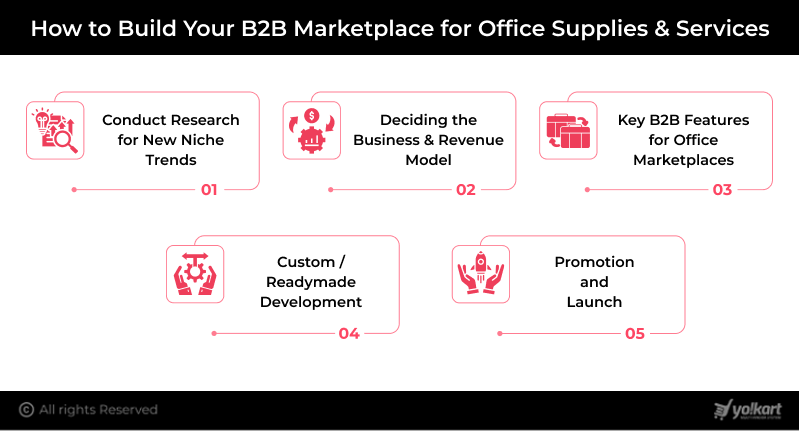
Step 1: Conduct Research for New Niche Trends
The first step is to identify the market gap. The generic office supplies market is saturated. Thus, the key to success lies in targeting underserved niches. Hence, you can focus on:
- Eco-Friendly/Sustainable Supplies: Focus on certified carbon-neutral paper, recycled plastic pens, biodegradable packaging, and suppliers with demonstrable ESG (Environmental, Social, and Governance) commitments.
- Remote Work Solutions: Cater to the modern hybrid workplace. This includes dropshipping services directly to employees’ homes, managing stipends for home-office setups, and selling collaborative software subscriptions.
- Managed Services: Go beyond simple product sales. Offer curated services like subscription-based coffee/snack delivery, managed printing contracts, and on-demand IT helpdesk support listed by vetted service providers.
- Vertical Specialization: Target a specific type of office, e.g., co-working spaces (bulk amenities, flexible leases for furniture) or medical offices (specialized supplies, compliance services).
Step 2: Deciding the Business & Revenue Model
Monetization in the B2B space is significantly more diverse and complex than the simple transaction-based commission model common in B2C eCommerce. A mixed marketplace model that combines several strategies is typically the most effective and profitable approach, ensuring multiple, stable income streams.
- Commission on Each Transaction: This remains the foundational revenue model, where the marketplace charges a percentage of the total value of each successful transaction. The commission rate is often variable, adjusted based on the specific product category, reflecting different margin profiles (e.g., lower commission on high-volume, low-margin items like paper, and higher commission on niche furniture or specialized services).
- Subscription/Membership: The platform can charge a recurring fee to either buyers or sellers for accessing enhanced features or a premium status.
- For sellers, this might unlock better visibility (lower commission rates or access to bulk order reports).
- For corporate buyers, a premium membership could grant access to exclusive bulk pricing tiers, dedicated account management, or advanced procurement analytics.
- Featured Listings/Advertising: This involves allowing sellers to pay for strategic promotional placement within the marketplace. Sellers can purchase banner advertisements on category pages to have their products appear at the top of search results, or gain a premium status that highlights their store.
- Lead Generation Fee: Specifically relevant for the “Services” side of the marketplace (e.g., cleaning, catering, IT support), this model charges service providers a fee for receiving a qualified business lead, such as a formal Request for Quote (RFQ) submitted by a vetted corporate buyer. The marketplace earns a commission simply for connecting a business opportunity to the provider.
- Value-Added Services: This involves charging for supplementary, non-core services that enhance the B2B procurement process. These are major profit centers and can include offerings like integrated logistics management, warehousing, trade financing, or corporate credit options.
Step 3: Essential B2B Features for Your Office Supplies and Services Marketplace
A B2B platform must handle complexity. Additionally, the feature set must cater to the corporate procurement process, not a consumer shopping trip. Thus, it should include:
| Feature Category | Core Features | B2B Rationale |
| Account Management | Corporate Account Hierarchy: Admin, purchasing manager, employee roles with custom spending limits. | Enables internal budget control and approval workflows essential for business buying. |
| RFQ (Request for Quote) Module: Allows buyers to request custom pricing for bulk orders or specialized services. | A standard B2B practice for large-volume, non-catalog purchases, enabling price negotiation. | |
| Order & Pricing | Tiered/Quantity-Based Pricing: Automated discounts applied based on volume, visible only to logged-in B2B users. | Incentivizes bulk purchasing, the cornerstone of B2B transactions. |
| Minimum Order Quantity (MOQ): Sellers can set minimum purchase requirements. | Protects vendor margins on wholesale deals. | |
| Quick Reorder & Shopping Lists: Saves frequently purchased items for one-click reordering. | Streamlines repetitive purchases, improving efficiency for procurement teams. | |
| Integrations | ERP/CRM Integration (APIs): Seamless connectivity with buyers’ and sellers’ existing Enterprise Resource Planning or Customer Relationship Management systems. | Ensures smooth data flow for inventory, invoicing, and logistics tracking. |
| Service Integration | Bookable Service Listings: Enables sellers to list bookable services (e.g., printer repair) with integrated scheduling and quote requests. | Expands the platform beyond physical goods into the high-margin services sector. |
Create a Feature-Packed B2B Marketplace for Office Supplies and Services
Step 4: Development Approach: Custom vs. Readymade
Choosing the right development path determines your time-to-market, initial investment, and long-term scalability. It also shapes how quickly you can validate demand, adapt to customer needs, and differentiate your platform in a competitive B2B landscape. Moreover, the approach you choose will influence your technical flexibility, operational efficiency, and overall ability to scale sustainably. Let’s explore both approaches for a better understanding:
1. Custom Development
This involves building the entire platform from scratch using an in-house team or a development agency. No doubt, this approach provides control and flexibility, but it also takes:
- Longer Timeline (8 – 18+ months): This longer timeline includes requirements gathering, wireframing, UI/UX design, front-end and back-end coding, testing, and deployment.
- High Cost($30,000 – $100,000+): Varies significantly based on the complexity, geographic location of the development team, and the full feature set.
- Deeply Tailored Process: Allows for the creation of unique, proprietary features that perfectly match your niche business model.
2. Readymade Solutions (Off-the-Shelf Software)
This involves purchasing a customizable, pre-built marketplace software solution that already includes the core multi-vendor and B2B functionality. Furthermore, solutions like Yo!Kart also provides source code ownership and comes at one time cost, with no recurring fee or any hidden cost. Moreover, it takes:
- Less Time (a few days to a few weeks): The core framework is already built, allowing for rapid deployment and focus on branding, customization, and vendor onboarding.
- Low to Medium Cost ($1,000 – $10,000+): Typically a one-time license fee or an annual subscription, plus costs for basic customization and setup.
- Rapid Launch: Offers a proven, robust foundation with core features. Additionally, offers customization and is easy to scale.
Comparison of Both Approaches
| Feature | Custom Development | Readymade Solutions |
| Speed to Market | Slower, requires full development, testing, and deployment | Quick Setup, Ready-to-Launch with Minimal Configuration |
| Initial Investment | High upfront cost for development, design, and maintenance | Low to moderate, based on subscription or licensing fees |
| Feature Uniqueness | Fully customizable, supports any niche or specialized feature | Relies on pre-built modules. |
| Ownership & Control | Full code ownership; complete control over updates and data | Depends on the licensing model; often, code-level access is provided. |
| Ideal For | Well-funded enterprises with a unique, complex business model | Startups, SMEs, and entrepreneurs prioritize fast launch, low risk, and core functionality. |
Step 5: Promotion and Launch
The success of a B2B marketplace hinges on attracting both buyers and sellers from the outset. A well-executed promotion and launch strategy ensures early adoption, builds credibility, and sets the foundation for long-term growth.
- To attract Sellers (Suppliers/Service Providers):
- Focus on Value: Highlight the ability to reach new, high-value corporate buyers that they couldn’t acquire otherwise.
- Low Friction Onboarding: Offer a simple, fast process for bulk product uploading and account verification.
- Incentives: Waive commission or offer a free premium subscription for the first three months.
- To attract Buyers (Companies/Procurement Teams):
- Targeted Outreach: Partner with industry associations or focus on specific geographic or industrial verticals.
- Value Proposition: Emphasize cost savings (bulk pricing), efficiency (streamlined reordering/approval), and compliance (sustainability reporting, preferred vendor lists).
- Launch Incentive: Offer a significant discount on the first large order or a credit towards a new service booking.
Yo!Kart: A Readymade Software to Build a B2B Marketplace for Office Supplies in a Week
For entrepreneurs and businesses aiming for a fast, cost-effective, and feature-rich launch, a readymade platform like Yo!Kart provides a compelling solution. It is specifically designed as a multi-vendor eCommerce platform that supports complex B2B needs.
Yo!Kart eliminates the need for months of custom coding by providing a fully functional, scalable, and white-labeled marketplace. Its architecture is built to handle the simultaneous needs of multiple sellers and complex buyer transactions, making it an ideal choice for the B2B office supplies and services sector. It allows you to launch the marketplace in a matter of weeks, thus you can focus on market validation and user acquisition rather than development headaches.
Inbuilt Features Supporting B2B Marketplace Models for Office Supplies and Services
Yo!Kart is equipped with the specific features required to handle the rigorous demands of B2B procurement:
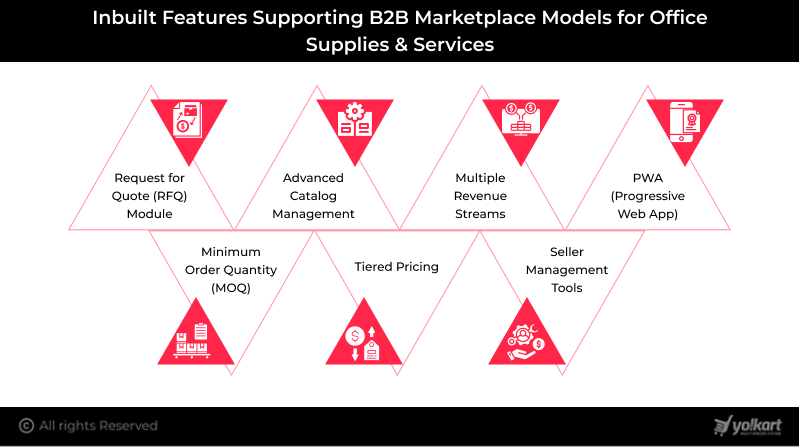
- Request for Quote (RFQ) Module: This is a crucial B2B feature, allowing buyers to submit detailed quote requests to multiple vendors for custom pricing on bulk or special orders.
- Minimum Order Quantity (MOQ): Sellers can set mandatory minimum order limits to ensure profitability on wholesale transactions.
- Advanced Catalog Management: Offers tools for sellers to easily manage a large number of SKUs, including bulk uploads and product variations.
- Tiered Pricing: Facilitates the implementation of B2B pricing models, enabling sellers to offer different prices based on the order quantity.
- Multiple Revenue Streams: Supports all the key monetization models, including commission, subscription, banner ads, and featured listings. Hence, it allows you to have a diverse and stable income strategy.
- Seller Management Tools: Provides dedicated dashboards for vendors to manage inventory, view analytics, process orders, and control their storefront presence.
- PWA Compliance (Progressive Web App): Ensures a fast, app-like experience on mobile devices without requiring separate mobile app development, crucial for on-the-go procurement teams.
B2B Marketplaces Powered by Yo!Kart
Yo!Kart powers diverse B2B marketplaces, offering tailored solutions for diverse industries ranging from flexographic printing to wholesale eCommerce. Listed below are some standout examples of businesses that have successfully launched their platforms using Yo!Kart:
1. Anyflexo
Industry: Flexographic Printing Supplies
Anyflexo revolutionizes the flexographic printing supplies market by transitioning from a legacy industry to a modern, scalable eCommerce solution. Powered by Yo!Kart, the platform, supports custom product catalogs, real-time inventory tracking, and automated restocking, making it easy for suppliers and buyers in the printing industry to connect and transact efficiently.
2. Bozinga
Industry: Wholesale B2B Marketplace
Bozinga, powered by Yo!Kart is a wholesale B2B marketplace that connects manufacturers, wholesalers, and bulk buyers in various industries. The platform’s multi-vendor support, customizable product listings, and efficient order management streamline the bulk buying process. By offering a secure, seamless platform, Bozinga simplifies transactions, improving operational efficiency for wholesale buyers and suppliers.
Experience Yo!Kart Firsthand
Conclusion
The B2B office supplies and services market is evolving rapidly, driven by rising demand for eco-friendly products, remote work solutions, and integrated services. Building a successful B2B marketplace is not about reinventing the wheel but about executing a strategy that addresses the complex needs of corporate procurement.
Moreover, by following a structured path-from identifying a profitable niche to selecting a robust, B2B-ready platform like Yo!Kart, entrepreneurs can significantly accelerate their time-to-market. The goal is to create a digital ecosystem that delivers not just products, but a superior, efficient, and cost-effective procurement experience.
FAQs
Q 1. What are the key features of a B2B marketplace for office supplies?
Ans. A B2B marketplace for office supplies should include features, such as:
- Bulk ordering
- Product catalogs
- Custom pricing
- Invoicing
- Purchase order management
- Payment gateways
- Multi-user accounts
- Real-time inventory tracking.
Q 2. What is the difference between B2B and B2C marketplaces?
Ans. B2B marketplaces cater to businesses selling to other businesses, involving larger transactions, customized pricing, and longer sales cycles. Whereas, B2C marketplaces serve individual consumers with smaller, standardized purchases, typically featuring retail products and faster sales processes.
Q 3. How long does it take to build a B2B marketplace for office supplies and services?
Ans. The timeline to build a B2B marketplace for office supplies and services typically takes 4 to 6 months, depending on features, design complexity, and whether you’re using a custom or ready-made platform.
However, readymade solutions reduce this timeline and allow you to enter the market within a few weeks.
Q 4. How can I ensure my B2B marketplace is scalable?
Ans. To ensure scalability, you should focus on a flexible architecture, use cloud-based hosting, integrate modular features, plan for high transaction volumes, and allow third-party integrations. Other than that, it is also essential to choose a platform that supports multi-currency and multi-language support to cater to a global customer base.
The post Build a B2B Marketplace for Office Supplies and Services appeared first on YoKart Blog.
]]>The post How Does Temu Make Money? appeared first on YoKart Blog.
]]>Temu has rapidly transformed the online retail landscape, evolving from a newcomer in 2022 into a global cross-border eCommerce powerhouse. Known for ultra-low prices, direct-to-consumer sourcing, and a seamless shopping experience, Temu is redefining how consumers access products worldwide. Its innovative business strategies and customer-centric approach have fueled rapid growth and disrupted traditional eCommerce models.
Understanding how Temu makes money provides valuable insights for entrepreneurs looking to launch their own marketplace platforms. Hence, in this blog, you will explore Temu’s revenue model, highlight the essential features of a Temu-like app, and get to know about the steps to build a scalable platform in today’s competitive digital commerce ecosystem.
Table of Contents
- Temu’s Growth Metrics You Should Know
- From App Launch to Billion Downloads: Temu’s Growth Strategy
- How Does Temu Make Money? Understanding Its Business Model
- How Can You Build an App Like Temu?
- Necessary Features to Have in an App Like Temu
- Step-by-Step Guide to Building an App Like Temu
- How Yo!Kart Can Help You Build an App Like Temu?
- Real-World Marketplaces Launched with Yo!Kart
- Conclusion
- FAQs
Temu’s Growth Metrics You Should Know
From its early days as a disruptive player in online retail, Temu has rapidly expanded to key markets including the U.S., Canada, and Australia. Its model blends aggressive pricing and broad product selection to attract value‑seeking shoppers worldwide. Moreover, the platform now serves hundreds of millions of users across dozens of markets, challenging established retail giants with a mobile‑first, bargain‑centric model. With each new region entered, Temu’s footprint deepens and its ecosystem becomes harder to replicate.
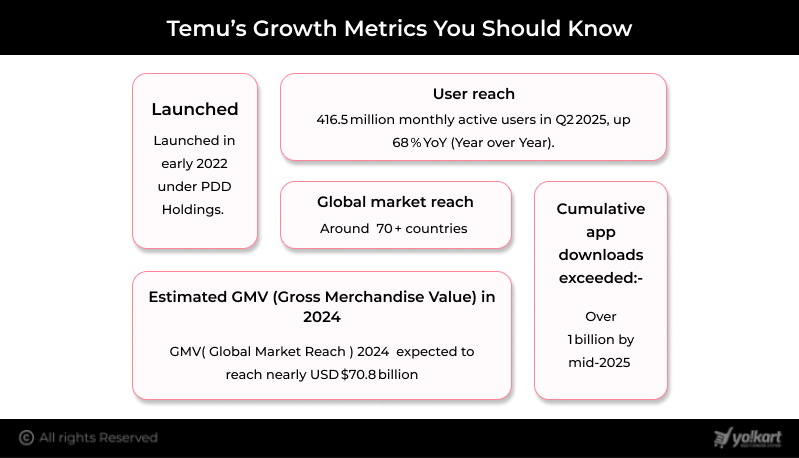
Key Stats:
- Launched: 2022 by PDD Holdings
- Global market reach: Active in 70 + countries
- Cumulative app downloads exceeded ~over 1 billion by mid-2025
- Estimated GMV (Gross Merchandise Value) in 2024: ~USD $70.8 billion
- User reach: ~416.5 million monthly active users in Q2 2025, up 68 % YoY (Year over Year).
These figures reflect how Temu rapidly scaled by combining low‑cost sourcing, global logistics, and mobile‑first growth.
From App Launch to Billion Downloads: Temu’s Growth Strategy
Founded in 2022, Temu, a rising star in the global eCommerce space, has quickly evolved from a startup to a competitive marketplace that is challenging established players. By capitalizing on a highly effective blend of strategies, Temu has reshaped consumer shopping habits and set new standards for online retail.
Key Milestones in Temu’s Growth:
1. Aggressive Marketing Campaigns
Temu’s rapid ascent was fueled by high-impact marketing campaigns that targeted a wide spectrum of consumers. From TV ads to social media influencers, Temu created widespread brand awareness, drawing millions of new users and driving app downloads to over a billion by mid-2025. Their campaigns focused on offering deep discounts and unique deals to attract budget-conscious shoppers.
2. App-First Strategy
Temu adopted an app-first strategy, building a mobile-first platform that was designed to offer a seamless, user-friendly shopping experience. With a focus on convenience and accessibility, Temu ensured that users could shop anytime, anywhere. This move paid off as mobile commerce continues to dominate global eCommerce trends.
3. Flash Deals and Time-Limited Promotions
Flash deals and limited-time promotions became a staple of Temu’s approach, enticing shoppers with exclusive offers. These deals generated a sense of urgency and excitement among customers, leading to higher conversion rates and frequent repeat purchases.
4. Customer-Centric Approach
Temu has placed the customer at the heart of its strategy by ensuring the platform is intuitive, offering personalized recommendations based on AI-powered algorithms, and streamlining the user experience. The company listens to customer feedback and continuously improves the platform to meet evolving demands. Additionally, Temu ensures fast and hassle-free returns, building trust and brand loyalty with its customer base.
The Role of PDD Holdings in Temu’s Success
Temu’s ability to offer unbeatable prices and reliable service can largely be attributed to its integration with PDD Holdings. Through the parent company’s extensive sourcing network and sophisticated logistics capabilities, Temu was able to streamline its supply chain, ensuring faster delivery times and minimizing operational costs. The access to PDD’s advanced AI-driven logistics systems has also allowed Temu to optimize inventory management and forecast demand more accurately. This efficient, data-driven approach has not only reduced costs but also enhanced the platform’s scalability, positioning Temu for long-term growth.
In addition, PDD Holdings’ competitive pricing strategies allowed Temu to undercut other eCommerce platforms while still maintaining healthy margins. This combination of cost leadership, fast shipping, and a customer-first mentality has given Temu a unique edge in the competitive eCommerce market.
Create a Competitive Marketplace Like Temu
How Does Temu Make Money? Understanding Its Business Model
Despite being widely recognized for its ultra-low prices, Temu has built a diversified revenue model that allows it to maintain profitability while attracting cost-conscious shoppers. Its business strategy combines direct sales, platform monetization, and data-driven services to create multiple income streams. Let’s have a look at Temu’s revenue channels:
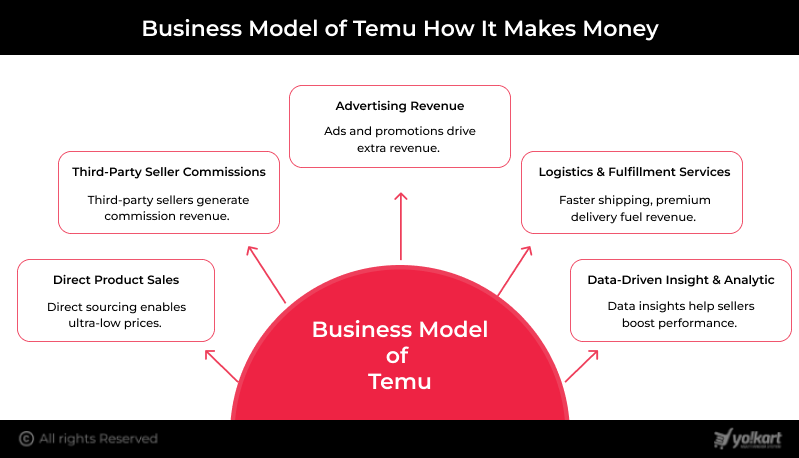
1. Direct Product Sales
Temu sources products directly from suppliers, leveraging its parent company PDD Holdings’ extensive supply chain. By purchasing goods at low cost and selling them at a modest markup, Temu captures margins while keeping prices highly competitive for consumers.
2. Third-Party Seller Commissions
Beyond direct sales, Temu allows external sellers to list products on its platform. This enables the company to earn a commission on each sale, creating a steady revenue stream without additional inventory risk.
3. Advertising Revenue
Temu monetizes its user base through sponsored product listings, banner ads, and in-app promotions. Brands looking to reach Temu’s highly engaged audience pay for visibility, adding another significant source of income.
4. Logistics & Fulfillment Services
With its efficient fulfillment network, Temu charges for faster shipping options, premium delivery, and warehousing services. This not only enhances the customer experience but also generates additional revenue.
5. Data-Driven Insights & Analytics
By analyzing transactions and browsing behavior, Temu provides sellers with actionable insights to optimize listings, promotions, and pricing strategies. These analytics services are another revenue stream, turning platform data into tangible business value.
Overall, Temu’s revenue model balances low prices for consumers with multiple monetization streams for the business, demonstrating how a customer-centric approach can coexist with profitability.
Profit Model Breakdown
Temu has adopted a high-volume, low-margin retail approach, relying on large-scale product sales to generate revenue while keeping prices exceptionally low. Despite the slim margins, the platform remains highly profitable by leveraging various income channels. Further, by integrating cost-efficient supply chains, advanced logistics, and data-driven tools, Temu can maintain its profitability even with low-priced products, much like how Amazon has used AWS and advertising to offset retail risks.
Key Highlights:
- Cost-efficient supply chains: Leveraging AI-driven logistics and optimized cross-border fulfillment to reduce costs.
- Multi-revenue approach: Incorporates commissions, advertising, and logistics services to offset low-margin retail sales.
- Stability through diversification: Reduces dependency on a single revenue stream, protecting against market changes and volatility.
- Scalable model: Enables Temu to grow rapidly while maintaining a profitable business structure.
Temu’s Growth Formula
Temu’s expansion is driven by a strong focus on customer-centricity and technology-led innovation. The platform reinvests profits into marketing, logistics, and international growth, ensuring it stays ahead of competitors. By combining low-cost sourcing with operational efficiency and AI-driven tools, Temu can scale quickly while maintaining cost leadership. Its future growth is expected to be supported by smarter product recommendations, automated supply chain operations, and potentially more advanced delivery solutions.
Key Highlights:
- Customer obsession: Prioritizes user experience and satisfaction to drive retention and engagement.
- Technology-driven innovation: Uses AI and data analytics for product recommendations and operational efficiency.
- Reinvestment strategy: Allocates profits to marketing, logistics, and global expansion initiatives.
- Operational efficiency: Streamlined supply chains and automation reduce costs and support scalability.
How Can You Build an App Like Temu?
Building an app like Temu remains a lucrative opportunity in 2026, thanks to the rising number of bargain-conscious consumers, growing cross-border eCommerce demand, and the adoption of AI-driven tools for personalized shopping experiences. This encourages aspiring entrepreneurs to create platforms that combine scalability, intuitive user interfaces, and seamless global logistics to provide a superior customer experience. Thus, by leveraging modern technologies and strategic operational models, businesses can minimize costs, reduce time-to-market, and compete effectively with established players in the multi-vendor marketplace.
However, the key is to focus on efficiency, tech-driven innovation, and adaptability, ensuring the platform can grow alongside changing consumer behaviors and international expansion needs.
Development Paths to Build a Temu-like Platform:
Custom Development:
- Enables you to build the platform from scratch.
- Offers a fully tailored solution to meet unique business requirements.
- Provide control over app design, features, and technology stack.
- Higher costs and longer timelines due to end-to-end development.
Best suited for businesses with specific differentiation strategies or proprietary features.
Ready-Made Multi-Vendor Solutions:
- Pre-built, white-label platforms allow rapid deployment and faster go-to-market.
- Lower upfront investment compared to building from scratch.
- Proven scalability with pre-tested modules for vendors, payments, logistics, and analytics.
- Flexible enough to customize branding, features, and pricing logic.
Ideal for entrepreneurs looking to validate their marketplace idea quickly and expand without heavy initial development costs.
Necessary Features to Have in an App Like Temu
To build an app that matches the scale and efficiency of Temu, your platform must combine user-friendly design, seller-focused tools, and a strong administrative backend. Hence, below is the breakdown of the essential features needed across all user groups to ensure a smooth, scalable, and competitive shopping experience.
User-Focused Features
- Profile Management: Allows users to easily create accounts, manage personal information, and track order history.
- Advanced Search Filters: Helps users quickly find products using smart search filters and AI-driven suggestions based on preferences.
- Cart and Wishlist: Simplifies the shopping process with features to add items to a cart, save for later, and make fast purchases.
- Real-time Tracking: Enables users to track their orders in real time, receive delivery updates, and manage returns with ease.
- Product Reviews and Ratings: Provides transparency by allowing customers to leave feedback, rate products, and ask questions before buying.
- Personalized Homepage: Customizes the user’s homepage with recommended products, deals, and promotions tailored to their interests.
- Push Notifications: Keep users engaged with timely notifications about price drops, limited-time offers, and special sales.
- In-App Customer Support: Offers 24/7 support through live chat, FAQs, and self-help features to resolve issues efficiently.
Vendor-Focused Features
- Vendor Onboarding: Streamlines the process for sellers to register, verify their credentials, and list products on the platform.
- Inventory and Order Management: Allows vendors to manage stock levels, process orders, and fulfill customer demands efficiently.
- Commission Tracking: Provides insights into sales performance, commission payouts, and helps vendors optimize their business strategies.
- Marketing Features: Enables vendors to boost product visibility with paid promotions and featured listings on the platform.
- Multi-Warehouse Management: Let vendors manage inventory across multiple locations and track shipments to ensure timely delivery.
- Vendor Support Tools: Assists vendors with order issues, returns, and disputes, ensuring smooth communication and resolution.
Admin-Focused Features
- Centralized Admin Dashboard: Gives admins a unified interface to oversee users, products, and vendor activity, ensuring smooth platform operations.
- Advanced Reporting: Provides actionable insights into platform performance, including sales trends, customer behavior, and inventory status.
- Security Monitoring: Protects the marketplace from fraudulent activity and ensures user data and transactions are secure.
- Automated Alerts: Notifies admins of important updates, like order completions, payment confirmations, and inventory stock levels.
- Multi-Tier Admin Roles: Facilitates access control, allowing admins to assign different levels of permissions to users based on roles.
Advanced Features
- Multi-Language and Multi-Currency Support: Expands the platform’s reach by supporting various languages, currencies, and country-specific needs.
- AI-Powered Personalization: Delivers personalized content and product suggestions to users while automating alerts based on user behavior.
- Virtual Try-Ons: Enhance the shopping experience by allowing users to visualize products in 3D or try them virtually (e.g., fashion or home décor).
- Gamification Features: Boosts user engagement through gamified elements like badges, points, and challenges, along with referral incentives.
- Real-Time Inventory Syncing with Suppliers: Ensures that inventory levels are always up to date by syncing real-time data between the platform and suppliers.
Turn Your Marketplace Idea Into a Feature-Packed Platform
Step-by-Step Guide to Building an App Like Temu
Building a successful app like Temu requires strategic planning, a well-defined roadmap, and a focused approach. From selecting your business model to executing marketing campaigns, this section will walk you through each step to launch your app effectively. Let’s begin:
1. Define Your Business Model and Niche
The first crucial step in building an app like Temu is defining your business model and niche. This will dictate how your platform operates and how you generate revenue. Other than that, you must:
Decide Marketplace Model:
- B2C (Business to Consumer): Direct sales from your platform to end-users, like Temu’s model.
- B2B (Business to Business): Allow businesses to sell products to other businesses (more common for wholesale or bulk transactions).
- Hybrid Model: A combination of both B2C and B2B, offering flexibility to target a broader audience, from individual consumers to businesses.
Target Audience:
- Understand Demographics: Research your target users, including their interests, buying behavior, and preferences.
- Niche Focus: Determine whether you’ll focus on a specific product category, such as fashion, electronics, or home goods, or go for a broad marketplace approach like Temu.
2. Plan Core and Advanced Features
Once your business model is defined, start planning the essential and advanced features you need to build a competitive and user-friendly app. They should include:
- Account Registration & Profile Management
- Advanced Product Search & Filters
- Personalized Recommendations
- Secure Checkout
- Order Tracking & Delivery Updates
- Vendor Dashboard
- Admin Panel
- Flash Deals & Limited-Time Offers
3. Choose the Development Approach
The next step is deciding between custom development and using a ready-made marketplace solution. Each option has its pros and cons, depending on your budget and timeline.
Custom Development:
- Pros: Complete control over design, functionality, and scalability. Tailored specifically to your needs.
- Cons: High initial development costs, long timelines (6-12 months), and the need for in-house technical resources.
Ready-Made Marketplace Solutions:
- Pros: Faster to market (4-12 weeks), lower initial costs, scalable, and customizable to some extent.
- Cons: Need to fulfill the minimum server requirements.
Recommendation: If you’re looking for a quick, cost-effective launch, a ready-made solution like Yo!Kart might be a great choice to get your app live while still offering scalability and essential features.
4. Launch and Market Your App
With your app built, the next step is to successfully launch and create buzz around your platform. Effective marketing can ensure your app attracts both vendors and users. Hence, you should:
| Pre-Launch | Post-Launch |
| Create a Buzz: Use teaser campaigns, email newsletters, and early access incentives. | Ongoing Marketing: Run seasonal sales, loyalty programs, and retargeting ads to maintain momentum. |
| Influencer Partnerships: Collaborate with influencers who align with your niche. | Track Performance: Monitor key metrics like user engagement, revenue, and retention rates. |
| SEO Optimization: Optimize your website and app for search engines to attract organic traffic. | Collect User Feedback: Use surveys or in-app feedback tools to improve user experience. |
How Yo!Kart Can Help You Build an App Like Temu?
Yo!Kart is a ready-made, multi-vendor marketplace solution designed to help entrepreneurs and businesses create scalable online platforms like Temu with ease. With its pre-integrated marketplace tools and flexible features, Yo!Kart provides everything you need to launch a successful eCommerce app without starting from scratch. Further, it is a fully white-label and customizable platform, giving you complete control over your brand identity while ensuring the app scales with your growing business needs.
Backed by mobile apps for both buyers and sellers, as well as automation tools for order management and marketing campaigns, Yo!Kart is built to power your marketplace at every stage of growth.
Key Advantages of Yo!Kart:
- Pre-integrated essential features: Includes vendor dashboards, inventory management, and real-time analytics for seamless operations.
- One-time payment with a lifetime license: No recurring fees or hidden costs, ensuring long-term value.
- Fully white-label and customizable: Tailor the platform to your brand’s unique identity.
- Mobile apps for buyers and sellers: Offering a smooth omnichannel shopping experience.
- High scalability and robust security: Built to support growth while maintaining the highest security standards.
- Automation tools for order management and marketing campaigns: Streamline your operations and marketing efforts.
- Multi-currency support: Ideal for global marketplaces, enabling transactions in various currencies.
- Advanced SEO, marketing, and reporting tools: Enhance visibility, optimize performance, and drive growth.
With Yo!Kart, you can fast-track the development of your Temu-like marketplace app while ensuring it remains customizable, scalable, and cost-effective.
Get a First-Hand Look at Yo!Kart
Real-World Marketplaces Launched with Yo!Kart
Yo!Kart has empowered businesses across various industries to build and scale their multi-vendor marketplaces. Below are three examples of how Yo!Kart helped entrepreneurs and enterprises turn their vision into reality with a powerful, customizable platform.
1. Myntist
Myntist is an Australia based, next-gen, marketplace powered by Yo!Kart. It enables trading of both physical products and digital assets on the platform. Additionally, it supports payments in fiat and its native cryptocurrency, $MYNT, and offers sellers flexible selling modes, including auctions and royalty-based resale. It also integrates with Shopify and eBay modules, allowing sellers to import selling and bidding (eBay) products from their Shopify-powered stores or eBay profiles to their Myntist storefronts.
2. Tana
Tana is a fast-growing, multi-vendor eCommerce marketplace in Albania. Built on Yo!Kart’s scalable architecture, it brings together local sellers across categories like electronics, fashion, beauty, and home goods, with advanced features like real-time order tracking, automated product import from WooCommerce/Shopify, and integration of local payment gateways.
3. 4GoodVibes
Powered by Yo!Kart, 4GoodVibes is a niche marketplace that showcases handmade, vintage, and custom products by artisans. It includes vendor-friendly tools such as custom invoicing, quick listing, unified order dashboards, and advanced filters, all designed to help small creators grow and connect with customers.
Conclusion
Temu’s remarkable success can be attributed to its cost-leadership strategy, highly efficient supply chain, and strong focus on delivering value to customers. By keeping operational costs low while ensuring a seamless shopping experience, Temu has been able to scale rapidly and attract millions of users worldwide. Entrepreneurs looking to replicate this model can leverage modern, scalable platforms like Yo!Kart, which provides a feature-rich, customizable solution for building multi-vendor marketplaces. Additionally, with the right combination of smart logistics, global reach, and an unwavering focus on unbeatable customer value, building a marketplace like Temu can drive long-term growth, scalability, and success.
FAQs
Q 1. How Does Temu Make Most of Its Money?
Ans. Temu generates revenue through multiple channels, including direct product sales, commissions from third-party sellers, advertising on its platform, and charging for premium logistics services. Thus, by diversifying income streams, it balances low retail margins with high-volume sales.
Q 2. Is Temu Profitable Despite Ultra-Low Prices?
Ans. Yes, Temu remains profitable by leveraging a cost-effective supply chain, low operational costs, and strategic revenue from commissions, advertising, and logistics, allowing it to scale rapidly while keeping prices low.
Q 3. Does Temu Charge Sellers on Its Marketplace?
Ans. Yes, Temu charges sellers a commission on sales made through the platform. This fee helps Temu generate revenue while allowing third-party sellers to reach a broad, global customer base.
Q 4. How Does Temu Use Its Supply Chain to Reduce Costs?
Ans. Temu reduces costs by leveraging its parent company, PDD Holdings, for efficient sourcing and AI-driven logistics. This integration ensures low shipping costs, faster delivery, and higher supply chain efficiency, contributing to its low-price strategy.
Q 5. Can Entrepreneurs Build a Temu-Like App Today?
Ans. Yes, entrepreneurs can build a Temu-like marketplace by using scalable, ready-made platforms like Yo!Kart. These solutions provide essential marketplace features, customizable branding, and efficient logistics, enabling quick market entry and growth.
The post How Does Temu Make Money? appeared first on YoKart Blog.
]]>The post How to Build a Website Like Alibaba: Features, Costs and Monetization Strategies appeared first on YoKart Blog.
]]>However, before we dive deep, let’s explore why build an eCommerce platform similar to Alibaba?
According to Statista, Alibaba Group recorded revenue of approximately $137.3 billion (996.35 billion yuan) in the fiscal year ending March 31, 2025. You can see a continuous growth in Alibaba’s revenue from 2015 to 2025.
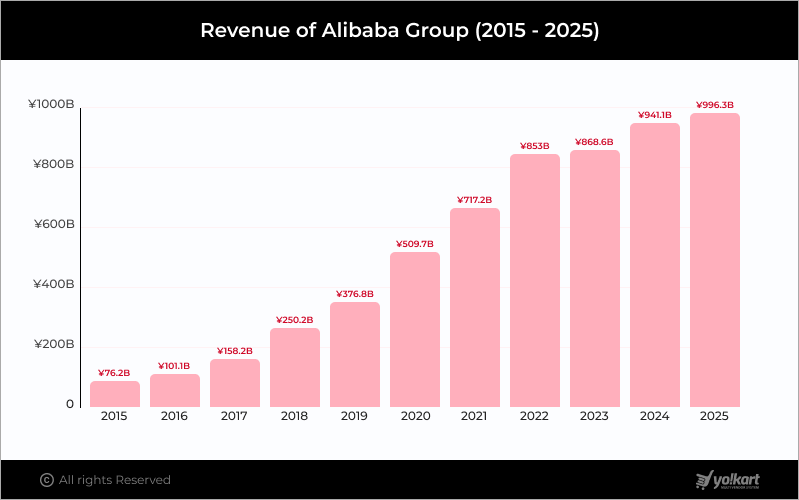
What attracts entrepreneurs more to build a marketplace like Alibaba is its diversified revenue channels and business models. It generates revenue through multiple sources and drives consistent growth via its strategic business model.
Moreover, by building a marketplace like Alibaba, you will not just create a centralized digital platform to connect buyers and sellers, but can extend your business beyond. Let’s explore how to create a website like Alibaba.
Table of Contents
- What is Alibaba?
- Alibaba History: Key Milestones and Achievements
- Business Model: How Does Alibaba Work?
- Top Well-Recognized Subsidiaries/Businesses of Alibaba Group
- Alibaba Revenue Model: How Does Alibaba Make Money?
- Revenue Distribution of Alibaba by Segment
- Key Features of Alibaba B2B Multi-Vendor eCommerce Platform
- How Much Does it Cost to Build an eCommerce Platform Similar to Alibaba?
- How to Build a Website or Marketplace Like Alibaba?
- Build a Multi-Vendor Marketplace Like Alibaba at an Affordable Cost
- Final Thought
- FAQs
What is Alibaba?
Alibaba is a leading B2B multi-vendor marketplace that enables buying and selling products in bulk. The platform is specially designed for B2B trade. It connects businesses (buyers) that prefer good margins with suppliers (vendors) seeking large quantity orders.
There are millions of active buyers, manufacturers, suppliers and wholesalers listed and registered on Alibaba. The marketplace handles approximately 300,000 trades daily. On the one hand, vendors connect with millions of global buyers. On the other hand, buyers also gain access to a wide variety of products from distinct categories and niches.
Alibaba’s offerings are not limited to products; it also extends to services, cloud computing, entertainment, logistics, finance, artificial intelligence, and more.
In short, Alibaba Group is a one-stop destination for individuals and businesses that offers a comprehensive digital solution, from selling products in bulk to selling to individual customers, providing cloud computing services to leveraging AI products, enabling a payment system to offering loans and providing a video streaming platform to making films.
- Parent organization: Alibaba Group
- Founded: April 4, 1999
- Headquarters: Hangzhou, China
- Company Type: Private
- Geographical Presence: Global
Alibaba History: Key Milestones and Achievements
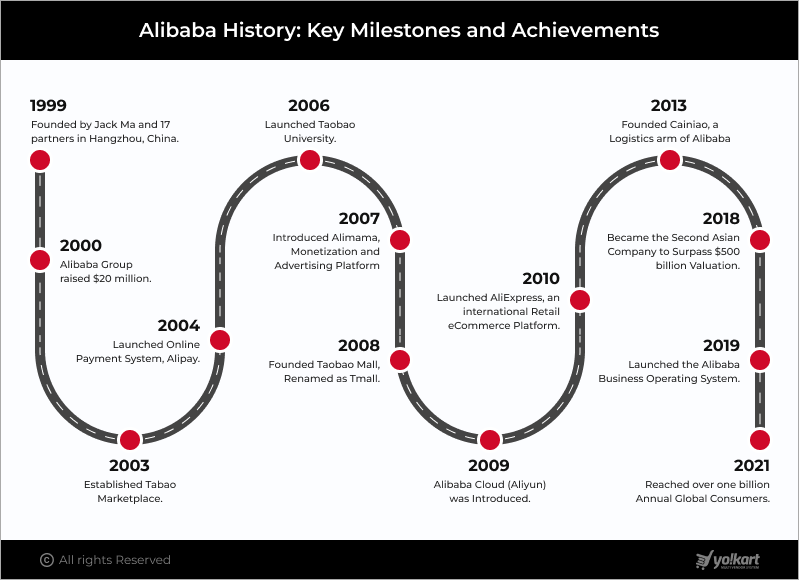
- 1999: Founded by Jack Ma and 17 partners in Hangzhou, China.
Launched China Marketplace (Currently 1688.com) - 2000: Alibaba Group raised $20 million.
- 2003: Established Tabao Marketplace
- 2004: Launched Online Payment System, Alipay.
- 2006: Launched Taobao University
- 2007: Introduced Alimama, Monetization and Advertising Platform
- 2008: Founded Taobao Mall, Renamed as Tmall (2011)
- 2009: Alibaba Cloud (Aliyun) was Introduced.
- 2010: Launched AliExpress, an international Retail eCommerce Platform.
- 2013: Founded Cainiao, a Logistics arm of Alibaba
- 2018: Became the Second Asian Company to Surpass $500 billion Valuation.
- 2019: Launched the Alibaba Business Operating System.
- 2021: Reached over one billion Annual Global Consumers
Business Model: How Does Alibaba Work?
Alibaba is a dedicated B2B multi-vendor marketplace that works as an intermediary between businesses. It connects businesses, including buyers and sellers, to trade in bulk. Manufacturers, distributors and suppliers primarily from China list their products and connect with buyers across the world. Buyers, on the other hand, visit the marketplace and find products at a good value.
Vendors’ Journey on Alibaba
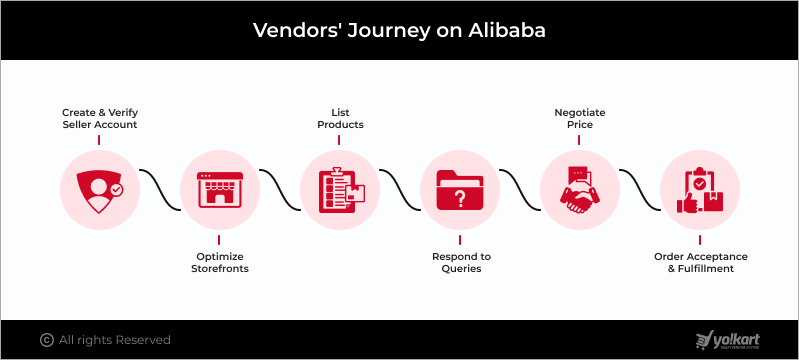
- Create and Verify Seller Account
- Optimize storefronts
- List Products
- Respond to Queries
- Negotiate Price
- Order Acceptance and Fulfillment
Buyers’ Journey on Alibaba
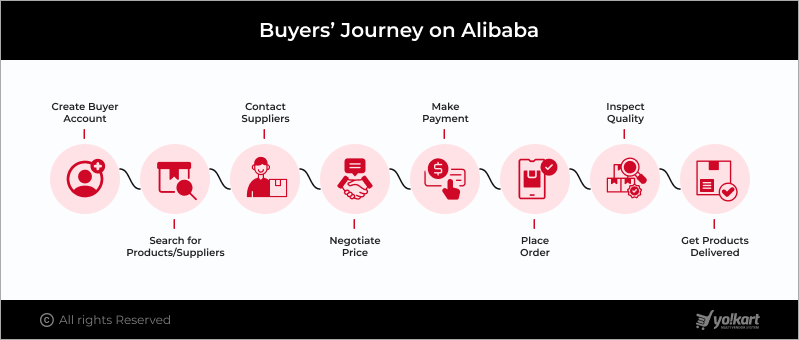
- Create Buyer Account
- Search for Products/Suppliers
- Contact Suppliers
- Negotiate Price
- Make Payment
- Place Order
- Inspect Quality (Through Alibaba Third-party Inspection Services or by Yourself
- Get Products Delivered
Buyers can also take post-delivery actions, such as providing feedback on the product or supplier, or contacting customer support for any complaints, concerns, or queries.
| Admin controls and manages the entire marketplace’s operations, including user management, payment management, order management, role management, return and complaint management, marketing, promotions and much more. |
Top Well-Recognized Subsidiaries/Businesses of Alibaba Group
However, alongside product sales, the Alibaba Group follows a diversified business model that makes it an ideal inspiration for entrepreneurs and business owners who tap into the eCommerce world and extend their offerings beyond. Let’s explore some widely recognized subsidiaries or businesses operated by Alibaba Group that contribute to its growth and expansion.
| Subsidiary | Founded Year | Key Offerings |
| 1688.com | April 1999 | A Chinese B2B eCommerce platform focused on the domestic market. |
| Taobao | May 2003 | A consumer-to-consumer (C2C) marketplace popular across China. |
| AliPay | February 2004 | A widely used digital payment service in China. |
| Youku | December 2006 | A major online video platform, often compared to YouTube. |
| Alimama | November 2007 | A digital marketing and monetization platform by Alibaba Group. |
| Tmall | April 2008 | A B2C platform featuring high-quality products from top brands. |
| Aliyun (Alibaba Cloud) | September 2009 | Global cloud computing solutions provider. |
| AliExpress | April 2010 | A global B2C eCommerce platform connecting buyers with Chinese suppliers. |
| Lazada | May 2012 | A leading Southeast Asian eCommerce marketplace. |
| Cainiao | May 2013 | A smart logistics network enabling fast domestic and cross-border deliveries. |
| DingTalk | December 2014 | An enterprise communication and collaboration platform. |
Want to Build an eCommerce Website Similar to Alibaba or its Subsidiaries?
Alibaba Revenue Model: How Does Alibaba Make Money?
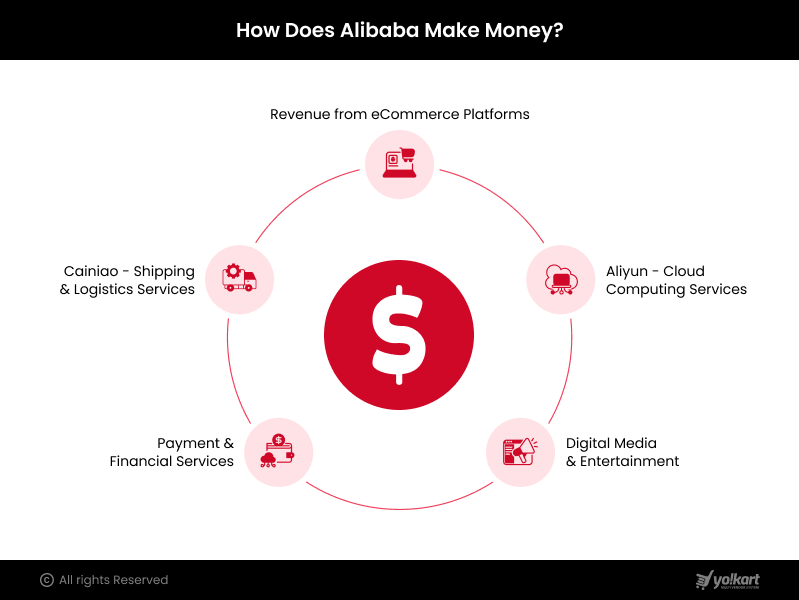
Whether you are a buyer or a seller, user registration and product listing on Alibaba are free. However, its diversified revenue models ensure steady income for the business.
The platform primarily generates revenue through advertising, membership fees, and commission on transactions. While some platforms like Tmall and AliExpress charge commissions on sales, others like Taobao and Alibaba itself rely more on advertising and subscription fees.
In addition, Alibaba Group earns money from its extended services such as cloud computing, logistics, and more. Let’s get an overview of the revenue model of Alibaba below:
Alibaba’s Revenue from eCommerce Platforms
Alibaba and its sister eCommerce platform enable the selling of products in retail and wholesale. These platforms generate revenue from multiple revenue streams. Tmall and Taobao are leading eCommerce platforms that generate a vast amount of revenue for Alibaba. Below are a few revenue streams that contribute to the company’s revenue.
- Commission: Alibaba itself doesn’t charge commission on sales. However, its sister platforms, such as AliExpress, Tmall and Juhuasuan, charge a percentage of GMV (Gross Merchandise Value) on transactions initiated or settled via Alipay.
- Membership and Subscription Fees: Membership and subscription-based services are another revenue generation source for Alibaba. Subscription prices varied by plans and offerings.
Primarily, Alibaba offers two different pricing plans: basic and standard. The subscriber can choose either a quarterly or an annual plan. These membership plans provide access to premium services and features, offering subscribers several exclusive benefits. Alibaba’s premium membership program 88VIP has continued to gain traction among its members.
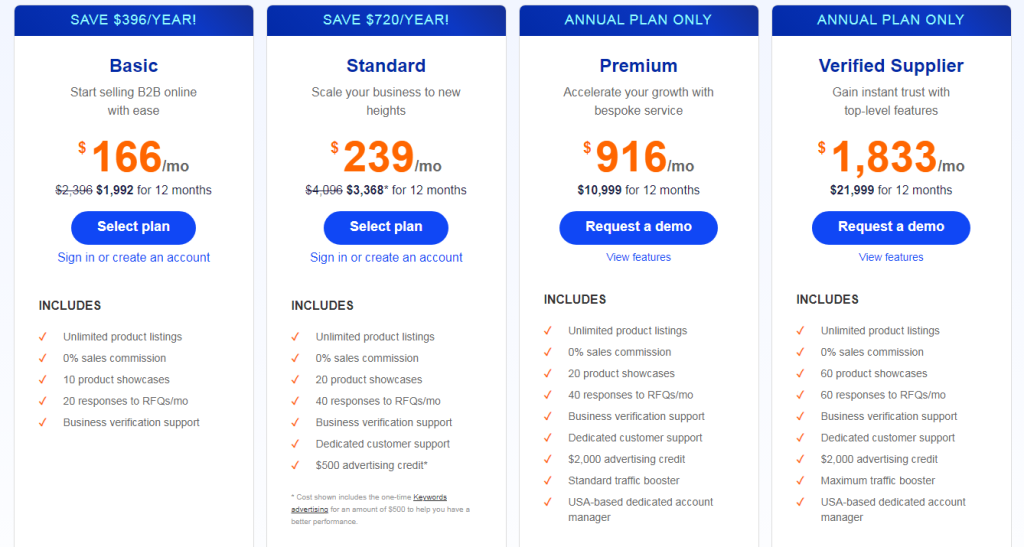
- Advertisements and Sponsored Ads: A significant percentage of Alibaba’s revenue comes from marketing services (advertising and sponsored ads). Merchants and third-party advertisers pay Alibaba in order to promote products, increase visibility, display banner ads, rank keywords and more.
Alimama is the advertising platform that analyses data across platforms and enables targeted marketing across the Alibaba ecosystem.
Suggested Read: How Does Alibaba Make Money : A Detailed Guide
Alibaba’s Revenue from Aliyun (Cloud Computing Services)
Aliyun, Alibaba’s cloud computing arm, has reported year-on-year revenue growth. It provides services like computing, storage, data management and AI solutions. It enables businesses to choose subscription plans or incur charges based on services used, pay-as-you-go.
AI-related products remain key growth drivers for Alibaba Cloud. In the first year of 2025, Alibaba Cloud reported revenue of $16.26 billion. Moreover, by analyzing the rapid adoption of AI products, Alibaba has planned to invest in cloud and AI infrastructure to sustain its growth and expansion.
Alibaba’s Revenue from Cainiao (Shipping and Logistics Services)
Cainiao is one of the world’s largest cross-border eCommerce logistics services providers. It’s one of Alibaba’s leading revenue sources. At the same time, Cainiao is also one of the fastest-growing units.
Cainiao generates revenue from services including warehousing, transportation, pick-up services, last-mile delivery and more. The highlight is that Cainiao generates a significant portion, about 70% from external sources and the remaining 30% of revenue comes from serving Alibaba’s internal needs.
Alibaba’s Revenue from Payment and Financial Services
Alibaba generates revenue from Alipay and other financial services. However, Alipay is now part of Alibaba’s financial services known as Ant Financial. It offers a range of payment and financial services. These services include payment processing, micro-loans, digital banking, wealth management and more. Moreover, Ant Group generates revenue via a combination of fees, interests, and transactional charges.
- Transaction Fees (Alipay): Alipay incurs transactional charges on transactions that take place through the platform. Moreover, utility payments, credit card services, insurance and other services also contribute to Alipay’s revenue.
- Loan Interest: The company also offers loans to customers and earns interest on them.
- Revenue from other Services: In addition to the above-mentioned revenue channels, Ant Financial charges fees and commissions to offer services like wealth management, digital payment and others.
Alibaba’s Revenue from Digital Media and Entertainment
Alibaba Digital Media and Entertainment is another source that generates revenue through subscription fees, licensing, and advertising. This segment of Alibaba includes Youku, a video streaming platform; Alibaba Music, a music division focusing on copyrights and more related to the industry; Alibaba Pictures produces films and TV shows; AliSports, UC web and more.
They all drive revenue for Alibaba in several ways. Such as Youku generates revenue through subscriptions and advertisements and Alibaba Pictures generates revenue by producing films and TV shows.
Revenue Distribution of Alibaba by Segment
The table below defines the revenue share of the Chinese eCommerce conglomerate Alibaba Group by segment. You can see the percentages of Alibaba’s revenue in the second quarter of 2025.
| Alibaba’s Segment/Subsidiary/Business | Revenue Percentage |
| China Commerce Retail | 47.88% |
| All others | 23.66% |
| Cloud Intelligence Group | 13.49% |
| International Commerce Retail | 11.47% |
| Quick Commerce | 5.7% |
| International Commerce Wholesale | 2.56% |
| China Commerce Wholesale | 2.46% |
Key Features of Alibaba B2B Multi-Vendor eCommerce Platform
Operating an online multi-vendor marketplace requires the necessary features and functionality to ensure a seamless and hassle-free experience for users. Similarly, being a leading B2B multi-vendor marketplace, Alibaba offers advanced out-of-the-box features and functionality.
It enables users to navigate complete transactions effortlessly. On Alibaba, two different users primarily participate: buyers and sellers. Let’s explore user-wise key features of Alibaba below:
Features for Buyers
Buyer is the first; at the same time, it’s the end user on the marketplace. The role of a buyer begins with a product search to end with leaving a review and ratings. Below are buyer-specific features of Alibaba:
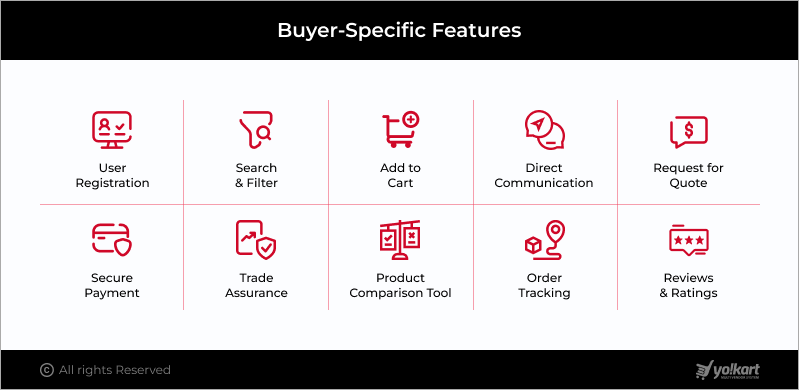
- Easy Registration and Login: Alibaba enables easy registration for buyers. They can register in just a few steps.
- Create an account by providing details like name, email address, location, and phone number.
- Complete security verification by verifying phone and email, entering the verification code.
- Add and verify payment details.
- Search and Filter: Buyers can find the results they are looking for. They search and view results by product, supplier, or worldwide. Buyers can also short products by enabling a toggle ‘Show manufacturers only’.
In addition, buyers on Alibaba can filter products at multiple levels to get more precise and relevant search results. These filters may include supplier country/region, supplier features, store reviews, certification and more. However, the filters can vary depending on the product category and types.
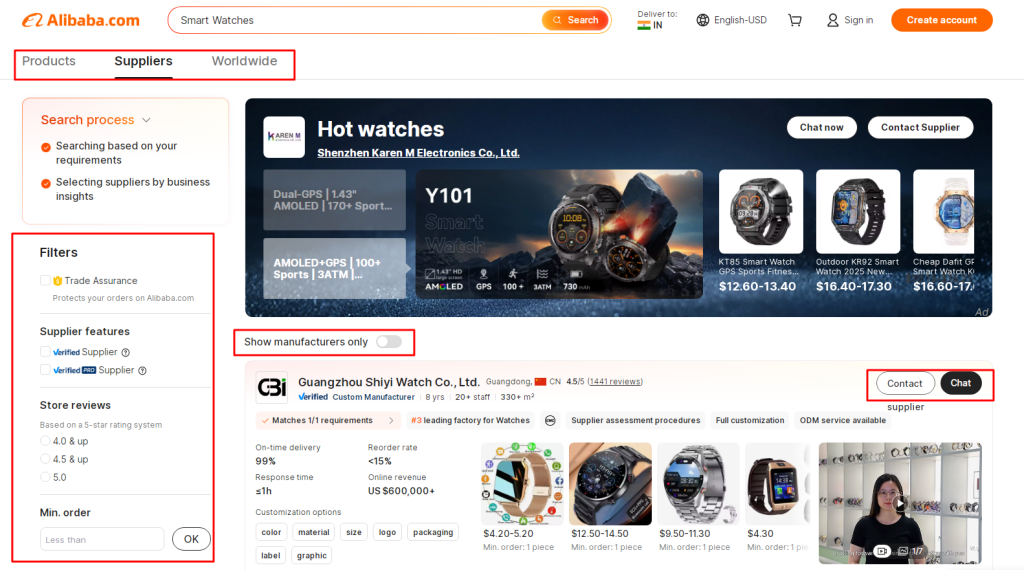
Alibaba also enables product search using images. Buyers can upload, paste or drag and drop images to search. They can even take snaps using Alibaba Lens to find results.

- Add to Cart: Buyers can collect and save items to the cart they want to buy or view later. The add to cart option also helps buyers to streamline the ordering process by enabling buyers to check out multiple products altogether.
- Chat/Contact Seller: Alibaba provides direct messaging tools with real-time translation to negotiate deals, share customized order requirements, and discuss terms such as pricing, quantity, and shipping. These options may include direct charting and contacting the supplier.
- Request for Quote (RFQ): Using this feature, buyers send and receive RFQ (Request for Quote). They can either raise a request to a particular seller or raise a universal request in order to grab the best possible deal, and any of the sellers can counteroffer.
- Secure Payment: Alibaba offers multiple and secure payment options for buyers. Each payment made on Alibaba is secured with strict SSL encryption and PCI DSS data protection protocols. Moreover, buyers can make payments using their preferred methods.
- Trade Assurance: Works as a protective shield for buyers on Alibaba. It safeguards payments, ensures on-time shipment and guarantees buyers receive the product delivered with optimal quality.
- Product Comparison Tools: Alibaba offers a feature that lets buyers compare products and suppliers simultaneously based on features, performance, and popularity. Buyers can compare up to 20 products or suppliers and choose.
- Order Tracking: One of the important features for buyers on any platform. Order tracking allows buyers to track orders and get updates on their current statuses. Alibaba allows its buyers to track orders using the built-in order tracking system.
- Reviews and Ratings: Buyers on Alibaba can post a review and rate using this feature. However, reviews and ratings on Alibaba are of different types that include:
- Verified purchase reviews: Buyers post reviews 90 days after the transaction is completed.
- Unverified purchase reviews: Buyers may leave reviews without a fully completed transaction on the platform.
- High-level buyers: High-level buyers who have had multiple interactions with a seller may post reviews on the seller’s service within 180 days after such an incident.
Looking for a Feature-rich Multi-Vendor Marketplace Solution?
Features for Suppliers
Vendors on Alibaba are manufacturers, suppliers and wholesalers who list and sell products on the platform. Alibaba brings all the necessary features for vendors. Enabling them to create unique storefronts to process and deliver orders, they perform all the tasks seamlessly. Let’s explore vendor-specific features of Alibaba below:
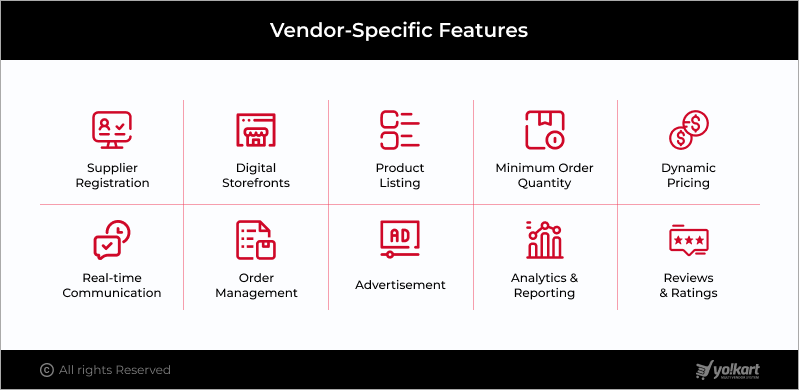
- Supplier Registration: Whether you are a manufacturer, wholesaler or supplier, Alibaba makes onboarding easy. You can register your business on Alibaba by simply providing and verifying the necessary details related to your business. Once registered, you can get started.
- Digital Storefronts: Alibaba provides an option for vendors to set up their own digital storefronts on the marketplace. They can customize and set up their online store, inclusively showcasing their products and businesses.
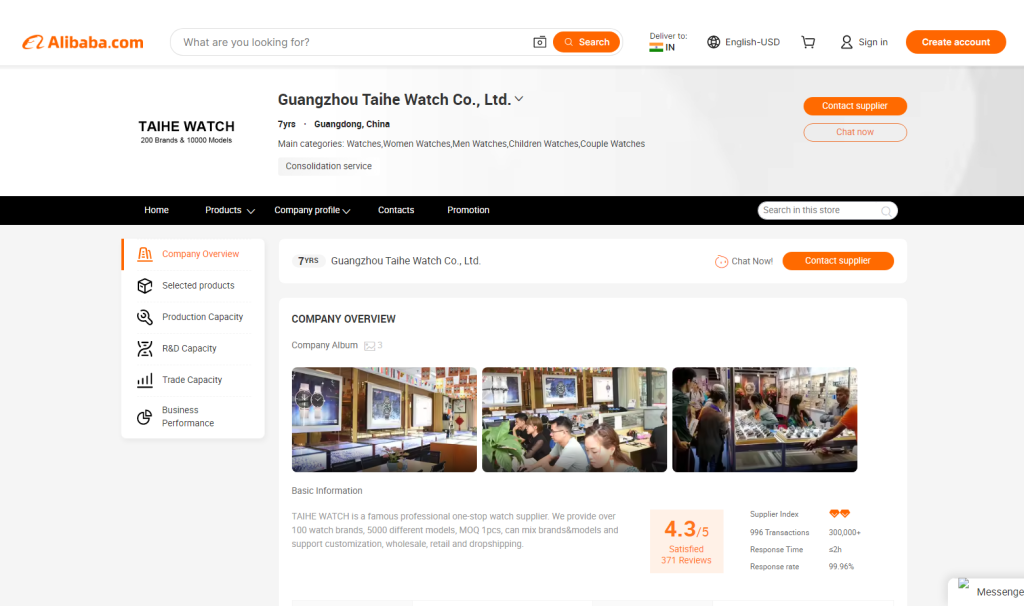
- Product Listing: Suppliers on Alibaba can either list products in bulk using the import export option or can list a single product, providing all the necessary details.
- Minimum Order Quantity: Using this feature, suppliers can restrict buyers from placing orders less than the quantity set. As Alibaba is a B2B focused marketplace, MOQ encourages bulk ordering and lets the suppliers handle order fulfillment, operations and efficiency.
- Dynamic Pricing: Alibaba enables vendors to make maximum profit using the dynamic pricing feature. This feature automatically adjusts pricing by analyzing various factors such as demand, competition and other market conditions.
- Direct and Real-time Communication: Each sales journey begins with a query. Alibaba’s direct and easy communication channels enable suppliers to directly interact with buyers on their queries in 18 languages, offering real-time translations.
In order to enable real-time communication, Alibaba also provides the AliSupplier app that allows suppliers to respond to buyers immediately, contributing to higher conversion chances.
- Order Management: Order management features on Alibaba allow suppliers to complete the ordering process. Starting from accepting orders to updating their statuses and communicating with buyers to ensure doorstep delivery, they can manage every aspect of the order.
- Advertisement: Alibaba allows suppliers to increase visibility of their products via paid ad campaigns. They can precisely target potential buyers through keywords, increase visibility in search results and boost conversion rates.
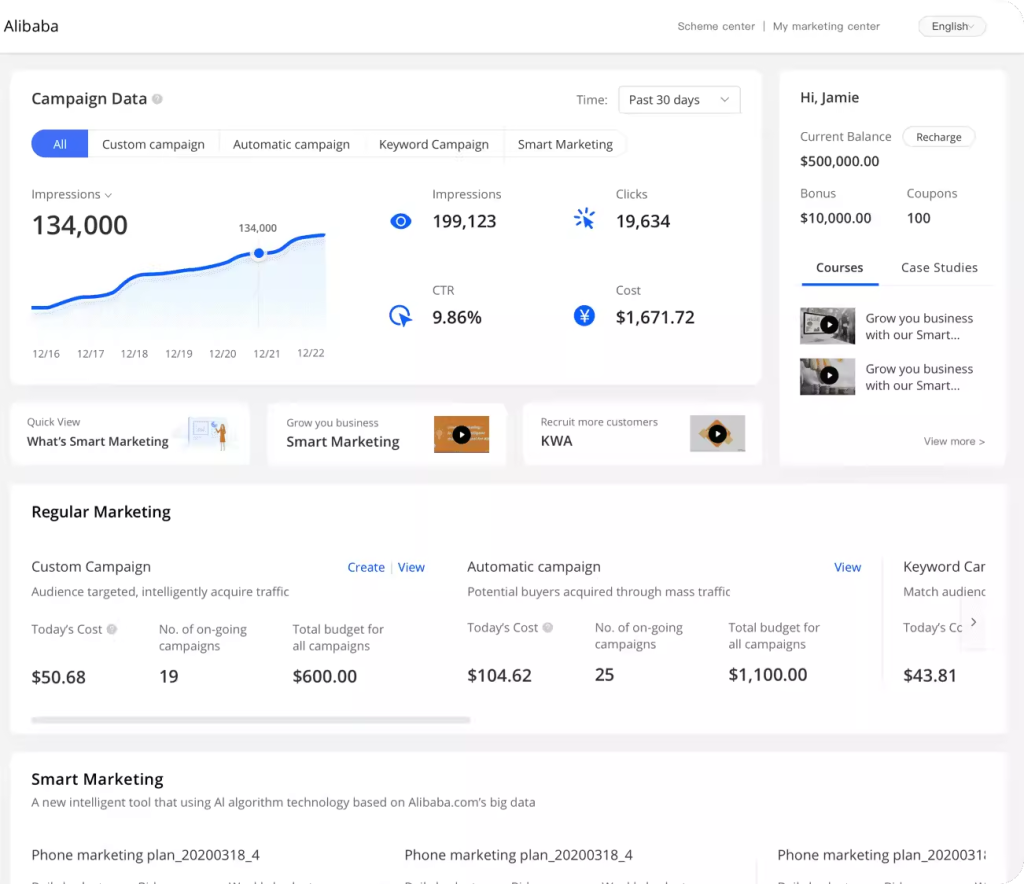
- Analytics and Reporting: Accessing the analytics and reporting dashboard, the supplier can get a complete overview of valuable data and insights, including order details, users’ behavior, search queries, conversion rates, the number of visitors and more. By analyzing these reports, suppliers can plan further strategies and implement them to drive more sales.
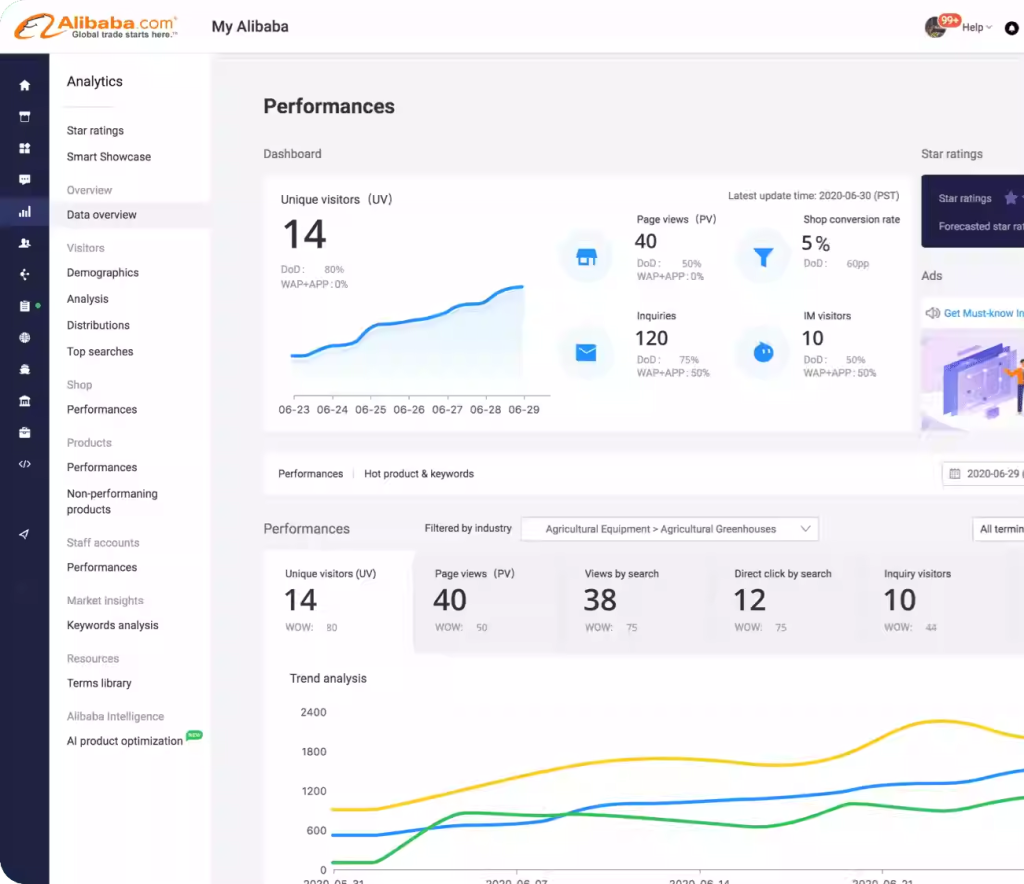
Features for Admin
Admin is the marketplace operator that operates, manages and grows the platform. From managing users to ensuring seamless operations, analyzing reports to processing payments, promoting business to acquiring users, implementing emerging technologies to taking care of updates, the admin requires all the necessary features to handle these operations.
Similarly, a B2B multi-vendor marketplace like Alibaba supports all the admin features that ensure seamless marketplace operations. However, Alibaba’s admin features are not officially available. Yet, you can check out these features required for the B2B marketplace admin:
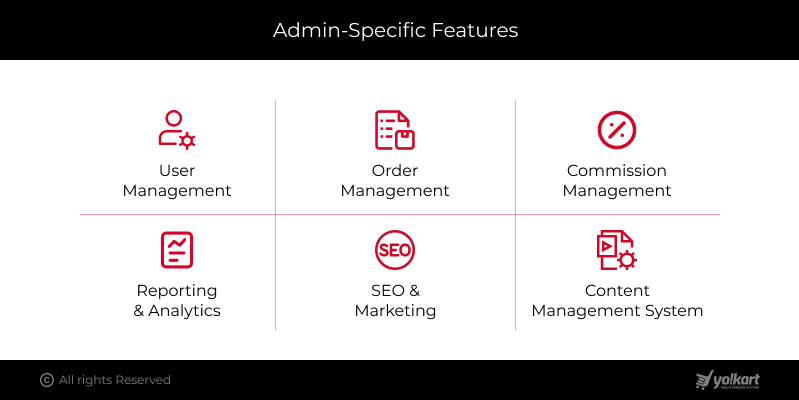
- User management: User management is an option that allows admins to manage the roles of different users including suppliers and buyers. In addition, the admin can also assign a sub-admin role to distribute workloads.
- Revenue/Commission Management: Admins need features to implement and manage multiple revenue streams such as commissions, subscription charges and more.
- Order Management: The order management feature provides complete control over the order-related operations to the admin. They handle everything, including refund and return management.
- Reporting and Analytics: Reporting and analytics in the Admin dashboard provide a complete overview of valuable data and insights of the marketplace.
Whether it’s about the number of users, transactions, tax, commission, or more, the reports showcase everything they need. In addition, by analyzing these data and insights, the admin can plan strategies and grow the marketplace.
- SEO and Marketing: In this highly competitive world, growing businesses require smart strategies, continuous effort and the right tools. SEO and marketing tools enable admins to drive more traffic, engagement and sales organically and through paid campaigns. They plan several marketing
- Content Management System: CMS is another important feature/tool that helps customize the marketplace, enhance user experience and tailor the platform as per the specific requirements without the need for coding expertise. They can easily create, manage, organize, and publish digital content on the marketplace.
How Much Does it Cost to Build an eCommerce Platform Similar to Alibaba?
Deciding on the cost to build a marketplace like Alibaba requires several considerations. The price can vary widely depending on factors such as the approach, technological requirements, features, functionality, integrations and other specific needs or complexity of the marketplace. In short, building a marketplace like Alibaba can cost anywhere between $10,000 – $1,00,000 or more.
However, you can build a B2B marketplace like Alibaba in two popular ways: build from scratch or choose a readymade solution.
Cost to Build an Alibaba-like Marketplace from Scratch
In this approach, you build an Alibaba-like marketplace from the ground up, which requires a significant amount of time, resources and money.
- Cost to Build from Scratch: Anywhere between $50000 – $100000 or more.
- Timeline: 6 to 12 months or more.
Cost to Build a Marketplace like Alibaba Using a Readymade Solution
Choosing a readymade B2B marketplace software can significantly reduce costs and timelines. Suppose you’re building an Alibaba-like eCommerce platform using Yo!Kart B2B, a readymade and dedicated B2B solution. The price can drop unexpectedly from thousands of dollars to a few hundred dollars.
- Cost to Build Using Readymade Solution (Yo!Kart B2B): Starting at $1249 (One-time)
- Timeline: 2 – 4 weeks
| Our Recommendation: Building a B2B marketplace using a readymade solution like Yo!Kart B2B can significantly reduce the cost. What makes it a preferred choice is that it offers a similar level of control and customization flexibility to custom development. |
Build a Marketplace like Alibaba at an Affordable Cost
How to Build a Website or Marketplace Like Alibaba?
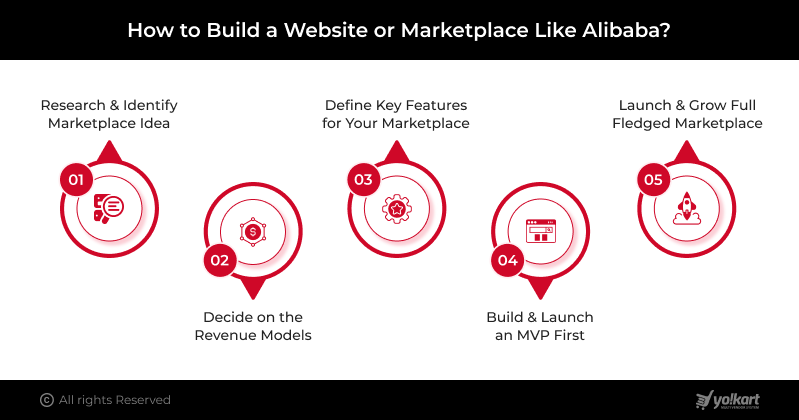
B2B eCommerce has shown substantial growth. According to the International Trade Administration, the global B2B eCommerce market size is expected to reach $36 trillion by 2026. The data indicates it’s the right time for entrepreneurs and startups to take advantage of this ever-growing eCommerce landscape.
If you are planning to build an eCommerce platform like Alibaba, it can be a game-changing decision. At the same time, you need to be careful to avoid potential threats to your business, investment and marketplace idea.
Below are a few time-tested steps suggested by industry experts to help you build a marketplace similar to Alibaba.
Step 1: Research and Identify Marketplace Idea
Alibaba is a dedicated B2B marketplace platform that connects manufacturers, suppliers, and wholesalers with global businesses that want to buy products in bulk at affordable rates. When planning to launch a marketplace like Alibaba, you need to discover a unique idea that can give your marketplace a competitive edge.
Hence, conduct thorough market research, analyze competitors, identify gaps, discover pain points, find an emerging market, understand targeted customers, and define a niche.
Moreover, conduct in-depth market research on Alibaba. It will also help you understand the areas and offerings where Alibaba itself is lacking and its customers are looking for an alternative that can meet their specific needs.
In addition, conducting market research will also give you an idea about the technology, budget and timeline required to build a B2B multi-vendor marketplace like Alibaba.
Step 2: Decide on the Revenue Models (Business Model)
If you want to build a marketplace like Alibaba, it clearly indicates a B2B eCommerce platform. However, when it comes to generating revenue for your eCommerce business, careful consideration is required. You can not simply decide on revenue generation streams that others are following.
Every business idea is unique. Hence, it requires a distinct approach to its monetization model considering the target audience, transaction type, users’ journey and more. Deduce with the revenue model that best suits your marketplace and its audience.
However, below are a few well-known revenue models marketplaces generate revenue from:
- Commission on Each Sale
- Subscriptions/Membership Fees
- Product Listing Fees
- PPC and Third-party Advertising
- Freemium Services
- Leads fees
You can choose any of the following or can implement a unique money-making idea that can help your business stand ahead and grow.
Step 3: Define Key Features for Your Marketplace
Operating a multi-vendor marketplace like Alibaba requires a comprehensive set of features and functionality to ensure seamless transactions on the platform. You need to define all the necessary features, functionality and services considering all the marketplace participants, their roles, operations and processes. The features listed below are critical when building a multi-vendor marketplace like Alibaba:
Features for Buyers:
- Easy Sign-up and Registration
- Search and Filter
- Add to Cart:
- Request for Quote (RFQ)
- Direct Communication
- Secure Payment:
- Trade Assurance:
- Product Comparison Tools:
- Order Tracking:
- Review and Ratings
Features for Suppliers
- Supplier Registration
- Digital Storefronts
- Product Listing
- Minimum Order Quantity
- Dynamic Pricing
- Direct Communication
- Order Management
- Advertisement
- Analytics and Reporting
Features for Admin
- User management
- Order Management
- Shipping Management
- Reporting and Analytics
- SEO and Marketing
- Content Management System
- Tax Management
- Ad Management Tool
- Dispute Handling/Customer Support
In addition to the above features, you can incorporate features and functionalities required specifically according to your business requirements.
Step 4: Build and Launch an MVP First
Building an MVP is a great way to validate your marketplace idea with a minimum investment. MVP (Minimum Viable Product) is the basic version of your full-fledged marketplace. It’s primarily designed to validate an idea, understand the user’s journey, and identify improvement areas.
It supports all the necessary features and functionality required to complete transactions for all user types. It significantly reduces the cost and time and helps entrepreneurs and business owners avoid potential threats to their ideas and investments.
An MVP is primarily intended to introduce its early adopters who explore and provide valuable feedback. Businesses implement feedback in order to improve the final product. MVPs are generally scalable platforms that can be expanded and grown as per the specific requirements. Ultimately, it contributes to saving time, money and resources alongside validating the marketplace idea.
Yo!Kart can be one of the best turnkey solutions to introduce your marketplace MVP, like Alibaba. It helps reduce the money and time required to launch a marketplace.
Step 5: Launch and Grow Full-Fledged Marketplace
In the final step, if you are satisfied with your marketplace MVP results, you can expand it into a full-fledged marketplace and launch. However, the job is not done yet. Operating a multi-vendor marketplace similar to Alibaba or any other requires a continuous effort.
From onboarding the maximum number of vendors to attracting more buyers and implementing new features to incorporating trends, your active participation is critical. Moreover, marketing and advertising are also one of those critical requirements that help you gain a competitive edge.
However, being a marketplace operator, you should always keep an eye on the users’ feedback, trends, and competitors to stay relevant, engaged and competitive.
Build a Multi-Vendor Marketplace Like Alibaba at an Affordable Cost
Yo!Kart is a white-label multi-vendor marketplace software. This readymade solution is primarily focused on providing entrepreneurs with a solution that enables them to build and launch a multi-vendor marketplace at an affordable price. It comes with all the necessary features and functionality required to operate an eCommerce platform.
If you are one of those entrepreneurs who is looking for a dedicated B2B marketplace software to build a platform like Alibaba, Yo!Kart B2B is right there for you. It’s a dedicated B2B multi-vendor marketplace software that supports B2B specific features and allows businesses of all sizes to trade seamlessly.
Moreover, choosing Yo!Kart as your marketplace software offers more than just a digital platform. The solution is fully customizable and scalable. Hence, you can tailor the platform to your specific needs and expand your eCommerce business without worrying about infrastructure and additional expenses related to expansion.
In addition, Yo!Kart’s source code ownership and self-hosted nature offer complete control over your marketplace and data, making it an ideal and better alternative to building a marketplace from scratch.
Launch a Fully Customizable and Scalable B2B Marketplace with Yo!Kart
Final Thought
In this informative guide on how to create a website like Alibaba, you have gone through every single detail about Alibaba. Starting from its history to understanding its business model, exploring Alibaba’s subsidiaries, features, and decoding its multiple and diversified revenue models.
In short, as an entrepreneur, you can collect all the necessary information about Alibaba that one should be aware of when building a B2B multi-vendor marketplace similar to it, including a step-by-step guide, costs and approaches to build.
I’m sure that if you are an entrepreneur planning to build a multi-vendor marketplace similar to Alibaba, you’ll consider YoKart, one of the most affordable and best readymade multi-vendor marketplace solutions.
FAQs
Q 1. Does Alibaba charge a commission on sales?
Ans. No, Alibaba doesn’t charge commission from sellers on sales. However, it charges payment processing fees on payments that take place through Alibaba.
Q 2. What are the revenue channels of Alibaba?
Ans. Alibaba generates revenue from other revenue streams like subscription charges, revenue from eCommerce subsidiaries, shipping services, payment and other financial services.
Q 3. Can I build an Alibaba-like B2B multi-vendor marketplace with Yo!Kart?
Ans. Yes, you can build an Alibaba-like B2B multi-vendor marketplace with Yo!Kart easily. Yo!Kart is a 100% white-label and readymade eCommerce solution that allows entrepreneurs and businesses to build their own eCommerce platform.
Q 4. Is Alibaba a B2B multi-vendor marketplace?
Ans. Yes, Alibaba is one of the top B2B multi-vendor marketplaces that enables businesses to trade in bulk online.
Q 5. Does Yo!Kart charge a recurring fee?
Ans. No, Yo!Kart doesn’t change any recurring fees or transactional charges. The solution is available at a one-time payment option. You can get a lifetime license to use Yo!Kart by paying once in a lifetime.
Q 6. How many buyers, sellers, listings and product categories are there on Alibaba?
Ans. Alibaba has over 40 million active B2B buyers, over 200K suppliers, 200 million+ listings and 5,900 product categories according to Alibaba.
Q 7. Is Alibaba a global B2B eCommerce platform?
Ans. Yes, Alibaba is a global B2B eCommerce platform. It operates across 200+ countries.
Q 8. How much does it cost to build a multi-vendor marketplace like Alibaba with Yo!Kart?
Ans. Building a multi-vendor marketplace similar to Alibaba starts at $1249 one-time. However, the final cost varies depending on your specific requirements.
Q 9. What are the subsidiaries of Alibaba Group?
Ans. AliExpress, 1688.com, Tmall, Juhuasuan, Lazada, and Taobao are popular eCommerce subsidiaries of Alibaba. Other than these, eCommerce platforms Alipay, Alimama, Alitrip, Aliyun and many other Alibaba subsidiaries are also contributing to its growth and expansion.
Q 10. Does Yo!Kart offer source code ownership?
Ans. Yes, Yo!Kart offers source code ownership, proving you have complete control over the platform.
The post How to Build a Website Like Alibaba: Features, Costs and Monetization Strategies appeared first on YoKart Blog.
]]>The post How Does Amazon Make Money? appeared first on YoKart Blog.
]]>Amazon has revolutionized the world of online retail, transforming from a humble online bookstore in 1994 into a global giant. Today, it is synonymous with convenience, fast delivery, and an unmatched customer experience. From retail to cloud computing and streaming, Amazon has reshaped how consumers and businesses connect online.
Its innovative business strategies, diversified revenue streams, and relentless focus on customer satisfaction have made it one of the most profitable and influential companies worldwide.
Thus, understanding how Amazon makes money offers valuable lessons for entrepreneurs aiming to launch their own eCommerce ventures. In this blog, you will dive deep into Amazon’s revenue model, highlight the essential features of a marketplace app like Amazon, and get to know how to build a scalable, feature-rich platform that can replicate its success in the digital marketplace.
Table of Contents
- Amazon at a Glance: Key Stats and Insights
- From 1994 to Today: Success Story of Amazon
- How Does Amazon Make Money? (Business/Revenue Model)
- How Can You Build a Platform Like Amazon?
- Necessary Features to Have in a Platform Like Amazon
- Step-by-Step Guide to Building an App Like Amazon
- How Yo!Kart Can Help You Build an App Like Amazon?
- Yo!Kart in Action: Inspiring Marketplace Success Stories
- Conclusion
- FAQs
Amazon at a Glance: Key Stats and Insights
Amazon has evolved into a global eCommerce and technology powerhouse, operating in over 190 countries and serving hundreds of millions of customers worldwide. The platform also partners with millions of third‑party sellers. According to the Q3 2025 earnings release of Amazon.com, Inc., the trailing twelve-month (TTM) net sales as of September 30, 2025, amounted to $691.33 billion.
Quick Snapshot:
- Prime membership (U.S. alone): ~180 million+ members.
- U.S. – market share: ~37.6 %.
- Amazon Web Services (AWS) revenue in 2024: ~USD 107.6 billion (≈19 % growth).
- Advertising growth: +18 % year‑over‑year in Q4 2024 to ~USD 17.3 billion.
These figures illustrate the scale and diversity of Amazon’s operations, from retail to cloud computing, subscriptions, and digital advertising, reinforcing why its business model serves as a blueprint for marketplace innovation.
From 1994 to Today: Success Story of Amazon
Founded by Jeff Bezos in 1994 as an online bookstore, Amazon has grown from a modest online bookstore to a trillion-dollar enterprise, driven by innovation, customer obsession, and strategic diversification. Its journey illustrates how technology, logistics, and a relentless focus on customer experience can redefine entire industries.
Key Milestones & Achievements:
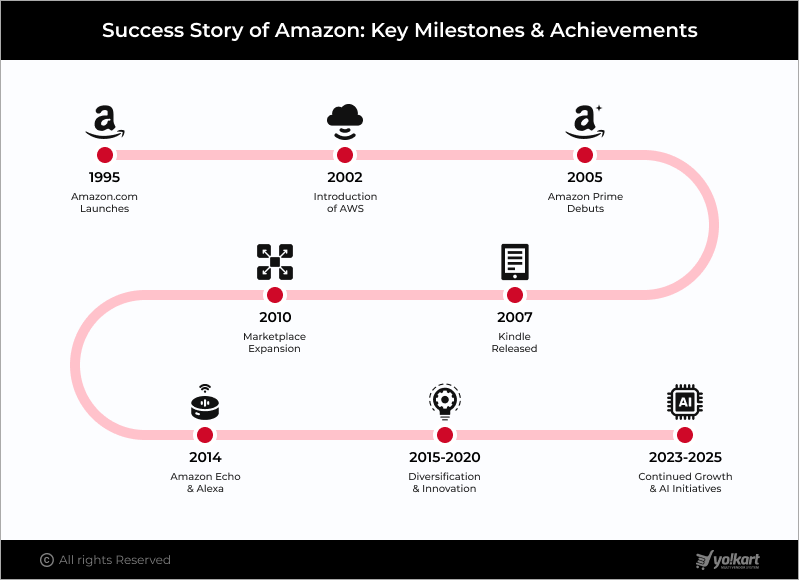
- 1995: Launch of Amazon.com as an online bookstore, quickly expanding its catalog to music, electronics, and more, setting the stage for a full-fledged empire.
- 2002: Introduction of Amazon Web Services (AWS), providing cloud computing solutions that transformed the tech industry and became a major revenue driver for the company.
- 2005: Launch of Amazon Prime, initially focused on fast shipping, later evolving to include video streaming, music, and exclusive deals, greatly enhancing customer loyalty.
- 2007: Release of the Kindle eReader, revolutionizing digital reading and establishing Amazon as a leader in both hardware and digital content.
- 2010: Marketplace expansion enabled millions of third-party sellers to reach global customers, significantly increasing product variety and reinforcing Amazon’s position as a retail giant.
- 2014: Launch of Amazon Echo and Alexa, marking Amazon’s entry into voice-activated smart devices and AI-driven home automation.
- 2015-2020: Aggressive diversification into streaming services (Prime Video), AI and machine learning-powered recommendations, and advanced logistics networks, reinforcing Amazon’s tech-forward approach.
- 2023-2025: Continued growth in AWS, advertising, and AI initiatives, solidifying Amazon’s dominance across multiple sectors while innovating in new areas like AI-driven shopping experiences and generative AI applications.
Amazon’s long-term success stems from its ability to combine relentless customer obsession with bold innovation and diversification across eCommerce, cloud computing, AI, streaming, and smart devices, setting benchmarks that competitors strive to match.
How Does Amazon Make Money? (Business/Revenue Model)
Amazon’s revenue model is a classic example of diversification, leveraging multiple income streams beyond traditional eCommerce. By integrating retail, technology, subscriptions, and advertising, Amazon creates a robust ecosystem that maximizes customer engagement, retention, and lifetime value.
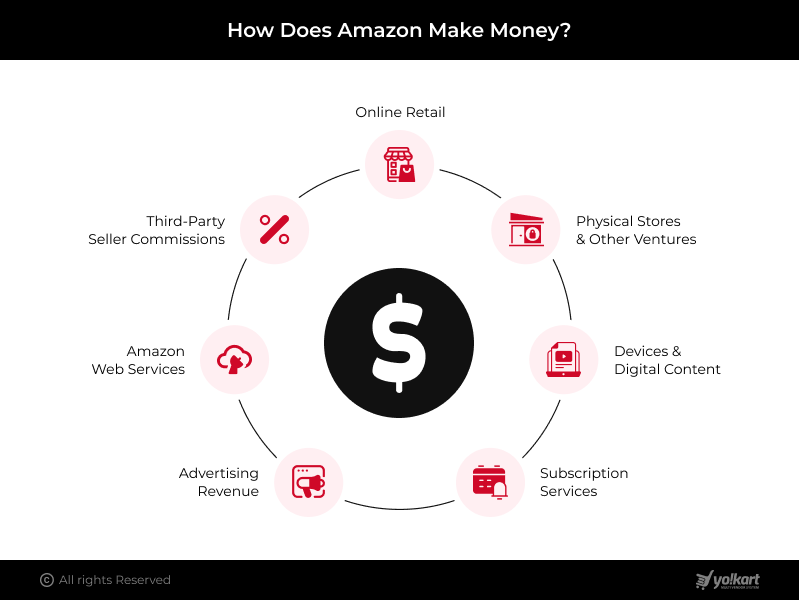
Its key revenue streams include:
- Online Retail (First-Party Sales):
Amazon earns by selling products directly to customers, including electronics, apparel, home goods, and more.
- Third-Party Seller Commissions & Fulfillment (FBA):
Millions of marketplace sellers pay fees for listing products and optional fulfillment by Amazon services, including storage, packaging, and shipping.
- Amazon Web Services (AWS):
Cloud computing, data storage, AI services, and enterprise solutions generate high-margin revenue, contributing significantly to Amazon’s profitability.
Notable Clients: Netflix, NASA, startups, and enterprises.
- Advertising Revenue:
Sponsored listings, display ads, and brand campaigns on Amazon’s platform drive a growing advertising business.
- Subscription Services:
Amazon Prime memberships, Kindle Unlimited, Audible, and other subscription programs offer recurring revenue while enhancing customer loyalty.
- Devices & Digital Content:
Amazon’s hardware lineup includes Kindle, Echo, Fire TV, and Alexa-enabled devices. These devices not only generate direct sales revenue but also drive digital content consumption through Prime Video, Audible, and eBooks, deepening customer loyalty and retention.
- Physical Stores & Other Ventures:
Amazon’s physical outlets like Whole Foods, Amazon Fresh, and Amazon Go blend digital convenience with in-person shopping, enhancing its omnichannel retail strategy. Beyond retail, ventures such as Zoox (autonomous vehicles) and Amazon Pharmacy expand their reach into mobility and healthcare, diversifying long-term growth avenues.
Breakdown of Amazon’s Profit Model
Amazon earns profits by combining high-volume, low-margin retail with high-margin services like AWS and advertising. This mix creates a balanced revenue model that cushions the company against economic fluctuations.
Additionally, its flywheel effect, more sellers bring better prices, attracting more buyers, which in turn attracts more sellers drives continuous growth and market dominance.
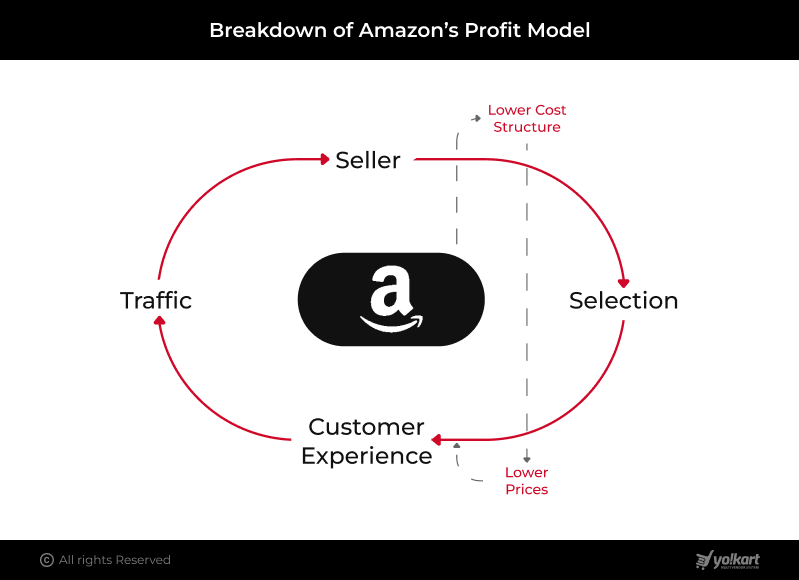
Key Points:
- High-volume retail + high-margin AWS & ads = profit balance
- Diversification protects against economic downturns
- The flywheel effect accelerates growth and market reach
Amazon’s Growth Strategy
Amazon’s growth is driven by a relentless focus on customer obsession and innovation. Moreover, the company continually reinvests profits into new technologies and global expansion, strengthening its market position.
Additionally, emerging areas such as AI, logistics automation, and drone delivery are set to fuel its next phase of growth, ensuring efficiency, faster service, and long-term competitiveness.
Key Points:
- Continuous reinvestment in technology and global expansion
- AI, logistics automation, and drone delivery as future growth drivers
- Customer-centric innovation fuels market leadership
Ecosystem Advantage: Each revenue stream reinforces the others. For example, AWS powers the platform, Prime drives engagement, and devices promote subscriptions, creating a self-sustaining ecosystem that increases customer lifetime value.
Learn How to Replicate Amazon’s Success for Your Marketplace
How Can You Build a Platform Like Amazon?
Amazon’s unparalleled success provides a proven blueprint for aspiring entrepreneurs looking to tap into this rapidly growing eCommerce market. Building an app like Amazon is a lucrative opportunity, as online retail shows no signs of slowing down.
However, to succeed in creating a marketplace that competes with industry giants, your app must prioritize three core principles: scalability, security, and user experience. Scalability ensures the app can grow with your customer base, security protects sensitive data and transactions, while a smooth, intuitive user interface (UI) guarantees a frictionless experience for both vendors and consumers.
Thus, to build an Amazon-like app, you have two primary development approaches:
- Custom Development: Developing an app from scratch allows you to build a platform that perfectly aligns with your business goals. You gain complete control over design, functionality, and integrations. While this approach delivers maximum flexibility, it requires a higher budget and a longer development timeline, typically several months to over a year. Additionally, the cost of building an Amazon-like app using this approach is very high.
- Ready-Made Multi-Vendor Solutions: Pre-built solutions offer a fast, cost-effective route to launch your Amazon-like marketplace. These platforms come with essential modules like vendor management, product catalogs, secure payment gateways, order tracking, and more. Most also provide scalability options, allowing you to add advanced features or expand into new markets without rebuilding the platform from scratch.
Hence, by carefully selecting the right development path and focusing on user experience, security, and scalability, entrepreneurs can create a feature-packed marketplace app capable of competing with established giants like Amazon.
Necessary Features to Have in a Platform Like Amazon
To replicate Amazon’s success, your eCommerce platform must offer a rich and diverse set of features. Below, we categorized the essential features into four key areas: User-Focused, Vendor-Focused, Admin-Focused, and Advanced Features. Let’s have a look at them:
Customer-Focused Features
- User Registration and Profile Management: Enable users to create and manage personalized accounts. Profile features should include saved preferences, order history, and payment methods for faster checkouts.
- Product Search, Filters, and Recommendations: Implement advanced search functionality with filters to help users find products quickly. Additionally, provide personalized product recommendations based on browsing behavior and past purchases.
- Shopping Cart and Checkout: Offer a user-friendly shopping cart with an option to save items for later. The checkout process should be seamless, with support for multiple payment methods, including credit/debit cards, digital wallets, net banking, and more.
- Order Tracking and History: Allow customers to track their orders in real-time and view their order history. Other than that, push notifications can update customers on the status of their orders (shipped, in transit, etc.).
- Multiple Payment Gateways: Integrate various payment gateways like PayPal, credit cards, Apple Pay, and other region-specific options to cater to a global audience.
Vendor-Focused Features
- Vendor Onboarding and Dashboard: Create an intuitive onboarding process for new vendors to list their products. Vendors should have access to a personalized dashboard where they can manage their store, products, and orders.
- Inventory and Order Management: Vendors should be able to efficiently manage their product inventory, including adding, updating, and removing products. Real-time updates on stock levels and order fulfillment are crucial for smooth operations.
- Commission Tracking and Analytics: Provide vendors with tools to track sales, commissions, and earnings. Analytics dashboards should offer insights into product performance, customer behavior, and sales trends to help vendors make data-driven decisions.
- Discount and Promotions Management: Allow vendors to create and manage their own discount codes, seasonal promotions, or special offers. This feature helps sellers drive sales and attract new customers, much like the flash sales and promotions Amazon frequently runs.
- Customer Interaction and Feedback Management: Provide vendors with the ability to interact with customers directly through messaging features, address queries, and respond to reviews or feedback. This encourages customer trust and fosters a sense of community around the vendor’s products.
Admin-Focused Features
- Centralized Control Panel: Admins should have a unified dashboard to monitor all aspects of the platform, including user accounts, vendor activities, transactions, and inventory management.
- User and Vendor Management: Admins must be able to manage user profiles and vendor accounts, including approving new sellers, monitoring activity, and handling disputes or issues.
- Reports and Insights: Generate comprehensive reports on sales performance, traffic data, user activity, and financials. These insights help in making informed decisions for growth and optimization.
- Commission Management: Commission management enables admins to set and track vendor commission rates, ensuring accurate payout calculations. It automatically handles commission deductions from sales, adjusts for refunds or cancellations, and generates detailed reports for transparency and financial oversight.
- Abandoned Cart: This feature allows admins to track and generate reports on items left in carts or removed by users. This data helps strategize recovery efforts by sending discount offers, reminders, or targeted marketing. It increases conversions by encouraging users to complete purchases and optimizes product listings based on insights.
Advanced Features
- AI-Based Product Recommendations: Implement AI-driven algorithms that suggest products to users based on their browsing history, preferences, and purchasing behavior, much like Amazon’s “You might also like” feature.
- Voice Search (Alexa-like Integration): Integrate voice search capabilities to allow users to find products hands-free, creating a more accessible and engaging shopping experience.
- Push Notifications and Personalized Offers: Send personalized notifications about new products, discounts, and exclusive offers to keep users engaged and encourage repeat purchases.
- Multi-Currency and Multi-Language Support: To cater to a global audience, your platform should support multiple currencies and languages. This ensures a seamless experience for customers from different regions and boosts international sales.
- Loyalty Programs and Prime-Like Memberships: Implement loyalty programs that reward repeat customers. Consider offering premium memberships with benefits like free shipping, exclusive deals, or early access to sales, similar to Amazon Prime.
Incorporating the right set of features is essential to create a competitive and user-friendly platform like Amazon. However, now that we’ve covered the key features, let’s move on to a detailed step-by-step guide to building an app like Amazon to help you navigate the development process effectively.
Create a Feature-Packed eCommerce Marketplace Today
Step-by-Step Guide to Building an App Like Amazon
Building an app like Amazon is a strategic, multi-phase process that requires careful planning, execution, and marketing. Henceforth, this step-by-step guide will help you understand each stage of development, from defining your business model to launching your app and scaling your marketplace.
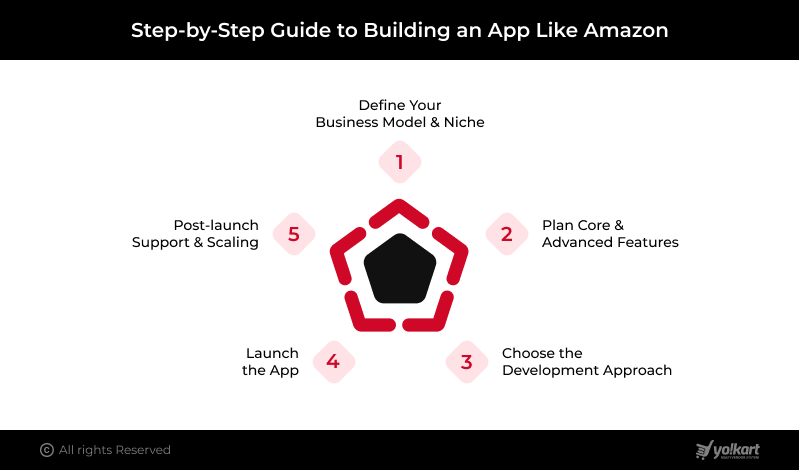
1. Define Your Business Model and Niche
The first step is to establish a clear business model that aligns with your goals, target audience, and marketplace type. Therefore, you must decide:
- Marketplace Type:
- B2C (Business to Consumer): A platform where businesses sell products directly to consumers (Amazon’s core model).
- B2B (Business to Business): A platform where businesses sell products to other businesses, often in bulk (ideal for wholesale products).
- Hybrid Model: A combination of both B2B and B2C to cater to a broader audience.
- Identify Your Target Audience:
Understand your potential customers’ demographics, buying habits, and product preferences. Determine whether you’re targeting a specific niche or a broad consumer base.
2. Plan Core and Advanced Features
Once you’ve defined your business model, plan out both core and advanced features for your marketplace app. These features will be critical in driving user engagement, satisfaction, and retention. It should include:
- User Registration & Profile Management
- Advanced Product Search & Filters
- Personalized Product Recommendations
- Shopping Cart & Secure Checkout
- Order Tracking & History
- Multiple Payment Options (Wallet, Credit/Debit, EMI)
- Vendor Dashboard & Inventory Management
- Admin Control Panel & User Management
- Advanced Search with Voice Integration (Alexa-like)
- Push Notifications & Personalized Offers
3. Choose the Development Approach
When it comes to building an app like Amazon, you have two primary development paths: custom development or using a ready-made platform. Each has its pros and cons, depending on your budget, time, and specific requirements.
Custom Development:
| Pros | Cons |
| Total flexibility to design unique features. | High initial development cost. |
| Full control over branding, UX/UI, and customization. | Longer development timelines (6-12 months). |
| Tailored to specific business needs and scalability. | Requires dedicated technical resources. |
Readymade Solutions:
| Pros | Cons |
| Faster time-to-market (4-12 weeks). | Pre-selected tech stack provided by the solution provider |
| Lower initial cost. | – |
| Scalable and customizable. | – |
Recommendation: If you need a fast and cost-effective solution to get started, a white-label software can be a great option.
4. Launch the App
Once your app is ready, shift focus to a successful launch and user acquisition. Start creating buzz before the launch with pre-launch email campaigns, social media teasers, and influencer partnerships. Optimize your platform for SEO to attract organic traffic and ensure visibility. During the launch, leverage paid advertising and offer incentives to vendors to onboard early. Post-launch, maintain momentum with targeted marketing campaigns, loyalty programs, and seasonal promotions to retain users, encourage repeat purchases, and continuously grow your platform.
5. Post-launch Support and Scaling
After launching your app, focus on sustaining growth through key post-launch strategies. Providing excellent customer support via live chat, phone, or AI-powered chatbots helps ensure user satisfaction. Regular updates with new features, bug fixes, and performance optimizations are vital for maintaining a smooth user experience. Ensuring scalability through cloud services like AWS or Google Cloud will help your platform handle increased traffic as it grows. Lastly, actively collecting user feedback allows you to refine features, improve the overall user experience, and stay competitive in the market.
How Yo!Kart Can Help You Build an App Like Amazon?
Yo!Kart is a ready-made, multi-vendor eCommerce solution built to help entrepreneurs and enterprises create online marketplaces like Amazon with ease. Designed for
Yo!Kart
scalability, flexibility, and high performance, Yo!Kart enables you to launch a feature-rich marketplace without starting from scratch. It comes equipped with pre-integrated marketplace tools such as vendor dashboards, inventory management, and real-time analytics to streamline operations from day one. As a fully customizable and white-label solution, Yo!Kart allows you to maintain complete brand control while adapting the platform to your unique business needs. Backed by mobile apps for buyers and sellers, advanced security, and seamless automation, Yo!Kart is built to scale effortlessly as your marketplace grows.
Key Advantages of Yo!Kart
- Pre-integrated marketplace essentials: vendor dashboards, inventory, order management, and analytics.
- One-time payment, lifetime license: no recurring monthly or hidden fees.
- Fully customizable and white-label: complete control over design and branding.
- Mobile apps for buyers and sellers: ensuring seamless omnichannel accessibility.
- High scalability and enterprise-grade security: designed for long-term business growth.
- Live chat and customer support tools: for better engagement and faster resolution.
- Product comparison and multi-currency support: ideal for global marketplaces.
- Automated operations: streamlining workflows for vendors and admins.
- Built-in SEO, marketing, and reporting tools: to drive visibility and optimize performance.
- Multi-language and multi-payment gateway support: enhancing reach and flexibility.
Experience the Future of eCommerce with Yo!Kart
Yo!Kart in Action: Inspiring Marketplace Success Stories
Several entrepreneurs and businesses have leveraged Yo!Kart to create feature-rich, multi-vendor marketplaces. Here are some notable examples:
1. Tajer – Qatar’s Multi‑Category Marketplace
Tajer is a value‑driven marketplace in Qatar that connects consumers with premium local and global brands across fashion, beauty, home & living, electronics, and more. Built with Yo!Kart, it features dynamic shipping logic, bilingual invoices (English/Arabic), and a mobile‑optimized front end that aligns with regional standards.
2. Jewora – India’s Artificial Jewellery Marketplace
Jewora is India’s dedicated multi‑vendor marketplace for artificial and imitation jewellery, offering thousands of designs (Kundan, Polki, American Diamond, Meenakari, and more). With Yo!Kart, as its foundation, shoppers enjoy secure checkout, pan‑India delivery, easy returns, and vendor tools, including analytics and brand stores.
3. Little Local – U.S. Hyper‑Local Marketplace
Little Local leverages Yo!Kart to connect consumers with neighborhood stores across the U.S., empowering small businesses while delivering same‑day pickup and next‑day shipping options. The platform’s vendor‑onboarding, commission management, and mobile‑app support enable a seamless local shopping experience.
4. My Valley – UK Eco‑Friendly Products Marketplace
My Valley is a UK‑based marketplace focusing on eco‑friendly products and sustainable brands. Built using Yo!Kart’s modular architecture, it offers multilingual support, multi‑currency pricing, vendor dashboards, and tailored reporting, designed to scale and support conscious‑consumer shopping.
Conclusion
Amazon’s success comes from innovation, customer focus, and diversified revenue streams, setting a standard for modern eCommerce. Its model shows how technology, data, and smart operations can create a seamless shopping experience that keeps customers coming back.
Aspiring entrepreneurs can replicate this model by leveraging scalable, modern multi-vendor platforms that provide the tools, flexibility, and technology needed to launch and grow a marketplace. Building an Amazon-like marketplace isn’t about size, but it’s about vision, technology, and customer experience.
FAQs
Q 1. What Is Amazon’s Main Business?
Ans. Amazon’s main business focuses on being a prominent online retailer/third-party marketplace and a top cloud computing provider. However, the bulk of its income comes from its eCommerce divisions, which provide a wide range of goods. Nonetheless, the company’s main source of operational revenue is the extremely lucrative Amazon Web Services (AWS) cloud division, which offers crucial infrastructure services to other companies.
Q 2. How Does Amazon Make Most of Its Money?
Ans. Amazon makes most of its money from the highly profitable cloud computing division, Amazon Web Services (AWS), which contributed 58% of its 2024 operating income. Although online retail generates the most revenue, the profit margins are significantly lower. Other income streams include third-party seller services, advertising, and Prime subscription fees, but AWS remains the primary profit engine.
Q 3. Does Amazon charge both sides of its marketplace?
Ans. Yes, Amazon charges both sides of its marketplace. From sellers, it charges referral/commission fees plus optional services like fulfillment and advertising. Similarly, it draws revenue from buyers through subscription services such as Prime and subscriptions for digital content. This two‑sided monetization broadens its revenue base and strengthens engagement.
Q 4. How does Amazon’s subscription model, beyond Prime, add to its revenue?
Ans. Beyond Prime, Amazon offers subscriptions like Audible, Kindle Unlimited, Amazon Music and other digital services. These recurring subscriptions generate consistent income, deepen customer loyalty, and increase lifetime value, while also embedding users into Amazon’s broader ecosystem of services.
Q 5. How can a multi-vendor marketplace generate revenue beyond product sales?
Ans. Beyond product sales, a marketplace can earn through:
- Commission on vendor sales
- Subscription plans
- Advertising
- Premium listings
- Value-added services (logistics, analytics, or marketing tools).
Diversifying revenue streams ensures steady income while enhancing vendor and customer engagement, making the platform sustainable and profitable.
Q 6. What strategies help attract and retain vendors on a new marketplace platform?
Ans. Strategies like offering easy onboarding, transparent commissions, marketing support, analytics tools, and prompt payments can help attract and retain vendors on the platform. Moreover, consistently improving platform features and engagement helps foster trust, ensuring a growing, loyal seller base.
Q 7. What features make a marketplace competitive in today’s eCommerce landscape?
Ans. A competitive marketplace today goes beyond standard features. Thus, by offering eco-friendly options, integrating community-building tools, social commerce, gamification, loyalty programs, localized experiences, and real-time customer support, help differentiate your platform, boost engagement, and foster long-term user loyalty.
Q 8. Can I customize a readymade solution to match my brand?
Ans. Yes, platforms like Yo!Kart is fully customizable and white-label, allowing businesses to adjust UI/UX, colors, logos, features, and workflows. This ensures your marketplace aligns with your brand identity while leveraging a ready-made, reliable infrastructure.
Q 9. How does Yo!Kart ensure scalability and performance for large marketplaces?
Ans. Yo!Kart is built with a scalable infrastructure and a modular architecture specifically designed for multi‑vendor marketplaces. The platform uses the LAMP stack and is designed for self‑hosting. Moreover, it allows marketplace owners full control over infrastructure and scaling, helping maintain high performance as operations expand.
The post How Does Amazon Make Money? appeared first on YoKart Blog.
]]>The post Best Multi-Vendor eCommerce Platforms for Enterprises appeared first on YoKart Blog.
]]>Yet, building a well-structured, enterprise-grade multi-vendor eCommerce marketplace requires a technologically resilient platform, one that is capable of handling complex operations and scaling effortlessly as the business grows.
This is where multi-vendor eCommerce platforms prove indispensable.
The ideal multi-vendor eCommerce platform combines architectural flexibility and operational efficiency that enables enterprises to innovate confidently. Howsoever, with countless solutions competing in the industry, choosing the right multi-vendor eCommerce platform becomes a strategic imperative that can define long-term success.
In this blog, we’ll explore the best multi-vendor eCommerce platforms for enterprises, evaluating their core capabilities and advantages to help you make an informed decision.
Table of Contents
Why Enterprises Need a Robust Multi-vendor eCommerce Platform?
Operating a multi-vendor eCommerce marketplace at an enterprise scale offers huge growth potential, however, it often brings some complex operational challenges. This is why businesses need a robust, scalable multi-vendor eCommerce platform to innovate confidently.
Here’s why businesses need a robust multi-vendor eCommerce platform:
- Faster Time-to-Market: A sophisticated multi-vendor eCommerce platform accelerates market launch by offering pre-built frameworks, market-ready features and optimized workflows, instead of developing everything from the ground up.
- Lower Development Costs: Developing an enterprise-grade marketplace from scratch demands considerable investment in planning, coding, design and testing. A proven multi-vendor eCommerce platform minimizes these costs by offering built-in features and functionalities, significantly by up to 5 times.
- Proven Platform Stability: Robust multi-vendor eCommerce platforms are already tried and tested frameworks that ensure stability and uptime reliability even with high vendor volumes and peak seasonal demand, reducing the risk of encountering any bugs or downtime errors.
- Scalable Architecture: Scalability becomes a defining factor as the marketplace grows. A well-architected multi-vendor eCommerce platform allows enterprises to expand effortlessly, ensuring smooth performance and operational flexibility as the business evolves.
- Easy Customization & Extensibility: Enterprises often have unique workflows, branding needs and integration requirements. A reliable multi-vendor platform provides modular architecture and plugin extensibility, allowing full customization and innovation aligned with strategic goals.
- Enhanced Security & Compliance: Enterprise-grade multi-vendor eCommerce platforms adhere to strict data protection laws and local regulatory standards in order to safeguard user data and maintain privacy. This helps businesses comply with local regulations and protect themselves from any unnecessary conflicts.
- Quick ROI: By minimizing the development cycles and enabling faster deployment, multi-vendor eCommerce platforms enable businesses to drive a quick return on investment.
Top 10 Best Multi-vendor eCommerce Platforms for Enterprises
The eCommerce industry comprises several multi-vendor eCommerce platforms competing for attention. Here’s a list of top 10 best multi-vendor eCommerce platforms for enterprises, curated to help you make an informed decision.
1. Yo!Kart
Yo!Kart is a scalable robust multi-vendor eCommerce platform that allows businesses to launch enterprise-ready multi-vendor marketplace quickly and cost-efficiently, without getting into the complexities of custom development. Yo!Kart supports various business models, whether B2B, B2C and others, allowing businesses to cater their various requirements and adapt the platform accordingly.
The software integrates with various built-in features such as vendor management, secure payment gateways, advanced analytics dashboard, multi-language & multi-currency support and advanced B2B workflows to build a fully functional & powerful multi-vendor marketplace. Additionally, Yo!kart is known for its extensively scalable solution that allows businesses to adapt to platform growth.
The software boasts an intuitive, user-friendly interface that is highly configurable and mobile responsive. Yo!Kart also offers mobile-ready apps for both buyers and sellers for efficient operations management. In addition, Yo!Kart stands out for its self-hosted infrastructure that offers flexibility to manage the software on your preferred server.
Salient Points:
- 100% white-label solution with rebranding flexibility
- Offers a lifetime license for a one-time upfront payment
- Integrates advanced eCommerce-ready features
- Supports multiple languages and currencies
- Highly scalable; grows with your business
- Can be customized to support unique business requirements
- Free technical support for 1 year after the purchase
- Has powered over 5000 marketplaces across the globe
Ratings: 4.8/5
Book a Free One-on-One Demo Session for Yo!Kart
2. BigCommerce
BigCommerce is a reputed SaaS-based eCommerce platform that allows businesses to launch multi-vendor marketplaces effortlessly. The software offers an open SaaS architecture that provides businesses with the strength of SaaS software and the flexibility of open APIs.
The software is engineered to support complex operations and handle increasing traffic at its core without any compromise. Its modular design allows businesses to adapt to the increasing demands and grow with the business. Moreover, the platform also supports PCI DSS compliance, is GDPR-ready and integrated with secure payment gateways. However, its API-first approach requires a skilled team of developers to build custom multi-vendor capabilities or integrate 3rd-party marketplace solutions like Webkul.
Salient Points:
- High-performance SaaS infrastructure
- Expansive API coverage for deep customization
- Offers multi-storefront management
- Quite complex interface compared to other solutions
- No in-built email marketing tools reported by users.
Ratings: 4.2/5
3. CS-Cart
CS-Cart is one of the renowned eCommerce solutions that provides marketplace owners with complete control over their online marketplace ecosystem. Known for its self-hosted and modular architecture, CS-Cart provides a strong foundation for businesses with large scale operations that requires high scalability and performance. The platform offers sophisticated vendor management system where sellers can independently oversee the key aspects such as catalogs, orders, performance and more, whereas admins retain complete governance over the same.
Whether trying to build a B2C marketplace, B2B website or a multi-vendor niche ecosystem, CS-Cart allows to innovate the platform to your unique needs. However, it demands high technical expertise to scale for implementation and scaling the platform.
Salient Points:
- Self-hosted eCommerce platform
- High costs compared to other self-hosted solutions
- Comprehensive product management features
- Robust functionality without integrating numerous add-ons separately
- Supports unlimited products, sellers and storefronts
Ratings: 4.6/5
4. Shopify Plus

Shopify Plus is a premium eCommerce marketplace platform that is engineered to meet the demands of businesses with large scale operations. While Shopify Plus is not inherently a multi-vendor eCommerce platform, it offers seamless integration and compatibility with famous marketplace extensions like Webkul and more.
Backed by Shopify’s SaaS-based infrastructure, Shopify Plus offers businesses with high reliability and operational resilience to operate seamlessly with precision. Additionally, the platform complies with industry-best security practices to safeguard user data and privacy.
However, despite its many benefits, the software relies heavily on third-party extensions to extend its functionalities, which as a result, also adds cost and complexity to the operations.
Salient Points:
- Offers full control over checkout flows and third-party integrations
- Enables multi-currency, multi-lingual and region-specific storefronts
- SaaS-based infrastructure with recurring subscriptions costs
- Limited ownership and data control
- Relies heavily on third-party integrations
Ratings: 4.4/5
5. Mirakl
Mirakl stands as a turnkey, reliable multi-vendor marketplace solution, purpose-built to endow businesses in launching powerful multivendor marketplaces.
Its SaaS-based architecture allows businesses to integrate marketplace capabilities into existing digital ecosystems. Its integration-first ecosystem ensure connectivity with several third-party system like ERP, CRM and others seamlessly.
The platform offers exceptional suite of marketplace features for end-to-end marketplace management. Its API-driven ecosystem allows businesses to tailor the website to their brand ethos, offering exceptional extensibility.
Furthermore, its integration-first approach allows businesses to scale without compromising performance. The software is designed with a strong emphasis on multi-vendor functionality and agility, enabling enterprises to operate multi-vendor operations efficiently.
Salient Points:
- Scalable solution and compliant with industry-best practices
- Enables seamless integration with ERP, CRM, etc.
- Global payment processing and seller payouts
- Supports both B2B and B2C eCommerce marketplace models
- High costs with revenue-based pricing control
Ratings: 4.5/5
6. WooCommerce
WooCommerce is a WordPress-based eCommerce platform that has now long been a preferred choice for businesses looking for a cost-effective yet scalable solution. While it’s originally designed for singer-vendor setups, WooCommerce’s expansive set of plugins and third-party integrations like Dokan and WCFM Marketplace transforms it into a multi-vendor storefront.
WooCommerce’s open-source architecture makes it exceptionally adaptable for large scale businesses that require complete control over functionality. When combined with optimized hosting solutions, the platform can handle increasing traffic, extensive product catalogs and transactions.
Its vast plugin ecosystem makes it highly extensible software, allowing businesses to tailor the platform according to their needs. However, it can be complex to manage the software due its vast plugin ecosystem and may increase costs over time. Additionally, businesses will need a skilled team of in-house developers for feature development and integrations.
Salient Points:
- Customizable shipping and tax options
- Open-source software with no transaction fees of WooCommerce itself
- Requires regular maintenance and updates
- May become slow with extensive plugins installed
- Technical expertise needed for development and customization
Ratings: 4.4/5
7. Arcadier
Arcadier is a globally recognized enterprise-level eCommerce marketplace software that enables quick marketplace deployment, helping businesses accelerate time-to-market. With its cloud-based, API-driven architecture, Arcadies enables enterprises to launch and scale marketplaces across a variety of verticals. The platform is designed to support marketplace agility and operational excellence. Its modular design allows enterprises to configure marketplaces to their business logic.
Enterprises can create custom modules and test them through its proprietary plugin engine, aligning precisely with their operational requirements. This enables introduction of unique functionalities and tailored workflows. In addition, Arcadier provides a scalable, future-ready foundation that helps businesses adapt to the increasing growth and expand their eCommerce operations.
Salient Points:
- Headless architecture
- API-based customization options
- Quick templated deployments
- Offers dedicated technical support
- Comprehensive vendor management tools
Ratings: 4.3/5
8. Marketplacer
Marketplacer is a well-known multi-vendor marketplace software that empowers businesses to build sophisticated marketplace websites with ease. The platform has established itself as a well-known enterprise-grade solution that supports diverse business models, whether it’s B2B, B2C or niche marketplaces.
Marketplacer offers a comprehensive suite of features for efficient eCommerce operations and provide a seamless buyer experience. The platform’s advanced analytics and tools dashboard offers actionable insights to admins to oversee platform performance and KPIs, and optimize their operations and marketing strategies accordingly.
Known for its operational excellence, the software is highly customizable, allowing businesses to personalize the marketplace according their distinct business needs. Additionally, its API-first infrastructure integrates effortlessly with third-party systems.
Salient Points:
- Offers both hosted and API based integration options
- Quick market deployment
- Strong backend functionality
- Third-party integrations may slow down the system
Ratings: 4.3/5
Leverage a Feature-Rich Multi-vendor eCommerce Platform
9. Magento
Magento which is now known as Adobe Commerce is a notable eCommerce marketplace platform that powers scalable multivendor marketplaces with diverse business models, whether B2B, B2C, etc. Built on an open-source framework, the software empowers enterprises to design and manage multi-store operations from a single unified backend. It offers a highly modular and adaptable architecture allows businesses to extend functionality, integrate third-party apps and deliver a personalized experience.
Enterprises choose Magento for its extensive scalability that allows businesses to expand globally and grow. The platform exceptionally handles increasing traffic, listings and transactions without any performance dip. Additionally, it complies with industry-best practices to keep the user data safe and secure. However, the businesses need a skilled in-house technical team for any development or customization due to its open-source architecture.
Salient Points:
- Open-source eCommerce marketplace platform
- Offers complete control over design and functionality
- Efficiently scales for global operations
- Longer development timeline compared to other solutions
- Complex hosting requirements needing specialized configurations
- Requires an in-house technical team for coding, designing testing
Ratings: 4/5
10. Kreezalid
Kreezalid is a distinguished SaaS-based eCommerce platform that empowers businesses to build a scalable eCommerce marketplace quickly and cost-effectively. Known for its user-friendly interface and no-code marketplace builder, it allows businesses to build a fully functional marketplace that can handle multiple users at once. The solution eliminates extensive development overhead with a readily available framework that includes extensive marketplace features right from the outset. It provides an agile framework to maintain a brand consistency and operational control.
Additionally, with a strong emphasis on usability, Kreezalid delivers a smooth, intuitive and refined user experience for all stakeholders involved. It integrates a responsive design, intuitive dashboard and advanced search filters to enhance the appeal of the app.
Salient Points:
- Rapid deployment with low development dependency
- White-label customization for custom branding
- Monthly subscription-based pricing that accumulate over time
- Limited backend flexibility reported by users
Ratings: 4.4/5
Which is the Best Multi-Vendor eCommerce Platform — Comparing the Top Solutions
Below is a detailed comparison of the best multi-vendor eCommerce platforms for enterprises discussed above, evaluating each based on its hosting flexibility, pricing model, source code ownership, free demo and technical support offered. This precise information will thus help you make an informed decision and choose a solution that meets all your business requirements:
| Software | Hosting | Pricing | Source Code Ownership | Free Demo | Technical Support |
| Yo!Kart | Self-hosted infrastructure | One-time cost; lifetime license | Yes | Yes, both instant & live | 1 year Free |
| BigCommerce | SaaS-based | Recurring subscription costs | No | 15 days free trial | Via phone, chat and ticket |
| CS-Cart | On-premise & Cloud | One-time & subscription | Yes, but for a limited time period | 14-day free trial | Yes |
| Shopify Plus | SaaS-based | Monthly or annual subscriptions | No | 3-day free trial | Mainly via chat only |
| Mirakl | SaaS-based | Monthly or annual subscriptions | No | Yes; via scheduled session | No |
| WooCommerce | On-premise | Based on chosen extensions & hosting | Yes | Yes | Yes |
| Arcadier | SaaS-based | Subscription-based | No | No | No |
| Marketplacer | SaaS-based | Based on quote | No | No | Yes; via documentation |
| Magento | Open Source | Free; price of extensions & plugins vary | Yes | Yes | Community support only |
| Kreezalid | SaaS-based | Subscription costs | No | Free 7 days trial | Via email & live chat |
Key Criteria Businesses Should Consider Before Choosing a Multi-vendor eCommerce Platform
With numerous multi-vendor eCommerce platforms available in the industry, choosing the best for your business requires a keen understanding of business requirements. We’ve prepared a list of some important factors that one should consider before making a commitment. The following list will help you evaluate the software accordingly and choose what’s best for your business:
1. Feature Set: An enterprise-ready marketplace platform must provide a comprehensive suite of features to ensure that your business operations work smoothly without any compromise. Hence, evaluating a software before-hand is essential to make sure the platform boasts a rich feature set.
2. User Experience & Design: Choose a software that offers a clean, intuitive user-interface to make sure that the platform works smoothly and responds quickly to user queries.
3. Pricing Model: Selecting a pricing model that maintains a balance between affordability, functionality and control is essential. Thus, it is advised to evaluate not only the pricing models by different providers but the offerings associated with them to clearly asses the cost-benefit ratio.
4. Scalability: A scalable multi-vendor eCommerce platform ensures that businesses adapt to the business growth without any compromise. Henceforth, assess the software based on its scaling capabilities to expand your eCommerce operations efficiently across the world.
5. Customization: Distinctiveness is an essential element while launching a multi-vendor marketplace in this evolving eCommerce industry. As the competition intensifies, businesses should consider an eCommerce platform that allows them to tailor their website according to their business ethos to stand out and compete in the industry.
6. Client Testimonials: Check client reviews and testimonials on different reviewing sites like Capterra, G2, Software Advice to evaluate the existing and previous client experiences to make an informed decision.
7. Free Demo: Modern eCommerce platforms offer free demo or trial, allowing businesses to assist the software functionalities first-hand and experience the software. This helps you evaluate the features, functionalities and workflows before committing.
8. Technical Support: Select a provider that offers dedicated technical support after-purchase to ensure that the marketplace works smoothly without any bugs or errors.
Adopt a Multi-Vendor eCommerce Platform that Meets All Your Business Requirements
Conclusion
Multi-vendor eCommerce platforms have today brought a most transformative change in this hypercompetitive eCommerce industry, enabling businesses to streamline operations and expand their business globally while delivering exceptional user experiences. Thus, selecting the right multi-vendor eCommerce platform is essential, whether an enterprise is aiming to build a B2B, B2C or niche marketplace. Enterprise-grade solution like Yo!Kart strikes a perfect amount of balance between scalability, customizability and performance. By investing in a future-ready platform, enterprises can thus maximize their ROI and establish a strong foothold in the industry.
FAQs
Q 1. What is a multi-vendor eCommerce platform?
Ans. A multi-vendor eCommerce platform is a ready-to-deploy framework that allows you to build a fully functional multi-vendor eCommerce marketplace. Engineered with precision, these platforms integrate core features of a multi-vendor marketplace from scratch, allowing you to accelerate the time-to-market and launch a multi-vendor eCommerce marketplace with minimal investment.
Q 2. Why should I choose a multi-vendor eCommerce platform instead of building one from scratch?
Ans. Multi-vendor eCommerce platforms are pre-built frameworks that allows you to save a considerable amount of time and cost, associated with custom development. They provide a proven, tested framework with essential in-built features, functionalities and business APIs. As a result, businesses can launch a scalable, fully functional marketplaces, prioritizing branding and marketing rather than technical complexities.
Q 3. How to choose the right multi-vendor eCommerce platform?
Ans. Choosing the right multi-vendor eCommerce platform for your marketplace requires a well-thought-out strategy to evaluate the software solutions on their feature offerings, pricing, customizability, client testimonials, vendor reputation and technical support offered. Additionally, it is advisable to look for scalability extent and performance of the software to choose a future-ready solution.
Q 4. Which is the best multi-vendor eCommerce platform for enterprises?
Ans. Out of the many software solutions available in the industry, Yo!Kart stands as the best multi-vendor eCommerce platform for enterprises, allowing you to build a future-ready, scalable multi-vendor marketplace. Its rich suite of features, one-time payment model, robust clientele, multilingual & multi-currency support, customizability and dedicated technical support makes it an excellent choice of enterprises planning to launch a multi-vendor eCommerce marketplace.
The post Best Multi-Vendor eCommerce Platforms for Enterprises appeared first on YoKart Blog.
]]>