The post A Complete Guide to Subscription-Based Models for Multi-Vendor Platforms appeared first on YoKart Blog.
]]>The multi-vendor eCommerce market is advancing at a mindboggling momentum, reflecting a spectacular growth at a CAGR of 18.9% from 2025-2030, while expecting to reach a splendid $83.26 trillion by 2030.
However, the real competitive edge no longer lies entirely in onboarding more vendors or expanding product catalogs. Today, the key distinguisher is the economic architecture behind the platform. This shift is prompting a deeper evaluation of business models, and thus subscription-based pricing models are swiftly moving to the forefront. Marketplaces seeking financial predictability and greater operational control are increasingly gravitating towards subscription-based models.
But, with this transition comes a critical question that if these subscription-based models are genuinely profitable in multi-vendor platforms.
Hence, this blog examines the strategic relevance of subscription-based models in multi-vendor platforms, how they operate and whether they’re really profitable in multi-vendor environments.
Table of Contents
- What is a Subscription-Based Model?
- How Does a Subscription-Based Model Work?
- Leading Players of Subscription-Based Marketplaces
- Key Features of a Subscription-Based eCommerce Marketplace
- Benefits of Adopting Subscription-Based Models
- Drawbacks of Recurring Revenue Models in Multi-Vendor Platforms
- Are Subscription-Based Models Profitable in Multi-Vendor Platforms?
- Top Alternative Monetization Models
- Best Software to Build a Subscription-Based Multi-Vendor Marketplace
- Conclusion
- FAQs
What is a Subscription-Based Model?
Recurring subscription-based eCommerce marketplace models offer a versatile revenue model in which users pay a fixed, recurring fee, typically on a monthly, quarterly or annual basis, to access the multi-vendor platform. Instead of charging per transaction or per sale, users are made to purchase a membership plan to access the products or services on the platform.
While the vendors benefit from specialized offers and advanced features, buyers benefit from exclusive perks, specialized delivery services and more. Additionally, these models shift the users’ mindset from reactive cost payments to proactive value investment. Moreover, users commit to a definite cost structure that aligns with the perceived value.
How do Subscription-Based Models Differ From Traditional Business Models?
A subscription-based model deviates fundamentally from conventional revenue structures by replacing unpredictable, transaction-led earnings with a stable, recurring income stream. Unlike commission-based models where earnings depend solely on transaction volume, subscription costs monetize continued access and specialized benefits.
Moreover, subscription-based revenue structures can be influential for both sellers and customers in many ways. Additionally, this dual-sided structure strengthens revenue predictability for marketplace owners. Compared with listing fees or pay-per-sale model, subscription-based models consolidate a unified, value-driven offering that enhances the long-term growth of a multi-vendor platform.
| Parameters | Subscription-based Models | Traditional Business Models |
| Explanation | Users pay a fixed, recurring fee to access the platform and offerings | Users pay only for the items they purchase |
| Revenue Stream | Recurring & predictable due to ongoing costs | Fluctuating & unpredictable due to one-time transactions |
| Value Delivery | Essential to deliver continuous value to engage and retain users | Delivered at the time of purchase |
| Demand Forecasting | Generally simpler due to recurring subscription revenue | Comparatively difficult as the customer demands, expectations & seasonal patterns keep fluctuating |
| Customer Relationship | Focuses on prolonged & continuous customer retention | Focused essentially on one-time transactions |
How Does a Subscription-Based Model Work?
Unlike long-established marketplace revenue models, subscription-based models create a predictable recurring revenue stream for marketplace owners, ensuring long-term marketplace growth. Here’s how subscription-based models work:
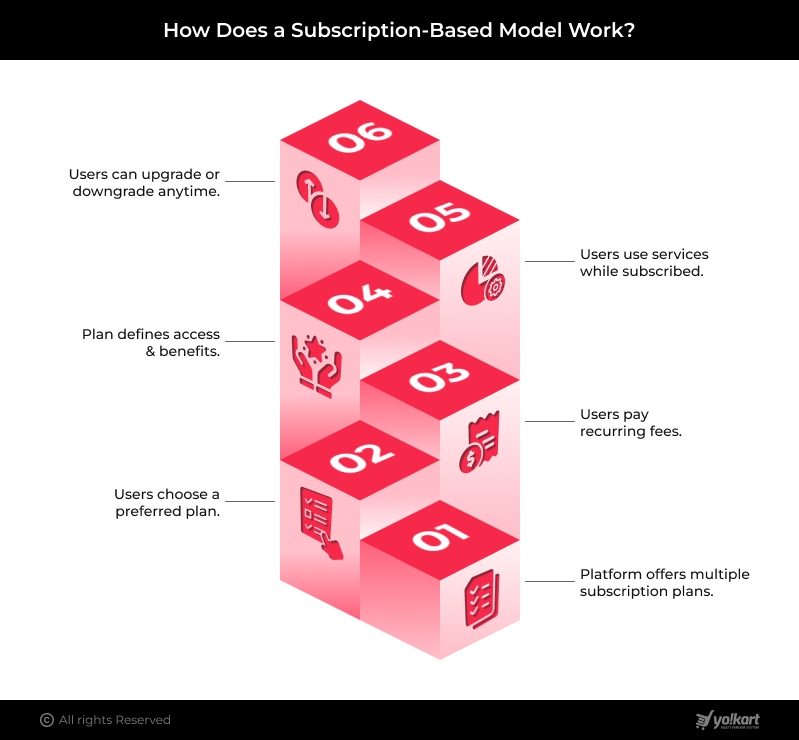
- The platform offers diverse subscription plans, each designed with different levels of functionalities and offerings.
- Users choose a subscription tier that they prefer.
- They pay a recurring fee, be it on a monthly, quarterly or an annual basis, to stay active on the platform.
- The chosen subscription tier determines the user’s operational capabilities and benefits.
- Users use the platform and obtain products/services for as long as their subscription remains active.
- Users can change their subscription tier to either higher or lower plans as per their requirements in the future.
Leading Players of Subscription-Based eCommerce Marketplaces
Subscription led marketplaces have earned a considerable amount of traction across both B2C and B2B environments. These platforms generate predictable recurring revenue while delivering sustained value to the users, modernizing traditional marketplace dynamics by replacing transactional uncertainty.
Here are some of the prominent marketplaces that deploy subscription models at scale:
1. Amazon:
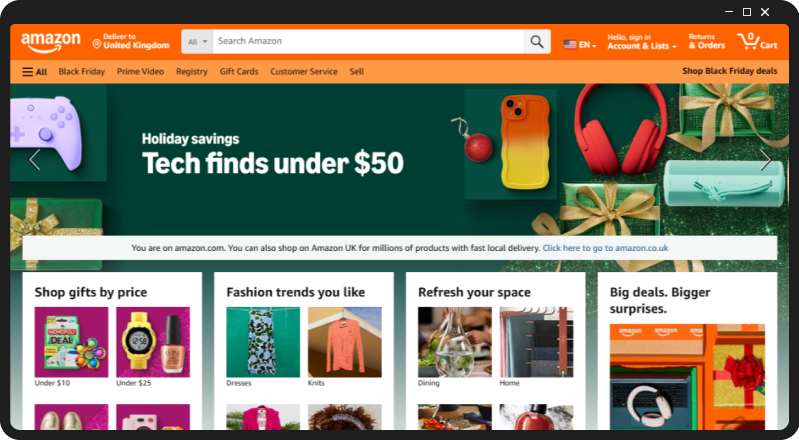
Amazon is a globally recognized eCommerce marketplace launched in 1995. While primarily known for selling books online, the platform has now progressed in diverse regions such as eCommerce, digital streaming, online advertising, artificial intelligence and cloud computing. Similarly, its subscription-based models include exclusive benefits for both its sellers and customers, known as:
- Amazon Professional Seller Plans: Amazon’s Professional Seller tier exemplifies a high-performing subscription framework within a global marketplace. Rather than paying per item sold, sellers subscribe to a fixed monthly fee, offering advanced operational capabilities. This allows Amazon to maintain reliable recurring revenue while offering sellers a scalable cost structure.
- Amazon Prime Membership: Amazon Prime is a flagship example of subscription-based value creation. The membership’s bundled benefits, such as expedited delivery, digital media and exclusive deals, fuel a high-velocity purchasing ecosystem that benefits customers, sellers and marketplace operators as well.
2. Etsy Plus:

Etsy Plus, an American eCommerce marketplace for handmade or vintage products, represents a refined, value-driven subscription tier tailored for ambitious vendors seeking greater visibility and brand distinction. This subscription offers enhanced storefront customization, priority access to merchandising tools and discounted listing & advertising credits. Thus, by offering advanced capabilities into a monthly plan, Etsy cultivates a professional seller segment while maintaining a steady, recurring income channel.
3. Audible:

Audible is a US-based audiobook and podcast service eCommerce marketplace is fundamentally designed around a consumer subscription model. Members pay a recurring monthly fee in exchange for monthly credits and exclusive access to premium audio content. For creators and publishers, this model ensures consistent demand and predictable payouts, while customers benefit from curated listening experiences, creating a high-retention environment.
4. Thumbtack:
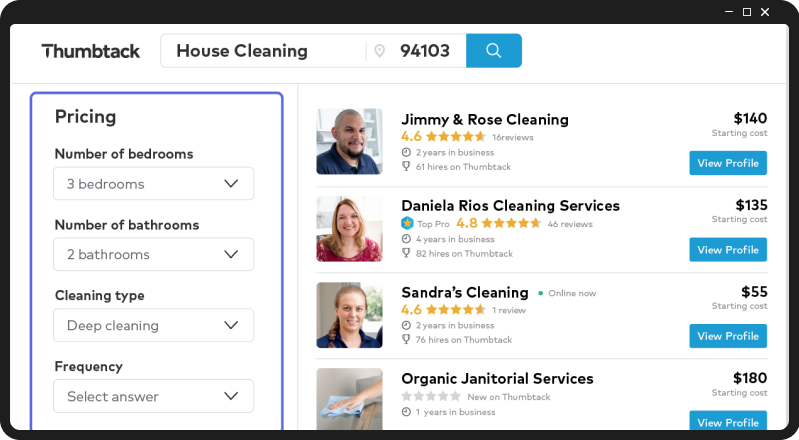
Thumbtack operates on a subscription-centric model for service professionals, offering them systematic access to high-intent customer leads. Instead of relying exclusively on commissions, Thumbtack employs recurring plans, ensuring predictable lead flow, positioning it as a dependable acquisition channel while securing robust, steady monthly revenue for the platform.
5. Envato Elements & StockX:
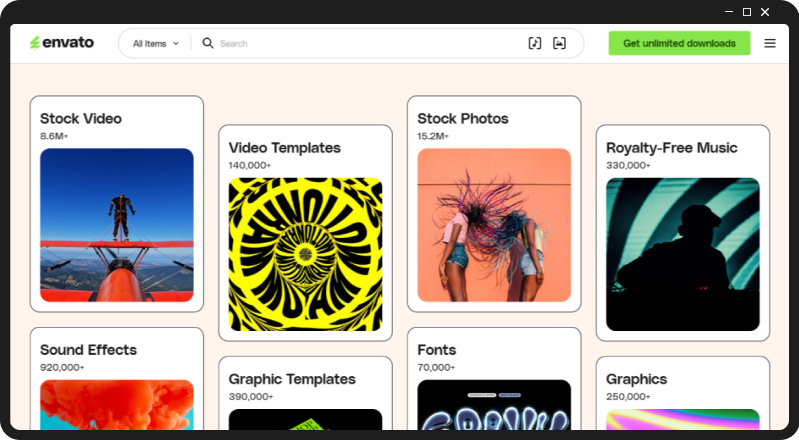
- Envato Elements epitomizes a subscription-first digital marketplace that offers customers unlimited access to curated creative assets under a monthly recurring payment.
- Conversely, StockX offers a Flex membership tier for its premium sellers to list and sell products at lower commissions.
Both these platforms demonstrate how subscriptions can be layered to amplify value while ensuring predictable, recurring revenue.
Planning to Build a Similar Multi-Vendor eCommerce Marketplace?
Essential Features to Launch a Subscription-Based eCommerce Marketplace
To build a multi-vendor eCommerce marketplace, the platform must integrate a robust suite of features specific to eCommerce operations. Hence, here’s a curated list of essential features required to launch a subscription-based eCommerce platform:
- Subscription Plan Management: Create flexible, multi-tiered subscription plans, reflecting clear differentiation in pricing, access privileges and benefits to support diverse monetization and engagement strategies.
- Role-based Access Controls: Assign platform permissions based on subscription tiers, enabling strategic feature gating that elevates premium value perception and naturally incentivizes tier upgrades.
- Vendor Onboarding & Verification: Streamline vendor registration with guided steps, compliance checks and seamless verification to establish a trustworthy, policy-aligned seller ecosystem on the platform.
- Automated Recurring Billing: Implement secure, automated billing cycles with multiple payment options, ensuring predictable, uninterrupted revenue flow while minimizing administrative overhead and enhancing payment reliability across global subscriber bases.
- Dedicated, Advanced Vendor Dashboards: Equip sellers with advanced dashboards featuring performance insights, product controls, subscription status and revenue analytics to drive operational clarity and data-led business growth.
- Products Listing Limits by Subscription Tiers: Define product upload caps, category access and listing privileges per tier, creating structured value differentiation that encourages sellers to upgrade for broader reach and more extensive selling capabilities.
- Buyer Subscription Tiers: Introduce structured customer memberships with clearly articulated benefits such as exclusive pricing, bonus rewards, priority service or faster delivery to strengthen loyalty and improve repeat purchase frequency.
- Exclusive Access & Early Access Features: Provide premium customers early access to discounts, collections, gated experiences or curated exclusives, strengthening perceived value and driving higher adoption of elevated membership plans.
- Marketing & Promotional Tools: Offer tactical promotional capabilities such as coupons, discounts, featured listings and outreach tools to empower sellers to enhance visibility and maximize returns from premium subscription tiers.
- Advanced Reports & Analytics: Deliver deep analytical visibility into subscription performance, user behavior, churn patterns, lifecycle metrics and platform earnings, enabling data-backed optimization of marketing campaigns and growth strategies.
- Integrated Payment Gateways: Ensure reliable, multi-currency payment processing with secure, global payment gateway compatibility, enabling smooth subscription purchases, renewals and upgrades across diverse customer & seller segments.
- Push Notifications: Send automated, timely alerts for subscription renewals, expirations, payment failures and upgrades, enhancing transparency while significantly reducing involuntary churn across the platform.
- Scalable, High-Performance Architecture: Deploy a performance-optimized, scalable infrastructure capable of handling large user bases, multiple locations, heavy subscription traffic and high transaction loads without compromising speed or user experience.
Key Benefits of Adopting Subscription-Based Models in Multi-Vendor Platforms
A subscription-based model delivers substantial benefits for multi-vendor platforms, especially those aiming for predictable growth, stronger vendor engagement and long-term customer loyalty. If executed properly, these subscriptions not only stabilize revenue but also enhance platform efficiency and user experience. Hence, here are the key benefits of adopting subscription-based models in multi-vendor platforms:
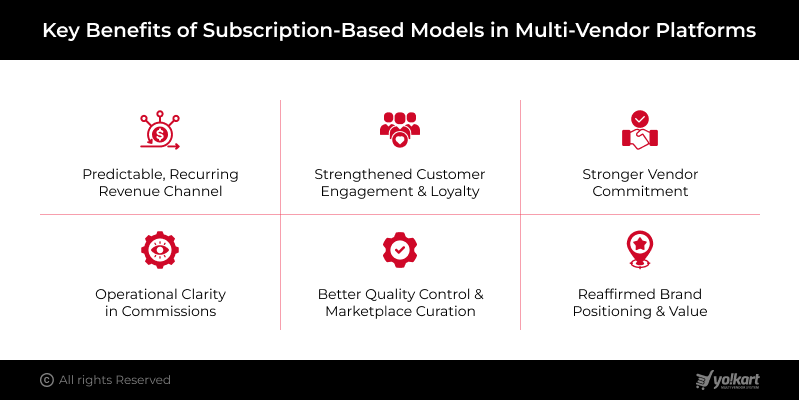
1. Predictable, Recurring Revenue Channel:
Subscription channels create a steady revenue stream that is largely independent of transactional volatility. This predictability enables more accurate financial forecasting, stronger cash-flow management and enhances the platform’s capacity to allocate resources with confidence. For marketplaces scaling globally or expanding into new verticals, a recurring revenue stream can become instrumental in supporting long-term growth and investment cycles.
2. Strengthened Customer Engagement & Loyalty:
Recurring plans, such as Amazon Prime’s membership tier, encourage repeat usage and reinforce brand affinity. Members are more likely to consolidate their purchases within the platform, increasing customer lifetime value. Moreover, curated benefits such as expedited delivery and exclusive discounts further create clear competitive differentiation, cultivating customer loyalty.
3. Stronger Vendor Commitment:
Sellers who pay a recurring subscription fee tend to demonstrate a higher degree of commitment to the platform. Subscription fees signal intentional investment, resulting in:
- More consistent product listings
- Improved service and fulfillment standards
- Proactive participation on the platform
This heightened commitment strengthens the marketplace’s overall supply-side stability and thus contributes to a more predictable, high-quality marketplace environment.
4. Operational Clarity in Contrast to Commissions:
In comparison to commission-based models, subscription plans offer simplicity and transparency, particularly attractive for high-volume or experienced sellers. Sellers benefit from transparent, fixed costs without concerns about diminishing margins as business scales, while customers benefit from exclusive perks, streamlined deliveries and more. Additionally, for the marketplace, this eliminates administrative overhead costs, streamlining operations and improving overall efficiency.
5. Better Quality Control & Marketplace Curation:
Subscription packages inherently filter out low-effort or low-quality sellers who are less likely to invest in maintaining platform standards, resulting in a more curated, trustworthy marketplace. This enhances buyer confidence and contributes to a more premium & professional ecosystem. Additionally, member-only access can help maintain higher engagement quality and reduce spam or fraudulent activities.
6. Reaffirmed Brand Positioning & Perceived Value:
A subscription proposition communicates enduring value, positioning the marketplace as a growth enabler rather than a transactional intermediary. Consistent delivery of premium features, exclusive tools or customer benefits strengthens the platform’s brand equity and frames the subscription as a strategic partnership.
Potential Drawbacks of Recurring Revenue Models in Multi-Vendor Platforms
Despite their ability to generate predictable recurring revenue, subscription-based models come with nuanced challenges that marketplace owners must weigh carefully. In multi-vendor ecosystems, an obstinate subscription strategy can introduce friction and operational risk.
Here are some of the common challenges that businesses must outweigh:
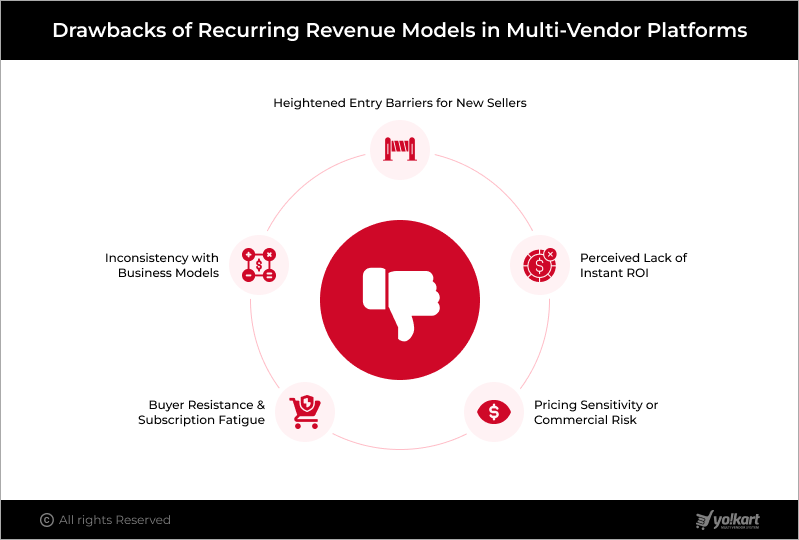
1. Heightened Entry Barriers for New Sellers:
A mandatory recurring fee can discourage new, small-scale sellers with limited budgets from onboarding. Unlike commission-based models that charge only when a sale is made, a subscription fee requires upfront financial commitment that can limit marketplace diversity and slows down early-stage seller acquisition.
2. Perceived Lack of Instant ROI:
Sellers often expect rapid and measurable returns, which is why, if the subscription does not translate into visibility, quality leads and incremental sales quickly, sellers may thus experience dissatisfaction. This can result in higher churn and negative sentiment that might compromise marketplace performance and reputation.
3. Inconsistency with Low-Volume or Seasonal Business Models:
Sellers with cyclical or inconsistent sales patterns may perceive subscription-based models as rigid and financially inefficient. Without a variable cost structure that mirrors their requirements, these sellers may opt for other competing platforms with more flexible pricing frameworks.
4. Pricing Sensitivity or Commercial Risk:
Determining an optimal subscription price is a delicate balancing act, because:
- Underpricing can erode profitability and dilute perceived value, struggling to cover operational costs
- On the contrary, overpricing can suppress user adoption and thus limit platform scalability
Price alignment is particularly risky in multi-vendor ecosystems where seller categories differ widely in margins, order value and sales value. Hence, implementing these costs demands higher precision and understanding.
5. Buyer Resistance and Subscription Fatigue:
On the consumer side, subscription fatigue is an increasingly notable trend nowadays. A customer who already pays for multiple streaming, shopping or delivery services may hesitate to adopt another subscription simply to access a marketplace. Hence, if not placed correctly, such fees can limit user acquisition and reduce marketplace traffic.
Adopt a Powerful Multi-Vendor Marketplace Software that Supports Diverse Monetization Models
Are Subscription-Based Models Profitable in Multi-Vendor Platforms?
A subscription-based model undeniably offers several operational and financial advantages, as highlighted in the earlier sections. It offers predictable revenue, stronger seller commitment and steadier financial planning. Yet, when these advantages are weighed against the broader landscape of marketplace dynamics, it becomes evident that relying solely on a single monetization model can create constraints over time.
A single business model, no matter how efficient, often performs well at the initial stages, but:
- It may restrict the platform’s flexibility as the marketplace matures. Different sellers incline toward different value propositions, and relying solely on a single revenue stream can thus leave potential earnings untapped.
- Competitive differentiation becomes hard to achieve when monetization lacks flexibility.
- Plus, certain product categories or seasonal sellers may find a single monetization model misaligned.
Hence, a diversified monetization structure creates a more balanced revenue mix and strengthens long-term profitability. In essence, while a subscription-based model is a strong strategic foundation, a multi-layered monetization strategy generally positions a multi-vendor platform for more resilient long-term profitability.
Top Alternative Monetization Models in Multi-Vendor Platforms
While subscription-based pricing delivers predictable recurring revenue, multi-vendor eCommerce platforms often benefit from diversifying their monetization channels. Broadening the revenue channels not only enhances financial resilience but also empowers the marketplace to serve a broad spectrum of users. Thus, the following models represent the most strategically relevant alternatives or complements to subscription-based monetization:
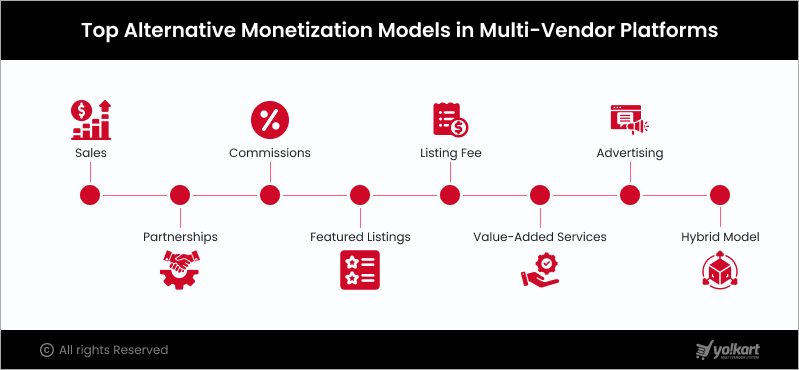
- Sales: It is the most straightforward model in which the platform generates revenue directly from sales of goods and services itself, getting the entire rental fee.
- Commissions: A foundational model for many marketplaces that allows admins to levy commissions per transaction made through the platform as a platform commission.
- Listing Fee: This allows marketplace owners to charge vendors a fixed cost to publish products or services on the platform to make sure only the serious and dedicated sellers join, discouraging spam and low-value listings.
- Advertising: Generate substantial income by offering paid advertising slots to third-party businesses on your marketplace, generating an additional revenue stream from clicks or conversions.
- Partnerships: Partner with local businesses for cross-promotions and exclusive brand visibility, unlocking co-branded offerings, revenue sharing and expanding distribution channels.
- Featured Listings: Premium visibility packages allow vendors to pay for prioritized visibility on premium pages of the marketplace such as top sections, curated collections or spotlight placements.
- Value-Added Services: Offer premium services or complementary products with the main products to increase the overall cart value, catering to customers seeking special services.
- Hybrid Model: Most leading multi-vendor eCommerce marketplaces adopt a hybrid monetization strategy, strategically blending the above-mentioned revenue streams, ensuring revenue stability.
Yo!Kart — Best Software to Build a Subscription-Based Multi-Vendor eCommerce Marketplace
Yo!Kart, a product of FATbit Technologies, stands out as an enterprise-grade multi-vendor eCommerce marketplace software engineered specifically for multi-vendor eCommerce platforms seeking scalable monetization. Meticulously crafted with precision, the software offers a powerful combination of flexibility, performance and scalability.
At its core, Yo!Kart provides a highly configurable framework that allows businesses to adapt to varied business models and requirements. The software provides advanced vendor management capabilities, automated billing & invoicing, granular access controls, integrated marketing tools and analytics that unveil profitability at every step. Additionally, Yo!Kart is built to support businesses of all sizes from startups and small businesses to mid-sized businesses and large enterprises, accommodating large vendor bases and increasing transactions without compromising performance.
Besides, with lifetime ownership, extensive customization capabilities, robust security frameworks and proven performance across marketplaces at scale, Yo!Kart enables businesses to launch and expand multi-vendor marketplaces confidently.
Additional Benefits of Yo!Kart:
- 100% white label software
- Self-hosted solution with one-time upfront pricing
- Lifetime license, no recurring charges
- Over 10 years of industry expertise
- Extensively scalable and secure
- Highly customizable, modular framework
- Expansive suite of multi-vendor marketplace features
- Adaptable, API-driven infrastructure
- 1 year free technical support post-purchase
Yo!Kart Supported Business Models & Marketplaces Built in that Space:
| Business Models | Industry Giants | Yo!Kart Powered Marketplaces |
| Subscription-based | Amazon Prime, Etsy Plus | All marketplaces built with Yo!Kart support a subscription-based revenue model |
| B2C (Business-to-Consumer) | Amazon, Walmart, eBay | Voyij, Tajer, 4GoodVibes, RxAll, etc. |
| B2B (Business-to-Business) | Alibaba, Amazon Business, Global Sources | UNI Diamonds, WaterSorted, Bozinga, Anyflexo, etc. |
| P2P (Peer-to-Peer) | Etsy, Poshmark, eBay | WeDIY, Iconic Motorbikes |
| Hyperlocal Platforms(connects buyers with local sellers) | OLX, OfferUp, InstaCart | Little Local, Shop American Sellers, Glocal Store, DotDune |
| Commission-Based | Amazon, Etsy, eBay | All marketplaces built with Yo!Kart support a commission-based model |
| Niche/Vertical Marketplaces | Newegg, ASOS, Zalando, GNC | Clic & Pick, Party Without Plastic, TransporTECO, Sandhai, Canna Market, CBD Supplements, etc. |
Navigate the Yo!Kart’s clients page to get more information about the marketplaces built with Yo!kart.
Book a Free Personalized Demo Session to Explore Yo!Kart Firsthand
Conclusion
Subscription-based models have today evolved from optional revenue add-ons to strategic growth levers for modern multi-vendor eCommerce platforms. As consumer behavior shifts towards convenience and predictable value, and sellers increasingly seek stability and enhanced platform services, subscriptions offer marketplaces a strong passage to recurring revenue and deeper engagement. However, profitability rarely lies in counting on a single monetization model. Hence, the most resilient, future-ready multi-vendor eCommerce platforms must blend subscriptions with complementary monetization strategies such as commissions, sales, advertisements or hybrid structures to create a balance and build a scalable multi-vendor eCommerce marketplace.
FAQs
Q 1. What are subscription-based models?
Ans. Subscription-based models are monetization models that involve a recurring subscription fee for users to access the marketplaces and get exclusive benefits. These models create a predictable revenue stream for marketplace owners while strengthening the platform engagement and loyalty.
Q 2. Are subscription-based models profitable in multi-vendor marketplaces?
Ans. Subscription-based revenue models offer a stable and predictable revenue channel for marketplaces, improving vendor retention and elevating customer lifetime value. However, relying solely on a single monetization model may limit growth potential. Thus, combining multiple business models offers a more strategic foundation for sustainable growth.
Q 3. Does Yo!Kart support subscription-based marketplaces?
Ans. Absolutely. Yo!Kart offers in-built capabilities for tiered subscription plans, recurring fee renewals, feature-based access controls, value-based privileges and robust analytics tools, allowing marketplace owners to manage and optimize subscription monetization easily.
Q 4. Can I customize Yo!Kart to support my unique business model?
Ans. Yes. Yo!Kart is built with a modular, highly customizable architecture that allows extensive customization to perfectly align with diverse business models, operational requirements, industry-specific demands and business vision. It offers the flexibility to tailor UI/UX, features and workflows to reflect your unique brand identity.
The post A Complete Guide to Subscription-Based Models for Multi-Vendor Platforms appeared first on YoKart Blog.
]]>The post Best Multi-Vendor eCommerce Platforms for Enterprises appeared first on YoKart Blog.
]]>Yet, building a well-structured, enterprise-grade multi-vendor eCommerce marketplace requires a technologically resilient platform, one that is capable of handling complex operations and scaling effortlessly as the business grows.
This is where multi-vendor eCommerce platforms prove indispensable.
The ideal multi-vendor eCommerce platform combines architectural flexibility and operational efficiency that enables enterprises to innovate confidently. Howsoever, with countless solutions competing in the industry, choosing the right multi-vendor eCommerce platform becomes a strategic imperative that can define long-term success.
In this blog, we’ll explore the best multi-vendor eCommerce platforms for enterprises, evaluating their core capabilities and advantages to help you make an informed decision.
Table of Contents
Why Enterprises Need a Robust Multi-vendor eCommerce Platform?
Operating a multi-vendor eCommerce marketplace at an enterprise scale offers huge growth potential, however, it often brings some complex operational challenges. This is why businesses need a robust, scalable multi-vendor eCommerce platform to innovate confidently.
Here’s why businesses need a robust multi-vendor eCommerce platform:
- Faster Time-to-Market: A sophisticated multi-vendor eCommerce platform accelerates market launch by offering pre-built frameworks, market-ready features and optimized workflows, instead of developing everything from the ground up.
- Lower Development Costs: Developing an enterprise-grade marketplace from scratch demands considerable investment in planning, coding, design and testing. A proven multi-vendor eCommerce platform minimizes these costs by offering built-in features and functionalities, significantly by up to 5 times.
- Proven Platform Stability: Robust multi-vendor eCommerce platforms are already tried and tested frameworks that ensure stability and uptime reliability even with high vendor volumes and peak seasonal demand, reducing the risk of encountering any bugs or downtime errors.
- Scalable Architecture: Scalability becomes a defining factor as the marketplace grows. A well-architected multi-vendor eCommerce platform allows enterprises to expand effortlessly, ensuring smooth performance and operational flexibility as the business evolves.
- Easy Customization & Extensibility: Enterprises often have unique workflows, branding needs and integration requirements. A reliable multi-vendor platform provides modular architecture and plugin extensibility, allowing full customization and innovation aligned with strategic goals.
- Enhanced Security & Compliance: Enterprise-grade multi-vendor eCommerce platforms adhere to strict data protection laws and local regulatory standards in order to safeguard user data and maintain privacy. This helps businesses comply with local regulations and protect themselves from any unnecessary conflicts.
- Quick ROI: By minimizing the development cycles and enabling faster deployment, multi-vendor eCommerce platforms enable businesses to drive a quick return on investment.
Top 10 Best Multi-vendor eCommerce Platforms for Enterprises
The eCommerce industry comprises several multi-vendor eCommerce platforms competing for attention. Here’s a list of top 10 best multi-vendor eCommerce platforms for enterprises, curated to help you make an informed decision.
1. Yo!Kart
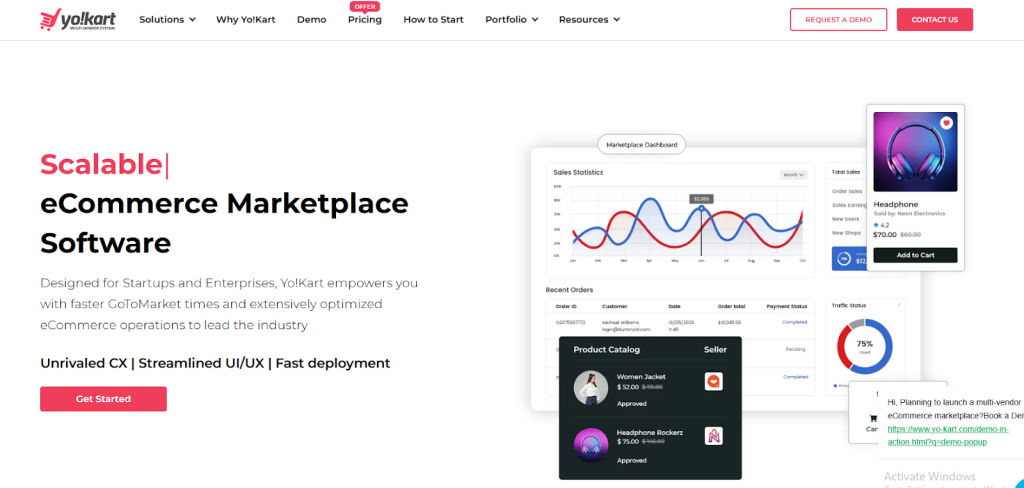
Yo!Kart is a scalable robust multi-vendor eCommerce platform that allows businesses to launch enterprise-ready multi-vendor marketplace quickly and cost-efficiently, without getting into the complexities of custom development. Yo!Kart supports various business models, whether B2B, B2C and others, allowing businesses to cater their various requirements and adapt the platform accordingly.
The software integrates with various built-in features such as vendor management, secure payment gateways, advanced analytics dashboard, multi-language & multi-currency support and advanced B2B workflows to build a fully functional & powerful multi-vendor marketplace. Additionally, Yo!kart is known for its extensively scalable solution that allows businesses to adapt to platform growth.
The software boasts an intuitive, user-friendly interface that is highly configurable and mobile responsive. Yo!Kart also offers mobile-ready apps for both buyers and sellers for efficient operations management. In addition, Yo!Kart stands out for its self-hosted infrastructure that offers flexibility to manage the software on your preferred server.
Salient Points:
- 100% white-label solution with rebranding flexibility
- Offers a lifetime license for a one-time upfront payment
- Integrates advanced eCommerce-ready features
- Supports multiple languages and currencies
- Highly scalable; grows with your business
- Can be customized to support unique business requirements
- Free technical support for 1 year after the purchase
- Has powered over 5000 marketplaces across the globe
Ratings: 4.8/5
Book a Free One-on-One Demo Session for Yo!Kart
2. BigCommerce
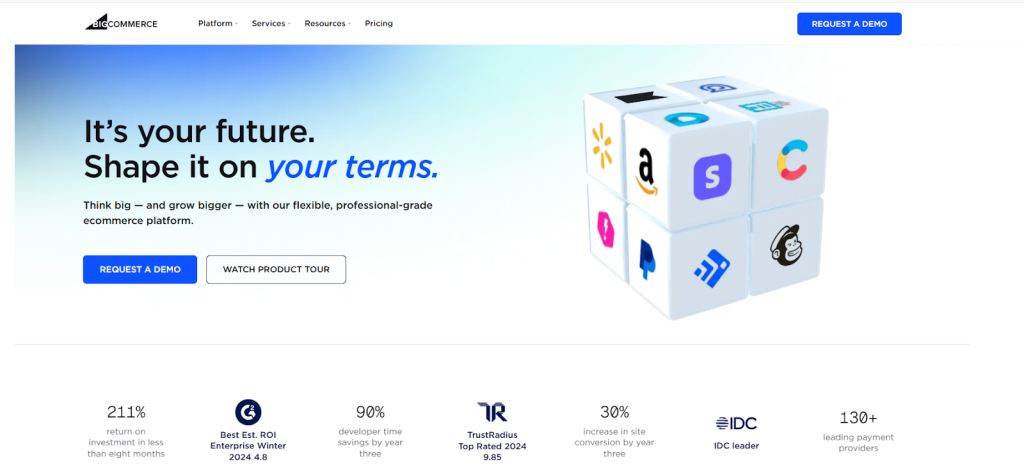
BigCommerce is a reputed SaaS-based eCommerce platform that allows businesses to launch multi-vendor marketplaces effortlessly. The software offers an open SaaS architecture that provides businesses with the strength of SaaS software and the flexibility of open APIs.
The software is engineered to support complex operations and handle increasing traffic at its core without any compromise. Its modular design allows businesses to adapt to the increasing demands and grow with the business. Moreover, the platform also supports PCI DSS compliance, is GDPR-ready and integrated with secure payment gateways. However, its API-first approach requires a skilled team of developers to build custom multi-vendor capabilities or integrate 3rd-party marketplace solutions like Webkul.
Salient Points:
- High-performance SaaS infrastructure
- Expansive API coverage for deep customization
- Offers multi-storefront management
- Quite complex interface compared to other solutions
- No in-built email marketing tools reported by users.
Ratings: 4.2/5
3. CS-Cart
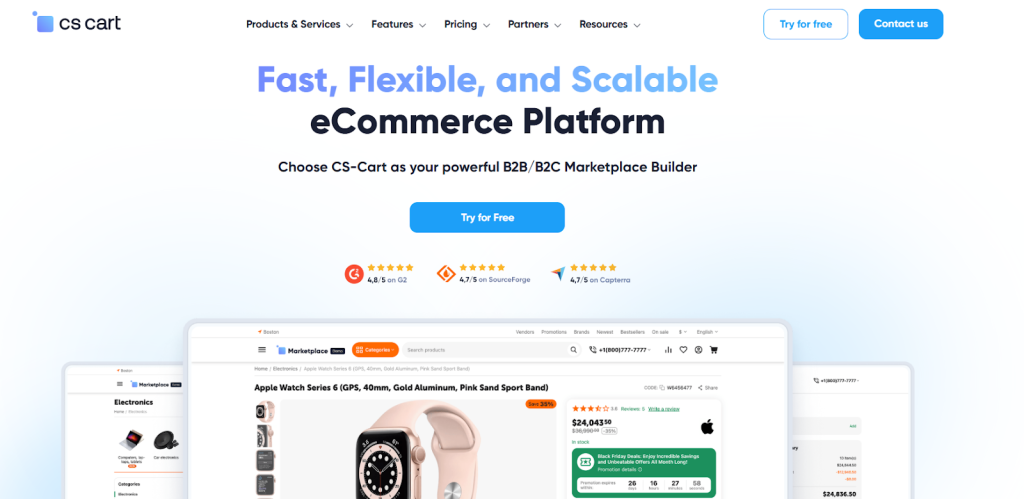
CS-Cart is one of the renowned eCommerce solutions that provides marketplace owners with complete control over their online marketplace ecosystem. Known for its self-hosted and modular architecture, CS-Cart provides a strong foundation for businesses with large scale operations that requires high scalability and performance. The platform offers sophisticated vendor management system where sellers can independently oversee the key aspects such as catalogs, orders, performance and more, whereas admins retain complete governance over the same.
Whether trying to build a B2C marketplace, B2B website or a multi-vendor niche ecosystem, CS-Cart allows to innovate the platform to your unique needs. However, it demands high technical expertise to scale for implementation and scaling the platform.
Salient Points:
- Self-hosted eCommerce platform
- High costs compared to other self-hosted solutions
- Comprehensive product management features
- Robust functionality without integrating numerous add-ons separately
- Supports unlimited products, sellers and storefronts
Ratings: 4.6/5
4. Shopify Plus

Shopify Plus is a premium eCommerce marketplace platform that is engineered to meet the demands of businesses with large scale operations. While Shopify Plus is not inherently a multi-vendor eCommerce platform, it offers seamless integration and compatibility with famous marketplace extensions like Webkul and more.
Backed by Shopify’s SaaS-based infrastructure, Shopify Plus offers businesses with high reliability and operational resilience to operate seamlessly with precision. Additionally, the platform complies with industry-best security practices to safeguard user data and privacy.
However, despite its many benefits, the software relies heavily on third-party extensions to extend its functionalities, which as a result, also adds cost and complexity to the operations.
Salient Points:
- Offers full control over checkout flows and third-party integrations
- Enables multi-currency, multi-lingual and region-specific storefronts
- SaaS-based infrastructure with recurring subscriptions costs
- Limited ownership and data control
- Relies heavily on third-party integrations
Ratings: 4.4/5
5. Mirakl
Mirakl stands as a turnkey, reliable multi-vendor marketplace solution, purpose-built to endow businesses in launching powerful multivendor marketplaces.
Its SaaS-based architecture allows businesses to integrate marketplace capabilities into existing digital ecosystems. Its integration-first ecosystem ensure connectivity with several third-party system like ERP, CRM and others seamlessly.
The platform offers exceptional suite of marketplace features for end-to-end marketplace management. Its API-driven ecosystem allows businesses to tailor the website to their brand ethos, offering exceptional extensibility.
Furthermore, its integration-first approach allows businesses to scale without compromising performance. The software is designed with a strong emphasis on multi-vendor functionality and agility, enabling enterprises to operate multi-vendor operations efficiently.
Salient Points:
- Scalable solution and compliant with industry-best practices
- Enables seamless integration with ERP, CRM, etc.
- Global payment processing and seller payouts
- Supports both B2B and B2C eCommerce marketplace models
- High costs with revenue-based pricing control
Ratings: 4.5/5
6. WooCommerce
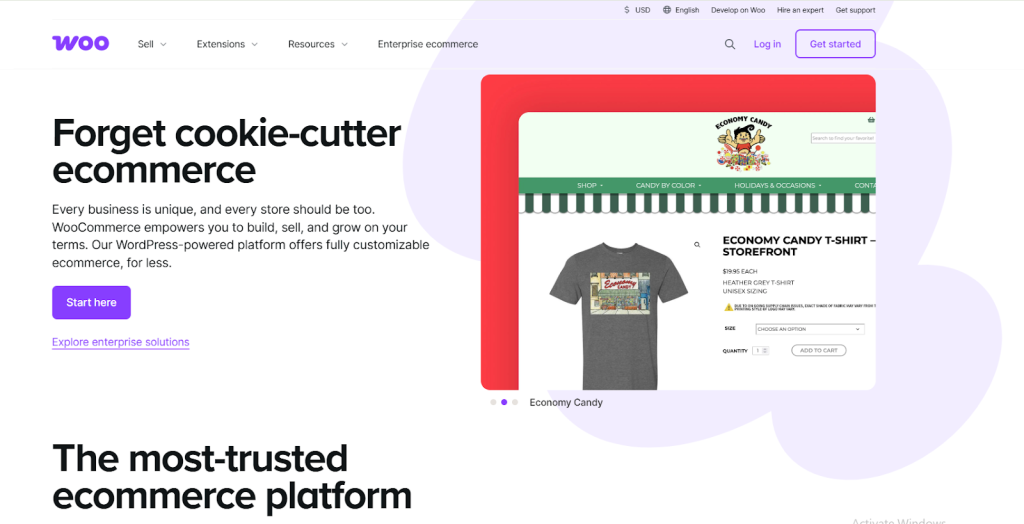
WooCommerce is a WordPress-based eCommerce platform that has now long been a preferred choice for businesses looking for a cost-effective yet scalable solution. While it’s originally designed for singer-vendor setups, WooCommerce’s expansive set of plugins and third-party integrations like Dokan and WCFM Marketplace transforms it into a multi-vendor storefront.
WooCommerce’s open-source architecture makes it exceptionally adaptable for large scale businesses that require complete control over functionality. When combined with optimized hosting solutions, the platform can handle increasing traffic, extensive product catalogs and transactions.
Its vast plugin ecosystem makes it highly extensible software, allowing businesses to tailor the platform according to their needs. However, it can be complex to manage the software due its vast plugin ecosystem and may increase costs over time. Additionally, businesses will need a skilled team of in-house developers for feature development and integrations.
Salient Points:
- Customizable shipping and tax options
- Open-source software with no transaction fees of WooCommerce itself
- Requires regular maintenance and updates
- May become slow with extensive plugins installed
- Technical expertise needed for development and customization
Ratings: 4.4/5
7. Arcadier
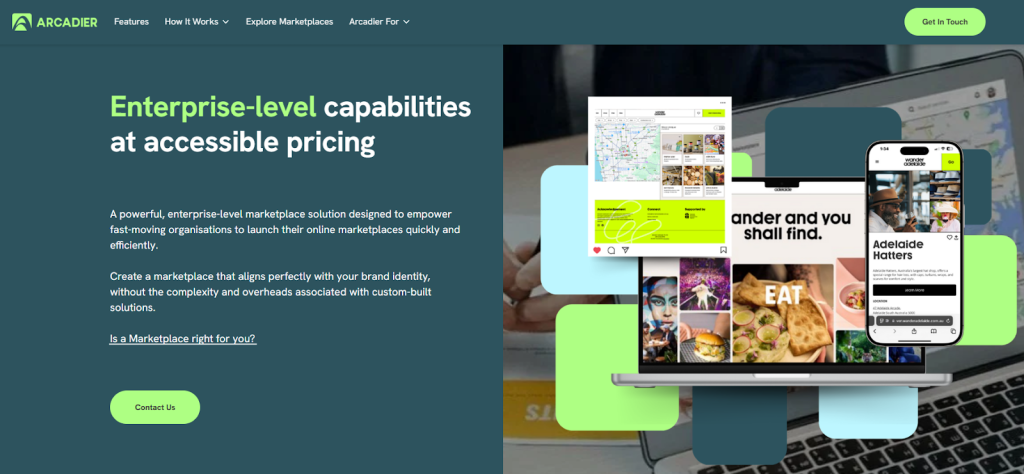
Arcadier is a globally recognized enterprise-level eCommerce marketplace software that enables quick marketplace deployment, helping businesses accelerate time-to-market. With its cloud-based, API-driven architecture, Arcadies enables enterprises to launch and scale marketplaces across a variety of verticals. The platform is designed to support marketplace agility and operational excellence. Its modular design allows enterprises to configure marketplaces to their business logic.
Enterprises can create custom modules and test them through its proprietary plugin engine, aligning precisely with their operational requirements. This enables introduction of unique functionalities and tailored workflows. In addition, Arcadier provides a scalable, future-ready foundation that helps businesses adapt to the increasing growth and expand their eCommerce operations.
Salient Points:
- Headless architecture
- API-based customization options
- Quick templated deployments
- Offers dedicated technical support
- Comprehensive vendor management tools
Ratings: 4.3/5
8. Marketplacer
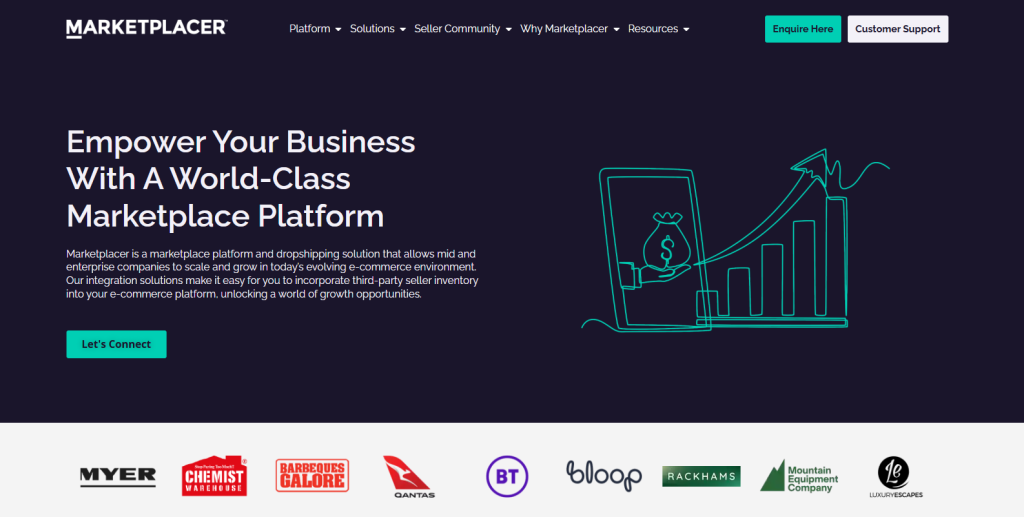
Marketplacer is a well-known multi-vendor marketplace software that empowers businesses to build sophisticated marketplace websites with ease. The platform has established itself as a well-known enterprise-grade solution that supports diverse business models, whether it’s B2B, B2C or niche marketplaces.
Marketplacer offers a comprehensive suite of features for efficient eCommerce operations and provide a seamless buyer experience. The platform’s advanced analytics and tools dashboard offers actionable insights to admins to oversee platform performance and KPIs, and optimize their operations and marketing strategies accordingly.
Known for its operational excellence, the software is highly customizable, allowing businesses to personalize the marketplace according their distinct business needs. Additionally, its API-first infrastructure integrates effortlessly with third-party systems.
Salient Points:
- Offers both hosted and API based integration options
- Quick market deployment
- Strong backend functionality
- Third-party integrations may slow down the system
Ratings: 4.3/5
Leverage a Feature-Rich Multi-vendor eCommerce Platform
9. Magento
Magento which is now known as Adobe Commerce is a notable eCommerce marketplace platform that powers scalable multivendor marketplaces with diverse business models, whether B2B, B2C, etc. Built on an open-source framework, the software empowers enterprises to design and manage multi-store operations from a single unified backend. It offers a highly modular and adaptable architecture allows businesses to extend functionality, integrate third-party apps and deliver a personalized experience.
Enterprises choose Magento for its extensive scalability that allows businesses to expand globally and grow. The platform exceptionally handles increasing traffic, listings and transactions without any performance dip. Additionally, it complies with industry-best practices to keep the user data safe and secure. However, the businesses need a skilled in-house technical team for any development or customization due to its open-source architecture.
Salient Points:
- Open-source eCommerce marketplace platform
- Offers complete control over design and functionality
- Efficiently scales for global operations
- Longer development timeline compared to other solutions
- Complex hosting requirements needing specialized configurations
- Requires an in-house technical team for coding, designing testing
Ratings: 4/5
10. Kreezalid
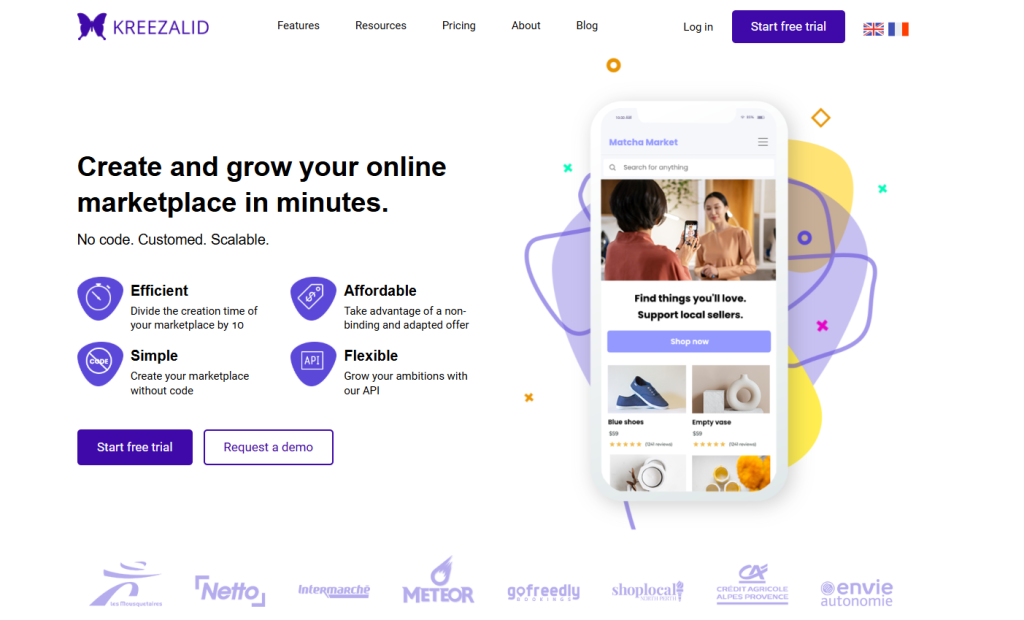
Kreezalid is a distinguished SaaS-based eCommerce platform that empowers businesses to build a scalable eCommerce marketplace quickly and cost-effectively. Known for its user-friendly interface and no-code marketplace builder, it allows businesses to build a fully functional marketplace that can handle multiple users at once. The solution eliminates extensive development overhead with a readily available framework that includes extensive marketplace features right from the outset. It provides an agile framework to maintain a brand consistency and operational control.
Additionally, with a strong emphasis on usability, Kreezalid delivers a smooth, intuitive and refined user experience for all stakeholders involved. It integrates a responsive design, intuitive dashboard and advanced search filters to enhance the appeal of the app.
Salient Points:
- Rapid deployment with low development dependency
- White-label customization for custom branding
- Monthly subscription-based pricing that accumulate over time
- Limited backend flexibility reported by users
Ratings: 4.4/5
Which is the Best Multi-Vendor eCommerce Platform — Comparing the Top Solutions
Below is a detailed comparison of the best multi-vendor eCommerce platforms for enterprises discussed above, evaluating each based on its hosting flexibility, pricing model, source code ownership, free demo and technical support offered. This precise information will thus help you make an informed decision and choose a solution that meets all your business requirements:
| Software | Hosting | Pricing | Source Code Ownership | Free Demo | Technical Support |
| Yo!Kart | Self-hosted infrastructure | One-time cost; lifetime license | Yes | Yes, both instant & live | 1 year Free |
| BigCommerce | SaaS-based | Recurring subscription costs | No | 15 days free trial | Via phone, chat and ticket |
| CS-Cart | On-premise & Cloud | One-time & subscription | Yes, but for a limited time period | 14-day free trial | Yes |
| Shopify Plus | SaaS-based | Monthly or annual subscriptions | No | 3-day free trial | Mainly via chat only |
| Mirakl | SaaS-based | Monthly or annual subscriptions | No | Yes; via scheduled session | No |
| WooCommerce | On-premise | Based on chosen extensions & hosting | Yes | Yes | Yes |
| Arcadier | SaaS-based | Subscription-based | No | No | No |
| Marketplacer | SaaS-based | Based on quote | No | No | Yes; via documentation |
| Magento | Open Source | Free; price of extensions & plugins vary | Yes | Yes | Community support only |
| Kreezalid | SaaS-based | Subscription costs | No | Free 7 days trial | Via email & live chat |
Key Criteria Businesses Should Consider Before Choosing a Multi-vendor eCommerce Platform
With numerous multi-vendor eCommerce platforms available in the industry, choosing the best for your business requires a keen understanding of business requirements. We’ve prepared a list of some important factors that one should consider before making a commitment. The following list will help you evaluate the software accordingly and choose what’s best for your business:
1. Feature Set: An enterprise-ready marketplace platform must provide a comprehensive suite of features to ensure that your business operations work smoothly without any compromise. Hence, evaluating a software before-hand is essential to make sure the platform boasts a rich feature set.
2. User Experience & Design: Choose a software that offers a clean, intuitive user-interface to make sure that the platform works smoothly and responds quickly to user queries.
3. Pricing Model: Selecting a pricing model that maintains a balance between affordability, functionality and control is essential. Thus, it is advised to evaluate not only the pricing models by different providers but the offerings associated with them to clearly asses the cost-benefit ratio.
4. Scalability: A scalable multi-vendor eCommerce platform ensures that businesses adapt to the business growth without any compromise. Henceforth, assess the software based on its scaling capabilities to expand your eCommerce operations efficiently across the world.
5. Customization: Distinctiveness is an essential element while launching a multi-vendor marketplace in this evolving eCommerce industry. As the competition intensifies, businesses should consider an eCommerce platform that allows them to tailor their website according to their business ethos to stand out and compete in the industry.
6. Client Testimonials: Check client reviews and testimonials on different reviewing sites like Capterra, G2, Software Advice to evaluate the existing and previous client experiences to make an informed decision.
7. Free Demo: Modern eCommerce platforms offer free demo or trial, allowing businesses to assist the software functionalities first-hand and experience the software. This helps you evaluate the features, functionalities and workflows before committing.
8. Technical Support: Select a provider that offers dedicated technical support after-purchase to ensure that the marketplace works smoothly without any bugs or errors.
Adopt a Multi-Vendor eCommerce Platform that Meets All Your Business Requirements
Conclusion
Multi-vendor eCommerce platforms have today brought a most transformative change in this hypercompetitive eCommerce industry, enabling businesses to streamline operations and expand their business globally while delivering exceptional user experiences. Thus, selecting the right multi-vendor eCommerce platform is essential, whether an enterprise is aiming to build a B2B, B2C or niche marketplace. Enterprise-grade solution like Yo!Kart strikes a perfect amount of balance between scalability, customizability and performance. By investing in a future-ready platform, enterprises can thus maximize their ROI and establish a strong foothold in the industry.
FAQs
Q 1. What is a multi-vendor eCommerce platform?
Ans. A multi-vendor eCommerce platform is a ready-to-deploy framework that allows you to build a fully functional multi-vendor eCommerce marketplace. Engineered with precision, these platforms integrate core features of a multi-vendor marketplace from scratch, allowing you to accelerate the time-to-market and launch a multi-vendor eCommerce marketplace with minimal investment.
Q 2. Why should I choose a multi-vendor eCommerce platform instead of building one from scratch?
Ans. Multi-vendor eCommerce platforms are pre-built frameworks that allows you to save a considerable amount of time and cost, associated with custom development. They provide a proven, tested framework with essential in-built features, functionalities and business APIs. As a result, businesses can launch a scalable, fully functional marketplaces, prioritizing branding and marketing rather than technical complexities.
Q 3. How to choose the right multi-vendor eCommerce platform?
Ans. Choosing the right multi-vendor eCommerce platform for your marketplace requires a well-thought-out strategy to evaluate the software solutions on their feature offerings, pricing, customizability, client testimonials, vendor reputation and technical support offered. Additionally, it is advisable to look for scalability extent and performance of the software to choose a future-ready solution.
Q 4. Which is the best multi-vendor eCommerce platform for enterprises?
Ans. Out of the many software solutions available in the industry, Yo!Kart stands as the best multi-vendor eCommerce platform for enterprises, allowing you to build a future-ready, scalable multi-vendor marketplace. Its rich suite of features, one-time payment model, robust clientele, multilingual & multi-currency support, customizability and dedicated technical support makes it an excellent choice of enterprises planning to launch a multi-vendor eCommerce marketplace.
The post Best Multi-Vendor eCommerce Platforms for Enterprises appeared first on YoKart Blog.
]]>The post Best Multi-Seller eCommerce Software for Startups, SMEs, and Enterprises appeared first on YoKart Blog.
]]>However, orchestrating a thriving multi-seller eCommerce platform requires more than just ambition. Behind every thriving marketplace lies a robust technological foundation that can handle complex eCommerce operations, deliver a seamless user experience, and evolve alongside your business. Without it, even the most promising marketplace risks operational bottlenecks and stalled growth.
Hence, this blog explains why selecting the right multi-seller eCommerce software is pivotal for sustainable growth while highlighting the best multi-seller eCommerce software for startups, SMEs, and enterprises.
Table of Contents
Understanding Multi-Seller eCommerce Marketplaces
The global retail landscape has evolved far beyond traditional single-vendor stores to multi-seller eCommerce marketplaces driven by technological innovation and changing consumer behavior.
A multi-vendor eCommerce marketplace is a centralized online platform where multiple sellers converge on a single platform to offer a diverse range of products or services. Unlike conventional eCommerce stores that showcase inventory owned specifically by a single vendor, multi-seller marketplaces act as a facilitator. The marketplace owner provides the technological infrastructure, regulatory framework, and brand visibility, while third-party sellers utilize the platform to reach a wider audience and expand their business without building their own standalone online marketplaces. This model effectively standardizes online commerce, allowing businesses of all sizes to coexist within the same digital space.
Industry giants like Amazon, Alibaba, and Etsy have hence demonstrated the scalability and profitability of the multi-seller eCommerce marketplace model, proving that an ecosystem-driven approach can outperform traditional single-vendor setups.
Why Businesses Need a Multi-Seller eCommerce Software?
Businesses today are under constant pressure to deliver seamless online experiences, manage multiple stakeholders, and scale rapidly. This is where a multi-vendor eCommerce software becomes indispensable. A purpose-built multi-seller eCommerce software provides the structure, speed, and scalability required to build multi-vendor eCommerce marketplaces effectively.
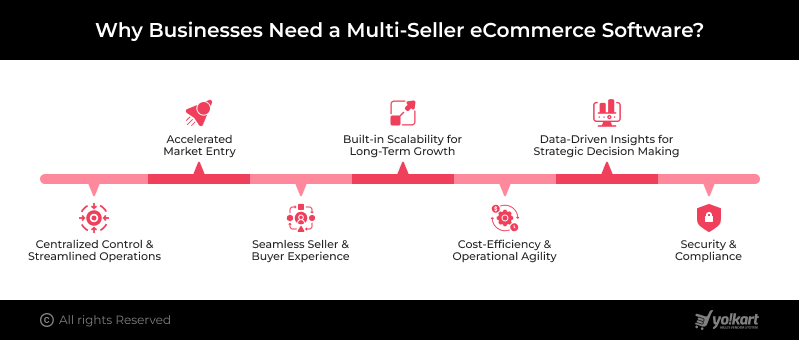
Here are the key benefits that a multi-seller eCommerce software offers:
1. Centralized Control & Streamlined Operations:
Managing numerous sellers, inventories, and orders across different channels can quickly become chaotic. A multi-vendor eCommerce software consolidates these operations into a unified system, automating workflows, simplifying vendor management, and ensuring operational efficiency.
2. Accelerated Market Entry:
Building a multi-vendor marketplace is resource-intensive and time-consuming. A ready-to-deploy multi-seller eCommerce software drastically shortens deployment time, allowing businesses to launch quickly, test new ideas, and adapt to changing market conditions without significant delays.
3. Seamless Seller & Buyer Experience:
A multi-seller eCommerce software provides sellers with dedicated dashboards, inventory tools, analytics, and marketing tools, enabling them to manage their stores efficiently. Simultaneously, it enhances the customer journey with personalized recommendations, secure checkouts, and faster fulfillment, driving higher engagement and retention.
4. Built-in Scalability for Long-Term Growth:
Scalability becomes critical as your business expands. Enterprise-grade multi-seller eCommerce software ensures consistent performance and stability, allowing businesses to expand seamlessly without compromising speed and performance. This flexibility is crucial for businesses aiming for sustainable, long-term growth.
5. Cost-Efficiency and Operational Agility:
Leveraging an established multi-vendor eCommerce software significantly reduces upfront investment and ongoing maintenance costs compared to custom development. Businesses benefit from operational reliability, a tested framework, technical support, and modular scalability, allowing them to focus on growth rather than technical bottlenecks.
6. Data-Driven Insights for Strategic Decision Making:
Modern marketplaces and marketing strategies thrive on real-time data. Advanced reports & analytics tools embedded in multi-seller eCommerce software allow the admin to monitor vendor performance, customer behavior, and buying patterns, which empower businesses to make informed decisions and optimize operations.
7. Security and Compliance:
With numerous sellers and high transaction volumes, ensuring data security and regulatory compliance becomes non-negotiable. Reliable multi-vendor eCommerce software integrates robust security standards, GDPR compliance, secure payment gateways, and fraud prevention to build customer trust.
Planning to Launch a Scalable Multi-Seller Marketplace that Expands Globally?
Introducing Yo!Kart: A Platform Built for Evolution
As global commerce transcends physical boundaries, businesses face increasing pressure to deliver scalable and frictionless experiences. While the industry boasts a diverse range of software solutions in this hypercompetitive digital landscape, finding the one that suits your business requirements and budget is essential.
Yo!Kart emerges as a purpose-built, multi-seller eCommerce software engineered to empower startups, SMEs, and large enterprises, providing the technological backbone for sustainable marketplace growth. Unlike conventional eCommerce platforms that limit growth due to rigid architectures or licensing constraints, Yo!Kart is an enterprise-based software designed to evolve with your business needs. Whether launching a niche B2C marketplace, expanding into B2B operations, or building a hybrid commerce model, Yo!Kart provides the flexibility and control necessary to adapt seamlessly at every stage of growth.
Built on years of market understanding and technological refinement, Yo!Kart combines scalability, performance, and ownership to enable businesses to launch, manage, and expand the multi-vendor eCommerce marketplaces without dependency on third-party systems.
Empowering Businesses Across Diverse Stages:
What differentiates Yo!Kart is its strategic intent. The software acknowledges the different needs of businesses, helping businesses tailor the marketplaces to their unique operational goals and market dynamics.
- Startups benefit from Yo!Kart’s quick deployment, cost-effectiveness, and ready-to-use multi-seller functionality which accelerate the time-to-market.
- SMEs leverage the flexibility and customization options to differentiate their marketplace and scale sustainably.
- Enterprises rely on the high-performance infrastructure, robust integrations, and complete ownership to manage large, complex ecosystems with confidence.
This adaptability makes Yo!Kart an ideal choice for businesses seeking a long-term, scalable, and secure multi-vendor eCommerce software that grows with their ambitions.
What Makes Yo!Kart A Powerful and Reliable Multi-Seller eCommerce Software?
Yo!Kart stands as an enterprise-grade multi-vendor eCommerce software, engineered to empower businesses with technological agility, operational control, and scalability. Its modular architecture is anchored in flexibility, performance, and ownership required to sustain success in the rapidly evolving eCommerce market. Here are the foundational pillars that define the strength and distinctiveness of Yo!Kart:
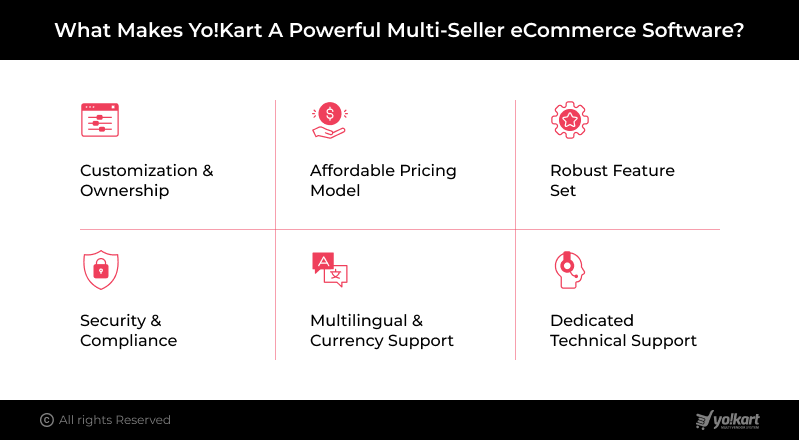
1. Customization & Ownership:
Unlike typical SaaS models that limit control, Yo!Kart offers lifetime ownership and extensive customization capabilities to tailor the functional & visual aspects to align perfectly with brand strategies.
2. Affordable Pricing Model:
The software follows a one-time license fee model with no recurring subscriptions or hidden charges, allowing businesses to reinvest their savings in marketing and growth initiatives.
3. Affordable Pricing Model:
Built to handle high transaction volumes, large catalog sizes, and increasing traffic, Yo!Kart delivers consistent performance even during peak demand, allowing businesses to expand to international markets.
4. Robust Feature Set:
From multi-vendor management and advanced product catalogs to commission control and data analytics, Yo!Kart integrates a comprehensive suite of eCommerce features to manage every aspect of an online marketplace.
5. Security and Compliance:
Yo!Kart adheres to global security best practices and compliance standards, such as built-in SSL support, GDPR compliance, secure payment gateways, and multi-layer authentication, to safeguard user data and transactional integrity.
6. Multilingual & Multi-Currency Support:
Designed for global commerce, Yo!Kart supports multiple languages and currencies to ensure consistent user experiences for diverse audiences and facilitate smooth localization, enabling businesses to expand effortlessly.
7. Dedicated Technical Support:
Beyond its product capabilities, Yo!Kart stands out for its dedicated 1-year free technical support post-purchase to ensure uninterrupted marketplace operations, empowering businesses to innovate confidently.
Proven eCommerce Success with Yo!Kart
Over the years, Yo!Kart has powered some of the most dynamic multi-vendor eCommerce marketplaces, enabling entrepreneurs, SMEs, and enterprises to dominate in their respective markets. Each success story demonstrates Yo!Kart’s technological depth, scalability, and business intelligence, helping clients materialize their complex marketplace visions into sustainable digital ecosystems.
1. UNI Diamonds — Redefining the Global Diamond Trade
UNI Diamonds, a leading global B2B trading marketplace, required a robust, data-driven B2B platform to digitize the traditionally opaque diamond supply chain. Yo!Kart’s highly customizable framework enabled the client to build a secure, scalable marketplace that connects suppliers and buyers across diverse regions.
Based In: Israel
2. Voyij — Transforming Local Retail in Alaska
Voyij sought to bridge the gap between Alaskan local retailers and global travelers by building a marketplace that reflects the state’s authentic culture and commerce. With Yo!Kart, Voyij successfully built a feature-rich, responsive multi-seller eCommerce marketplace that preserved each seller’s brand identity while ensuring seamless customer experiences.
Based In: USA
3. Bozinga — Building a B2B Wholesale Marketplace
Bozinga aimed to create a B2B wholesale marketplace that connects manufacturers, distributors, and service providers across the Americas with buyers worldwide. With Yo!Kart’s customizable modules, Bozinga launched a platform optimized for high-traffic performance, B2B transactions, and scalable growth.
Based In: Columbia
Schedule a Free Personalized Demo to Get a First-Hand Experience of Yo!Kart
Conclusion
As eCommerce continues to redefine the way businesses operate, having the right foundation to build a multi-seller eCommerce marketplace is a competitive necessity. Multi-seller eCommerce software like Yo!Kart emerges as a robust solution engineered to meet the unique demands of startups, growing SMEs, and large enterprises aiming to establish or expand their digital footprint. The software’s blend of affordability, ownership, and robust functionality empowers businesses to accelerate digital transformation while maintaining strategic flexibility and brand integrity.
Hence, for forward-thinking businesses looking to build a resilient, revenue-driven marketplace that evolves as the business expands, Yo!Kart delivers the strategic infrastructure to lead with innovation.
The post Best Multi-Seller eCommerce Software for Startups, SMEs, and Enterprises appeared first on YoKart Blog.
]]>The post Understanding the Different Types of eCommerce Business Models appeared first on YoKart Blog.
]]>The model you adopt directly influences how you attract customers, generate revenue, manage logistics, and scale your eCommerce business operations. Clarity on this front lays the foundation for sustainable growth, competitive differentiation, and operational efficiency.
Whether you’re entering new markets, re-evaluating your digital strategy, or refining your value proposition, understanding the distinctions between different eCommerce business models is essential. Each business model presents unique advantages, challenges, and alignment opportunities depending on your product type, audience, and goals.
In this blog, we’ll understand the different types of eCommerce business models to help you identify the structure that aligns with your strategic business goals.
Table of Contents
- Importance of Choosing the Right eCommerce Business Model
- The Core eCommerce Business Models
- Smart eCommerce Fulfillment Models Transforming Online Retail
- How to Choose the Right eCommerce Business Model?
- Which eCommerce Business Model is Popular in 2025?
- Best eCommerce Marketplace Software to Build a Thriving Marketplace
- Conclusion
- FAQs
Importance of Choosing the Right eCommerce Business Model
A clear, well-aligned eCommerce business model is essential for building a scalable, customer-centric eCommerce marketplace. It shapes how a platform delivers value, aligns internal resources, and competes in an increasingly saturated online market. Without a clear business model, businesses risk inefficiencies, misaligned strategies, and missed growth opportunities.
Here’s why choosing the right eCommerce business model is essential:
1. Strategic Foundation: A well-defined eCommerce business model provides the structural and strategic blueprint of how a business creates and delivers value. It aligns your core operations with long-term business objectives and revenue generation strategies, ensuring cohesive, goal-oriented growth.
2. Operational Clarity: A strategic business model brings consistency and direction to your day-to-day eCommerce business operations. It guides decisions related to inventory management, shipping logistics, and vendor relationships, improving efficiency, reducing friction, and enabling better performance tracking and continuous optimization.
3. Competitive Advantage: A distinct and purpose-driven business model helps you differentiate from competitors and set your brand apart through unique pricing structures, customer experiences, or innovative fulfillment methods. This helps position your brand more efficiently to attract customers and build long-term brand equity.
4. Scalability & Adaptability: A strong business model is designed not just for current success, but for future growth. It enables businesses to expand into new markets while retaining operational control or brand coherence. Moreover, it makes it easier to pivot in response to shifting market dynamics, customer behavior, or emerging technologies.
5. Risk Mitigation: By defining how an eCommerce platform functions and thrives, a solid business model helps reduce operational and financial risks. You can anticipate challenges and navigate uncertainty more effectively with a clear model. Additionally, it allows for better forecasting and resource planning, ensuring greater stability during times of uncertainty.
The Core eCommerce Business Models
A clearly defined eCommerce marketplace model forms the backbone of your eCommerce marketplace. It informs everything from your pricing structure and marketing strategy to customer journey and long-term growth potential. Here, we explore the most prominent eCommerce business models driving the global eCommerce landscape:
1. Business-to-Consumer (B2C) Marketplace Model:
The B2C eCommerce marketplace model is the most widely recognized form of eCommerce that centers around businesses selling products or services directly to individual customers through a digital platform. In this model, the marketplace serves as an intermediary that connects multiple sellers with end-users, offering a broad range of products or services in one place.
Customers browse, compare, and purchase products for personal use, benefitting from competitive pricing, convenience, and a streamlined shopping experience. In a B2C eCommerce marketplace, the entire customer journey is optimized for speed, convenience, and emotional connection. The focus is typically on mass appeal, quick conversions, and delivering a seamless buying experience across devices and platforms.
B2C purchases are largely influenced by need, impulse, social influence, and brand affinity. Hence, to succeed in this space, businesses must master consumer psychology and heavily invest in branding, user experience, and digital marketing.
Example:
- Amazon: Considered as the world’s largest B2C ecommerce marketplace, Amazon offers a wide range of products across diverse categories. It connects third-party sellers and brands with consumers globally, backed by robust logistics, fast delivery, and customer-centric services. Additionally, it also offers services such as Prime, which includes benefits like free and expedited shipping, exclusive deals, access to streaming services, and more.
- ASOS: ASOS is a fashion-focused B2C eCommerce marketplace offering trendy clothing, accessories, and beauty products. It targets young customers with trendy, affordable options, combining its in-house brands with third-party sellers on a global scale.
- Wayfair: Wayfair is a B2C eCommerce marketplace that specializes in home goods, decor, and furniture. It connects consumers with a wide range of suppliers and manufacturers, offering millions of products for every room and style. Known for its competitive pricing, extensive catalog, and user-friendly interface, Wayfair provides detailed product descriptions, customer reviews, and virtual room planning tools to enhance the shopping experience.
Pros:
- Access to a global customer base with diverse needs and preferences.
- Benefit from shorter sales cycles driven by impulse and personal needs.
- Shape your brand identity and messaging without relying on intermediaries.
- Leverage rich customer data from every interaction to personalize marketing.
- Reduced overhead costs by eliminating the need for physical storefronts.
Cons:
- Highly competitive markets demand constant innovation & differentiation.
- Retaining price-sensitive customers requires ongoing marketing efforts.
- Handling logistics, returns, & support at scale adds significant operational pressure.
- Lower average order values and tighter margins reduce profit margins.
- Customer loyalty is short-lived due to shifting preferences & abundant alternatives.
Strategies to Thrive in the B2C eCommerce:
- Stand out with unique branding, exclusive products, or niche positioning.
- Choose a reliable technology partner to build a thriving B2C marketplace.
- Build an emotional connection through compelling brand storytelling.
- Ensure fast, mobile-friendly shopping experiences with frictionless checkout.
- Streamline logistics with reliable fulfillment partners and automated processes.
- Provide responsive, multi-channel customer support with quick resolutions.
- Upsell and bundle products to increase the average order value and margins.
- Continuously test and adapt marketing strategies to align with evolving trends.
2. Business-to-Business (B2B) Marketplace Model:
The B2B eCommerce marketplace model focuses on the digital exchange of goods or services between two commercial entities. These may include manufacturers, wholesalers, distributors, or retailers who sell to other businesses rather than directly to end consumers. In this model, the marketplace acts as a centralized hub where multiple businesses connect with other businesses, often facilitating transactions in bulk quantities with customized pricing structures.
The B2B model has undergone a significant transformation over the past decade. What was once dominated by offline catalogs, fax orders, and lengthy negotiations is now increasingly digital-first, powered by custom portals, API integrations, real-time pricing, and automated purchasing workflows. A B2B eCommerce marketplace prioritizes transparency, compliance, and robust functionality, supporting complex workflows such as bulk ordering, tiered pricing, and invoicing. Hence, B2B purchases are driven by logic, long-term value, business requirements, and ROI considerations.
Example:
1. Alibaba: Alibaba is the world’s largest B2B eCommerce marketplace that connects millions of suppliers and buyers globally. It offers a wide range of products across diverse industries, from fashion and beauty to entertainment and construction. The platform supports bulk ordering, customized manufacturing, and cross-border trade.
2. Global Sources: Based in Hong Kong, Global Sources is a trusted B2B eCommerce platform that connects verified suppliers with buyers across the globe. It focuses on electronics, fashion, and home products, offering services such as trade shows, supplier vetting, and industry insights. The platform fosters trusted relationships through quality assurance and curated sourcing tools, and is known for its emphasis on supplier credibility and professional buyer-supplier matchmaking.
3. eWorldTrade: eWorldTrade is a US-based modern B2B eCommerce marketplace that emphasizes digital trade facilitation through verified company listings, secure communication, and advanced lead generation tools. The platform supports industries ranging from agriculture to electronics and offers verified company profiles, digital marketing services, and RFQ tools. Additionally, it focuses on helping small to mid-sized businesses in international trade with ease, cost-effectively and transparently.
Pros:
- Access to a global network of suppliers and buyers.
- Streamlined procurement processes with digital catalogs & automated workflows.
- Enables bulk ordering and volume discounts, benefitting both buyers & sellers.
- Offers personalized pricing, negotiated deals, and credit terms.
- Supports scalability with minimal infrastructure investment.
Cons:
- Longer sales cycle due to complex decision-making processes.
- Requires advanced features like custom catalogs, payment terms, and more.
- High competition can lead to price pressure and reduced margins.
- Trust barriers can increase when dealing with new or overseas suppliers.
- Integration with legacy systems can be time-consuming and costly.
Strategies to Thrive in the B2B eCommerce:
- Showcase verified credentials, transparent pricing, and genuine reviews to build trust.
- Provide advanced platform capabilities like custom catalogs, flexible payment terms, and bulk ordering.
- Leverage turnkey B2B marketplace software for rapid marketplace deployment.
- Offer multiple payment methods, flexible credit terms, and installment options.
- Differentiate beyond price through superior service, product quality, and value-added services.
- Maintain consistent communication and support to foster long-term relationships.
- Ensure mobile optimization and localized content for global accessibility.
- Invest in integration tools or APIs to streamline connections with legacy systems.
Launch a Scalable eCommerce Marketplace Like Alibaba or Global Sources
3. Consumer-to-Consumer (C2C) Marketplace Model:
Consumer-to-Consumer (C2C) eCommerce refers to the facilitation of transactions between individual customers, typically via a third-party digital marketplace that operates as an intermediary. These platforms, also known as Peer-to-Peer (P2P) marketplaces, enable users to list products, communicate with potential buyers, manage transactions, and sometimes handle fulfillment.
In contrast to traditional retail models, C2C marketplace models are decentralized and user-driven. They focus on building scalable infrastructure, consumer trust, and community engagement mechanisms to create liquidity in both supply and demand. This model is central to the resale economy, peer-to-peer services, and circular commerce for secondhand or refurbished goods.
Example:
1. Etsy: Etsy is a niche C2C marketplace that specializes in handmade, vintage, and unique goods. It connects independent artisans and small businesses selling directly to consumers who seek personalized, creative, or custom-made items in categories like crafts, jewelry, and home decor.
2. eBay: eBay is a global C2C eCommerce marketplace that allows individuals to buy and sell new or used goods through auctions or fixed-price listings. Known for its wide product range and secure payment systems, eBay enables smooth peer-to-peer transactions across categories like electronics, collectibles, fashion, and home goods.
3. Depop: Founded in 2011, Depop is a fast-growing C2C eCommerce platform focused on secondhand and vintage fashion, particularly popular among GenZ. It blends social media features with eCommerce and allows users to follow others, like items, and communicate directly. Sellers often showcase their personal style, creating a community-driven marketplace that promotes sustainability, individuality, and circular fashion through peer-to-peer clothing resale.
Pros:
- Low entry barriers allow anyone to become a seller with minimal setup.
- Promotes reuse and sustainability through secondhand product sales.
- Scales organically as more users join and trade on the platform.
- Enables personalized, niche, or vintage item discovery.
- Fosters community through direct individual interactions.
Cons:
- Inconsistent product quality and descriptions may affect buyer trust.
- Limited seller accountability often leads to fraud or disputes.
- User experience can vary greatly depending on individual sellers.
- Slower shipping times due to individual handling & lack of logistics support.
- Lack of standardized return & refund policies.
Strategies to Thrive in the C2C eCommerce:
- Implement strict product listing guidelines with mandatory photos & detailed descriptions.
- Introduce seller verification & rating systems to improve accountability.
- Provide integrated logistics options or shipping partnerships for faster delivery.
- Establish clear, platform-wide return and refund policies to build buyer & seller confidence.
- Incentivize repeat transactions through loyalty programs and promotional tools.
- Utilize AI and data analytics to personalize product discovery for buyers.
- Foster an active community with engaging features like chat, likes, and follows.
4. Business-to-Government (B2G) Marketplace Model:
Business-to-Government (B2G) eCommerce, also referred to as Business-to-Administration (B2A), is the commercial eCommerce business model in which private enterprises sell products or services to government agencies at various levels, be it local, state, national, or international.
Transactions in such models are typically regulated through formal procurement processes, public tenders, bid solicitations, and government-approved vendor contracts. Unlike other eCommerce business models, B2G models involve a stringent framework of compliance, transparency, documentation, and service-level agreements.
B2G models often include high-stakes industries such as public health, national defense, transportation infrastructure, IT modernization, disaster recovery, and education.
Example:
1. Amazon Business (GSA-approved): Amazon Business is a GSA-approved eCommerce platform that enables government agencies to purchase office supplies, IT hardware, and industrial goods. It offers federal compliance, tax-exempt purchasing, and bulk ordering, streamlining procurement processes for public sector organizations.
2. United States Federal Marketplace (FMP): The Federal Marketplace is a US government initiative that consolidates acquisition programs and procurement tools. It simplifies how federal agencies connect with qualified vendors for goods and services through a digital portal aligned with modern eCommerce practices.
3. Cisco & Microsoft: Cisco & Microsoft engage in B2G eCommerce by serving as major providers, offering secure cloud infrastructure, cybersecurity solutions, and enterprise software tailored to government needs.
Pros:
- Offers stable, large-scale contracts with guaranteed government payments.
- Enhances credibility and reputation for businesses working with government bodies.
- Provides long-term business opportunities through repeat procurement cycles.
- Reduces market risks through reliable demand from public sector agencies.
- Encourages compliance-driven operations and process improvements.
Cons:
- Lengthy & complex bidding and approval processes can delay deals.
- High regulatory and compliance requirements increase the administrative burden.
- Intense competition among vendors for limited government contracts.
- Limited pricing flexibility due to fixed budget allocations and bidding rules.
- Payments may be delayed due to bureaucratic processing timelines.
Strategies to Thrive in the B2G eCommerce:
- Understand & comply with all government procurement regulations & documentation requirements.
- Invest in certifications, security clearances, and compliance audits to qualify for tenders.
- Integrate advanced features and build a tailored B2G eCommerce platform to reflect a unique brand identity.
- Focus on niche capabilities or specialized solutions to reduce competition in broad contract categories.
- Invest in cybersecurity and data protection to meet stringent government standards.
5. Consumer-to-Business (C2B) Marketplace Model:
Consumer-to-Business (C2B) eCommerce is a reverse eCommerce marketplace model in which individual consumers create value that is consumed or monetized by businesses, effectively inverting the traditional commercial value chain.
In this paradigm, the marketplace acts as a facilitator that connects consumers, such as freelancers, influencers, content creators, or data providers, with businesses seeking their skills. Unlike B2C, where businesses initiate product delivery to end-users, the C2B model empowers consumers as active participants in the value chain.
This model has flourished in the digital era with the rise of the gig economy, freelance marketplaces, user-generated content, influencer marketing, and data-as-a-service ecosystems. C2B transactions are driven by personalization, reputation, niche expertise, and the ability to scale on demand.
Hence, success in the C2B space hinges on creating a dynamic, secure, and flexible environment where consumers feel valued and businesses can tap into unique, often untapped, market resources.
Example:
1. Freelance Platforms: Freelance marketplaces like Upwork or Fiverr allow individuals to offer professional services, such as writing, design, and programming, to businesses seeking on-demand talent. These platforms facilitate project-based work, enabling consumers to monetize their expertise while providing businesses with flexible and scalable solutions that avoid long-term hiring commitments.
2. Stock Media & Digital Asset Platforms: Platforms like Shutterstock or Envato enable consumers to upload and sell digital assets such as photos, videos, music, and templates. Businesses can purchase these assets for marketing, design, or content needs, offering creators with recurring revenue while providing companies with high-quality, affordable media resources.
3. Affiliate & Referral Models: Affiliate networks such as Amazon Associates or ShareASale allow individuals to promote products and earn commissions on generated sales. While businesses benefit from increased exposure and customer acquisition, affiliates monetize their content, audience reach, or influence through targeted promotions.
4. Consumer Research & Feedback Platforms: Websites like G2, UserTesting, or Respondent pay individuals to provide feedback, opinions, or usability testing for business products or services. Businesses use this input for market research and product development, turning consumers into valuable resources of insights and innovation.
Pros:
- Access to diverse, specialized content on demand.
- Cost-effective compared to hiring full-time employees.
- Encourages innovation through consumer-driven input.
- Empowers individuals to monetize their skills.
- Scalable for short-term or project-based needs.
Cons:
- Quality and consistency of consumer services may vary.
- Trust and credibility can be hard to establish initially.
- High competition may drive down consumer earnings.
- Regulatory and compliance issues across borders.
- Payment disputes or delays may arise.
Strategies to Thrive in the C2B eCommerce:
- Create a secure, user-friendly C2B platform that makes onboarding & transactions simple.
- Set clear quality standards and provide training resources to maintain consistency.
- Provide tools for portfolio building, reviews, and skill showcasing to attract customers.
- Implement robust vetting systems to ensure the quality & credibility of service providers.
- Encourage niche specialization to attract a loyal customer base.
- Foster community engagement through forums and resource sharing.
- Introduce flexible pricing models to accommodate diverse business budgets & project scopes.
- Implement secure, transparent payment systems with escrow and dispute resolution tools.
6. Business-to-Business-to-Consumer (B2B2C) Marketplace Model:
The Business-to-Business-to-Consumer (B2B2C) model is a hybrid strategy that blends the best aspects of B2B and B2C commerce. In this structure, one business (manufacturer, service provider, or brand owner) supplies goods or services to another business (such as a distributor, marketplace, or retailer), which then delivers those offerings to end consumers.
What differentiates the B2B2C marketplace model from traditional B2B distribution is the shared ownership of the customer experience. Brands in this model often retain visibility, influence, or even direct communication with the end consumer. Additionally, it often involves co-branded platforms, integrated APIs, or white-label partnerships, where the end consumer interacts with a brand interface that may mask the complexity of business partnerships behind it.
Example:
1. Instacart: Instacart operates a B2B2C model by partnering with grocery retailers to deliver products to consumers via its platform. It provides retailers with digital infrastructure and logistics, while consumers benefit from convenient online grocery shopping and home delivery.
2. Amazon FBA (Fulfilled by Amazon): Amazon FBA enables third-party sellers to list products on Amazon (B2B), while Amazon handles warehousing, packing, and shipping to consumers (B2C). This B2B2C model allows sellers to scale quickly and deliver a seamless customer experience through Amazon’s trusted infrastructure and vast customer base.
3. Fintech-as-a-Service: Platforms like Stripe or Square offer embedded financial services (such as payments, lending, or banking) to businesses, which then provide these services to their customers. This B2B2C model powers seamless payment experiences, financing, or banking services within third-party apps, creating a smooth transaction layer between businesses and end consumers.
Pros:
- Expands consumer reach by combining businesses and consumers.
- Enables rapid scaling through partner networks.
- Strengthens brand credibility through trusted platforms.
- Encourages innovation through collaborative ecosystems.
- Generates multiple revenue streams for both B2B and B2C ends.
Cons:
- Complex coordination between multiple stakeholders.
- Risk of brand dilution due to shared customer ownership.
- High operational and integration costs.
- Challenges in maintaining a consistent user experience.
- Dependency on partner performance and reliability.
Strategies to Thrive in the B2B2C eCommerce:
- Implement strong project management frameworks to streamline coordination between stakeholders.
- Use co-branding guidelines and marketing oversight to prevent brand dilution.
- Adopt scalable, cost-efficient eCommerce marketplace solutions to reduce operational expenses.
- Implement shared data analytics to optimize performance across the value chain.
- Establish shared customer experience standards to ensure consistency.
7. Direct-to-Consumer (D2C) Marketplace Model:
The Direct-to-Consumer (D2C) eCommerce is a retail strategy where manufacturers or brands sell their own products or services to end consumers, bypassing all intermediaries such as wholesalers, distributors, and third-party retailers.
D2C eCommerce is typically executed through digital channels, such as proprietary websites, mobile apps, and social commerce platforms, where businesses have complete control over branding, pricing, marketing, and customer experience. Unlike conventional retail models, D2C brands own the entire customer journey, from awareness and consideration to purchase and post-sale service. It gives brands the autonomy to innovate quickly, personalize experiences at scale, and build loyal communities around their offerings, all without the friction of third-party gatekeeping.
D2C eCommerce marketplace models are especially popular among digitally native vertical brands and are becoming a cornerstone strategy for both startups and legacy brands undergoing digital transformation.
Example:
1. Nike: Nike uses a hybrid D2C model, selling directly to consumers through its branded stores, website, and app. It focuses on personalized customer experiences, loyalty programs, and exclusive products, reducing reliance on third-party retailers while enhancing brand control and customer data insights.
2. Casper: Casper operates as a digitally native vertical brand, selling mattresses and sleep products directly through its website and selected branded retail stores. By cutting out intermediaries, its D2C model reduces costs, emphasizes convenience, and streamlines the supply chain to offer high-quality products at competitive prices.
3. Tesla: Tesla bypasses traditional dealerships with its D2C model, selling vehicles directly to consumers via its website and company-owned showrooms. This approach provides better control over pricing, user experience, transparency, and customer relationships.
Pros:
- Complete control over branding and customer experience.
- Higher profit margins by cutting out intermediaries.
- Faster feedback loops for product improvement.
- Enhanced customer loyalty through direct relationships.
- Greater pricing control and flexibility.
Cons:
- Higher upfront cost for infrastructure and marketing.
- Managing logistics and fulfillment can be complex.
- Dependence on digital channels increases competition.
- Challenging to scale rapidly without established networks.
- Requires significant investments in preventing cybersecurity threats.
Strategies to Thrive in the D2C eCommerce:
- Start lean with scalable & customizable eCommerce platforms to reduce upfront infrastructure costs.
- Build a strong brand identity that resonates emotionally with your target audience.
- Invest in a high-quality digital storefront optimized for mobile and SEO.
- Differentiate through unique value propositions to stand out.
- Continuously gather and act on customer feedback for product innovation.
- Ensure robust cybersecurity measures to protect customer data and trust.
- Use social commerce and influencer partnerships to drive traffic and awareness.
Launch a High-Performing eCommerce Marketplace that Grows Exponentially
8. Hybrid Marketplace Model:
A hybrid eCommerce business model refers to a multifaceted strategy that combines two or more eCommerce marketplace models into a single integrated strategy. Hybrid models allow businesses to operate across multiple customer segments, sales channels, or fulfillment methods, often blending various marketplace models into one.
At its core, the hybrid model reflects the omnichannel reality of modern commerce, where consumers and business buyers interact with brands across numerous touchpoints. Rather than choosing a single path, businesses orchestrate a cohesive commerce ecosystem that allows them to serve different segments in different ways. This model is often favored by mid-sized to enterprise-level organizations, as well as fast-scaling eCommerce setups, because it enables them to diversify risk, test new revenue streams, and respond dynamically to shifting consumer behaviors and supply chain disruptions.
While operationally complex, the hybrid model is built on the premise of commerce convergence, bringing together multiple models into a unified business model that enhances brand resilience, profitability, and customer reach.
Core Hybrid Approaches:
- Brand-Owned D2C + Third-Party Retailers: Brands sell on Amazon, Walmart, Etsy, etc., for maximum reach, but maintain their own branded site for loyalty and storytelling.
- Retail + eCommerce: Combines online D2C sales with physical retail stores to offer a seamless omnichannel experience.
- Branded Marketplace Model: Brands sell their own products and also host third-party sellers on their platforms to expand product offerings and diversify revenue channels.
- Wholesale + D2C Channels: Brands operate D2C storefronts while also distributing through wholesale B2B retail partners for broader reach.
Example:
1. Samsung: Samsung operates its own D2C eCommerce platform while also selling through major retailers like Amazon, Best Buy, and more. It combines direct sales, third-party distributions, and B2B partnerships to maximize reach and maintain control over the customer experience and product positioning.
2. Nestle: Nestle blends D2C and B2B models by offering selected products via its own eCommerce platforms (e.g., Nespresso). It also partners with platforms like Amazon for subscription offerings, while selectively hosting branded experiences and product bundles, merging convenience with customer retention across multiple channels.
3. Adobe: Adobe utilizes a hybrid marketplace by selling software directly via its website while also partnering with resellers, B2B platforms, and cloud partners like AWS. Additionally, its Adobe Exchange marketplace hosts third-party plugins and extensions, creating an ecosystem that supports both internal offerings and external developers. This hybrid model supports both individual creators and enterprise clients, combining D2C digital delivery with global B2B distribution.
Pros:
- Expands customer reach across multiple channels.
- Diversifies revenue streams for greater financial resilience.
- Enables upselling through curated third-party offerings.
- Enhances customer convenience via omnichannel presence.
- Leverages data from multiple touchpoints for better insights.
Cons:
- Increases operational complexity across channels.
- Requires competitive pricing and careful inventory coordination
- Higher risk of channel conflicts and cannibalization
- Demands more advanced logistics and fulfillment systems.
- May involve complex vendor and partner management.
Strategies to Thrive in the Hybrid eCommerce:
- Define clear channel strategies to avoid conflicts and ensure brand consistency.
- Implement centralized inventory and order management to streamline multi-channel operations.
- Use dynamic pricing strategies to stay competitive while protecting profit margins.
- Establish clear channel governance policies to minimize conflicts.
- Continuously test and refine new combinations of marketplace models for growth.
- Balance automation with human oversight to manage complexity efficiently.
- Create strong vendor and partner management frameworks with clear KPIs and communication protocols.
Smart eCommerce Fulfillment Models Transforming Online Retail
In a competitive eCommerce environment, how you deliver value is just as critical as what you sell. Modern businesses are no longer bound to traditional retail models; advances in technology, supply chain optimization, and customer behavior shifts have given rise to a variety of value delivery approaches. Below are the key value delivery methods that are shaping today’s eCommerce landscape:
1. White Label:
White labeling enables a business to rebrand and sell products manufactured by some other company under its own brand identity. This approach allows for rapid market entry without the high upfront investment in R&D or manufacturing. Businesses focus on branding, marketing, and distribution while leveraging third-party manufacturing capabilities.
– Ideal for: Businesses looking to leverage established products or designs without building from scratch.
– Key Benefit: Quick scalability with minimal product development risk.
– Limitation: Limited differentiation until supported by strong branding and customer experience.
2. Private Label:
Private label products are manufactured by a third party but sold exclusively under the retailer’s brand. Unlike white label goods, private-label products are developed with distinct specifications, packaging, and branding, providing a higher degree of differentiation. Retail giants and niche D2C brands alike employ this model to strengthen brand equity and pricing power.
– Ideal for: Brands seeking exclusivity and differentiation in crowded markets.
– Key Benefit: Greater brand ownership and exclusivity.
– Limitation: Higher upfront investment in product design and manufacturing.
3. Wholesale:
Wholesaling remains a cornerstone of B2B eCommerce. It involves purchasing products in bulk directly from manufacturers or distributors and reselling them to retailers or institutional buyers. This model benefits from economies of scale but requires significant capital investment and inventory management capabilities. However, in today’s digital age, wholesale platforms have evolved into fully integrated eCommerce solutions, offering order automation, bulk discounts, and multi-channel inventory visibility.
– Ideal for: Businesses with the infrastructure to handle bulk stock and a strategy to move large volumes efficiently.
– Key Benefit: Achieve economies of scale and maintain a reliable, predictable supply chain.
– Limitation: Requires significant capital investment for bulk purchasing and storage.
4. Dropshipping:
Dropshipping completely eliminates inventory management from the entire eCommerce operation. Sellers market products and process orders, while a third-party supplier handles storage, packaging, and direct delivery to the customer. This low-risk model reduces upfront costs and operational complexities, but often demands careful supplier vetting to maintain quality and service standards.
– Ideal for: Businesses exploring or testing new product categories without heavy capital investment.
– Key Benefit: Minimal capital requirements and operational flexibility.
– Limitation: Lower margins and reduced control over fulfillment speed and quality.
5. Subscription Services:
Subscription commerce focuses on recurring revenue, weekly, monthly, or annually, by delivering products or services at regular intervals. This method fosters customer loyalty and provides a predictable cash flow. Whether it’s consumables, curated boxes, or premium digital content, this subscription model thrives when coupled with personalization and customer engagement strategies.
– Ideal for: Products or services with repeat purchase potential.
– Key Benefit: Recurring, predictable revenue and stronger lifetime customer loyalty.
– Limitation: Requires consistent value delivery to avoid churn.
6. Print on Demand (POD):
Print on Demand allows businesses to sell custom-designed products, such as apparel, accessories, home decor, or stationery, without holding inventory. Items are produced and shipped only when a customer places an order, enabling virtually unlimited product variations without upfront manufacturing costs. This model combines creative flexibility with low operational risks, thriving on design agility and trend responsiveness.
– Ideal for: Businesses that thrive on personalization, creative designs, or trend-driven products.
– Key Benefit: Zero inventory risk and rapid product experimentation
– Limitation: Longer fulfillment times and potentially lower margins.
How to Choose the Right eCommerce Business Model?
Selecting the right business model to build an eCommerce marketplace is a strategic decision that shapes the platform’s market positioning, operational structure, revenue potential, and ability to scale. The right choice is rarely about following trends, but aligning the model with your core value proposition, target audience, and business capabilities.
Here are the key considerations to make an informed decision:
1. Define Your Target Market and Audience: A precise understanding of your target audience is essential to determine the right eCommerce business model for your marketplace. Determine whether your primary focus is B2B, B2C, B2G, B2B2C, or a strategic blend. Take the following factors into account:
- Purchase Decision Cycle: B2B transactions typically involve longer decision-making cycles due to multiple stakeholders and consultative processes. In contrast, B2C decisions are often faster and driven by emotions, impulse, or seasonal trends. Hence, understand which cycle suits your business vision and its ability to cater to it.
- Price Sensitivity: High-value, complex solutions generally call for a B2B model, which allows for tailored pricing and long-term relations, while B2C markets might be more price-sensitive, requiring a model that offers competitive pricing or bulk purchases.
- Order Volume and Frequency: B2B transactions often involve high-volume, recurring transactions. Whereas, B2C purchases tend to be smaller and more specific.
2. Evaluate Your Value Proposition: The chosen eCommerce business model determines the strengths of your eCommerce marketplace. Consider whether you deliver bespoke solutions, brand-led experiences, or price-driven value. Additionally, select a definite structure that best communicates and monetizes. The goal is to ensure that the business model amplifies your value proposition.
3. Assess Operational Capabilities: The operational readiness determines the feasibility of the platform. Evaluate the ability to manage inventory, maintain stock levels, fulfillment speed, and technology integration. The operational infrastructure must support your chosen eCommerce business model efficiently, ensuring reliability, scalability, and compliance with service-level commitments across all touchpoints.
4. Consider Revenue Predictability: Revenue predictability plays a significant role in shaping your eCommerce business model. Certain models, such as subscription services, that offer recurring revenue can be more valuable over time. In contrast, others rely on transactional volume, where income fluctuates depending on the demand and activity. Understanding these differences thus helps you align financial planning with business stability.
5. Analyse Market Competition and Differentiation: Evaluate market saturation, competitor positioning, and pricing strategies to position your eCommerce marketplace effectively. In highly competitive segments, niche targeting, product customization, or fulfillment speed can become key differentiators. Establishing a competitive differentiation strategy ensures long-term visibility and brand value.
6. Factor in Scalability & Adaptability: Choose a business model that scales efficiently into global markets without compromising performance and creating complexity. Ensure operational processes, technology, and supplier relationships can handle increased demand. Additionally, choose a structure that can adapt in response to the changes without requiring a complete overhaul.
7. Test and Validate Before Deployment: Conduct thorough testing through MVP launches and limited product releases before committing substantial resources and complete deployment. These initiatives verify demand, refine operational workflows, and identify unforeseen challenges, increasing the likelihood of a smooth, profitable scale-up.
Ready to Build a Marketplace that Stands Out in the Competition?
Which eCommerce Business Model is Popular in 2025?
Multi-vendor marketplace models emerge as a dominant force in the eCommerce industry today. According to an analysis, marketplaces now account for 67% of global online sales, outpacing traditional commerce.
Within this trend, B2C and hybrid eCommerce business models remain highly competitive, with D2C strategies gaining particular traction for their ability to provide complete control over branding & customer journey, maximize margins, and deliver personalized experiences. Additionally, B2B marketplaces are surging too. A report by Gartner suggests that 80% of B2B buyers will shift to digital marketplaces over legacy platforms.
Alongside these, subscription-based models continue to gain momentum by generating predictable recurring revenue and fostering strong customer loyalty. AI-powered personalization, omnichannel presence, voice commerce, and mobile-first experiences enable brands to deliver a consistent, personalized experience.
Furthermore, Quick Commerce is also gaining massive popularity, offering ultra-fast deliveries that meet rising consumer demands for convenience, especially in urban areas.
Best eCommerce Marketplace Software to Build a Thriving Marketplace
When it comes to building a robust, scalable eCommerce marketplace, Yo!Kart stands out as the most reliable eCommerce marketplace software available in the market. It is a turnkey, ready-to-launch marketplace software that allows businesses to launch their own digital marketplace across diverse niches. Designed specifically for multi-vendor operations, Yo!Kart can be customized to build an eCommerce marketplace that supports multiple business models, including B2C, B2B, and more.
Here are the key benefits businesses gain by choosing Yo!Kart:
- 100% white label solution that allows you to design the platform to your unique branding.
- Highly customizable software, allowing you to adapt to diverse eCommerce business models.
- Self-hosted solution provides you the flexibility to host the software on your preferred choice of server.
- Lifetime ownership with a one-time investment and no monthly or annual recurring charges.
- Highly affordable software with base white label pricing packages starting from $999.
- Extensively scalable solution with multilingual & multi-currency support to expand to global markets.
- With over a decade of industry experience, Yo!Kart is trusted by businesses worldwide and has powered more than 5,000 unique marketplaces.
- Free demo availability to explore the functionalities of the software firsthand.
- Native mobile apps available for both Android and iOS platforms for a go-to buyer experience.
- 1 year of free technical support post purchase to help in case of any unforeseen bugs or downtimes.
Additionally, Yo!Kart not only provides core eCommerce functionalities but also focuses on customer experience, vendor management, and performance analytics, making it easier for marketplace owners to attract sellers & retain buyers to maximize revenue. Whether yo’re starting a niche marketplace or aiming for a global audience, Yo!Kart offers the flexibility, speed, and reliability to thrive in today’s competitive eCommerce landscape.
Secure a Personalized Demo Session to Explore the Functionalities of Yo!Kart
Conclusion
In an ever-evolving digital landscape, the eCommerce marketplaces have emerged as a crucial force propelling industry growth. Selecting the right eCommerce business model is a strategic decision that directly shapes customer experience, operational efficiency, and long-term profitability. Each eCommerce business model offers distinct opportunities and considerations. The key is to align the chosen model with the business’s core strengths, target audience, and long-term objectives, while remaining agile enough to evolve. The right model not only optimizes revenue streams but also creates a sustainable competitive advantage.
FAQs
Q 1. How do I know which eCommerce business model is right for me?
Ans. Choosing the right eCommerce business model depends on factors like target audience, product types, budget, and long-term goals. Start by analyzing the product or service you’re selling, how much control you want over your inventory, and whether you want to deal with logistics or not. Doing market research and understanding your niche will help you know the right eCommerce business model for your marketplace.
Q 2. How does eCommerce business model innovation affect customer experience?
Ans. Innovation in eCommerce business models can significantly enhance customer experience by offering more personalized, seamless, and convenient shopping. Adopting a subscription, marketplace, or on-demand model, for instance, can enhance the customer experience by offering personalized, flexible, and convenient shopping options. Such models often provide unique value propositions that provide customer satisfaction and loyalty.
Q 3. Can I combine multiple eCommerce business models while building a marketplace?
Ans. Yes, it is possible to integrate multiple eCommerce business models within a single marketplace. Hybrid models allow for greater flexibility, catering to a broader customer base and expanding your offerings while providing diverse revenue streams.
Q 4. What are the risks of choosing the wrong eCommerce business model to build an eCommerce marketplace?
Ans. Choosing the wrong eCommerce business model can lead to inefficiencies, loss of market relevance, and financial strain. For example, a B2C model in a market that favors C2C may not attract the right audience. Risks also include scaling issues, inadequate customer experience, and difficulties in managing operations or inventory. Hence, proper market research and a solid business plan are essential to avoid any risks of failure.
Q 5. Does a readymade marketplace software allow to build an eCommerce marketplace that caters to multiple eCommerce business models?
Ans. Yes, many readymade marketplace software like Yo!Kart are designed to support multiple eCommerce business models to build a marketplace. Such software provides flexibility to build and scale your marketplace effortlessly, allowing you to adapt to various business needs and user types.
Q 6. Which is the best eCommerce marketplace software to build a marketplace?
Ans. Among many solutions available in the industry, Yo!Kart stands out to be the ultimate eCommerce marketplace software that allows you to build an eCommerce marketplace across multiple business models, whether B2B, B2C, or more. Its rich set of features, robust clientele, industry experience, integrated payment gateways, customizable themes, and extensive scalability options make it an excellent choice for entrepreneurs looking to build an eCommerce marketplace.
The post Understanding the Different Types of eCommerce Business Models appeared first on YoKart Blog.
]]>The post How to Build a Farm Marketplace For Local Poultry And Livestock Sales? appeared first on YoKart Blog.
]]>The agricultural eCommerce industry is estimated to surpass $308.76 billion by 2032 worldwide, opening new doors for farmers, breeders, and agri-entrepreneurs to reach wider markets, optimize operations, and increase profitability.
As consumer demands continue to evolve, traditional methods of selling poultry and livestock are no longer meeting the mark. This changing landscape is opening up new avenues for entrepreneurs to build a farm marketplace for local poultry and livestock sales.
Hence, this blog explores the growing need for a specialized farm marketplace for local poultry and livestock sales and why now is the perfect time to invest in building a farm market platform.
Table of Contents
- What is a Local Poultry and Livestock Sales Marketplace?
- Types of Multivendor Poultry and Livestock Sales Marketplaces
- The Need to Build a Farm Marketplace
- Poultry and Livestock Market Growth: Trends & Key Statistics
- Popular Multivendor Marketplaces for Local Poultry and Livestock Sales
- Benefits of Launching a Farm Marketplace for Local Poultry and Livestock Sales
- Key Features of a Multivendor Poultry and Livestock Sales Marketplace
- Strategic Steps to Build a Farm Marketplace For Local Poultry And Livestock Sales
- Yo!Kart — Best Multivendor Marketplace Software to Launch a Poultry And Livestock Sales Platform
- Wrapping Up
- FAQs
What is a Farm Marketplace for Local Poultry and Livestock Sales?
A local poultry and livestock sales marketplace is a digital platform that connects regional farmers, breeders, and agricultural producers with buyers, wholesalers, retailers, and even meat processing enterprises seeking to purchase animals, poultry products, or livestock-related services.
Unlike conventional brick-and-mortar or informal trading systems, these online marketplaces are structured to enable seamless buying and selling of farm animals and poultry through a centralized, technology-driven interface. At its core, such a marketplace serves as a multivendor eCommerce ecosystem where various sellers can list their livestock, poultry, and related goods, while buyers can browse, compare, negotiate, and purchase based on their preferences, such as availability, quality, breed, health certifications, and pricing.
These platforms facilitate end-to-end transaction management, from product discovery and digital catalogs to payments and logistics. Such platforms thus bridge the gap between rural producers and urban consumers and allow vendors to reach a broader customer base without geographic limitations.
Types of Multivendor Poultry and Livestock Sales Marketplaces
A local poultry and livestock sales marketplace transforms the age-old animal trade into a modern, structured, and technology-enabled commercial experience. Such marketplaces not only improve market access but also support the broader goal of creating transparent and efficient food supply chains in the agriculture sector.
However, there are several types of multivendor marketplaces for local poultry and livestock sales, which are as follows:
- B2C (Business-to-Consumer) Marketplace: Tailored to serve individual customers such as small-scale farmers, homesteaders, or urban buyers interested in fresh poultry and ethically raised livestock. These platforms focus on customer experience, ease of use, and direct-to-consumer delivery models.
- B2B (Business-to-Business) Marketplace: Designed for bulk transactions, B2B poultry and livestock sales marketplaces cater to wholesale and commercial buyers. These marketplaces emphasize request-for-quotes, bulk purchases, certifications, and streamlined procurement processes. Ideal for meat processors, restaurants, and food distribution companies seeking dependable livestock sources.
- Hybrid Marketplaces: Combining B2B and B2C elements, hybrid models offer flexibility to cater to both commercial entities and end consumers.
The Need to Build a Farm Marketplace
The limitations of trading poultry and livestock via offline channels are becoming more apparent, with traditional selling methods getting fragmented and outdated. A dedicated farm marketplace bridges this gap by connecting farmers directly with buyers through a centralized platform, bringing much-needed modernization to the agriculture trade.
Challenges Faced Due to Traditional Selling Methods
The poultry and livestock trade sector still relies heavily on outdated, fragmented methods like in-person auctions, middlemen, and local fairs despite its long-standing importance. These traditional methods are struggling to keep pace as modern buyers increasingly demand traceability, organic certification, and ethically sourced products.
Here are a few challenges faced via traditional methods:
1. Limited Market Reach: Traditional sales channels rely heavily on localized networks, such as physical auctions, farm visits, or regional intermediaries. This restricts the sellers’ ability to connect with a broader & more diverse customer base, resulting in missed opportunities to scale.
2. Dependence on Middlemen: The traditional supply chain is heavily dependent on intermediaries who often control access to markets and buyers. While they may ease transactions, their involvement often inflates costs, reduces farmer margins, and distorts fair market dynamics.
3. Lack of Standardized Prices: Without a unified pricing mechanism, livestock and poultry prices fluctuate based on subjective assessments, regional demand, or bargaining dynamics. As a result, farmers are frequently at a disadvantage, forced to accept suboptimal prices.
4. Quality and Trust Issues: Customers often lack access to verified information on animal health, vaccination records, breed quality, or farming practices. As a result, this information gap leads to reduced buyer trust, repeat sales challenges, and reputational risks for sellers.
5. Logistical & Infrastructure Constraints: Poor transport infrastructure, lack of cold chains, and insufficient veterinary facilities often compromise animal welfare during transit and limit the expansion of trade across wider geographies.
6. Seasonal Volatility and Demand Fluctuation: Livestock and poultry trades are often subject to seasonal variations, festivals, and regional consumption patterns. Hence, traditional sellers struggle to anticipate demand surges or manage surplus inventory effectively without predictive analytics or digital tools.
Poultry and Livestock Market Growth: Trends & Key Statistics
The poultry and livestock sales markets are rapidly evolving as global demand for high-protein foods rises with population growth. Modern technologies are reshaping traditional supply chains, thus creating direct connections between farmers, consumers, and distributors.
According to the latest industry reports,
- The global agriculture market is projected to grow from $15.5 trillion in 2025 to $20.63 trillion by 2029, expanding at a CAGR of 7.9%.
- The poultry market’s value worldwide is forecast to increase from $315.35 billion in 2025 to $401.21 billion by 2032.
- In terms of species, chicken leads with 51.2% of the market share in 2025, followed by geese (23.4%), duck (14.7%), turkey (7.8%), and other poultry items (2.9%).
- The global livestock and meat market is expected to reach approximately $1.6 trillion by 2034.
- Regionally, North America holds the largest portion of the livestock market at 35%, trailed by Europe (27%), Asia Pacific (24%), and Latin America (4%).
- By 2034, the livestock and meat market in the US is projected to reach a value of $406.12 billion.
Popular Multivendor Marketplaces for Local Poultry and Livestock Sales
The digital shift in the agriculture industry has opened new avenues for poultry and livestock farmers to expand their reach beyond traditional, localized markets. In fact, online multivendor poultry and livestock sales marketplaces support diverse business models, from backyard farming to commercial-scale operations.
Here are some noteworthy marketplaces that exemplify innovation and operational excellence in this evolving space:
1. SellMyLivestock
Based in the UK, SellMyLivestock provides farmers with a trusted digital channel to list and purchase animals online. The platform emphasizes traceability, regulatory compliance, and data transparency, core requirements for modern agricultural commerce. With detailed livestock records, photos, and health certifications, it serves as a prime example of how data-driven solutions enhance buyer confidence and streamline procurement.
- Founded In: 2012
- Headquarters: Hampshire, United Kingdom
2. MyPetChicken
Operating as a highly specialized digital platform, MyPetChicken is a niche eCommerce marketplace focused on backyard chicken owners and small-scale poultry keepers in the US. The platform successfully aggregates offerings from multiple hatcheries and suppliers to provide customers with a rich and diverse selection of chicken breeds, hatching eggs, coops, poultry supplies, and related equipment. Though not a full-fledged multivendor platform in the conventional sense, it operates a vendor-inclusive model by sourcing from multiple hatcheries and suppliers.
- Founded In: 2005
- Headquarters: Georgia, United States
3. McMurray Hatchery
A household name in North American poultry farming, McMurray Hatchery is one of the oldest and most trusted hatcheries in the United States. While it is primarily a direct-to-consumer operation, it has evolved to serve as a large-scale poultry sales hub, offering over 100 breeds of chicks, ducks, turkeys, and other fowl. Additionally, the platform integrates biosecurity compliance, bulk order management, detailed breed specifications, health-certified shipments, and educational resources.
- Founded In: 1917
- Headquarters: Iowa, United States
4. Rural365
Offering an intuitive online marketplace for poultry, goats, rabbits, and related farm animals, Rural365 caters to hobby farmers and homesteaders in the US. While its model is more simplified than enterprise-grade platforms, it successfully addresses a valuable segment often overlooked by mainstream agriculture tech, underscoring the market potential within rural consumer bases.
- Founded In: 2018
- Headquarters: South Dakota, United States
5. Cackel Hatchery
A long-established hatchery in the US, Cackle Hatchery has embraced eCommerce to sell poultry, hatching eggs, and supplies online. While it operates primarily as a single-vendor site, it also features collaborations with independent breeders and vendors, effectively functioning as a hybrid multivendor model. The platform allows small breeders to showcase rare or specialty breeds through its wide-reaching channel.
- Founded In: 1936
- Headquarters: Missouri, United States
Launch a Multivendor Poultry & Livestock Marketplace Inspired by Leading Platforms
Benefits of Launching a Farm Marketplace for Local Poultry and Livestock Sales
Launching a farm marketplace for local poultry and livestock trade offers distinct advantages that align with current industry shifts, consumer preferences, and digital transformation in agriculture. As the industry modernizes, such digital marketplaces are increasingly seen as essential infrastructure rather than optional innovations.
Here’s why:
1. Empowers Local Producers and Farmers
A dedicated multivendor marketplace democratizes market access by allowing independent farmers, breeders, and small businesses to list their livestock and poultry without the need for physical market presence. This removes traditional barriers such as middlemen, geographical limitations, and infrastructure constraints, which allows farmers to gain direct exposure to a larger, often regional or national, buyer base.
2. Consolidated Inventory & Increased Variety
By aggregating listings from multiple vendors, a marketplace offers buyers a wider selection of breeds, livestock ages, and price points. This variety enhances the buyer experience and promotes competitive pricing, while also increasing the likelihood of sales conversions for sellers.
3. Increased Operational Efficiency
Digital platforms centralize operations such as order management, logistics coordination, and payment processing, which reduces administrative overhead for individual sellers and enhances overall supply chain efficiency. With centralized tools for transaction management, automated payments, and delivery coordination, sellers can focus more on production and quality, while buyers enjoy a seamless procurement experience.
4. Real-time Analytics and Demand Forecasting
With integrated analytics, digital platforms facilitate the capture of valuable data on customer preferences, seasonal demand trends, and pricing dynamics. These insights enable data-driven decision-making and foster a more resilient, responsive supply chain.
5. Brand Building and Trust Enhancement
A professional, tech-enabled farm marketplace for local poultry and livestock trade helps vendors build credibility and a stronger online presence. Features such as vendor ratings, verified reviews, farm origin tagging, real-time health & vaccination records, and standardized health certifications contribute to greater buyer trust, which is an essential component in the agriculture trade.
Key Features of a Multivendor Poultry and Livestock Sales Marketplace
A multivendor poultry and livestock sales marketplace should serve as a digital infrastructure that streamlines transactions, builds trust, and ensures traceability to compete in the industry. Here are the key features that define a user-centric, scalable farm marketplace for livestock and poultry trade:
1. Vendor Registration and Profile Management: Enable farmers and sellers to register, manage profiles, list products, and maintain their business identities seamlessly.
2. Dedicated Vendor Dashboards: Allow sellers to manage inventory, orders, pricing, shipping, and customer interactions through centralized, intuitive dashboards made just for them.
3. Advanced Product Listing and Categorization: Support detailed product listings with high-quality images, competitive pricing, and brief information on breed, age, weight, health, etc, to help buyers make informed purchasing decisions.
4. Real-time Inventory Management: Enable sellers to efficiently update stock, handle bulk orders, and manage deliveries without operational delays through a centralized control panel.
5. Advanced Search & Filters: Empower customers to locate specific livestock or poultry using filters like breed, price, location, and seller rating, allowing them to quickly find the products that they need.
6. Robust Admin Panel: Enables marketplace owners to facilitate platform governance, user registrations, dispute resolution, and policy enforcement with complete control.
7. Secure Payment Gateways Integration: Integrate secure, trusted payment gateways to your marketplace that also support multiple payment methods such as credit/debit cards, bank transfers, digital wallet, or cash.
8. In-app Communication Tools: Provide built-in messaging and inquiry systems for buyers and sellers to negotiate, verify details, confirm orders, and resolve disputes.
9. Ratings & Reviews: Enable trust building through a transparent ratings & reviews system, enabling buyers to leave feedback in order to maintain transparency and build a reputation-driven marketplace ecosystem.
10. Mobile Responsiveness & App Support: Ensure seamless accessibility with a mobile-first, PWA-enabled platform. Additionally, offer mobile apps to ensure maximum usability and ease of use.
11. Multi-lingual & Multi-currency Support: Cater to regional audiences and cross-border buyers through localized languages and currency options, facilitating trade across international borders.
12. Reports & Analytics Tools: Provides admins and sellers with actionable insights on sales, traffic, inventory movement, and buyer behavior to guide them in making data-driven decisions.
13. Commissions Management: Allows the admin to set commission rates for various products, enabling revenue generation from each transaction conducted on the platform.
14. Marketing & Promotions Tools: Drive traffic and boost product visibility with customizable discount codes, email campaigns, SEO tools, and social media integrations.
15. Regulatory Compliance: Ensure adherence to local and international regulations such as tax regulations and data privacy standards with built-in compliance checks, audit trails, and automated reporting tools.
Strategic Steps to Build a Farm Marketplace For Local Poultry And Livestock Sales
Establishing a farm marketplace for local poultry and livestock sales requires a strategic foundation rooted in market insights, clarity of purpose, and sustainable growth models. Below are the essential steps to building a farm marketplace that businesses should follow:
1. Conduct In-Depth Market Research
Before really jumping into the development, begin with rigorous market research and understand the dynamics of local poultry and livestock trade, including consumer behaviors, demand trends, pricing patterns, and the challenges faced by local farmers and buyers.
Additionally, identify gaps in the existing systems, such as inefficient supply chains, limited market reach, or lack of transparency, and define how your platform will address them.
This thorough research will thus help you validate your marketplace idea, uncover unmet needs, and craft a go-to-market strategy tailored to your target geography and audience.
2. Clearly Define your Niche
The agricultural sector is broad and multifaceted. To achieve stronger market positioning and service clarity, it’s essential to define a specific niche. Will your marketplace serve small-scale backyard poultry farmers, organic livestock producers, or large-scale commercial vendors? A well-defined focus enables the development of tailored service offerings, ensures alignment with relevant compliance standards, and supports a more effective, targeted marketing strategy.
3. Determine the Business and Revenue Model
Selecting a revenue model aligned with your platform goals is critical to long-term success. Some of the common models include:
- Commission: Earn a percentage from every transaction made on the platform.
- Membership Plans: Charge sellers or buyers a recurring fee for access to premium features or exclusive benefits.
- In-App Ad Placements: Generate revenue by offering advertising space within your platform.
- Featured Listings: Charge sellers a fee in exchange for highlighting their products or services for greater visibility on the platform.
- Value-Added Services: Monetize by providing extra services like logistics, analytics, or add-ons.
Finally, evaluate which model works best for you and aligns with your value proposition, vendor expectations, and local market dynamics. You can also combine multiple models to diversify revenue streams and ensure platform sustainability.
Maximize Revenue Generation by Building a Profitable Poultry & Livestock Sales Platform
4. Select Between the Development Approaches
Your marketplace’s technical foundation determines its scalability and performance. There are typically three options: Custom Development, Open-Source Solutions, and Readymade Software, each of which offers distinct advantages. Here’s a brief overview of each:
a. Custom Development: Custom development involves building a platform completely from scratch, tailored specifically to your business requirements. This approach allows for maximum flexibility in design, features, and integrations.
Pros:
- Extensively customizable to meet specific business demands
- Offers complete control over design, features, and integrations
Cons:
- Requires a hefty amount of investment
- Longer development timelines, up to several months or even a year
- Requires a skilled team of developers
- Complex maintenance and support responsibilities
- Risk of scope creep without proper planning
- Higher ongoing costs for updates and scalability
b. Open-Source Software: These solutions are built on community-driven platforms with publicly available source code. These solutions can be modified and enhanced to build fully functional marketplaces. However, they also require an in-house team of skilled developers to modify the source code.
Pros:
- Lower upfront costs with flexible customization
- Large community support and shared plugins/modules
- Avoids vendor lock-in
Cons:
- Technical complexity requires in-house or external development resources
- Compatibility issues with third-party tools or updates
- Varying levels of documentation and support quality
- Greater security risks if updates and patches are neglected
- Limited official support; reliant on community help
- Overhead costs may be increased in the future
c. Readymade Software: Readymade eCommerce marketplace software solutions are pre-built platforms designed for quick deployment. These solutions integrate essential features and integrations from the beginning to build fully functional marketplaces. Most solutions now also offer extensive scalability and customization options to align your platform to your unique business requirements.
Pros:
- Enables rapid deployment with minimal setup effort
- Offers a cost-effective entry into the market
- Provides clear, predictable pricing structures
- Delivers optimized performance out of the box
- Supports high scalability and customization
- Integrates built-in features out of the box
- Built on tried-and-tested frameworks for reliability
Cons:
- Potential vendor lock-in in case of SaaS software
Build a Farm Marketplace with the Most Complete, Industry-Leading Readymade Software
5. Launch and Market Strategically
Once the platform is built, begin with a soft launch to onboard early vendors and buyers. This is because a successful launch hinges on a dual strategy, i.e., platform readiness and market engagement. Use early user feedback to make iterative improvements, and based on that, create a comprehensive marketing strategy that may include:
- Vendor Onboarding: Conduct workshops, webinars, and on-site training for farmers and cooperatives.
- Buyer Acquisition: Leverage content marketing, social proof, verified listings, and transparent seller ratings to build trust.
- Strategic Partnerships: Collaborate with veterinary providers, logistics firms, and local authorities to enhance credibility and operational support.
Yo!Kart — Best Multivendor Marketplace Software to Launch a Poultry And Livestock Sales Platform
As the agriculture and livestock sectors increasingly shift towards digital commerce, the need for a reliable, scalable marketplace solution has become paramount.
Yo!Kart emerges as a purpose-built multivendor eCommerce platform tailored to launch scalable online marketplaces. Designed to meet the complexities of niche commerce, Yo!Kart offers a blend of flexibility, domain-specific features, and enterprise-grade stability to build a farm marketplace for local poultry and livestock sales.
Yo!Kart comes with a suite of rich pre-integrated features that significantly reduce the friction of managing diverse vendor operations while providing a user-centric shopping experience. Additionally, the software is built to handle high transactions, increasing traffic, and complex order flows conveniently without compromising performance.
Here’s why you should choose Yo!Kart:
- 100% White Label
- Self-hosted Solution with One-Time Payment
- Lifetime License, No Recurring Charges
- Customizability for Niche Needs
- Tailored Multivendor Architecture
- Highly Scalable and Secure
- Mobile-Ready & SEO-Optimized
- 1 Year of Free Technical Support
More importantly, Yo!Kart has also served clients in the agriculture sector by launching high-performing marketplaces. Here are some of them:
- NPK Marketplace – US-based Sustainable Architecture Marketplace
- Rexporta – B2B Hardware Marketplace for Agriculture & Homeware Tools
Click here to check Yo!Kart’s client portfolio
Schedule a One-on-One Demo Session to Know More About Yo!Kart
Wrapping Up
Addressing the longstanding inefficiencies in the traditional trade, the transition of the agriculture and livestock industry into a digital space marks a pivotal shift in how producers, vendors, and consumers interact. Businesses can foster transparency, efficiency, and wider market access by aggregating local farmers, breeders, and suppliers onto a single platform while meeting the consumer demand for traceability and convenience. Hence, with a multivendor marketplace software like Yo!Kart, businesses can readily deploy a tailored, scalable platform that connects rural producers to broader markets, enhances revenue streams, and drives long-term sustainability.
FAQs
Q 1. What is a farm marketplace for local poultry and livestock sales?
Ans. A multivendor local poultry and livestock sales marketplace is an online platform where multiple independent sellers, such as farmers, livestock breeders, and poultry producers, can list and sell their animals or related products to buyers looking to purchase poultry and livestock. Customers can browse through various sellers, compare prices, and make purchases directly through the platform. Each vendor manages their own listings, inventory, and orders, while the marketplace owner facilitates transactions, payments, and logistics.
Q 2. How much does it cost to build a local poultry and livestock sales marketplace?
Ans. The cost to build a poultry and livestock sales marketplace varies based on the chosen development approach. While a custom-built platform may take anywhere from $10,000 – $500,000, a readymade software solution reduces this cost by up to 5 to 10 times. For instance, Yo!Kart’s white packages start from just $999, ensuring affordability at every touchpoint.
Q 3. How much time does it take to build a farm marketplace for local poultry and livestock sales?
Ans. The development timeline varies based on your development approach. Building a marketplace via custom development may take up to several months to over a year to launch the platform. On the contrary, by utilizing a readymade software, you can launch the marketplace in as little as a few days, depending on design and customization needs.
Q 4. How can Yo!Kart help in building a farm marketplace for local poultry and livestock sales?
Ans. Yo!Kart is a turnkey, self-hosted multivendor eCommerce marketplace software that allows you to build a farm marketplace quickly and cost-effectively across several niches. Backed by industry-specific features and adaptable architecture, the software can be easily customized to build a local poultry livestock trade marketplace. Additionally, the software is highly secure and scalable to launch a marketplace that can expand easily without compromising performance.
Q 5. How do I market a multivendor local poultry and livestock sales marketplace?
Ans. A strong focus on community engagement and trust-building can be key to growing your platform. Here are the marketing strategies to effectively market your platform:
- Optimize local SEO and Google Business listings to boost regional visibility.
- Run targeted social media campaigns to attract users on the platform.
- Partner with hatcheries and vet clinics to expand reach and build trust.
- Launch referral programs and seller incentives to drive vendor onboarding.
- Promote the marketplace at agri-fairs, community events, and farmer meetups.
The post How to Build a Farm Marketplace For Local Poultry And Livestock Sales? appeared first on YoKart Blog.
]]>The post How to Build an Online Marketplace for Refurbished Gadgets & Electronics? appeared first on YoKart Blog.
]]>With the industry growing at a CAGR of 10.2% from 2025-2032 and estimated to surpass $121.99 billion by 2032, the demand for reliable refurbished gadgets & electronics has evolved from niche to necessity. This growth opens a compelling opportunity for businesses seeking to build an online marketplace for refurbished gadgets & electronics.
Hence, in this blog, we outline the critical considerations for launching a scalable online marketplace for refurbished gadgets & electronics.
Table of Contents
- Understanding the Refurbished Gadgets & Electronics Market
- Why is the Refurbished Goods Market Growing?
- Top Refurbished Gadgets & Electronics Marketplaces
- Why Build an Online Marketplace for Refurbished Gadgets & Electronics?
- Strategic Steps to Build an Online Marketplace for Refurbished Gadgets & Electronics
- Launching Your Refurbished Gadgets & Electronics Marketplace: Essential Building Blocks
- How Does Yo!Kart Help You Build an Online Refurbished Electronics Marketplace?
- Parting Thoughts
- FAQs
Understanding the Refurbished Gadgets & Electronics Market
Refurbished gadgets & electronics have emerged as a smart alternative to new and often overpriced devices. With consumers becoming more conscious of their spending habits and environmental impact, the refurbished gadgets & electronics market is becoming a rapidly growing segment in the global tech market.
However, before exploring how to tap into this opportunity, it’s important to clearly understand what refurbished gadgets & electronics are, how they differ from other categories, and what types of products dominate this space.
What are Refurbished Gadgets & Electronics?
Refurbished gadgets & electronics are pre-owned devices that are returned to manufacturers or certified refurbishers. These products are then inspected, repaired (if needed), and restored to a fully functional state that meets preset quality standards and are further resold, often at a reduced price. And, the platform that sells these products is known as the refurbished gadgets & electronics marketplace.
Unlike used products, which are typically sold as-is by individual sellers without guarantees or warranties, refurbished goods carry assurances for performance, reliability, and often include warranties. This distinction is crucial for businesses seeking dependable technology solutions while managing cost efficiency and risk mitigation.
Refurbished products are increasingly embraced by enterprises, educational institutions, service providers, and more as a strategic procurement option, delivering substantial savings without compromising operational integrity.
Types of Refurbished Gadgets & Electronics
The refurbished electronics ecosystem encompasses a broad spectrum of product categories. Each category presents its own set of quality benchmarks, grading criteria, resale potential, and target markets. Some common types include:
1. Laptops: Widely used across corporate, educational, and freelance sectors, refurbished laptops offer performance reliability at reduced cost, ideal for bulk procurement and deployment.
2. Smartphones: High-demand devices in the secondary market, refurbished smartphones, including iOS and Android models, serve telecom resellers, retail chains, and budget-conscious users.
3. Desktops & Workstations: Ideal for enterprise environments, refurbished desktops are reliable options for offices, training labs, and public sector institutions.
4. Tablets & iPads: Lightweight, versatile, and refurbished to near-new condition, tablets are favored in logistics, healthcare, education, and hospitality as they combine portability with functionality at a lower total cost of ownership.
5. Monitors & Displays: Refurbished LED and LCD monitors provide businesses with cost-efficient display solutions for multi-screen setups, training centers, or back-office operations.
6. Printers & Scanners: Commercial-grade printing and scanning devices, refurbished and recalibrated, are frequently used in government agencies, corporate sectors, schools, and logistics operations.
7. Audio & Video Equipment: Includes refurbished microphones, headsets, projectors, and conferencing tools used in corporate AV setups, educational institutes, and remote communication systems.
8. Gaming Consoles: High resale value makes consoles like PlayStation, Xbox, etc., attractive in the refurbished retail channel, suitable for targeting tech-savvy consumers.
9. Smartwatches & Wearables: Refurbished wearables, such as fitness trackers and smartwatches, are growing in enterprise wellness programs and resale ecosystems.
10. Networking Equipment: This includes routers, switches, firewalls, and access points. Refurbished networking hardware is in demand among IT service providers, startups, and SMEs looking to optimize infrastructure costs.
Launch a Refurbished Electronics Marketplace Tailored to a Specific Niche
Get StartedWhy is the Refurbished Goods Market Growing?
The growth of the refurbished gadgets & electronics market is a documented shift driven by several key forces. For businesses seeking to build a refurbished gadgets & electronics marketplace, understanding these drivers is essential to capitalize on the industry’s momentum and align strategies with emerging demand patterns.
Here are the key factors fueling the rapid expansion of the refurbished goods market:
1. Rising Demand for Affordable, Quality Electronics:
As operational budgets tighten across industries, businesses are actively seeking ways to optimize spending without compromising on technological capabilities. Refurbished electronics offer a pragmatic alternative to new hardware, especially attractive to startups, SMEs, educational institutions, and government buyers with constrained budgets.
2. Corporate & Institutional Sustainability Prominence:
Environmental, Social, and Governance (ESG) standards are compelling enterprises to adopt circular economy principles. Refurbished electronics extend product lifecycles and reduce e-waste, helping organizations meet sustainability KPIs while maintaining operational efficiency.
3. Consumer Trust & Awareness Growth:
Buyers (individuals or businesses) today are increasingly aware of the value proposition offered by refurbished gadgets & electronics. Hence, the stigma around second-hand tech is fading and is being replaced by data-driven buying decisions and lifecycle management.
4. Regulatory Support & Trade-In Incentives:
Governments in key regions, such as the US, Europe, etc, are supporting circular economy models through tax benefits, buyback programs, and e-waste directives. These policies are expanding the supply and improving the legitimacy of the refurbished goods market.
5. eCommerce Maturity:
The proliferation of online marketplaces has streamlined access to refurbished gadgets & electronics. With advanced filters, product verification, and integrated logistics, digital channels are becoming the paramount choice for refurbished tech acquisition.
Top Refurbished Gadgets & Electronics Marketplaces
Launching a refurbished electronics marketplace is a strategic business venture. However, before that, you must be aware of the existing platforms in the space once and their growth strategies. Though the industry does not possess much competition, nevertheless, here are a few platforms leading the industry:
1. Amazon Renewed: Trusted by its broad reach and backed by its logistical infrastructure, Amazon Renewed features thoroughly tested, certified refurbished gadgets & electronics with a minimum 90-day warranty from vetted suppliers, suitable for enterprise buyers and resellers.
2. Refurbed: Based in Austria, Refurbed operates across Europe and offers refurbished gadgets that are 100% functional with a 12-month warranty, highly focusing on sustainability and quality assurance. Their B2B program supports corporate clients with tailored volume discounts and support services.
3. Back Market: Founded in 2014, Back Market is a global leader in refurbished tech. The platform partners with certified refurbishers to deliver high-quality electronics with transparent grading and strong customer support, catering to both B2C and B2B segments.
4.. Gazelle: Specializing in refurbished mobile devices, Gazelle offers certified pre-owned smartphones and tablets, combining consistent supply with quality assurance since its launch in 2007. The platform also offers flexible bulk purchasing options, making it a reliable source for retailers and tech refurbishers alike.
5. Reebelo: With operations in multiple countries, Reebelo is an online refurbished gadgets & electronics marketplace. The platform provides an expansive range of products from refurbished mobile phones and electronics to fashion and baby products. It connects consumers to professionally restored tech with warranty and return guarantees, supporting circular economy goals.
Inspired to Build a Refurbished Gadgets & Electronics Marketplace?
Reach Experts!Benefits of Building an Online Marketplace for Refurbished Gadgets & Electronics
The refurbished electronics market size worldwide is currently valued at $61.81 billion, which is further expected to reach a staggering $121.99 billion by 2032 at a CAGR of 10.2% (2025-2032). This impressive growth marks a compelling business opportunity for entrepreneurs & enterprises alike to build an online refurbished gadgets & electronics marketplace and meet this growing demand by tapping into a high-margin, value-driven business segment.
Here’s why businesses should consider developing an online marketplace for refurbished gadgets & electronics:
1. Centralized Access to Affordable Tech
Consumers today are more value-conscious than ever, gravitating toward tech options that combine affordability with dependability. A centralized marketplace helps these consumers make informed choices with tools like side-by-side comparisons, verified certifications, and customer reviews, ensuring a smooth and trustworthy buying experience.
2. Capturing Untapped Market Potential
The refurbished gadgets & electronics market is growing massively. However, despite this growth, the industry is still largely fragmented, with inventory spread across individual sellers, repair centers, and local resellers. Hence, a purpose-built marketplace dedicated to certified refurbished electronics can bridge this gap, providing a focused, reliable channel that users (customers & sellers) can depend on.
3. Fostering Confidence via Marketplace Transparency
The perception of refurbished products has evolved significantly, and a professional online marketplace can actively foster trust by implementing clear grading criteria, offering guarantees, and enabling transparent return policies. These features are crucial to converting skeptical first-time buyers into repeat customers. By building in such reassurances, platforms serve as a critical trust bridge between refurbishers and end-users.
4. Revenue Diversification & High Margins
Refurbished electronics often come with better margins compared to new devices, especially when sourced in bulk and resold at scale. Moreover, the marketplace can unlock additional revenue streams through commissions, featured seller listings, extended warranties, and logistics services beyond product sales. By enabling verified refurbishers, retailers, and third-party sellers to onboard, you can create a self-sustaining ecosystem that drives repeat engagement.
5. Sustainability-Driven Value Proposition
The consumers these days are increasingly aware of the environmental impacts of e-waste. A marketplace for refurbished electronics supports the circular economy by extending the lifecycle of devices, reducing landfill waste, and minimizing carbon footprints. Therefore, by creating a platform that promotes reuse and responsible consumption, businesses can align with ESG goals, which can significantly boost brand equity and customer loyalty.
6. Scalabe Globally with an Online Platform
With the right technology infrastructure, a refurbished electronics marketplace can scale geographically and support cross-border trade. Businesses can serve international markets by incorporating essential features, such as multi-lingual support, multi-currency functionality, and legal compliance, and open up access to refurbished electronics in regions where the supply or affordability of new devices is limited.
Strategic Steps to Build an Online Marketplace for Refurbished Gadgets & Electronics
Establishing a successful online marketplace for refurbished gadgets & electronics requires a well-planned, methodical approach. From identifying the market gaps to choosing the right development model, each strategic step is crucial to long-term scalability and market relevance.
Here’s how to build an online marketplace for refurbished gadgets & electronics:
1. Identify Competitors and Market Gaps
To build a refurbished electronics marketplace successfully, you should first conduct thorough market research. Evaluate existing players to understand their offerings, pricing strategies, customer policies, and seller ecosystems. You can then study customer reviews to identify customer pain points and unmet expectations. By mapping out the strengths and weaknesses of a competitor, you can uncover the market gaps, which can further shape your unique value proposition and differentiate your offerings within the industry.
2. Define Your Marketplace Model
Once you identify the market gaps, it is essential to define the business model that aligns with your business vision. Defining your business model in the early phases ensures all decisions are aligned with future growth. Common models include:
- B2C (Business-to-Consumer): Where verified refurbishers or retailers sell directly to consumers.
- B2B (Business-to-Business): Enable bulk purchasing of refurbished devices for bulk buyers such as IT companies, educational institutions, or resellers.
- Hybrid Models: Combining aspects of the above models to diversify revenue and cater to a broader audience.
3. List Down Key Features Required
The credibility and usability of your refurbished gadgets & electronics marketplace hinges on the features you prioritize. While a clean, intuitive user interface is a must, the underlying functionality is what builds trust and enables seamless transactions.
Key features include:
- Advanced Product Filtering: Enable customers to search by brand, specification, condition (Grade A, B, C), warranty, etc., to enhance product discovery.
- Multi-Vendor Management: Allow multiple sellers to onboard, register, and sell on the marketplace without any friction.
- Detailed Product Listings: Enable sellers to clearly list products, incorporating all the essential details such as description, condition, images, price, warranty terms, and more.
- Device Certification & Quality Labels: Instill trust with clear condition descriptors and refurbishment process transparency.
- Dedicated Seller Dashboards: Equip sellers with dedicated dashboards and tools to manage inventory, orders, pricing, and performance metrics.
- Admin Dashboard & Reporting Tools: Offer real-time visibility into sales performance, user activity, and inventory trends with a robust admin dashboard that oversees all operations.
- Integrated Payments: Allow users to pay via multiple payment methods such as credit/debit cards, cash, digital wallet, or bank transfers. Also, integrate with reliable payment gateways for secure transactions.
- Logistics & Returns Module: Partner with courier services for device pickup and offer hassle-free returns.
- Customer Reviews & Ratings: Build community trust and influence purchase decisions through verified feedback systems.
- Security & Compliance: Integrate with robust security standards and industry-leading protocols to safeguard legal standing and ensure data safety.
4. Plan Monetization Strategies
Once the business model and key features are identified, it’s time to outline revenue strategies. Designing a sustainable monetization model is crucial for the platform’s market viability. Choose revenue models that align with your user behavior and market potential.
Here are a few revenue strategies for your reference:
- Commissions: Charge sellers a fixed percentage on each successful transaction.
- Subscription Plans: Offer exclusive benefits to sellers on a monthly or annual basis.
- Listing Fees: Charge sellers for posting products or for premium visibility on the marketplace.
- Value-Added Services: Monetize extended warranties, device insurance, or third-party refurbishing certifications.
- Advertising: Monetize through targeted ads from third-party businesses.
- Featured Listings: Allow sellers to boost visibility with paid promotions on the interface.
5. Choose Between Development Approaches
The choice of technology implementation impacts time-to-market, flexibility, and long-term costs. Thus, it is essential to choose the development approach wisely. The two primary options are:
1. Custom Development: Custom development involves building a marketplace completely from the ground up. Although this approach offers complete flexibility over design, features, and functionalities, it also requires more time, a higher initial investment, and a dedicated technical team to handle development.
2. Readymade Software: Readymade software solutions are pre-built frameworks that accelerate launch timelines and reduce costs. Such solutions equip industry-specific features from the beginning to build a fully functional marketplace. They offer faster go-to-market timelines and lower upfront costs compared to custom development.
Therefore, it is essential to evaluate each approach based on the requirements, budget, timelines, and scalability needs. Also, make sure that the choice supports multi-vendor capabilities, responsive design, integration with CRM, and localization features like language and currency.
6. Choosing the Right Company to Build the Platform
Upon identifying the right development approach for your refurbished electronics marketplace, you should now shortlist the marketplace development companies and evaluate them based on key requirements. This will help you identify the best fit for your marketplace. Here are some of the key factors to consider:
- Proven experience in multi-vendor marketplace development
- Capabilities in UI/UX, backend infrastructure, and API integrations
- Strong portfolio and client testimonials
- Scalability and customization
- Free demo availability
- Agile development practices
- Post-launch support
Finally, interview potential companies, review their portfolios, request demos, and clarify ownership of code. Also, define clear deliverables, KPIs, and timelines through a transparent project agreement.
7. Build, Test, and Configure Your Platform
Once development begins, adopting an agile methodology to build an online refurbished gadgets & electronics marketplace can go a long way to remain flexible and support iterative progress.
The initial focus should be on MVP development, launching with only the essential features necessary to gather early user feedback. Following this, the platform should then be configured to suit the specific needs of your business model. This includes setting up commission structures, platform policies, organizing category hierarchies, and configuring shipping logic.
Additionally, it’s crucial to ensure compliance with all relevant legal requirements from the beginning, including GDPR, PCI-DSS, and regional warranty standards, to avoid complications and foster long-term trust with users and partners.
8. Launch and Market
Implementing a soft launch before a full-scale development is an effective way to mitigate risk and optimize platform performance. Implement key go-to-market tactics such as acquiring vendors early, showcasing trust-building assets like certifications and warranties, and using SEO, PPC, and email marketing to drive engagement.
Additionally, integrate referral programs and educational content further to boost the growth of your refurbished gadgets marketplace. Finally, collect user feedback during the early months to improve both the user experience and backend operations.
Key Essentials to Launch a Refurbished Gadgets & Electronics Marketplace
Successfully launching a marketplace for refurbished electronics requires more than just a functional website; it demands a strategic infrastructure that ensures trust, quality, and scalability. Below are the foundational elements critical to a successful launch:
1. Product Sourcing & Quality Assurance:
A successful marketplace should source high-quality refurbished gadgets from certified refurbishers by establishing partnerships with sellers that follow standardized repair, testing, and grading procedures. Additionally, implement stringent quality control protocols and define product condition grades (e.g., Grade A, B, C) to ensure every product meets performance and industry standards. This transparency in product grading will thus help you build buyer confidence.
Leverage a Software that Integrates All Essential APIs from the Outset
Talk to Us!2. Trust-Building Mechanisms:
Trust is a key factor for selling refurbished products. Thus, to establish trust, you should onboard verified sellers and verify their documents carefully, display detailed product listings with condition grades & high-quality images, provide warranties & guarantees to assure quality, and offer a clearly stated, transparent return policy before checkout. In addition, enabling comparison features, highlighting eco-savings, and sharing your refurbishment standards also reinforce credibility and build trust among customers, ensuring repeat business.
3. Customer Support Infrastructure:
Set up a robust, multi-channel support system including live chat, email, phone assistance, and more. Deploy AI chatbots for instant answers to FAQs, order tracking, and issue resolution. Apart from this, ensure human support is available for complex cases. Provide self-service resources like guides, troubleshooting FAQs, and return instructions. Thus, providing reliable support services to customers will help enhance your brand reputation.
4. Marketing Tools:
It is essential to lay the groundwork for organic and paid visibility before you build a refurbished gadgets & electronics marketplace. Thus, equip your platform with integrated marketing utilities, such as affiliate marketing, SEO management, promotional banners, referral programs, and email automation tools, to enhance visibility and engagement. A strong initial marketing push will help attract traffic, build brand awareness, and drive early sales momentum.
5. Analytics and Performance Tracking:
Integrate robust built-in reports and analytics tools into the dashboard to gain insights into user behaviour, product performance, and sales trends. Track key metrics such as bounce rate, average session duration, abandoned carts, and conversion rates. Additionally, you can also use A/B testing for features and landing pages to refine UX. This is because data-driven decision-making enables faster growth, reduces friction, and smarter resource allocation, allowing you to gain a competitive advantage.
6. Regulatory Compliance:
Operating a refurbished gadgets marketplace requires adhering to legal groundwork to build platform credibility. Thus, it is essential to draft clear terms of service, return policies, and privacy statements aligned with consumer protection laws. Additionally, ensure that the products meet local safety and refurbishment standards. Comply with GDPR for user data privacy and integrate a tax management system to calculate and apply appropriate regional taxes.
7. Scalability & Future-Readiness:
A refurbished gadgets & electronics marketplace should be built with scalability in mind. For this, you can adopt a modular, API-first infrastructure that allows for seamless integrations of new features and evolves with demand. Ensure your tech stack supports mobile-first experiences, multilingual interfaces, and global expansion. Additionally, regular performance benchmarking, load testing, and security audits can prove helpful to ensure your infrastructure remains agile.
How Does Yo!Kart Help You Build an Online Refurbished Gadgets & Electronics Marketplace?
Yo!Kart is a trunkey, purpose-built eCommerce marketplace software tailored for multivendor marketplaces, offering an agile foundation for launching a dedicated marketplace for refurbished gadgets & electronics. Designed to cater to nuanced B2C and B2B workflows, Yo!Kart ensures you can build a scalable, performance-optimized marketplace that meets industry-specific demands.
The software offers industry-aligned features that address unique operational & compliance needs and supports essential functionalities tailored to your niche. Its fully customizable and modular architecture allows businesses to tailor the marketplace according to their unique business vision, whether it’s a niche offering or a large-scale electronics marketplace.
Here’s why you should choose Yo!Kart to build a refurbished gadgets & electronics marketplace:
- Industry-Aligned Functionality
- 100% White Label
- Self-hosted Solution
- One-time Upfront Payment
- No Recurring Charges
- Highly Customizable and Scalable
- Vendor Management Tools
- Integrated Marketing and SEO Tools
- Mobile-Ready and Performance-Optimized
- 1 Year of Free Technical Support
See Why Leading Brands Trust Yo!Kart – View Our Client Portfolio.
Secure a Personalized Demo Session to Know More About Yo!Kart
Book Now!Parting Thoughts
The refurbished electronics market is no longer a niche market these days. As the demand for cost-effective, sustainable technology continues to rise worldwide, it is a rapidly expanding segment ripe with massive opportunities to grow. And, building an online marketplace for refurbished gadgets & electronics thus is a strategic business venture.
However, success in this space relies on thorough market understanding, operational rigor, and a strategic business plan. Relatively, choosing the right tech partner is as crucial as mapping the business plan. This is where leveraging a scalable multi-vendor eCommerce marketplace software like Yo!Kart offers a quick, cost-effective alternative to build a refurbished gadgets & electronics marketplace. Hence, as demand accelerates, businesses that act decisively with the right tools and strategies stand to lead in the industry.
FAQs
Q1. What is a refurbished gadgets & electronics marketplace?
Ans. A refurbished gadgets & electronics marketplace is a digital platform where verified sellers or refurbishers list and sell pre-owned devices that have been tested, repaired (if necessary), and restored to complete working condition. These products are typically sold at lower prices than new ones and often come with limited warranties or guarantees. These marketplaces connect buyers with trustworthy vendors and typically facilitate seamless logistics & transactions.
Q2. What is the difference between refurbished and used electronics?
Ans. The key difference between refurbished and used electronics lies in quality assurance and reliability:
- Refurbished electronics are pre-owned products that have been returned and repaired, if needed, by certified refurbishers for further reselling. Such products include smartphones, laptops, wearables, desktops, networking devices, and more, and often come with a warranty and are resold through trusted channels or marketplaces.
- Used electronics, on the other hand, are sold as-is by individuals or vendors with no refurbishment or guarantee of functionality. These devices may show wear and tear and typically don’t include any warranties or support.
Q3. How much time does it take to build an online marketplace for refurbished gadgets & electronics?
Ans. The development timeline to build an online refurbished electronics marketplace varies based on the development approach you choose. While custom development takes up to months or even a year, building a marketplace by using readymade software can significantly reduce the timeline, enabling you to launch your marketplace within a few weeks.
Q4. Custom development or readymade software: Which is the best development approach to build a refurbished electronics marketplace?
Ans. For most entrepreneurs and businesses, readymade software offers the best development approach to build a refurbished gadgets marketplace, due to:
- Faster time-to-market
- Lower upfront investment
- Pre-integrated features essential for marketplaces
- Scalability and technical support
Such software allows rapid deployment and reduces development timelines compared to custom development, allowing you to capitalize on the market quickly.
Q5. How does Yo!Kart help in building a marketplace for refurbished electronics?
Ans. Yo!Kart is a white-label, multi-vendor eCommerce marketplace software built to create scalable and customizable online marketplaces across diverse industries. Perfectly suited for niche markets, Yo!Kart can be tailored to meet specific business requirements to build a refurbished electronics marketplace while offering a comprehensive suite of powerful features. Its flexible architecture supports B2B, B2C, and hybrid business models, ensuring adaptability as your marketplace grows. As a self-hosted solution, Yo!Kart is available with a one-time payment for a lifetime license, giving you full ownership and control over your platform.
Q6. Does Yo!Kart support scaling the refurbished gadgets marketplace to international markets?
Ans. Yes, Yo!Kart is designed with scalability and international expansion in mind, making it a well-suited software to build a refurbished gadgets marketplace globally. It offers multi-language and multi-currency support to cater to diverse customer bases, along with region-specific shipping settings for localized user experiences. The platform also includes robust tax management features to handle compliance across multiple regions. These capabilities collectively empower your marketplace to expand internationally and effectively serve global customers and sellers.
The post How to Build an Online Marketplace for Refurbished Gadgets & Electronics? appeared first on YoKart Blog.
]]>The post What is a Marketplace Platform: Overview, Use Cases, and Features appeared first on YoKart Blog.
]]>The eCommerce industry worldwide is now expected to soar to $5.89 trillion by 2029, reflecting a major shift in the eCommerce landscape. This shift has brought marketplace platforms to the forefront of digital transformation strategies.
These platforms provide the technological infrastructure that allows businesses to build their own branded digital marketplaces, tailored to specific verticals, audiences, and operational needs. Whether you’re an enterprise aiming to launch an eCommerce marketplace or an established business expanding your operations, a marketplace platform offers unmatched strategic flexibility.
In this blog, we’ll explore what a marketplace platform is, how it differs from conventional online marketplaces, its core business use cases, and the top marketplace platforms in the industry.
Table of Contents
- What is a Marketplace Platform?
- What is an Online Marketplace?
- How is a Marketplace Platform Different from an Online Marketplace?
- Use Cases of a Marketplace Platform
- Key Features of a Marketplace Platform
- Top Marketplace Platforms to Build Your Online Marketplace
- Key Factors to Consider Before Choosing a Marketplace Platform
- Conclusion
- FAQs
What is a Marketplace Platform?
A marketplace platform is a comprehensive, technology-driven infrastructure that allows businesses to bring their eCommerce marketplace business vision to reality. A marketplace platform is a pre-built framework or infrastructure that enables businesses or entrepreneurs to create and launch eCommerce marketplaces with greater efficiency and reduced development time.
Marketplace platforms come equipped with core features necessary to operate an eCommerce platform, including vendor onboarding and management, product listing tools, order processing, secure payment gateways, customer management systems, and analytics dashboards. These platforms are often highly customizable, allowing businesses to tailor the marketplace experience to specific niches or verticals such as fashion, electronics, home goods, digital products, handicrafts, and more.
By leveraging these pre-built solutions, businesses can thus significantly cut down on time-to-market, reduce development costs, and focus more on growth & user acquisition rather than technical complexities. This makes marketplace platforms particularly attractive for startups and enterprises looking to capitalize on the booming digital commerce space.
What is an Online Marketplace?
An online marketplace is where multiple third-party sellers list and sell their products or services to various customers. It is a digital platform that facilitates transactions between sellers and customers under one roof.
Unlike a traditional eCommerce store operated by a single vendor, an online marketplace facilitates the sale of goods and services from various independent sellers, offering customers a diverse selection while the marketplace owner manages the platform, infrastructure, and user experience.
In essence, an online marketplace is a powerful ecosystem that connects independent suppliers across geographies, optimizes supply chains, and fosters efficiency, making it an indispensable model for modern commerce.
How is a Marketplace Platform Different from an Online Marketplace?
While a marketplace platform and an online marketplace may seem synonymous at first glance, they serve distinct purposes within the digital eCommerce landscape. Here’s how:
- A marketplace platform refers to the underlying technology infrastructure or software solution that enables the creation of multi-vendor eCommerce marketplaces. Such solutions are white-label, customizable software provided to businesses looking to launch their marketplaces quickly in the market without investing a hefty amount in custom development.
- On the contrary, an online marketplace is much like an end product (such as Amazon, Etsy, or eBay) built upon such a platform. Essentially, such marketplaces provide a digital platform where buyers and sellers interact, facilitated by a marketplace operator. A wide pool of sellers can list and sell their products or services on the marketplace to a global audience. These platforms are built on top of marketplace platforms, but they themselves are consumer-oriented business entities.
Hence, in simpler terms, a marketplace platform is a tech-enabler, while an online marketplace is a commercial application or an end product.
| Parameters | Marketplace Platform | Online Marketplace |
| Definition | Technical infrastructure or software solution for building an online marketplace. | A digital platform where buyers and sellers interact and transact. |
| Target Audience | Startups, entrepreneurs, SMBs, or even large enterprises | Consumers, businesses, or end-users |
| Intent | To empower businesses to build and manage their own eCommerce marketplaces. | Facilitates transactions between buyers and third-party sellers. |
| Popular Examples | Yo!Kart, Shopify, ShareTribe, CS-Cart, and more. | Amazon, eBay, Etsy, Udemy, Upwork, and more. |
| Revenue Model | SaaS licensing, One-time purchases, or Custom development charges. | Commissions, Listing Fees, Advertisements, Partnerships, Memberships, and more. |
Use Cases of a Marketplace Platform
Marketplace platforms have evolved beyond standard software solutions and now serve as the foundation infrastructure for several business models across diverse industries. Below are some of the high-impact use cases of a marketplace platform:
1. Retail & eCommerce
Businesses can launch multi-faceted eCommerce platforms where multiple sellers can list and sell their products or services to a wide audience under one digital roof. This model enhances customer experience by providing a wide range of products through a single platform.
- Expected Market Growth: $37.72 trillion (2034)
- Popular Marketplaces: Amazon, eBay, Etsy, Walmart Marketplace
2. B2B eCommerce Platform
Enterprises can leverage B2B marketplace platforms to build an eCommerce marketplace that connects businesses, such as manufacturers, wholesalers, or distributors, with other businesses to sell products in bulk amounts. These platforms streamline complex supply chains, support tiered pricing, and offer tools for quote management and negotiation.
- Expected Market Growth: $57.58 trillion (2030)
- Popular Marketplaces: Alibaba, eWorldTrade, Global Sources
Launch a Scalable eCommerce Marketplace with Diverse Business Models
3. eLearning Services & Gig Economy
From freelance job boards to home services, service marketplace platforms power ecosystems that bring together service providers under a unified digital ecosystem. Features such as scheduling, location-based matching, reviews, and integrated payments make them ideal for industries like consulting, repairs, tutoring, and beyond.
- Expected Market Growth: $2.147 trillion (2033)
- Popular Marketplaces: Udemy, Upwork, Fiverr, Preply
4. Rental Marketplaces
Businesses also leverage marketplace platforms to build rental marketplaces across several niches such as equipment, fashion, vehicles, sports gear, furniture, or more. These platforms handle bookings, availability tracking, deposits, and return logistics efficiently.
- Equipment Rental Market Growth: $200.85 billion (2032)
- Popular Marketplaces: United Rentals, Turo, Hertz, Rent The Runway
5. Niche Community Marketplaces
Vertical marketplaces catering to niche segments, such as home goods, costumes, vintage collectibles, healthcare products, 3D printing goods, and more, offer a tightly focused value proposition. These niche platforms build loyal customer bases and differentiate through community-first features and curated vendor onboarding.
- Popular Marketplaces: Etsy, GNC, Venited, StockX, Bath & Body Works
Key Features of a Marketplace Platform
A robust marketplace platform serves as a digital backbone for enabling seamless interactions between multiple vendors and a diverse customer base. To support complex operational demands and ensure scalable growth, a marketplace platform must encompass a wide array of features.
Below are the crucial features that define a high-performing marketplace solution:
1. Multi-vendor Management:
A multi-vendor architecture allows multiple sellers to register, manage their storefronts, add products, and fulfill orders independently. Hence, a centralized dashboard for onboarding, managing, and monitoring multiple sellers is essential. A well-structured vendor module empowers sellers to seamlessly sell products on the platform while maintaining centralized control for the marketplace owner.
2. Product Catalog Management:
Support for diverse product types, such as physical goods, digital products, services, or bookings, is non-negotiable. Therefore, the catalog system should be flexible to support diverse product types, advanced attribute settings, and hierarchical categorization. The platform should offer rich media support, bulk uploads, and attribute management to accommodate extensive inventories.
3. Integrated Payments System:
Secure, multi-currency payment gateways with split payment functionalities are an essential part of a marketplace platform. The platform should support various payment methods, including cash, credit/debit cards, bank transfers, and digital wallets, and also include automated commission management, refunds, and payout scheduling.
4. Reports & Analytics Tools:
Built-in real-time analytics tools offer visibility into sales performance, vendor metrics, customer behavior, and earnings, and provide actionable insights to improve your eCommerce marketplace to get a competitive advantage. Thus, admin dashboards should typically include customizable reports to support data-driven decision-making and strategic growth.
5. Marketing & SEO Tools:
Your online marketplace should come equipped with SEO-friendly URLs, meta-tag management, promotional campaign tools, email marketing modules, and integrations with third-party marketing platforms in order to drive visibility and conversions. As a result, these integrated promotional tools empower marketplace owners to drive traffic and retain customers efficiently on the platform.
6. Order & Inventory Management:
A robust order & inventory management ensures real-time stock availability, centralized order tracking, automated status updates, and seamless returns processing. It streamlines supply chain operations, minimizes errors, and supports timely deliveries, enabling vendors and buyers to operate efficiently within the platform and maintain high service standards.
7. Advanced Search Filters:
By allowing customers to narrow down results by attributes such as category, price, rating, availability, and more, these sophisticated search filtering capabilities enhance product discovery. This functionality thus significantly reduces search time, drives higher engagement, and improves conversion rates by helping users quickly find exactly what they need.
8. Intuitive User Interface:
A clean, intuitive user interface ensures seamless navigation, easy onboarding, and efficient transaction flows for all users. Thus, driving engagement and ease of use across all stakeholders. Designed with usability in mind, a user-centric interface reduces learning curves and enhances satisfaction while encouraging repeat usage and fostering customer trust.
9. Security & Compliance:
A marketplace platform must adhere to industry-leading security protocols and regulatory standards, including data encryption, two-factor authentication, GDPR, and PCI-DSS compliance. This is because compliance with relevant regulations safeguards legal standing and ensures trust across all transactional activities.
10. Scalable Architecture:
A scalable architecture supports seamless performance under a growing user base, product catalogs, geographical boundaries, and transaction volumes. The marketplace platform must ensure high availability, quick deployment of new features, and cost-efficient growth, making the platform resilient and adaptable to evolving market demands.
Utilize a Feature-Rich Marketplace Platform to Build Your Online Marketplace
Top Marketplace Platforms to Build Your Online Marketplace
With so many software solutions available in the industry, choosing the one that suits your business needs can be quite an overwhelming task. Therefore, here’s a list of the top-performing marketplace platforms in the industry:
1. Yo!Kart
Yo!Kart is a purpose-built multi-vendor marketplace platform tailored for entrepreneurs, startups, SMBs, and enterprises seeking to launch scalable eCommerce marketplaces. What sets Yo!Kart apart is its license-based model. Yo!Kart is a self-hosted solution that offers a lifetime license at a one-time upfront cost, eliminating any recurring subscription costs. Known for its flexibility, scalability, and future-readiness, Yo!Kart supports all kinds of business models, be it B2C, B2B, or others. The software is engineered for high performance, even under enterprise-level traffic and catalog volume. Its modular architecture enables custom development and third-party integrations, making it suitable for niche marketplaces or region-specific requirements.
Key Highlights:
- 100% white label solution
- Self-hosted software with a lifetime license
- No monthly or yearly recurring costs
- Free demo available
- Robust clientele in over 100 countries
- Multi-lingual & multi-currency functionalities
- Robust reporting & analytics tools
- Highly secure and scalable
- Support for mobile apps
- 1 year of free technical support
Ratings: 4.8/5 
Secure a Personalized Demo Session to Explore the Robust Functionalities of Yo!Kart
2. Shopify
While Shopify is traditionally a single-vendor solution, it can be transformed into a fully functional multi-vendor marketplace software through third-party multi-vendor apps such as Multi-Vendor Marketplace by Webkul. For businesses already invested in the Shopify ecosystem, this offers a flexible entry point into marketplace operations. When enhanced with plugins, it can support vendor onboarding, commission management, separate dashboards, and product approval workflows.
Key Highlights:
- Low initial investment
- Built-in reports and analytics tools
- Quick marketplace launch using third-party apps
- Mobile responsive designs
- Customizable designs for vendor dashboards
Ratings: 4.4/5
3. CS-Cart
CS-Cart is a feature-rich solution designed for businesses looking to launch a multi-vendor marketplace. The platform offers an intuitive, mobile-optimized vendor panel and supports advanced marketplace functions such as vendor subscription plans, payout scheduling, and real-time shipping calculations. The software is extensible via its robust ecosystem of add-ons and themes, and it supports integrations with major payment gateways and CRM systems. Its architecture caters specifically to multi-seller environments, with robust tools for vendor management, commission automation, catalog control, and payment distribution.
Key Highlights:
- Comprehensive multi-vendor capabilities
- Responsive design with 9 included themes
- SSL support and secure payment gateway integration
- SEO optimization capabilities
- Built-in tools for promotions and discounts
Ratings: 4.6/5
4. Sharetribe
Sharetribe is a cloud-based marketplace builder renowned for its speed to market and ease of use. Designed for entrepreneurs and small to medium-sized enterprises, Sharetribe excels at enabling businesses to launch peer-to-peer or service-based marketplaces with minimal development overhead. The software is available in two versions: Sharetribe Go and Sharetribe Flex. While Sharetribe Go offers a no-code interface, Sharetribe Flex, on the other hand, provides developers with a headless backend for building tailored experiences.
Key Highlights:
- No-code marketplace builder
- Intuitive interface for quick setup and configuration
- Secure payment processing through Stripe integration
- 14-day free trial availability
Ratings: 4.5/5
5. BigCommerce
BigCommerce is a cloud-hosted eCommerce software solution with enterprise-level capabilities. Like Shopify, BigCommerce does not provide built-in multi-vendor functionality but supports it through integrations with marketplace apps such as Webkul’s Multi Vendor Marketplace or custom APIs. BigCommerce is known for its performance, extensibility, and security. What sets BigCommerce apart is its open API framework, which enables seamless customization and integration into existing CRM and fulfillment systems.
Key Highlights:
- Advanced built-in features and functionalities
- Native multi-storefront capability
- Advanced SEO capabilities
- Comprehensive analytics and reporting tools
Ratings: 4.4/5
Suggested Read: Top 20 Multi-vendor eCommerce Marketplace Platforms to Start an Online Business in 2025
Key Factors to Consider Before Choosing a Marketplace Platform
Choosing the right marketplace platform for your eCommerce marketplace is a decision that impacts not only the technical foundation of your business but its long-term scalability and operational efficiency as well. Whether launching a horizontal marketplace with diversified product offerings or one that focuses solely on a significant niche, a structured evaluation across key business and technology parameters is essential.
Here are some of the key factors mentioned below:
1. Compatibility with the Business Model: Whether launching a B2B, B2C, P2P, or hybrid marketplace, ensure that the marketplace platform supports the business model and its corresponding workflows. Also, look for features that cater to your specific operational needs.
2. Scalability & Flexibility: The platform should scale effortlessly as your marketplace grows. Evaluate its ability to handle increased traffic, vendors, and transaction volumes without compromising performance. Additionally, opt for platforms that offer high flexibility through modular architecture and extensible APIs.
3. Hosting Flexibility & Infrastructure: The hosting model must meet your operational requirements for uptime, performance, and compliance. Look for platforms that offer flexibility to deploy the software on your preferred server.
4. Evaluate Total Cost of Ownership: Don’t assess the platform based on the licensing cost alone. Factor in customization costs, third-party integrations, hosting, security, and maintenance expenses. Finally, select a solution that offers long-term ROI and operational efficiency without lock-in constraints.
5. Analyze Client Reviews & Case Studies: Review client case studies, testimonials, and third-party ratings to gauge real-world performance. Also, look for diversity in their clientele across industries and geographies as it indicates platform adaptability. This is because marketplace platforms with a track record of enterprise deployments or powering global marketplaces are more likely to meet high operational standards.
6. Evaluate Security & Compliance: Ensure that the marketplace platform adheres to global compliance and security standards. Data encryption, secure authentication, role-based access controls, and audit logs are essential to maintain trust and regulatory alignment.
7. Documentation and Technical Support: Comprehensive documentation and dedicated technical support are a must-have in a marketplace software. Ensure that the software offers technical guides, documentation, user manuals, and technical support to ensure that the marketplace runs smoothly.
8. Free Demo Availability: Request a live product demo before committing, which allows you to test the platform’s usability, performance, and fit. Furthermore, use this opportunity to evaluate admin dashboards, buyer/seller workflows, integrations, and front-end flexibility firsthand.
Launch Your eCommerce Marketplace with Confidence
Conclusion
The future of eCommerce belongs to businesses who build strategic eCommerce marketplaces that cater to the emerging needs of each stakeholder involved. However, in a landscape defined by specialization, the marketplace platform is not just a backend tool but a strategic asset that accelerates your time-to-market and represents your business model. It empowers businesses to build feature-rich, scalable eCommerce marketplaces that streamline essential eCommerce operations. Hence, it is essential to choose your marketplace platform wisely as competition intensifies. Investing in a flexible, future-ready marketplace platform can be a differentiator that positions your brand for long-term success.
FAQs
Q 1. What is the difference between a marketplace platform and an online marketplace?
Ans. The core difference between a marketplace platform and an online marketplace is:
An online marketplace is a digital platform where multiple sellers can sign up at a time and list & sell products to a wide pool of audience. Examples are Amazon, eBay, and Etsy. On the contrary, a marketplace platform is the one that powers an online marketplace. They are the underlying technology or infrastructure that allows businesses to build an online marketplace across several business models or industries, accelerating the market entry. Examples include Yo!Kart, Sharetribe, Shopify, and CS-Cart.
Q 2. Can I build an online marketplace without any prior coding knowledge?
Ans. Yes, with marketplace platforms like Yo!Kart, you can easily build an online marketplace without any prior technical expertise. These platforms offer intuitive, user-friendly interfaces, customizable templates, and built-in features & integrations designed to simplify the entire process from setup to operation, enabling rapid deployment. This empowers entrepreneurs and businesses to focus on growth rather than technical complexities.
Q 3. How do online marketplaces make money?
Ans. Online marketplaces generate revenue through multiple revenue streams, which are as follows:
- Commissions: Charging sellers a percentage fee on each transaction.
- Memberships: Offering subscription plans with enhanced features or exclusive benefits.
- Advertisements: Displaying third-party ads or sponsored listings within the marketplace.
- Partnerships: Collaborating with brands or service providers for mutual benefits.
- Featured Recommendations: Charging sellers for priority placement or featured product spots.
These diversified revenue models help marketplaces scale sustainably while offering value to users.
Q 4. Why should I choose a marketplace platform to build an eCommerce marketplace?
Ans. Using a marketplace platform offers several advantages, such as speed to market, cost-effectiveness, scalability to grow your business, and flexibility to reflect your unique brand identity. May marketplace platforms now offer built-in security features & regulatory compliance and technical support to overcome any technical challenges faced.
Q 5. Which is the best marketplace platform in the industry?
Ans. Yo!Kart is the most recommended marketplace platform as it helps businesses build online marketplaces across several industries rapidly, be it B2B, B2C, or hybrid. Yo!Kart is a complete solution that integrates several essential features and business APIs to build a fully functional marketplace. Additionally, the software offers extensive scalability and customizability options to tailor your marketplace to your unique business needs.
The post What is a Marketplace Platform: Overview, Use Cases, and Features appeared first on YoKart Blog.
]]>The post A Detailed Guide For Multi-Vendor Marketplace Development appeared first on YoKart Blog.
]]>In this ever-evolving digital economy, the rules of traditional commerce are being rewritten—and digital platforms are coming out on top. As consumers demand more variety, faster fulfillment, and richer shopping experiences, multivendor marketplaces have become the gold standard for scalable, customer-centric commerce.
According to Statista, the global eCommerce market is expected to surpass $5.89 trillion by 2029. And, sales through multivendor marketplaces alone are projected to reach $8.7 trillion by 2025. From global giants like Amazon and Walmart to niche leaders such as Etsy and eBay, multivendor platforms are setting new standards in scalability, customer experience, and vendor empowerment.
Thus, with more businesses recognizing the long-term value of shared infrastructure, diversified product offerings, and lower inventory risks, multivendor marketplace development is becoming a strategic priority for startups and enterprises alike.
Therefore, this guide breaks down the entire multivendor marketplace development process—from foundational planning and monetization strategy to feature integration and launch to help businesses build a scalable multivendor marketplace.
Table of Contents
- What is a Multivendor Marketplace?
- Types of Multivendor Marketplaces
- Popular Multivendor Marketplaces
- Why Multivendor Marketplaces Are the Future of Online Business?
- Why Invest in Multivendor Marketplace Development?
- Key Features of a Successful Multivendor Marketplace
- Key Steps for Successful Multivendor Marketplace Development
- Multivendor Marketplace Development: Build from Scratch vs. Buy a Readymade Solution
- Factors Affecting the Cost of Multivendor Marketplace Development
- Yo!Kart Multivendor Marketplace Software: The Most Reliable Tech Partner
- Wrapping Up
- FAQs
What is a Multivendor Marketplace?
A multivendor marketplace is a digital platform that enables multiple independent sellers to list and sell their products or services under a single digital storefront. Unlike a single-vendor store, where only one brand or business offers goods, a multivendor marketplace functions more like a virtual shopping mall, housing a variety of sellers under one roof. Therefore, this model facilitates a broader, more diverse catalog by aggregating offerings from various merchants, all managed within one centralized system.
At its core, multivendor marketplaces are built to facilitate seamless interaction between three key stakeholders: the platform owner (admin), the vendors, and the end customers. The marketplace owner is responsible for the overall infrastructure, user experience, compliance, and monetization strategy, while individual vendors manage their own catalogs, pricing, inventory, and fulfillment operations.
Here’s how a multivendor marketplace works:
1. Sellers sign up on the marketplace, create their individual stores, and list products or services with relevant details.
2. Customers visit the marketplace, browse products from various vendors, and make purchases, often adding products from multiple sellers into one cart.
3. Once the order is placed, the system automatically splits the order based on vendor involvement, notifying each seller to fulfill their respective portion.
4. The marketplace collects the payment, takes a commission, and transfers the rest to the vendors, often using automated split-payment systems.
5. Upon receiving the product, buyers can rate both products and vendors, contributing to marketplace transparency and credibility.
6. The marketplace owner/admin oversees the platform, handles disputes, ensures policy compliance, and manages monetization strategies.
Types of Multivendor Marketplaces
Multivendor marketplaces are broadly categorized based on the nature of products or services they offer, the target audience, and the business model. Understanding these classifications is essential for entrepreneurs and enterprises seeking a strategic edge in multivendor marketplace development.
1. Based on Offerings
- Product-based Marketplace: These platforms allow vendors to list and sell physical goods. Customers can compare offerings from different vendors and make informed purchasing decisions.
Example: Amazon, eBay, Etsy
- Service-based Marketplace: These marketplaces connect service providers with customers. Vendors offer services instead of physical products, and the platform facilitates discovery, booking, and payment.
Example: Upwork, Thumbtack, Fiverr
- Hybrid Marketplace: Combines both product and service offerings, allowing users to purchase goods and book services within a unified ecosystem, enhancing convenience and cross-selling opportunities.
Example: Urban Company, TaskRabbit
2. Based on the Target Audience
- Business-to-Business (B2B) Marketplace: Facilitates transactions between businesses, typically involving bulk orders, procurement processes, or supply-chain integrations tailored for enterprise needs.
Example: Alibaba, ThomasNet, Faire
- Business-to-Consumer (B2C) Marketplace: Enables businesses to sell directly to consumers, offering a scalable retail channel with tools for customer engagement, fulfillment, and support.
Example: Walmart, ASOS, Amazon
- Consumer-to-Consumer (C2C) Marketplace: Empowers individuals to trade goods or services directly with other consumers, leveraging peer-to-peer models supported by platform-mediated trust, ratings, and payment systems.
Example: eBay, Poshmark
3. Based on Business Model
- Horizontal Marketplace: Offers a broad spectrum of categories across multiple industries, prioritizing scale, customer reach, and product diversity to attract a wide, general audience.
Example: Amazon, Flipkart, AliExpress
- Vertical Marketplace: Specializes in a single niche or industry, delivering deep expertise, tailored solutions, and curated offerings that enhance value for a specific customer segment.
Example: StockX, GNC, Bath & Body Works
Launch a Multivendor Marketplace that Caters to Diverse Business Models
Popular Multivendor Marketplaces
The influence of multivendor marketplaces is increasingly shaping the global eCommerce landscape. These digital ecosystems have proven to be resilient, scalable, and highly lucrative—capturing both consumer trust and investor confidence. Thus, understanding the trust of leading multivendor marketplaces can provide valuable insights into the operational dynamics and business models that drive this domain.
Here’s a list of popular multivendor marketplaces in the world:
| Platform | Founded In | Business Model | Annual Revenue |
| Amazon | 1994 | Multivendor eCommerce | $646.34 billion |
| Alibaba | 1999 | Multivendor eCommerce | $134.4 billion |
| Walmart | 2009 | Omnichannel Retail | $70.141 billion |
| Mercado Libre | 1999 | Online Retail Marketplace | $20.5 billion |
| Wayfair | 2002 | Furniture Retail | $11.9 billion |
| Zalando | 2008 | Fashion eCommerce | $11.22 billion |
| eBay | 1995 | Online Auction Marketplace | $10.16 billion |
| ASOS | 2000 | Fashion Marketplace | $3.87 billion |
| Etsy | 2005 | Handicrafts Marketplace | $2.8 billion |
| Newegg | 2001 | Electronics eCommerce | $1.65 billion |
Why Multivendor Marketplaces Are the Future of Online Business?
Multivendor marketplaces have emerged as transformative platforms that create value for every stakeholder involved, making it a uniquely sustainable and profitable business ecosystem. Therefore, this section explores how each stakeholder benefits, making the case for why this model has become the gold standard for modern eCommerce.
Advantages for Buyers in a Multivendor Marketplace
- Wider Product Selection: Multivendor marketplaces aggregate offerings from numerous sellers, allowing buyers to access a vast range of products from numerous brands in one place. This diversity significantly enhances customer choice and convenience.
- Competitive Pricing & Offers: The presence of multiple sellers offering similar products naturally fosters competition, driving down prices and increasing promotional offers, discounts, and loyalty programs for buyers.
- Streamlined User Experience: From advanced search and filtering options to personalized recommendations and secure checkout processes, buyers benefit from a frictionless, user-centric experience that mirrors the expectations set by leading global platforms.
Opportunities for Sellers in a Multivendor Platform
- Instant Access to Wider Customer Base: Instead of investing heavily in traffic acquisition and digital infrastructure, sellers gain instant access to a large and often targeted customer base, reducing their go-to-market time and cost.
- Reduced Operational Overhead: With logistics, payments, and customer service often integrated within the platform, sellers can focus on product sourcing and fulfillment, while the platform handles the heavy lifting.
- Scalability and Growth Opportunities: As the platform scales, so does the exposure for the seller. Many marketplaces offer tiered seller programs, international shipping options, and tools for catalog expansion, enabling sellers to grow in parallel with the marketplace.
The Business Edge for Marketplace Owners
- Diverse Revenue Streams: Monetization avenues such as commissions per sale, subscription fees, featured listings, advertising space, and transaction charges provide a steady and scalable income model. This diversity ensures consistent revenue flow and long-term profitability.
- Low Inventory Risk: Unlike traditional eCommerce models, marketplace owners do not need to hold inventory. The platform merely facilitates transactions, minimizing operational risks and warehousing costs.
- Scalable Business Model: Multivendor marketplaces scale exponentially with each new vendor added. More vendor means more products, more buyers, and more transactions—all contributing to the platform’s growth without proportional operational burden.
Why Invest in Multivendor Marketplace Development?
In an era defined by digital acceleration and consumer convenience, multivendor marketplace development has emerged as a strategic growth lever for businesses seeking to capture a broad audience, drive scalable revenue, and foster ecosystem-led commerce. Here’s why investing in such a platform is not merely a technological upgrade, but a forward-thinking business decision that aligns with the trajectory of global commerce:
1. Intensifying Market Statistics
The global eCommerce landscape is undergoing a paradigm shift, with multivendor platforms at the forefront of this transformation. According to statistics, 62% of global e-commerce sales are made through online marketplaces, with multivendor platforms accounting for a significant share of this growth.
Industry giants like Amazon, Etsy, Alibaba, and Walmart Marketplace are testament to this scalable, high-yield model. Startups and enterprises alike are recognizing the immense value of enabling third-party sellers under one digital roof—diversifying offerings without incurring inventory risks.
2. Diverse and Sustainable Monetization Models
One of the most appealing aspects of a multivendor marketplace is the flexibility in revenue generation. Unlike traditional eCommerce stores, these platforms support multiple monetization streams, allowing for both short-term returns and long-term profitability. Some common models include:
- Commission-based Model: Earn a percentage from every transaction made by vendors—low risk, high scalability.
- Subscription Charges: Charge vendors for monthly or annual access to sell on the platform or offer exclusive benefits, ensuring predictable recurring revenue.
- Third-Party Advertising: Offering promotional opportunities to businesses by placing ads on the marketplace.
- Featured Listings: Empowering sellers to promote their stores or products on the marketplace to enhance visibility.
- Value-Added Services: Offering premium services that go beyond a product’s core functionality, such as offering premium features, one-day or same-day delivery, etc.
This diversification of income streams not only ensures financial viability from day one but also allows marketplace owners to refine monetization strategies as the platform evolves.
3. Long-Term Scalability
Multivendor marketplaces are inherently designed for scalable growth. Unlike traditional single-vendor eCommerce platforms, multivendor platforms allow vendors to manage their own inventory, enabling the platform to grow exponentially without direct operational burden on the marketplace owner. As new vendors join the platform, product diversity increases, which in turn enhances buyer engagement and retention.
Additionally, the modular nature of contemporary platforms allows businesses to iterate quickly, launch in new verticals, or localize their offerings for different markets—all while leveraging a unified backend.
4. Automated Operations
Modern multivendor marketplaces support automation at multiple levels—from inventory synchronization and order fulfillment to performance analytics and fraud detection. This automation significantly reduces operational overhead and empowers platform owners to focus on strategic expansion, ecosystem partnerships, and data-driven optimizations. Ultimately, automation transforms a multivendor marketplace from a manually intensive operation into a smart, self-optimizing ecosystem.
Create a Highly Professional, Profitable Multivendor Marketplace
Key Features of a Successful Multivendor Marketplace
A robust and scalable multivendor marketplace thrives on the seamless coordination of multiple stakeholders—buyers, sellers, and admins. The success of such a platform hinges on a carefully engineered feature set that prioritizes user experience, operational efficiency, and monetization potential.
Below are the must-have features that form the backbone of a high-performing multivendor marketplace:
1. Powerful Vendor Dashboard: A dedicated vendor dashboard is essential for enabling sellers to manage their eCommerce operations efficiently. Key functionalities should include product handling, inventory management, order & shipping status tracking, and sales analytics.
2. Intuitive Buyer Experience: Buyers expect a personalized and streamlined shopping experience. Therefore, it is essential to provide effortless navigation, personalized recommendations, and secure transactions on the platform.
3. Robust Admin Panel: The admin panel must offer complete control and transparency over the platform’s ecosystem and empower the marketplace owner to manage products, monitor transactions & commissions, configure platform rules, and other related actions.
4. Secure Payment Gateways: The payment processing system must be seamless, secure, and support multiple providers, including international transactions. It should offer split payments for vendors and admins, multiple payment methods, and ensure compliance with the latest security standards.
5. Order & Shipping Management: Seamless logistics are critical for customer satisfaction. Hence, the system should integrate with major shipping providers via APIs and support vendor-specific shipping rules by product and region.
6. Ratings & Reviews System: Trust-building mechanisms are vital for long-term sustainability. Thus, the system should include a robust review and feedback mechanism that allows buyers to rate products & sellers and showcase them on the seller’s storefront.
7. Marketing & SEO Tools: A thriving marketplace needs built-in growth enablers like SEO-optimized URLs and metadata for visibility, integrated email and SMS campaigns for engagement, and affiliate or referral systems to drive user acquisition through incentivized promotion.
8. Mobile Responsive: The marketplace should be fully responsive across all devices and screen sizes, ensuring a seamless user experience on mobile browsers. A Progressive Web App (PWA) approach is recommended to deliver app-like performance and accessibility without requiring a native app download.
9. Native Mobile App Support: To maximize user engagement and accessibility, native mobile apps for both Android and iOS can be developed. These apps should mirror the full functionality of the marketplace while leveraging device-native features to optimize performance, usability, and customer retention.
Key Steps for Successful Multivendor Marketplace Development
Building a multivendor marketplace is much more than just building a digital platform, it is about designing a resilient ecosystem that balances the needs of each stakeholder involved. The process demands strategic insights, technical excellence, and market alignment.
Here’s a comprehensive breakdown of the core steps involved in multivendor marketplace development from a business-first perspective:
Step 1: Market Research and Niche Selection
The foundation of any multivendor marketplace lies in a deep understanding of the market it tends to serve. This begins with comprehensive research to identify viable niches, evaluate customer needs, and analyze the strengths and weaknesses of competitors. Modern tools such as SEMrush, Google Trends, and industry reports from platforms like Statista, Grand View Research can provide valuable insights into demand patterns, emerging sectors, and regional gaps.
The objective here is to carve out a differentiated space that addresses an underserved audience or offers a unique value proposition. At this stage, businesses should also define core buyer personas and validate the potential for vendor participation.
A clear market-fit analysis sets the direction for product positioning, features, and growth strategies.
Step 2: Strategic Planning: Defining Business Model & Monetization Strategy
Once the market opportunity is defined, the next critical step is establishing a solid business framework. This includes:
- Defining your core value proposition: What unique experience will your multivendor marketplace offer to vendors and customers?
- Choose the revenue strategies: Evaluate commission-based, subscription-based, freemium, partnerships, and advertising revenue models. Consider hybrid combinations based on user behaviors.
- Define your operational workflows: Beyond revenue, operational workflows must be designed, covering everything from vendor onboarding and product moderation to transaction management and dispute resolution.
Establishing these systems early on prevents operational bottlenecks and results in a lean, scalable business model mapped with clear revenue logic and operational clarity.
Step 3: Choosing the Right Technology Stack
Choosing the right technology stack is pivotal to ensuring your marketplace is scalable, secure, and adaptable. At this stage, the focus should be on identifying solutions that can support seamless interactions between buyers and sellers, ensure fast load times, and provide secure transactions.
A good technology foundation enables easy integration with payment systems, logistics services, and third-party tools for analytics, marketing, and customer support. Besides, scalability is also crucial; your technology choices must accommodate platform growth without sacrificing speed or user experience.
Ultimately, the chosen stack must align with your business goals, technical expertise, and future plans for expansion, ensuring your multivendor marketplace remains competitive and adaptable as the market evolves.
Step 4: Designing UI/UX
User experience is the linchpin of any successful multivendor marketplace. Whether it’s the buyer browsing products or a vendor managing their store—every interaction should be intuitive, seamless, and visually appealing. This is because user experience directly impacts vendor retention, conversion rates, and transaction volumes.
What do you need to do:
- Design dedicated interfaces for buyers, sellers, and admins—each tailored to their unique needs and goals.
- Use design thinking methodology to map user journeys, eliminate friction points, and ensure mobile-first responsiveness.
- High-fidelity prototypes should be developed and validated before coding begins.
- Mobile responsiveness, accessibility compliance, and localized content are also essential, especially for platforms aiming at global or multi-regional audiences.
- Optimize search and filtering capabilities, personalized recommendations, and checkout flows.
As a result, you’ll get a frictionless, conversion-driven interface that balances the aesthetics and performance of a multivendor marketplace.
Deliver Rich User Experience with an Intuitive Multivendor Platform
Step 5: Agile Development: Front-end, Back-end, and Infrastructure
With the design finalized, development begins—ideally through an agile methodology. The platform should be built in incremental sprints, starting with the most critical components: the buyer interface (catalogs, filters, checkout), the vendor portal (product uploads, order management, performance metrics), and the admin panel (commission settings, content control, analytics).
Development teams should prioritize clean, scalable code that adheres to established coding standards and best practices. Modular architecture and component-based development should be embraced to facilitate easier maintenance and feature expansion in the future. Moreover, building in phases allows for faster market entry, early feedback, and iterative improvement based on real user data.
Step 6: Integrating Essential Features and Business APIs
A multivendor marketplace must operate as an interconnected ecosystem to operate efficiently. The platform should integrate essential features and integrations that ensure seamless operations and enhance user experience.
These integrations include:
- Secure payment gateways (e.g., Stripe, PayPal)
- Real-time inventory and order management systems
- Shipping and logistics APIs
- Tax calculation services
- Customer communication tools
- Analytics platforms for performance tracking
- Social media and marketing tools
Additionally, integrate essential eCommerce features such as advanced search & filtering, product reviews & ratings, multi-lingual & multi-currency support, wishlist or save for later features, seamless vendor onboarding, bulk order discounts, RFQs, and role-based access controls to ensure that your multivendor marketplace remains competitive.
By integrating these features and APIs, your multivendor marketplace will be equipped to handle complex operations while delivering a seamless experience for users. These tools collectively support scalability, compliance, automation, and data-driven decision-making.
Step 7: Testing and Quality Assurance
Before going live, your multivendor marketplace must undergo rigorous quality assurance testing. This includes functional testing to ensure all features work as intended, performance testing under simulated traffic loads, and compatibility testing across devices and browsers.
Security is paramount, especially when handling user data and payments. Implement best practices such as SSL encryption, secure login protocols, two-factor authentication, and regular penetration testing. Additionally, ensure that the platform complies with relevant regulations and security standards, such as GDPR, PCI-DSS, and data protection laws in your target regions.
Step 8: Launch and Optimize Based on User Feedback
The final stage is the launch, but it should not be seen as an endpoint—rather, it is the beginning of continuous evolution based on future trends and user feedback.
Start with a soft launch or beta release to a limited audience, collect feedback, and make necessary improvements. Simultaneously, roll out a well-defined go-to-market strategy involving digital marketing, influencer outreach, vendor partnerships, and SEO.
Post-launch, monitor key performance indicators such as conversion rates, customer acquisition costs, user activities, and cart abandonment. These metrics will guide future development cycles.
Continuous optimization—driven by user insights and market changes—is critical to sustaining growth, improving engagement, and maintaining a competitive edge in the long term.
Multivendor Marketplace Development: Build from Scratch vs. Buy a Readymade Solution
While embarking on multivendor marketplace development, one of the most strategic decisions a business must make is whether to build the platform from scratch or leverage a readymade (self-hosted or SaaS-based) software. While each approach has distinct advantages and considerations, making the right choice is highly dependent on your business model, scalability goals, budget, and timeline.
1. Custom Development
Custom development involves building a multivendor marketplace from the ground up, tailored to your specific business needs, user experience goals, and long-term vision. This approach gives you complete control over the architecture, features, user experience, and branding—ensuring complete flexibility.
Pros:
- Tailored precisely to your business logic, user flows, and branding requirements.
- Enables you to design the platform with scalability and performance in mind.
- Complete ownership of source code and infrastructure.
Cons:
- Building a platform from scratch requires a higher initial investment.
- Longer development cycles, often taking up to several months or even a year.
- Need to hire a dedicated technical team of developers, designers, and testers.
- Demands ongoing updates and maintenance to stay updated.
- Often includes risks of encountering any bugs, downtime errors, etc.
Best Suited For:
Large enterprises, businesses with highly specialized requirements, or those seeking to build a differentiated and scalable digital product.
2. Readymade Software
Readymade software solutions (like Yo!Kart, CS-Cart, or Sharetribe) are pre-built frameworks that can be customized to build a fully functional multivendor marketplace. These multivendor marketplace software equips all essential features, functionalities, and business APIs right from the outset, allowing you to launch your platform quickly and cost-efficiently.
Pros:
- Allows rapid deployment and faster time-to-market (as little as a few weeks).
- Comes equipped with core marketplace features and integrations.
- Already tested, eliminating the risks of coming across any bugs.
- Eliminate the need for a large in-house technical team.
- Enjoy flexibility in scalability, branding, and feature enhancements.
- Available on subscription or license-based model, making them a cost-effective solution.
Cons:
- SaaS solutions like CS-Cart or Sharetribe can become expensive over time due to ongoing subscription costs. Therefore, it is recommended to utilize on-premise solutions like Yo!Kart that offers a one-time license fee.
- SaaS solutions create dependency on the software provider for updates, features, and enhancements, while an on-premise solution like Yo!Kart grants greater control over the platform.
Best Suited For:
All types of businesses—be it startups, SMBs, large enterprises, or businesses looking to validate their marketplace idea.
Develop a Scalable Multivendor Marketplace with the Best-in-Class Software
Factors Affecting the Cost of Multivendor Marketplace Development
Developing a multivendor marketplace is a significant strategic investment, and the total cost can vary widely based on numerous factors. Among these, the development approach stands out as the primary determinant of overall expenditure, followed by other secondary factors.
Here’s a detailed overview:
1. Development Approaches: The foundational decision that impacts every aspect of your project’s timeline and budget depends on whether you pursue custom development or opt for a ready-made solution. Here’s a breakdown of estimated costs that are incurred by each development approach:
- Custom Development: As discussed above, although custom development offers full flexibility, scalability, and ownership, it requires higher upfront investment and longer timelines. Thus, costing you anywhere from $15,000 to $200,000, or more (excluding any kind of customizations).
- Readymade Software: These out-of-the-box multivendor marketplace software provide essential marketplace features and offer a cost-effective, rapid deployment option. By significantly reducing development effort and costs, they can cut costs by up to five times compared to custom-built platforms.
2. Features & Functional Requirements: Personalizing features and workflows while developing a multivendor marketplace significantly affect development costs. Core features—such as product listing, order processing, and payment gateways—are standard across most marketplaces. However, adding advanced capabilities can substantially increase the complexity and cost of development.
3. UI/UX Design Requirements: The design phase is where user experience is crafted. Hence, a highly customized interface that aligns with your brand and provides a seamless buyer/seller experience will demand more effort, creativity, and budget than using standard or pre-built templates.
4. Development Team and its Geographical Location: Your choice between in-house developers, freelance professionals, or outsourcing to a specialized software development company impacts the quality, timeline, and total cost. Moreover, this cost may vary by geographical region as well, with higher developer rates in places like North America and Western Europe. Therefore, when outsourcing, prioritize both quality and clear communication.
5. Maintenance & Ongoing Updates: Development doesn’t end at launch. Regular updates, bug fixes, server management, scalability enhancements, and further improvements may also incur ongoing costs post-deployment.
Yo!Kart Multivendor Marketplace Software: The Most Reliable Tech Partner
When embarking on multivendor marketplace development, choosing the right technology partner is one of the most crucial decisions you’ll make. A reliable and experienced development partner not only ensures a smooth development process but also guarantees that your platform is scalable, secure, and aligned with your business objectives.
Yo!Kart has emerged as a premier multivendor marketplace software that empowers businesses to build their own multivendor marketplaces. The software is designed to cater to the unique requirements of both startups and established businesses across several industries. Moreover, it provides a comprehensive, customizable, and cost-effective approach to building a multivendor marketplace that stands out in the market. Here’s why you should choose Yo!Kart:
- With an established track record for over 10 years, Yo!Kart has powered over 5000 innovative marketplaces across different niches and business models.
- Yo!Kart is a 100% white-label solution that allows you to rebrand your platform to showcase your unique business identity.
- Its scalable architecture ensures that your business model can evolve as you scale and accommodate growing users & transactions seamlessly.
- Yo!Kart is a self-hosted solution that provides a lifetime license for a one-time upfront payment, eliminating any recurring costs.
- Yo!Kart is a highly affordable solution, with white labeling packages beginning from $999, saving up on development costs compared to building from scratch.
- Highly customizable multivendor marketplace software, enabling you to tailor the marketplace to your specific needs.
- The multivendor marketplace software comes pre-integrated with a robust suite of advanced features essential for eCommerce operations.
- The software is designed specifically for multivendor marketplaces, allowing you to efficiently manage multiple sellers, products, and transactions.
- Being fully responsive and optimized for mobile, Yo!Kart ensures that your marketplace is accessible across all devices.
- Yo!Kart offers a dedicated 1 year of free technical support post-purchase to assist with any unexpected technical issues.
Whether you’re a startup looking to enter the multivendor marketplace space or an established enterprise aiming to enhance your marketplace offering, Yo!Kart offers scalable options that suit businesses of all sizes. Its flexibility, coupled with the ability to integrate with other systems and third-party services, makes Yo!Kart a versatile platform for a wide range of marketplace types.
Know More About Yo!Kart with a Personalized Demo Scheduled Just for You
Wrapping Up
Multivendor marketplace development presents a lucrative opportunity for businesses aiming to capitalize on the booming eCommerce sector. With the potential to bring together a variety of sellers, products, and services, these platforms create a dynamic ecosystem that benefits all stakeholders involved. Whether you build from scratch or leverage a multivendor marketplace software, the choice depends on your business’s budget, scale, and long-term goals. Therefore, partnering with the right technology partner can ensure your platform’s success and longevity in the ever-growing eCommerce space.
FAQs
Q 1. Is it worthwhile to invest in multivendor marketplace development?
Ans. Yes, investing in multivendor marketplace development is a worthwhile investment. With the continued growth of eCommerce and increasing consumer preference for consolidated platforms, launching a multivendor marketplace allows businesses to scale quickly, diversify offerings, and generate multiple revenue streams through commissions, subscriptions, and value-added services.
Q 2. SaaS or Self-hosted: Which one is the best approach to build a multivendor marketplace?
Ans. A self-hosted solution is often the preferred approach for building a multivendor marketplace, especially for businesses seeking greater control, scalability, quick market entry, and data ownership. Unlike SaaS, a self-hosted solution offers full customization capabilities and avoids recurring subscription costs, making it a more sustainable option for long-term growth.
Q 3. What key factors should be evaluated when selecting a multivendor marketplace software?
Ans. When choosing a multivendor marketplace software, consider the following factors:
- White labeling capabilities for rebranding
- Scalable to support future growth
- Customizable to suit business requirements
- Total cost of ownership to align with your budget
- Free demo availability for hands-on experience
- Client reviews and testimonials for credibility
- Technical support provided for assistance
Evaluating these factors before making a choice helps you ensure that the software aligns with your business goals and operational needs.
Q 4. Which is the best multivendor marketplace software to build a multivendor marketplace?
Ans. Yo!kart is recognized as a premier multivendor marketplace software designed specifically for businesses to build their own multivendor marketplaces. It is a feature-rich, scalable, and customizable marketplace software that caters to several industries. Moreover, with a proven track record and dedicated support, Yo!Kart stands out as a trusted solution compared to other solutions available in the market.
Q 5. How does Yo!Kart support scaling a platform to international markets?
Ans. Yo!Kart is built with scalability in mind. It supports expansion to international markets seamlessly through multi-lingual & multi-currency support, localized tax and shipping rules, compliance with local regulatory standards, and integration with robust payment gateways. These features allow businesses to scale their operations seamlessly across borders while delivering a localized experience to customers and sellers alike.
The post A Detailed Guide For Multi-Vendor Marketplace Development appeared first on YoKart Blog.
]]>The post Challenges Faced while Building a B2B Vertical Marketplace and Their Solution appeared first on YoKart Blog.
]]>The overall B2B eCommerce market worldwide is expected to reach $13,104.7 billion in 2025 and is further anticipated to project a revenue of $33,317.4 billion by 2030. And, with the B2B vertical marketplaces stepping into the spotlight, businesses can now trade more efficiently within their specific domains.
However, launching a B2B vertical marketplace isn’t just about going digital. It is about building trust among users, managing complex workflows, ensuring compliance, and aligning with the evolving expectations of modern enterprises. The path comprises a multitude of unique challenges, but also holds immense opportunities for those who get it right.
Therefore, this blog explores such hurdles in depth, offering practical solutions and shedding light on how a purpose-built software like Yo!Kart can materialize your vision.
Table of Contents
What is a B2B Vertical Marketplace?
A B2B vertical marketplace is a specialized digital platform that facilitates transactions between businesses operating within a specific industry or niche. Compared to horizontal marketplaces that cater to a broad range of products across multiple sectors, a vertical marketplace narrows its focus to a particular industry.
Whether it is fashion, healthcare, furniture, electronics, sports, or digital goods, a B2B vertical marketplace offers solutions tailored exclusively to the unique needs of that domain.
These marketplaces are built to address the intricacies and nuances of B2B transactions, which often involve complex pricing structures, bulk orders, custom workflows, and regulatory requirements. This way, a B2B vertical marketplace acts as a central hub where buyers and sellers in the same industry can connect and negotiate with greater transparency and confidence.
What are the Benefits of Building a B2B Vertical Marketplace?
In this digitally driven, hyper-specialized economy, B2B vertical marketplaces have emerged as transformative platforms that reshape how businesses interact and grow within a specific industry.
Building a B2B vertical marketplace yields strategic benefits, which are as follows:
1. Enhanced Industry Focus and Expertise: A vertical marketplace zeroes in on a specific sector–whether fashion, healthcare, furniture, digital goods, or electronics. This concentrated focus enables the platform to offer specialized features, workflows, and insights that resonate deeply with the end users. As a result, fostering higher engagement as the platform aligns with user expectations.
2. Enhanced Buyer-Seller Trust: Industry-focused marketplaces inherently attract a highly relevant user base. Such marketplaces result in a higher quality of engagement, faster sales cycles, and stronger long-term relationships. This familiarity increases the level of trust and credibility within the platform, promoting higher transaction volumes.
3. Operational Efficiency: With deep integration capabilities tailored to industry-specific features, such as RFQ, bulk order handling, or multi-tier pricing, vertical marketplaces help businesses reduce manual effort, eliminate redundancies, and improve transaction transparency. Automation of procurement, order management, and inventory tracking also contributes to significant cost and time savings.
4. Scalable Monetization Model: B2B Vertical marketplaces can capitalize on multiple monetization streams, such as commission fees, subscription tiers, featured listings, and value-added services.
5. Competitive Differentiation: In a crowded digital commerce space, vertical B2B marketplaces stand out by offering purpose-built solutions that address unique industry pain points. This level of customization provides a clear competitive edge and fosters brand loyalty.
Keen to Launch a B2B Vertical Marketplace that Scales?
Challenges Faced while Building a B2B Vertical Marketplace and Their Solution
Challenge 1: Navigating Complex & Custom B2B Workflows
B2B transactions are inherently more intricate than B2C due to layered decision-making processes, bulk order handling, procurement approvals, custom quotations, and extended sales cycles. These operations demand highly tailored workflows that cater to specific industry needs and customer expectations. Additionally, the presence of complex buyer hierarchies and negotiated pricing models adds another layer of operational sophistication that cannot be addressed with one-size-fits-all eCommerce marketplace software.
Solution:
To effectively address these complexities, a B2B vertical marketplace must be architected with modular and customizable workflows. This includes support for:
- Multi-user accounts with role-based permissions
- Dynamic pricing and quote management
- Request for quotation (RFQ) processes
- Bulk order management and custom shipping rules
- Integration with reliable CRM systems
Moreover, the platform should also enable seamless collaboration between buyers and sellers to streamline communication and negotiation—ultimately reducing friction in the procurement process.
How does Yo!Kart help?
Yo!Kart is a purpose-built eCommerce marketplace software that accommodates the intricacies of B2B workflows and allows you to build scalable B2B vertical marketplaces across several niches.
- The software supports multi-vendor configurations, buyer-seller negotiation tools, bulk order management, and robust catalog handling.
- Integrates a robust RFQ model with both standard (private) and global(public) modes.
- Yo!Kart offers extensive customization capabilities, enabling businesses to align their operational workflows with industry-specific standards.
Therefore, from RFQ management to dynamic pricing models, Yo!Kart provides a ready-made foundation for complex B2B interactions—all while ensuring a seamless and intuitive user experience.
Challenge 2: Finding a Reliable Technology Partner
Selecting the right technology partner for your B2B vertical marketplace is a critical and often overwhelming decision. The market is saturated with solutions that vary in architecture, customization flexibility, and long-term scalability. Which is why many businesses struggle to identify a platform that not only meets immediate launch requirements and budget constraints but also evolves with business growth and industry demands.
Solution:
The ideal technology partner must offer more than just a marketplace platform; they must provide strategic guidance, a scalable tech stack, and a proven track record in B2B vertical eCommerce. Therefore, the ideal approach is to assess the technology partner based on their:
- Domain expertise and track record
- Platform flexibility and ability to scale
- Customization capabilities
- Free demo availability
- Clients’ feedback and experiences
- Transparency in pricing and development roadmaps
- Features and integrations offered
- Post-deployment Support
A thorough evaluation should go beyond demos and pricing; it should include deep dives into case studies and trials of core functionalities to validate real-world performance in order to carefully analyze the best fit for your B2B vertical marketplace.
How does Yo!Kart help?
Yo!Kart differentiates itself by being a dedicated B2B marketplace software with a proven track record. It is not a repurposed B2C software, but is designed specifically to meet the needs of B2B commerce. Here’s how Yo!Kart proves to be a reliable technology partner:
- Robust B2B marketplace software with over 10 years of expertise.
- Trusted by a diverse clientele across 5000+ projects.
- 100% white-label solution for platform rebranding.
- Self-hosted software with a one-time payment plan.
- No monthly or annual recurring fees.
- Extensively scalable and customizable.
- Multi-currency and multi-lingual support for global reach.
- Free demo to explore complete functionality.
- Cost-effective, with starter packages from $499.
- Unparalleled features available from the outset.
- Integrated with over 20 payment gateways.
- 1 year of free technical support after purchase.
Additionally, the software allows limitless product listings, user profiles, and transactions without compromising performance. This is how Yo!Kart’s transparent pricing model and extensive experience across industries make it a reliable technology partner for startups and enterprises alike.
Launch a B2B Vertical Marketplace with the Best-in-Class Marketplace Software
Challenge 3: Managing Budget Constraints Without Compromising Quality
Building a B2B vertical marketplace is inherently capital-intensive. This is because they often demand high levels of customization, industry-specific features, advanced user roles, secure payment infrastructure, and complex negotiation workflows. Moreover, B2B vertical marketplaces must handle large order volumes, manage sensitive business information, and ensure compliance with niche regulations—all of which increase operational costs.
Thus, budget limitations often force businesses to trade between feature richness and go-to-market speed. Which is why many startups and SMBs, in particular, struggle to find an affordable solution that doesn’t compromise on quality, scalability, and customizability.
Solution:
B2B vertical marketplaces must adopt a phased development approach to navigate the budget constraints effectively. Here are a few ways to keep budget constraints in check:
- Adopt an MVP-first strategy to prioritize core features and validate the business model before investing money.
- Use modular and scalable technology stacks that allow incremental feature additions as the budget grows.
- Invest in a readymade yet customizable software with pre-built B2B capabilities to minimize custom development costs.
- Avoid high recurring SaaS costs by opting for software with a one-time license.
How does Yo!Kart help?
Yo!Kart offers a cost-effective, ready-to-deploy B2B eCommerce marketplace software tailored to vertical-specific needs. Here are some of the benefits offered by Yo!Kart:
- Offers a one-time license fee with lifetime ownership—eliminating long-term recurring costs.
- Comes with pre-built B2B functionalities such as RFQs, bulk ordering, and multi-vendor support, reducing the need for ground-up development.
- Provides a scalable architecture that enables gradual expansion as the business grows without any limitations.
- Includes transparent pricing packages with the lowest package starting at just $499.
- Supports customizations and white-labeling capabilities, offering businesses full control over enhancements and branding.
- Includes 1 year of free technical support post-purchase to ensure that the software works perfectly without any downtimes or bugs.
Challenge 4: Ensuring Regulatory Compliance Across Regions
B2B vertical marketplaces operate within complex regulatory environments where adherence to legal, financial, and data compliance standards is critical. Depending on the vertical, businesses may need to meet requirements related to data protection (e.g., GDPR), payment compliance, industry-specific certifications, and local regulatory standards. Failure to adhere can result in legal liabilities, loss of trust, and severe financial penalties—making regulatory oversight a critical concern from day one.
Solution:
To navigate this complexity, businesses must embed compliance into the architecture and operations of their marketplace. This involves:
- Incorporating compliance-by-design through early integration of data protection and regulatory modules.
- Partnering with legal and compliance experts during planning and development to avoid gaps.
- Use secure infrastructure and certified systems (e.g., SSL, PCI-DSS) to ensure platform and transaction integrity.
- Stay updated with changing regulations to maintain platform relevance and legality.
How does Yo!Kart help?
Yo!Kart is built with a security-first and compliance-ready architecture, making it easier for B2B vertical marketplaces to meet regulatory requirements. The software offers GDPR compliance, secure payment gateways, and configurable tax rules to meet diverse jurisdictional requirements.
- Designed with GDPR compliance support, SSL security, and over 20 secure payment gateways.
- Allows integration with tax compliance tools for vertical-specific regulatory needs.
- Enables region-specific configurations to support international operations.
- Offers role-based access control, strengthening operational transparency.
Challenge 5: Establishing Credibility and Customer Trust
Trust is not just a value-add, but a prerequisite in B2B vertical marketplaces. Enterprises and vendors engaging in high-value deals require assurance that the platform they are using is secure, professionally managed, and capable of delivering consistent performance. Building this trust becomes even more challenging when the marketplace is new or lacks brand recognition.
Thus, vendors may hesitate to onboard if they perceive risks related to data security, operational reliability, or marketplace governance. Buyers, too, need confidence in the legitimacy of sellers and the consistency of product/service quality. Hence, any initial friction—whether technical, operational, or service-related—can erode confidence and result in low adoption rates.
Solution:
Trust is cultivated through a mix of strategic positioning, robust technology, and seamless user experience. Therefore, business owners must:
- Partner with seasoned developers and software providers with a track record in B2B eCommerce.
- Implement transparent buyer and seller onboarding processes with verifiable credentials.
- Offer strong support infrastructure—real-time chat, responsive customer service, and dedicated account managers.
- Focus on delivering consistent, secure, and scalable experiences from the outset.
How does Yo!Kart help?
Yo!Kart is built by FATbit Technologies, a company with over 20 years of experience in delivering eCommerce solutions. Thus, significantly reducing the trust deficit by bringing a decade-long legacy of powering diverse B2B and B2C marketplaces globally. Here’s how Yo!Kart helps:
- It is a purpose-built eCommerce marketplace software that is trusted by businesses across the world.
- Yo!Kart comes pre-integrated with several advanced features for vendor onboarding & verification, platform marketing, and secure payments.
- With a proven track record of powering 5000+ marketplaces globally, Yo!Kart lends credibility and technical assurance to new ventures.
- The software is pre-tested, security-compliant, and supported by a team with deep industry knowledge.
- It provides extensive documentation and training resources—key drivers in demonstrating long-term commitment and building stakeholder trust.
Challenge 6: Niche-Specific Feature Requirements for Industry Alignment
In a B2B vertical marketplace, success hinges on how well the platform caters to the specific needs of the target industry. Unlike horizontal marketplaces that serve a broad range of products and services, vertical marketplaces focus on a particular niche—be it fashion, vehicle, electronics, home goods, digital products, or health supplements. Each of these industries operates with unique procurement processes, compliance standards, catalog structures, and pricing models.
Moreover, niche markets often involve complex decision-making processes, extended sales cycles, negotiated pricing, bulk ordering, and request-for-quote (RFQ) mechanisms. A platform that fails to address these distinct business dynamics risks poor user adoption and limited engagement.
Solution:
To effectively serve a niche market, marketplace operators must go beyond basic functionality and invest in an infrastructure that supports:
- Niche-Specific Features: Ensure that the features integrated into the B2B vertical platform are relevant and tailored to the specific niche.
- Industry-Specific Workflows: Implement modules that align with how transactions actually occur in the target sector.
- Custom Product Form: Design a product listing module that includes customized fields specific to each product category.
- Adaptive Pricing Modules: Enable pricing models that accommodate volume discounts, custom quotations, and negotiated rates.
- Compliance-Ready Features: Ensure the platform supports documentation uploads and regulatory checks necessary for operating within heavily regulated niches.
Moreover, these elements should not be added as afterthoughts, but they must be foundational to the marketplace’s architecture in order to drive trust and long-term engagement.
How does Yo!Kart help?
Yo!Kart is a highly versatile eCommerce marketplace software that supports businesses to build their B2B marketplaces across various industries. The software is purpose-made to support the distinct functionalities of a B2B vertical marketplace. For niche marketplaces, it offers:
- Yo!Kart includes core features like bulk ordering, variable pricing modules, advanced reporting & analytics tools, and RFQ workflows, already tuned for B2B use.
- White label solution that supports tailored branding for marketplaces to reflect their unique identity.
- Whether you’re launching in a sub-niche or planning future vertical expansions, Yo!Kart scales with your growth roadmap.
- Built-in compliance tools and support for documentation processes make it easier to meet industry mandates.
- The software provides customization options for designing and personalizing logos for your B2B vertical marketplaces.
By enabling tailored experiences, Yo!Kart empowers B2B entrepreneurs to create marketplaces that truly resonate with their niche audiences—ensuring higher engagement, trust, and long-term growth.
Build a Feature-rich B2B Vertical Marketplace that Stands Out
Challenge 7: Executing Seamless and Secure Data Migration
Data migration is one of the most underestimated yet critical challenges in building a B2B vertical marketplace. Established businesses typically maintain large volumes of structured and unstructured data across legacy systems, such as product catalogs, vendor databases, customer profiles, pricing models, purchase histories, and inventory records.
Migrating this data into a new marketplace platform without compromising data integrity, accuracy, or operational continuity requires a strategic, phased approach.
Moreover, B2B data is often deeply interlinked and governed by complex business logic specific to the industry. Missteps in this phase can lead to operational bottlenecks, disrupted vendor relationships, and diminished buyer trust.
Solution:
A successful data migration strategy while building a B2B vertical marketplace should be phased and precision-driven. The key steps include:
- Start with a comprehensive audit of existing data sources. Identify what needs to be migrated and classify them based on criticality.
- Clean and validate data to eliminate redundancies, duplicates, and outdated records. Standardize formats to align with the marketplace platform’s schema.
- Perform full-scale migration using secure protocols to ensure data integrity and privacy.
- Verify that all data has been correctly migrated and made accessible. Provide post-migration support to address unforeseen issues.
How does Yo!Kart help?
Yo!Kart streamlines the data migration process with robust tools and tailored services:
- The platform offers robust import/export tools compatible with common data formats to facilitate efficient and accurate data migration.
- With secure transfer mechanisms and strict compliance practices, Yo!Kart ensures data confidentiality throughout the migration lifecycle.
Whether you’re transitioning from a legacy B2B portal or bespoke system, Yo!Kart ensures that critical data is preserved, securely transferred, and optimized for performance—enabling a smooth launch and uninterrupted business operations.
Challenge 8: Navigating Complex Platform Configuration and Customization Needs
Unlike B2C platforms, where standard templates often suffice, configuring a B2B eCommerce marketplace to suit the intricacies of a specific vertical can be daunting. B2B vertical marketplaces demand customized pricing structures, tiered access controls, bulk ordering workflows, RFQ (Request for Quote) processes, tax configurations, and integrations with CRM systems. Without deep technical know-how, businesses often struggle to optimize these settings, risking operational inefficiencies or mismatches between platform capabilities and business needs.
As a result, improper configuration can lead to user dissatisfaction, compliance issues, and even failed transactions, especially when businesses scale.
Solution:
Ease of configuration should be a priority from the ground up. The platform should offer:
- A user-friendly admin panel with intuitive controls and guided setup options.
- Flexible modules that adapt to various vertical-specific workflows.
- Comprehensive documentation, training sessions, and technical support.
- Scalable architecture to accommodate evolving configurations as the marketplace grows.
How does Yo!Kart help?
Yo!Kart B2B is designed specifically to address the configuration challenges often faced by B2B marketplace operators, especially those catering to niche industries with unique operational requirements. Here’s how Yo!Kart helps:
- It offers a user-friendly dashboard that allows non-technical teams to configure key marketplace functions like product listings, vendor management, tax rules, and commission structures without coding knowledge.
- Supports multi-level product categorization and bulk product uploads to streamline setup for marketplaces with extensive inventories.
- Equipped with multi-language, multi-currency, and region-specific tax configuration tools to support global expansion and localization.
- Offers tailored enhancements through Yo!Kart’s expert development team to address unique operational needs.
- Includes detailed user manuals, configuration guides, and onboarding support to simplify the initial setup and platform adoption.
Additionally, for more complex use cases, the platform’s modular architecture and clean codebase support custom development and third-party integrations, ensuring long-term adaptability.
Challenge 9: Achieving the Right Balance Between Buyers and Sellers
A common yet critical challenge in building a successful B2B vertical marketplace is maintaining a healthy equilibrium between the number of buyers and sellers. An imbalance—either too many sellers with not enough buyers or vice versa—can lead to operational inefficiencies and low engagement.
For instance, an oversupply of vendors without sufficient demand may result in seller dissatisfaction due to a lack of sales opportunities, while a buyer-heavy platform may struggle with limited product variety or lead times.
Thus, in a B2B landscape, where transactions are high-value and relationships are long-term, this balance becomes even more pivotal.
Solution:
Strategically cultivating a balanced ecosystem from the outset is essential. This includes:
- Conducting targeted market research to understand demand and supply-side dynamics within the vertical.
- Phased onboarding strategies—beginning with a curated group of sellers and concurrently attracting buyers through strategic outreach and partnerships.
- Incentivizing early adopters, such as reduced commission fees or marketing support, to foster trust and retention.
- Clearly articulating unique benefits for each group—competitive commission structures for sellers and negotiated pricing or credit terms for buyers.
- Leveraging detailed analytics to continuously monitor marketplace activity, buyer-seller ratios, and product/service diversity.
How does Yo!Kart help?
Yo!Kart is designed to enable B2B marketplace owners to effectively manage the demand-supply dynamics of their platform. It provides robust tools and features that are tailor-made to address this challenge head-on:
- Allows marketplace operators to grow either side—buyers or sellers—without compromising performance or user experience.
- Offers deep insights into buyer and seller behavior, helping operators identify imbalances and take corrective actions in real-time.
- Tailored interfaces enhance user satisfaction by offering role-specific features and seamless navigation.
- Supports targeted campaigns to onboard and retain both sellers and buyers, ensuring parallel growth.
- Enables platform-specific customization to align engagement strategies with business goals, ensuring that neither side of the marketplace is left underserved.
By leveraging these capabilities, Yo!Kart empowers B2B marketplace founders to cultivate a well-balanced, sustainable ecosystem that fuels long-term success.
Challenge 10: Strategic Vendor Acquisition and Onboarding
One of the most persistent hurdles B2B vertical marketplaces face is vendor onboarding. Unlike B2C platforms, where sellers may be eager to join due to high traffic volumes, B2B platforms often struggle to build initial credibility. This is particularly challenging in niche sectors where the vendor pool is limited and highly specialized.
B2B platforms demand more comprehensive onboarding due to the nature of high-value transactions, niche-specific product offerings, and strict compliance requirements. Moreover, vendors are often cautious about investing their time and resources into new platforms without a clear return on investment or established buyer presence. A lack of effective marketing and vendor acquisition strategy can further exacerbate this issue, resulting in a slow and inefficient vendor acquisition phase.
Solution:
To streamline vendor onboarding, marketplaces must implement a multi-pronged strategy that combines digital onboarding tools, guided support, and industry-specific outreach. This includes:
- Clearly communicate the value proposition of the marketplace to potential vendors.
- Tailor outreach campaigns using niche-specific channels and content that speaks directly to vendor pain points.
- Provide early incentives, such as reduced commissions or promotional visibility, to encourage initial vendor participation.
- Focused campaigns directed at specific vendor segments enhance platform visibility and conversion.
- Make the registration and onboarding process frictionless by offering guided setup, dedicated support teams, and comprehensive onboarding documentation or video walkthroughs.
- Implementing automated compliance checks ensures credibility while reducing onboarding time.
How does Yo!Kart help?
Yo!Kart is engineered to simplify and accelerate vendor onboarding with a suite of built-in features specifically designed for B2B marketplaces, which include:
- Offers a user-friendly, intuitive interface that allows vendors to manage their products, orders, inventory, and customer communication with ease.
- Built-in SEO tools, promotional banners, and featured listings help vendors gain visibility, thereby making the platform more attractive for new sellers.
- Supports unlimited vendors with individual vendor dashboards and role-based access controls, enabling seamless scaling.
- Provides detailed documentation and support resources, including onboarding manuals, to help vendors throughout the registration and setup phase.
- Empower marketplace owners to execute targeted campaigns that attract the right vendor demographics and build platform credibility.
- Marketplace owners can monitor vendor activity, performance, and feedback through a centralized admin panel, ensuring quality control and improved vendor accountability.
Secure a Personalized Demo Session to See Yo!Kart in Action
Conclusion
Every successful B2B vertical marketplace starts with a bold idea, but turning that idea into a scalable, trusted, and user-friendly platform is where the real challenge lies. From aligning complex workflows to earning stakeholder trust, the road to launch a B2B vertical marketplace is anything but linear.
However, the key lies in choosing the right foundation. With a solution like Yo!Kart, businesses gain more than just a technology platform, but gain a partner built for the nuances of B2B commerce. One that understands the unique requirements of each stakeholder involved and that user experience drives adoption just as much as functionality.
Therefore, with the right vision and technology in place, you can build a B2B vertical platform that establishes a competitive edge in the market.
FAQs
Q 1. What sets Yo!Kart apart from other B2B eCommerce marketplace solutions in the market?
Ans. Yo!Kart B2B is designed specifically for multi-vendor marketplaces with a strong focus on B2B workflows. Unlike generic solutions, Yo!Kart comes with pre-integrated features specifically designed for B2B operations—such as RFQ modules, bulk ordering, tiered pricing, and a dedicated seller storefronts. Additionally, its flexibility, scalability, and white-label capabilities make it ideal for launching industry-specific B2B marketplaces.
Q 2. Does Yo!Kart support multi-vendor capabilities for B2B vertical marketplaces?
Ans. Yes, Yo!Kart offers robust multi-vendor functionality, enabling businesses to onboard multiple suppliers, manage vendor-specific catalogues, commissions, and track performance—all within a centralized admin panel. The system is designed to accommodate complex B2B interactions between buyers and sellers efficiently without compromising the performance.
Q 3. What is the estimated cost of building a B2B vertical marketplace using Yo!Kart?
Ans. Yo!Kart offers multiple pricing packages to suit different business stages—from startups to enterprise-level projects. The cost depends on the chosen package, required customizations, and integration needs. Moreover, unlike SaaS models, Yo!Kart offers lifetime ownership for a one-time payment, making it a cost-effective solution in the long term.
For an accurate quote, it’s recommended to either check out our pricing packages or directly contact our team based on your requirements.
Q 4. Does Yo!Kart offer any mobile apps for B2B vertical marketplaces?
Ans. Yes, Yo!Kart offers fully functional mobile apps for both Android and iOS platforms. The app boasts a clean, intuitive user interface that allows buyers to seamlessly navigate through the platform and buy goods at their convenience.
For more information regarding the mobile apps, kindly click here.
The post Challenges Faced while Building a B2B Vertical Marketplace and Their Solution appeared first on YoKart Blog.
]]>The post Top 10 Multi-Vendor Marketplace Software in Canada (2025) appeared first on YoKart Blog.
]]>With this, the Canadian eCommerce industry is also booming. The projected market volume is expected to reach an impressive $101.27 billion by 2029, up from $72.15 billion in 2025 at a CAGR of 8.84% over the period—representing a lucrative business opportunity to build a multi-vendor marketplace in Canada and position your platform in the industry.
However, building a multi-vendor platform requires robust eCommerce marketplace software to manage several eCommerce operations, such as vendor onboarding, product management, secure transactions, and customer engagement—all while ensuring a frictionless experience for each stakeholder involved.
Hence, in this guide, we’re cutting through the noise to highlight the top 10 multi-vendor marketplace software in Canada.
Table of Contents
What is a Multi-Vendor Marketplace?
A multi-vendor marketplace is an online platform where multiple independent sellers or vendors can list and sell their products or services through a single storefront. A multi-vendor marketplace enables third-party sellers to create their own product listings.
In contrast, the marketplace owner oversees operations, manages transactions, and earns revenue through commissions, subscriptions, or listing fees, unlike traditional eCommerce stores that are operated by a single retailer.
While buyers enjoy a diverse selection of products from various sellers, often with competitive pricing, vendors gain access to a large customer base without having to invest in building their own online store.
Here are a few such benefits of a multi-vendor marketplace:
1. Diverse Product Selection: Customers can access a wider range of products and brands from different sellers in one place.
2. Global Reach: Sellers can reach a broader customer base without having to set up international shipping or deal with different currencies and languages.
3. Revenue Diversification: Marketplace owners generate income from multiple revenue streams that too via multiple vendors, reducing reliance on a single revenue stream.
4. Enhanced Customer Experience: Buyers benefit from competitive pricing, reviews, and a convenient shopping experience across multiple categories.
5. Lower Operational Costs: The zero-inventory business model allows business owners to eliminate the need for physical stock, warehousing, and inventory management.
Top Multi-Vendor Marketplaces in Canada
Canada hosts a variety of multi-vendor marketplaces that cater to diverse customer needs. Here are some notable examples of multi-vendor marketplaces in Canada:
- Amazon (amazon.ca): Amazon is one of the largest online marketplaces worldwide, and its Canadian branch is no exception. It offers a wide variety of products from electronics to household goods, and third-party vendors can list their products alongside Amazon’s own offerings.
- Best Buy: Specializing in electronics and appliances, Best Buy, Canada’s online marketplace features products from various brands—along with customer reviews and ratings.
- Hudson’s Bay: A historic Canadian retailer, Hudson’s Bay operates an online marketplace offering a wide selection of products, including clothing, home goods, and beauty products.
- Well (well.ca): Established in 2008, Well.ca is an online retailer offering a wide range of products across categories like health, beauty, and baby care. The company operates distribution centers in Guelph and Calgary, serving customers across Canada and the United States.
- Costco: While primarily a warehouse club, Costco’s online marketplace allows third-party sellers to list a wide range of products, from electronics to kitchen appliances, making it a popular multi-vendor platform for Canadian consumers.
- Canadian Tire: Known for its diverse offerings across categories like automotive, home improvement, and outdoor goods, Canadian Tire’s marketplace also features products from various vendors, particularly in the home and lifestyle categories.
Launch a Multi-Vendor Marketplace in Canada Similar to Amazon or Hudson’s Bay
Why Choose eCommerce Marketplace Software to Build a Multi-Vendor Marketplace?
Launching a multi-vendor marketplace from scratch is a complex process that requires a substantial investment in technology, infrastructure, time, money, and development expertise. Whereas, a multi-vendor eCommerce software solution streamlines this development journey by offering a robust, scalable, and feature-rich foundation tailored for marketplace operations.
Here’s how such software facilitates the development of a scalable and feature-rich multi-vendor marketplace:
1. Accelerated Time-to-Market: Developing a multi-vendor marketplace from the ground up demands months—if not years—of planning, coding, and testing. A multi-vendor marketplace software eliminates these roadblocks with ready-to-deploy solutions that allow businesses to launch quickly. This allows businesses to enter the market swiftly, capitalize on emerging trends, and gain a competitive edge.
2. Feature-Rich & Scalable Infrastructure: Multi-vendor eCommerce software solutions come equipped with essential marketplace functionalities, including vendor onboarding, commission management, product catalog management, and order processing. Moreover, these solutions offer extensive scalability, ensuring seamless growth as vendors, customers, listings, and transactions increase over time.
3. Cost Effectiveness: Custom-built marketplaces demand high development and maintenance costs, often running into hundreds of thousands of dollars. Conversely, multi-vendor eCommerce software solutions provide a cost-efficient alternative, offering a ready-to-use framework at a fraction of the cost. Moreover, most software solutions also offer a scalable pricing model—ranging from one-time purchases to SaaS-based subscription plans.
4. No Technical Expertise Required: Not all businesses have the technical expertise to build a multi-vendor marketplace from scratch. Modern multi-vendor marketplace software with a pre-built framework is designed with user-friendly interfaces, allowing you to develop a multi-vendor marketplace without any prior coding knowledge required. This empowers entrepreneurs and enterprises alike to build a multi-vendor marketplace in Canada with ease.
5. Security & Compliance: Cybersecurity threats and compliance requirements pose significant challenges to online marketplaces. Multi-vendor marketplace software solutions include built-in security protocols, PCI compliance, GDPR adherence, and fraud prevention mechanisms, ensuring safe transactions and data protection.
10 Popular Multi-Vendor Marketplace Software in Canada
Choosing the right multi-vendor marketplace software in Canada can be quite overwhelming. Here are a few popular software solutions to help you choose the right one for your multi-vendor marketplace:
1. Yo!Kart
Yo!Kart is a scalable multi-vendor marketplace software designed to help you build a multi-vendor marketplace across the globe. It offers a feature-rich platform with built-in tools to manage vendors, products, orders, and payments efficiently. With a robust clientele, the software excels in providing reliable support to businesses, be it a startup, SMBs, or a large enterprise to build a feature-rich, scalable multi-vendor marketplace.
Key Highlights:
- 100% white labeling capabilities to rebrand the platform.
- Offers flexibility over hosting with its self-hosted nature.
- Supports multiple payment options, enhancing customer convenience.
- Unlike SaaS models, Yo!Kart provides complete ownership of the platform at a one-time upfront payment.
- Affordable solutions with prices starting from just $499.
- Provides insightful business data to drive informed decisions.
- Offers extensive customization options to align with business-specific needs.
- Facilitates global expansion by incorporating features such as multi-lingual & multi-currency support, etc.
- Secure one year of free technical support after the purchase.
Downsides:
- You’ll have to manage your own server or hosting since it is a self-hosted solution.
- The learning curve is quite high, considering the extensive feature set.
Ratings: 4.6/5
Book a One-on-One Personalized Demo to Know More About Yo!Kart
2. Shopify Multi-Vendor Software
Shopify is a notable multi-vendor marketplace software that enables businesses to set up and manage online stores with ease. While Shopify is inherently a single-vendor solution, its functionality can be extended to support a multi-vendor marketplace through third-party applications such as Webkul’s Multi-Vendor Marketplace and the Multi-Vendor Marketplace app by PurpleTree. This allows businesses to transform their Shopify store into a thriving multi-vendor ecosystem.
Key Highlights:
- Reduced startup costs compared to building a marketplace from scratch
- Built-in tools for vendor management and commission structures
- Automated features for order processing and inventory tracking
- Built-in payment processing through Shopify Payments and integration with multiple payment gateways
Downsides:
- The ongoing subscription fees can be costly since it is a SaaS-based solution.
- Shopify’s customization options are somewhat limited compared to open-source solutions.
- Not designed as a native multi-vendor platform, requires third-party apps and customizations to enable marketplace functionality.
- Limited multi-vendor features out-of-the-box, requiring reliance on plugins that can impact site performance.
- While apps offer additional features, they come with added costs and possible integration issues.
Ratings: 4.5/5
3. Sharetribe
Sharetribe is one of the recognized no-code/low-code solutions specifically created to help entrepreneurs and organizations launch custom marketplaces quickly and efficiently. Unlike other multi-vendor eCommerce software solutions that require significant adaptation to support multiple vendors, Sharetribe was built with marketplace functionality at its core. Businesses can also choose the level of control and scalability they need with its two distinct offerings—Sharetribe Go for fast deployment with no coding, and Sharetribe Flex for fully customizable experiences via APIs.
Key Highlights:
- No-code setup with quick deployment.
- Built-in payment processing via Stripe with commission structures.
- Custom UI/UX and workflows with Sharetribe Flex.
- Ideal for niche marketplaces and service-based platforms.
Downsides:
- Restricted options for personalizing the multi-vendor marketplace.
- Very few custom themes available.
- Basic customization requires additional payments beyond the base plan.
- Multiple currency conversions lead to high fees.
- Higher costs for basic features like domain configuration.
- Lack of adequate safeguards for preventing data loss.
- No bulk upload feature for large inventories.
Ratings: 4.4/5
4. CS-Cart
CS-Cart is also a self-hosted, multi-vendor marketplace software that has earned a strong global reputation for its feature-rich platform and administrative control. Designed specifically for managing multiple vendors under one digital roof, it allows business owners to oversee vendors, products, payments, and logistics from a unified, intuitive interface. Moreover, Its architecture supports high-volume operations and varied product types, from consumer goods to B2B services.
Key Highlights:
- Fully independent vendor dashboards and inventory management.
- Real-time vendor payouts, flexible commission settings, and withdrawal management.
- Wide ecosystem of add-ons, including SEO, analytics, and loyalty tools.
- Advanced commission logic and revenue models.
Downsides:
- Assistance gets expensive, once support expires after an initial period.
- Requires more technical experience than many small business owners have.
- Initial pricing is high compared to competitors.
- Many essential features require purchasing separate add-ons.
- Outdated documentation can be hard to understand.
Ratings: 4.6/5
5. BigCommerce
BigCommerce is a widely recognized SaaS-based multi-vendor eCommerce software best known for its enterprise-grade performance, extensibility, and seamless integrations. While it does not support multi-vendor functionality natively, it becomes a formidable marketplace solution when paired with third-party apps such as Webkul, Multi-Vendor Marketplace by CedCommerce, or custom API integrations. Additionally, it offers best-in-class uptime, scalable infrastructure, and robust APIs that support complex workflows and integrations.
Key Highlights:
- Built-in SEO and performance optimization.
- Full app ecosystem to extend functionality (e.g., tax automation, shipping).
- Extensible via APIs for custom marketplace logic.
- Highly secure, PCI-compliant SaaS infrastructure.
Downsides:
- Lacks built-in marketplace functionality and requires third-party apps or custom development.
- Multi-vendor features are not part of BigCommerce’s core offering.
- Complex workflow customization can be challenging for beginners.
- Revenue-based pricing tiers force unexpected plan upgrades as the business grows.
- Steeper learning curve due to extensive feature set.
- Managing inventory across multiple vendors can be difficult.
Ratings: 4.4/5
6. Virto Commerce
Virto Commerce is an enterprise-grade, open-source eCommerce marketplace software built with scalability and flexibility in mind. It was developed to support large-scale B2B operations and complex multi-vendor ecosystems. Designed with a composable commerce architecture, Virto enables businesses to tailor every aspect of their marketplace—from product catalogs and pricing rules to vendor roles and logistics flows. It’s especially well-suited for businesses operating in regulated industries, selling configurable products, or managing supplier networks.
Key Highlights:
- Multi-vendor support with full control over vendor roles.
- Sophisticated pricing models, product catalog management, and order workflows.
- White-label and multi-brand marketplace support.
Downsides:
- Challenging initial setup, taking time to configure.
- Enterprise-focused pricing models may not suit smaller businesses.
- Limited public case studies and implementation examples.
- Systems can experience downtime due to lack of centralized issue resolution.
- Limited customization options.
Ratings: 4.6/5
7. Shuup
Shuup is a full-featured multi-vendor marketplace software built for versatility. Whether you’re launching a B2B wholesale marketplace, a product exchange platform, or a niche consumer marketplace, Shuup provides a solid foundation with advanced customization tools. Its modular architecture allows businesses to turn on or off based on their unique business model, keeping operations streamlined and efficient. Moreover, built with cutting-edge technology, Shuup offers strong developer support and a scalable backend—making it suitable for startups and mid-sized businesses alike.
Key Highlights:
- Customizable workflows and user permissions.
- Vendor onboarding and payout automation.
- Built-in tools for vendor management and communications.
- B2B enhancements such as RFQ and custom pricing.
Downsides:
- Complex interface that takes time to learn initially.
- Requires technical knowledge for customization and setup.
- Limited scalability for some features.
- Complex setup process requiring significant technical support.
- Takes considerable time to fix bugs, with some issues taking over 4 weeks to resolve.
Ratings: 3.8/5
8. Nautical Commerce
Nautical Commerce is a sophisticated multi-vendor marketplace software built to accelerate digital transformation for retailers, distributors, and B2B enterprises. Positioned as a turnkey solution for B2B, B2C, and hybrid business models, Nautical caters especially well to retailers, distributors, and manufacturers that want to digitize their commerce infrastructure without building from scratch—substantially reducing go-to-market time. Its composable infrastructure supports integrations with existing ERP and CRM systems, making it ideal for mid to large-scale enterprises with complex operational needs.
Key Highlights:
- Automated vendor onboarding with self-service tools.
- Third-party APIs to integrate core enterprise systems.
- Centralized marketplace management with real-time reporting and analytics.
Downsides:
- Premium pricing may be out of reach for early-stage or small businesses.
- Requires strong technical involvement for configuration and integration.
- Limited variants per product listing in lower tiers.
- Restricted number of staff users and admin roles in basic plans.
Ratings: 4.6/5
Build a Scalable Multi-Vendor Marketplace in Canada with the Best-in-Class Software
9. Magento
Magento—now under Adobe Commerce—remains one of the widely adopted eCommerce marketplace software. Though not inherently built as a multi-vendor marketplace, its extensive ecosystem of extensions—such as Webkul or CedCommerce—allows businesses to transform a Magento site into a fully functional, multi-vendor ecosystem.
Key Highlights:
- Advanced product and inventory management across multiple vendors.
- Scalable infrastructure built to support high-volume traffic and catalogs.
- Deep integration options for ERP, CRM, marketing automation, and analytics.
Downsides:
- Requires significant technical resources to implement and maintain.
- Can be costly when combining hosting, extensions, and development.
- Performance optimization is needed for high-traffic marketplaces.
- Steep learning curve for non-technical users.
Ratings: 4.2/5
10. PrestaShop
PrestaShop is a well-established, open-source multi-vendor eCommerce software that offers a lightweight and accessible foundation for launching multi-vendor marketplaces. While not multi-vendor by default, PrestaShop supports this capability through reliable third-party modules, particularly from providers like Webkul and Knowband. Ideal for startups, SMEs, and entrepreneurs, PrestaShop is known for its user-friendly backend, active global community, and strong multilingual support.
Key Highlights:
- Rich marketplace ecosystem with third-party modules for vendor management.
- Easy-to-use dashboard for sellers and marketplace admins.
- Built-in SEO tools and marketing automation.
Downsides:
- Requires third-party modules to enable full multi-vendor functionality.
- Scalability can become a challenge for high-growth businesses.
- Limited out-of-the-box features compared to enterprise-grade platforms.
- May require additional security measures and performance tuning.
Ratings: 4.3/5
Conclusion
In the rapidly evolving eCommerce landscape, the demand to build a multi-vendor marketplace in Canada has never been greater. As entrepreneurs and enterprises in Canada look to carve out a distinct presence in the eCommerce space, choosing the right eCommerce marketplace software to build a multi-vendor marketplace becomes a pivotal decision. Whether you’re a startup seeking rapid deployment or an established brand aiming to expand your ecosystem, the multi-vendor eCommerce software solutions mentioned above offer tailored functionalities that can align with your operational needs, budget, and growth vision.
Hence, invest in the right multi-vendor marketplace software based on your business requirements since choosing a reliable multi-vendor marketplace software is not merely a technical decision but a strategic move to position your marketplace as a dominant player in Canada’s digital economy.
FAQs
Q 1. What is an eCommerce marketplace software?
Ans. eCommerce marketplace software is a pre-built, ready-to-use solution that provides businesses with all the essential tools and features needed to create and manage an online store or marketplace. It allows entrepreneurs to quickly launch and scale their eCommerce ventures without requiring extensive technical knowledge or custom development.
Q 2. Which one is beneficial to build a multi-vendor marketplace: Custom Development or Multi-vendor eCommerce Software?
Ans. Choosing multi-vendor marketplace software to build a multi-vendor marketplace is generally more beneficial as it offers ready-made solutions for multi-vendor marketplaces, reducing development time and cost. It provides features like vendor management, commission tracking, and product listings out of the box, making it a practical choice for most businesses.
Q 3. What are the key factors to keep in mind before choosing a multi-vendor eCommerce software to build a multi-vendor marketplace?
Ans. Key factors to keep in mind before choosing a multi-vendor marketplace software to build a multi-vendor platform include:
- Scalability: Ensure the eCommerce marketplace software can grow as your marketplace expands.
- Customization Options: Check if you can tailor the software to fit your specific business needs.
- Vendor Management: Look for features to manage multiple vendors, their products, and commissions efficiently.
- Security: Ensure robust payment and data protection features in the software.
- Comprehensive Customer Support: Choose software with good customer support.
- Cost: Consider the pricing model if it fits within your budget and evaluate the cost-benefit ratio.
Q 4. How much does it cost to build a multi-vendor marketplace with eCommerce marketplace software?
Ans. The cost can vary based on the type of multi-vendor eCommerce software you choose. For SaaS software, you typically pay a monthly or yearly subscription fee. Whereas, for self-hosted solutions, the upfront cost is higher but often more cost-effective in the long term. A self-hosted solution with a lifetime license could cost anywhere from a few hundred to a thousand dollars, depending on the software and customization needs.
However, the cost to build a multi-vendor marketplace with Yo!Kart starts from just $499. For more details regarding the pricing, kindly check Yo!Kart’s pricing page.
Q 5. Which is the best eCommerce marketplace software to build a multi-vendor marketplace in Canada?
Ans. Yo!Kart is one of the top choices for building a multi-vendor marketplace in Canada, offering essential features like vendor management, easy customization, and a scalable platform for growing businesses. It is popular for its adaptability, scalability, cost-effectiveness, customizability, and robust clientele. Moreover, it is a self-hosted software that provides you the flexibility to host the server whether on-premise or third-party with a lifetime ownership.
The post Top 10 Multi-Vendor Marketplace Software in Canada (2025) appeared first on YoKart Blog.
]]>