The post How to Build C2C Marketplace – Everything To Know appeared first on YoKart Blog.
]]>The C2C model in eCommerce empowers users to switch between buying, selling, or doing both. When compared to B2C or B2B, it’s an ecosystem that emphasizes interactions between users, opening up multiple use cases where an online marketplace platform acts as an intermediary and facilitates online commerce between these users.
Although C2C has been around since the likes of eBay (est. 1995), it’s in the last few years, that it’s been increasingly leveraged across industries. Bolstered by recent trends such as recommerce, increased capabilities of web/mobile apps, and a generational shift towards finding creative monetization opportunities ― the C2C model in eCommerce is an evolutionary progression of retail, in the contemporary era. The future looks even brighter as eCommerce businesses look to explore more ways to leverage C2C models.
But should you look to build a C2C eCommerce marketplace? If yes, how? Read this blog to get all your questions answered. By the end of this article, you will have an in-depth analysis of Why and How to build a C2C marketplace in 2024.
Table Of Contents
Benefits of Running a C2C eCommerce Marketplace
So if you are asking yourself: C2C model in eCommerce, Is it for me? To get an answer around that, first learn the benefits/advantages it offers. Based on this, you will have an analysis of the fundamental drivers that pillar this type of eCommerce business. This can help you if you want to evaluate this decision, or in a certain scenario, you might just want to tweak an existing B2C eCommerce idea. Read below to find the benefits of starting a C2C marketplace.
No Inventory/Warehousing Hassle
While multivendor eCommerce, (or an online website that has multiple sellers), does not require the intermediary to own an inventory, some B2C marketplaces do start with an inventory. This is done to get that initial traction when you don’t have any sellers onboard. For instance, Amazon started by selling an inventory of books.
In a C2C eCommerce marketplace, even that is not required. The commerce takes place between users, so the intermediary marketplace does not need to have any inventory. Similarly, there is also no need for physical warehouses to stock any fulfillment orders.
Lower investment requirements and lower overheads
Just like you won’t need warehouses, there are other advantages that makes a C2C marketplace asset-light. For a start, you need to make lower investment upfront. Then the requirement for physical assets like offices is lesser. (By following the right process, a C2C marketplace can practically be started from your garage.) As an intermediary, there might be a lesser need for staff. Moreover, marketing too requires lesser costs. While this means that initial investment is lower, this also implies that the running cost of the business is lower as well.
However, this can be subjective, and may not be true for all C2C eCommerce marketplaces. Some offer pick-up and drop-off services for the products. This means that the involvement of the business as an intermediary is more than a typical eBay-like C2C business.
Easier Seller Acquisition
If you were to ask any eCommerce marketplace startup entrepreneur, one of the biggest challenges is to find a way around the chicken-egg problem of eCommerce marketplaces i.e. who do you reach first: the buyers or the sellers? Without sellers, there will be no buyers, and vice versa.
C2C model in eCommerce is a tailormade hack for this paradox ― reach out to both simultaneously. Since the buyers can be sellers and vice-versa, you are effectively reaching out to the same set of users.
Leverage Latest Trends with C2C marketplace
Let’s discuss something we touched upon at the beginning of this article. How C2C is catching the pulse of the market ― and leveraging commerce between users to encash on the latest trends:
- Recommerce: Simply put, it is the trend where customers sell used products to other interested consumers. Apart from giving consumers products at a lower price point, this also caters to gaining concerns of sustainability and recycling.
- Building a community: Contemporary C2C eCommerce marketplaces like Vinted and Taobao have successfully built a community around their platform. This further engages its target audience, gains their loyalty, and helps the business to gain a stronghold in the market.
- Engaging the new generation user: Independent, tech-driven, and social media savvy, Gen Z is more proactive with creating income streams than any of their previous generations. According to The Economist, Gen Z is experiencing the highest “young person premium. Interestingly, C2C marketplaces give these newer generations innovative side hustle opportunities.
Top 5 C2C eCommerce Marketplace Examples
By now you know some of the typical benefits of a C2C marketplace, let’s get to know some popular platforms that have leveraged these benefits to build their brand. Read about the top C2C eCommerce platforms below:
1. eBay
eBay is a well-known C2C platform that allows consumers to sell to other consumers online. It was one of the pioneers of the C2C model in eCommerce. From automobile accessories to fashion to electronics, the platform allows its users to post products under multiple product categories. eBay earns revenue by charging sellers for connecting them with potential buyers.
Buyers have several payment options, including credit card, PayPal, or bank debit, which is one of the reasons sellers choose eBay over other sites. The seller then uses eBay’s shipping software to generate labels and ships the package using one of the three major carriers eBay has partnered with – USPS, UPS, or FedEx.
2. Etsy
If eBay can be credited for introducing the C2C model in the eCommerce industry, Etsy pioneered the concept of a C2C marketplace for a specific niche. A brand that is now well-known for handicrafts and unique items, Etsy differentiated its business by addressing key pain points of its target audience. Some of these include an intuitive selling process, that makes it easier for first-time sellers to register and sell. Also, low commission rates add further value. The fundamental driver, however, is a sense of community and focus that Etsy brings to the table for its users. Currently, Etsy has a GMS of $3.6 bn and a user base of 96 million from across the world.
3. Poshmark
What Etsy has done for handicraft C2C users, Poshmark has done it for fashion C2C users ― Poshmark is a C2C marketplace like Etsy, but it operates exclusively in the fashion industry. And just like the former, Poshmark too has tailored its platform to its target audience. For instance, it has a higher selling fee, but the applicable slabs are flat. Similarly, listing on the platform is free, and seamless. All these differences ease complexities for users and allow them to post multiple products easily. Ease of use and capabilities to post multiple products are pivotal drivers in fashion C2C. These are some of the ways Poshmark has been able to stand out for its target audience, positioning its brand as a popular C2C marketplace platform.
4. Vinted
This Fashion C2C platform started operations in Lithuania, gradually spreading across the continent of Europe. The platform operates in the fashion niche and also caters to the luxury fashion product categories. Vinted started operations in 2008, registering as the country’s first unicorn in 2019, reaching a current valuation of US $3.7 bn.
While Vinted is a C2C marketplace like eBay, and operates on a similar business model, it also differs in several ways. For instance, it has a ban on readymade product photos like those from the store or the product’s brand pages. The platform allows only authentic user-generated photos. These measures ensure that the platform discourages professional resellers, and stays true to its C2C ethos.
5. TaoBao
Owned by Alibaba, TaoBao is a China-based C2C eCommerce marketplace. It acts as a platform within China ― and as a window to the rest of the world as well. TaoBao differs from the rest of the C2C platforms in the sense that its policies do not restrict professional resellers and smaller businesses. However, the platform does support typical C2C operations. Also, just like the others, the brand has worked on fostering a loyal community around its platform. Features like direct buyer-seller communication channels, microstore capabilities, well-designed mobile apps, and more. The C2C marketplace has about 612 million active users in China alone. Overall, it is the eighth largest of all global eCommerce platforms.
Ready to Join the Race of These Successful C2C Marketplaces?
Complete Process to Build C2C Marketplace
The success of these C2C eCommerce marketplaces inspires aspiring entrepreneurs and if you are one of them, the below-mentioned information is going to help you. Building a C2C marketplace like eBay or Vinted requires a deep understanding of the target audience and their needs, as well as a clear vision for the platform’s functionality and design.
Let’s see how to build C2C marketplace.
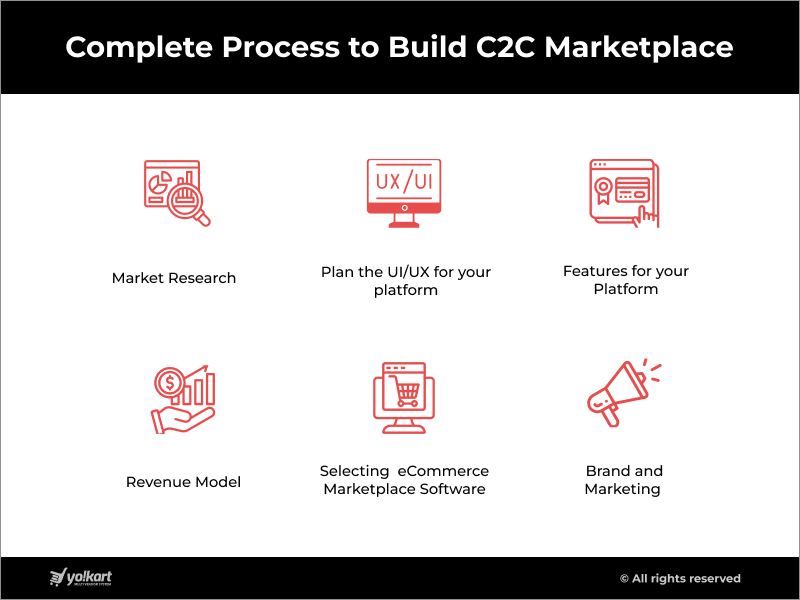
1. Market Research
When building a C2C marketplace platform, the first step is to determine the type of marketplace you want to create, for whom to create, and what should be included in the platform. Here everything would start with first identifying the target audience and understanding their needs. For instance, when the founders of Etsy worked with web developers with a specific user base, they came across several pain points. With that the idea to start their eCommerce business took shape, and the rest is history.
Another important consideration here is a competitive analysis. For instance, in the example shared above, the users were using eBay before Etsy was launched. However, eBay wasn’t able to provide a solution to their pain points. Moreover, the commissions were higher. Etsy in its strategy, catered to these pain points. Likewise, your competitive research will be the backbone of your business idea to start.
2. Plan the UI/UX (Front-End) of your platform
The visual design of your site plays a significant role in a user’s initial evaluation and impression. To ensure that your design effectively captures the user’s attention, it’s important to focus on elements such as layout, typography, images, and consistency.
The design should align with the purpose of the site. To create a design that is effective, simplicity is key. Along with appearance, it’s also crucial to ensure that users can easily find what they are searching for or complete desired actions with ease. In line with the principle of simplicity, the next important aspect of the design is visual hierarchy.
This involves arranging website elements in a way that guides visitors to the most important elements first. A Z-Pattern design follows the natural path of a reader’s eye movement, from left to right, top to bottom. The pattern starts at the top left corner and moves to the top right, then down the left side, and finally back to the right side. This pattern encompasses all four crucial elements of effective design: branding, call-to-action, structure, and hierarchy.
3. Identify Essential Features for your Platform
Incorporating eCommerce features that give your buyers a shopping experience they want to come back for; sellers an easy shopping experience; and finally you with the tools to execute your business strategy will be key to your success. Let’s see which features will be key in C2C eCommerce success.
Features pivotal for users (buyers and sellers):
- Easy Log-in: From the user’s perspective, the sign-up process can be a roadblock to their desired activities on the eCommerce platform. Expedite this process by creating an easy sign-up experience.
- Search & Filters: Empower your customers by providing them with a filtering option that allows them to be more specific about their preferences and hides products that are not their priority. This makes the search process more efficient and helps to improve their overall experience on your C2C marketplace.
- Easy-to-use product listing feature: While detailed product listing is key to all eCommerce, the simplicity of use is equally integral to C2C operations. Your users need to have an intuitive and capable product listing feature at their disposal.
- Buyer-Seller Communication: Implement communication channels that enable sellers to communicate with their buyers. Because a strong community is key to C2C interaction, such a communication channel is an important facet. Moreover, it also reduces the likelihood of order cancellations and returns.
- Dedicated Account Management: Provide the buyers and sellers with a personal user panel that offers complete information about their transactions on the C2C platform. Moreover, this would assist them to plan and personalize their activities on the platform.
- Request For Quote: If you are planning to build a C2C marketplace like eBay or Vinted, which can have products with flexible pricing, you should consider adding a “Make an Offer” button alongside product pricing. This enables the buyers to quote a price of the product to the sellers, enabling negotiations.
Start your C2C Marketplace with RFQ for price negotiations
- Product Listing Control: Provide the ability for the admin to oversee and manage the products uploaded by sellers, including the removal of any illegal or prohibited items. This helps to maintain the integrity and compliance of the C2C marketplace.
- Marketing & Promotion: The admin can boost the marketplace’s visibility by utilizing the integrated modules, leading to an increase in website traffic and an improved conversion rate.
- Reports & Analytics: Effective decision-making hinges on data. Give the Admin pivotal data insights with detailed reports and analytics.
- Content Management: The admin can effortlessly manage the content and make timely changes to align with the current market trends and demands.
4. Choose a Revenue Model
The selection of a revenue model is contingent upon the needs and objectives of your business. Nonetheless, the following are the commonly employed models by C2C marketplace businesses.
- Commission Model: Commission fees are another widely used revenue model in marketplace businesses. This model involves charging a fee for every transaction made on the platform, which can be collected from either the end customer, the seller, or both. This revenue model is highly effective as it generates revenue with every transaction.
- Listing Fee: The listing fee model involves charging users for every product/service they list on the platform. Listing fees are typically lower and more affordable than subscription fees, but this also means that earning a significant amount of revenue can be more challenging. As such, it may be a good idea to use this model as a secondary Revenue Stream.
- Subscription Model: The subscription fee model entails charging marketplace users a recurring charge for accessing the marketplace. This approach offers the advantage of predictability in terms of monthly revenue and has the potential to draw more users to platform.
- Monetizing Advertisements: Website banners and other real estate can be utilized to post sellers’ ads, in exchange for a fee.
To achieve optimal results, it is advisable not to limit yourself to one specific revenue model and instead consider combining multiple revenue streams.
5. Selecting the Right C2C eCommerce Marketplace Software
Some years back, you had to hire a team to code the entire website from scratch, test each aspect, deploy it, and wait for customer feedback. A highly resource-intensive task, that took hundreds/thousands of development hours, delaying your go-to-market strategy. Also, you have to pay for all these hours of development on a per hour basis, leading to the cost to develop jumping up significantly.
In the current day and age, you have the option of capable C2C eCommerce solutions. These help you to build a C2C e-marketplace website without unnecessarily coding the entire website. Only certain scenarios like integrating an enterprise’s legacy IT infrastructure, or any other particular requirements need a longer development process. Otherwise, it’s about choosing the right turnkey eCommerce solution.
It can be a challenging task to find the perfect C2C marketplace software with all the choices available, but if you evaluate the requirements of a C2C marketplace, then choose along these lines:Consider factors such as scalability, payment options, integrations, right C2C features,customer support, and costs. By considering these factors, you can select a C2C eCommerce software.
6. Strategize for your brand and marketing
After your C2C eCommerce platform has been deployed on the server, focus on the next step i.e. branding and marketing. A strong and lasting relationship with customers is crucial, especially in a highly competitive environment. To achieve this, it’s important to prioritize trust. This will allow customers to become advocates for your business, leading to increased brand visibility, attracting more customers, and ultimately boosting revenue. And to build trust, an effective brand strategy is pivotal.
To build your brand strategy, focus on understanding the value of your business. Convey this value via a simple to understand and relatable brand message. Base your marketing strategy on this message ― engage with your audience through authentic storytelling, leverage social media platforms for targeted advertising, implement SEO strategies to drive organic traffic, and leverage tools like email marketing to foster customer relationships.
Yo!Kart – Best C2C Marketplace Solution
Yo!Kart is an all-inclusive multi-vendor solution that has a customizable design, purpose-built C2C features, and robust technology, With Yo!Kart, business owners can easily create, launch, and scale their C2C platform. It provides entrepreneurs with the opportunity to start their marketplace with just a one-time-investment. Further, Yo!Kart offers the following:
- Capability to support C2C eCommerce model in multiple niches.
- A range of C2C eCommerce focused features.
- Easy to use, simplified user interface with a conversion focused system.
- Secure and versatile system with pre-integrated business APIs and 20+ payment gateways.
Book A Personalized Demo To See Yo!Kart In Action
Closing Thoughts
In conclusion, building a C2C eCommerce marketplace is a complex process that requires careful planning and execution. This process can be simplified if you choose the right C2C eCommerce solution, and have a well defined go-to-market strategy and a well formed business plan. With a purpose-built eCommerce website and the right strategies in place you can set forth with a business model that is defining contemporary online retail.
FAQs
Q. What is a C2C marketplace?
Ans: C2C is short for Consumer to Consumer. So, an eCommerce marketplace that provides a platform for consumers to sell or/and buy. In other words, users can conveniently register as buyers or/and sellers on the platform.
For instance, Etsy is a C2C marketplace. Sellers on the marketplace use the platform to sell their products. Additionally, they also use the platform to source raw materials on the platform as a buyer. So the same user can be a seller or a buyer on Etsy.
Q. What are the key considerations to make a C2C business model work?
Ans: Let’s again take a look at Etsy’s example. The marketplace implemented the following business strategies to achieve success.
- Offer an intuitive and convenient marketplace platform that allows users who are not business owners to do business on the platform.
- Provide supportive features for ease of business.
- Give a low barrier of entry to sellers with low commission rates, and more.
- Build a community just like Etsy has right from the start.
- Build a full ecosystem keeping the target users in mind with value-added services, seller workshops, and more to empower and encourage seller onboarding.
- Lastly, but significantly, create your brand identity in a way that resonates with the target audience with effective marketing strategies.
Q. What are the benefits of a C2C marketplace platform business?
Ans: There are some key benefits of a C2C marketplace platform and they all centre around the fact it is relatively easier to gain traction with the users.
For a start, it’s relatively easier to solve the chicken-egg conundrum, as sellers and buyers can be targeted using cohesive marketing strategies, so onboarding both simultaneously is easier.
Furthermore, a C2C marketplace is easier to scale up, as the same users can perform dual roles of sellers and buyers. Also, in such an ecosystem, users can identify with their peers, catalyzing a community effect within the marketplace. This can potentially lead to more users signing up, and enhance user engagement opportunities. With the right features, this opportunity can be leveraged to gain platform success.
Q. How will I attract users to my C2C marketplace platform?
Ans: You can attract users on the platform by following Etsy’s template success.
- User-friendly, engaging, and intuitive platform.
- Domain-specific features.
- Low commission rates.
- Effective marketing strategies.
Q. How do I choose the best C2C marketplace software?
Ans: It is recommended you choose C2C marketplace software that allows you to build a best-suited platform for C2C users. Some key parameters are as follows:
- No-code marketplace builders, that will require no coding from your side.
- User-centric Solutions that are built to offer logical, and easier workflows for efficient and intuitive management.
- SEO-ready solution with multiple features to upsell, and cross-sell.
- API-driven versatile interface that allows you to leverage third-party eCommerce services seamlessly.
- Customizability and scalability – that gives long-term viability for the business.
- Affordable solutions that do not require recurring investments in the form of subscription fees, transactional, or any other charges that can prove to be an impediment in the long run. Furthermore, this will also help you to minimize business overheads and extend the benefit to the users in the form of lower commission charges.
These are some, but essential and detrimental features that can help you to implement a C2C marketplace platform with greater chances of success.
Q. How to build a C2C marketplace platform?
Ans: The following steps can be adopted to build a C2C marketplace platform
- Perform market research, competitor analysis, and identify buyer needs.
- Identify the best-suited features to implement the business plan.
- Choose between custom-development and readymade solutions.
- Start lean with essential features, also known as the “MVP approach”. Scale as move on in the business, as per the feedback received from the early adopters.
- Start with a purpose-driven marketing approach that allows you to create a distinct brand voice in the market.
The post How to Build C2C Marketplace – Everything To Know appeared first on YoKart Blog.
]]>The post An Informative Guide to Build a Marketplace Like Noon appeared first on YoKart Blog.
]]>Noon is an eCommerce marketplace that was founded in the United Arab Emirates in 2017 by Mohamed Alabbar. The marketplace is headquartered in Riyadh, Saudi Arabia, and operates primarily in the Middle East, with a focus on the UAE, Saudi Arabia, and Egypt. It has experienced rapid growth since its launch and has also raised significant funding from investors to support its expansion.
Table Of Contents
- Tracing the Expansion of Noon – A Successful eCommerce Marketplace in UAE
- What Makes Noon a Popular Marketplace?
- How Does a Marketplace Like Noon Work?
- Revenue Generation Streams of Noon
- Essential Features Required to Build a Marketplace Like Noon
- How Can Yo!Kart Help to Build a Marketplace Like Noon?
- Signing Off
- FAQs
Tracing the Expansion of Noon – A Successful eCommerce Marketplace in UAE
At the outset, Noon encountered several unique challenges such as building trust among consumers. If that was enough, the postal system of Saudi Arabia was also unreliable as a major chunk of consumers did not have home addresses and collected their mail from the post office. To overcome these fulfillment challenges, Noon kept its delivery and fulfillment services in-house.
Noon seeks to own 15% of the eCommerce market by 2026, approximately $70 billion worth. As of 2021, Noon had over 20 million products listed on its platform, and it has become one of the top eCommerce companies in the Middle East.
In addition, as Noon is a venture of Emaar Group, one of the largest real estate developers in the region, it enabled Noon to open physical stores that offer its customers a chance to experience the products before buying them online. The perks of launching a marketplace like Noon are unparalleled and almost every aspiring business owner dreams about setting foot in this flourishing sector.
If you are also one of them, then we have a detailed guide to let you acquire knowledge about building a similar marketplace like Noon. By the end of this guide, you will have a good understanding of what it takes to launch a successful marketplace and be well on your way to creating your own eCommerce platform.
What Makes Noon a Popular Marketplace?
Noon is a popular marketplace known for several key reasons and benefits that set it apart in the competitive eCommerce landscape.
Diverse Product Range
Noon offers a vast array of products across numerous categories, ranging from electronics, beauty, fashion, groceries, home essentials, etc. This extensive selection caters to a wide range of customer preferences and needs, making it a one-stop shop for customers to meet their needs.
Convenience and Accessibility
Noon’s user-friendly interface, intuitive mobile apps, and website design prioritize ease of use for customers. Furthermore, its seamless browsing experience, coupled with multiple payment gateways ensures hassle-free shopping experiences.
Competitive Deals and Pricing
The platform frequently provides attractive discounts, deals, and offers, enhancing its appeal among cost-conscious customers. Seasonal sales, regular promotions, and exclusive deals make Noon a more enticing and affordable platform.
Improved Brand Recognition
Noon’s brand recognition is derived from its capability to quickly attract a large number of buyers and sellers. This platform facilitated multiple businesses with access to a large customer base and opened doors to customer engagement and retention.
It’s worth noting that building a marketplace like Noon will require a lot of effort and resources and when done well, it can be a very rewarding and profitable venture.
High scalability
Noon’s partnership with diverse sellers and wide range of offerings fueled its popularity and scalability. Moreover, with the increasing number of buyers and sellers on the platform, Noon’s revenue increased.
Leverage the Benefits Of Building a Marketplace Like Noon
It’s worth noting that building a marketplace is not an easy task and requires a lot of effort and resources, but if done well, it can be a very rewarding and profitable venture.
How Does a Marketplace Like Noon Work?
Let’s dive into how a marketplace like Noon works.
The platform allows sellers to list their products for sale, and buyers to browse and purchase those products.
- Sellers register with the platform, and once their account is approved, they can list a wide range of products on the platform.
- Buyers can browse and purchase products through the website or mobile app. They can search for products by category, brand, price, and more.
- Once a buyer has found a product they want to purchase, they can add it to their cart and proceed to checkout.
- Multiple payment options, including credit cards, cash on delivery, and online banking are available. Once the payment has been processed, the platform will arrange product delivery to the buyer.
Overall, Noon works as a platform that allows customers to browse, purchase, and get products delivered, and also provides customer service support for both buyers and sellers.
Revenue Generation Streams of Noon
Overall, Noon generates revenue through a combination of commissions on sales, advertising, delivery fees, subscription service, and physical store sales.
- Commission: Noon charges a commission on every sale made on the platform, which is typically a percentage of the total sale price. The commission varies depending on the product category, and sellers set their own prices.
- Advertising: Noon also generates revenue through advertising. Companies can advertise their products on the platform, allowing them to reach a larger audience.
- Delivery fee: Noon also charges a delivery fee for each order placed on the platform, which is typically a flat fee.
- Subscription service: Noon also generates revenue through a subscription service called “Noon Prime”, which is a membership program that offers free and fast delivery, exclusive deals, and more to customers who pay a monthly or annual fee.
Ready to Unlock the Revenue Potential of Your Marketplace Like Noon?
Essential Features Required to Build a Marketplace Like Noon
Building a marketplace like Noon requires several essential features to be implemented to provide a seamless and efficient experience for both buyers and sellers. Some of the essential features required to build a website like Noon include:
| Features | Description |
| User Registration and Authentication | Allows buyers and sellers to register and create an account on the platform, and also secure the registration process. |
| Product Listing | Sellers can list a wide range of products on the platform, from electronics and fashion to home goods and more. Sellers must register with the platform, and once their account is approved, they can list their products for sale. |
| Product Management | Enables sellers to manage their inventory including adding, editing, and deleting products. |
| Search and Filtering | Buyers can search for products by category, brand, price, and more. This makes it easy for buyers to find the products they are looking for. |
| Shopping Cart and Checkout | Buyers can add products to their cart and proceed to checkout. Noon offers several payment options, including credit cards, cash on delivery, and online banking. |
| Customer Service | Provides customer service to both buyers and sellers, including assistance with returns, exchanges, and refunds. |
| Delivery and Tracking | Manages product delivery and provides tracking information so that the buyer can track their order. |
| Mobile Apps | Mobile apps allow customers to access the marketplace on the go and make purchases. |
| Order Management | Allows customers to track the status of their orders, manage their delivery address, and track and cancel orders. |
| Analytics and Reporting | Admin(s) can track and analyze data such as sales, customer behavior, and performance of products. |
| Security | This feature is crucial to ensure that the platform is secure and protects the personal and financial data of customers and sellers. |
Planning to Launch a Feature-Rich Noon-Like Marketplace
How Can Yo!Kart Help to Build a Marketplace Like Noon?
Yo!Kart is a pre-built, customizable eCommerce marketplace software that can be used to build a website like Noon. It offers features such as multi-vendor support, product management, order management, and payment gateway integration. Yo!Kart also provides a variety of templates that can be used to give the marketplace a unique look and feel.
Additionally, Yo!Kart has built-in SEO-friendly tools which help to increase the visibility of your marketplace. To build a marketplace like Noon using Yo!Kart, you would need to purchase a Yo!Kart license, set up hosting for your marketplace, customize the platform to suit your specific needs, and then add your vendors and products to the marketplace.
Once your marketplace is built, you will need to launch and promote it. This will typically involve creating a marketing plan, as well as setting up social media and email marketing campaigns. You will also need to optimize your site for search engines, as well as create and publish content that will attract customers and vendors to your platform.
Start Your Noon-Like Marketplace Using Yo!Kart
Signing Off
In conclusion, building a marketplace like Noon is a complex and challenging task, but it can also be a rewarding one. With the right strategy and tools, you can create a platform that attracts customers, vendors, and partners, which helps you to grow your business. By following the steps outlined above, we hope you are ready to establish your eCommerce marketplace like Noon.
Don’t Miss Out on the Opportunity to Build Your Marketplace Like Noon
FAQs
Q1. How much does it cost to build a marketplace like Noon?
Ans: The cost to build a website like Noon varies based on features, design, complexity, development time, and more. Usually, the costs range from hundreds to thousands of dollars. Even opting for the right development impacts the expenses. MVP approach focuses on integrating essential features, reducing initial expenses but requires scalability later. On the other hand, leveraging eCommerce software may cost less upfront. So, efficient planning, having a clear outline of features, and choosing the right approach can help manage expenses and build a marketplace like Noon.
Q2. How much time does it take to launch a business like Noon?
Ans: The timeline to launch a business like Noon depends on multiple parameters like market research, development process, resource availability, team expertise, tech stack, marketing strategies, and so on. Besides, it depends on the chosen development approach. Opting for a custom-built approach may take a few months while using a readymade eCommerce software can help launch a business like Noon in a few days.
The post An Informative Guide to Build a Marketplace Like Noon appeared first on YoKart Blog.
]]>The post Role of Inventory Management Module in an Online eCommerce Platform appeared first on YoKart Blog.
]]>Inventory management, in reality, is a careful balancing chore, where business owners need to ensure they have sufficient stock to not run out of a product while also making sure the stock is not in excess being dumped in the warehouse.
Implementing the best practices for inventory management provides full visibility of every phase to the entrepreneurs and even prepares them for the unexpected. If not executed correctly, businesses may run a considerable risk of failing to meet customer demands and eventually losing money.
Table Of Contents
-
1. Choose the Right Inventory Management Technique
2. Calculate Inventory Turnover Ratio
3. Initiate Barcode Scanning of Products
4. Figure Out Safety Stock Levels
5. Plan Seasonal Inventory
What is eCommerce Inventory Management?
The simple process of sourcing, storing, tracking, and shipping physical products is referred to as inventory management. It can be leveraged by eCommerce businesses to increase efficiency and reduce operational costs. Efficient inventory management requires real-time information on the available stock, its price, and how long to keep it to make sure there is sufficient stock to fulfill orders.
As the business scales and the number of products increases, it becomes more challenging to manage inventory. Therefore, informed forecasting along with insightful comprehension of the business is required to identify which products are in stock, overstocked, understocked, and out of stock. And, all of these can be achieved with the help of the right inventory management system that can seamlessly fit into the supply chain management.
Common Challenges of eCommerce Inventory Management
No matter if you are a new online store, a small business, or a veteran online retailer, any business can fall prey to the challenges of eCommerce inventory management if not handled properly. Knowing these challenges ahead of time and the right approach to address them can help solve them before they become huge problems and hindrances to the successful running of the business.
Below are some of the most common challenges encountered while managing the eCommerce inventory affecting the growth of the business.
Overstocking & Overselling
It is essential for eCommerce businesses to grasp the purchasing patterns of their customers to prevent overstocking and overselling. Overselling refers to when a business sells the last of a certain product to multiple buyers and overstocking is when a business has bought too much of a certain product.
Overselling eventually results in order cancellations which negatively impacts the customer experience and satisfaction, whereas, overstocking diminishes the profit margin of the products. Forecasting accurate demand is the key to stopping this cycle. Automated inventory management is an effective way to precisely forecast the demand and how much stock will be required in the upcoming days or months.
Know How a Readymade eCommerce Platform Can Streamline the Inventory Management Challenges
Unsynced Inventory Across Channels
At the outset, businesses start with a single sales channel and a single warehouse to store inventory. As the business scales, multiple online sales channels like marketplaces, social media platforms, etc., and warehouses are required to keep up with the business requirements. However, it becomes difficult to manage the inventory and sales via multiple channels.
Receiving an order for an out-of-stock item reflects that the sales channel is not in sync with the updated inventory. This is a common challenge for businesses that are aggressively expanding to new sales channels. A proper inventory management system will be required to keep track of multiple warehouse processing orders, how much stock is left in the inventory, and so on.
Lack of Data Insights
This is another major challenge for eCommerce businesses when there is an increase in product demand and inventory management becomes more complex, eventually affecting future strategies. Merely having the access to the inventory data is not sufficient, having the knowledge and comprehension of utilizing that data to its fullest is also required for business owners.
As an example, ordering products from vendors takes a certain amount of time to deliver. However, the amount of time is not the same for every vendor. Some might deliver the product the next day, while some may take a week or so, which will certainly affect the delivery time to your end customers.
So just having the data with you is not sufficient, business owners should also have the know-how of using those insights for the smooth functioning of their business.
Common Practices for Seamless eCommerce Inventory Management
Considering there are no two businesses alike, there is no “one size fits all” strategy for efficient inventory management. However, the adoption of quality inventory management strategies is required to streamline the operations in an eCommerce business. Let’s have a look at some of the most beneficial and useful inventory management strategies out there to ensure seamless business operations.
Choose the Right Inventory Management Technique
There are multiple inventory management techniques that offer greater flexibility for eCommerce of various sizes and industries. Common techniques are:
1. Just In Time
As the name indicates, this technique involves stocking the product each time a customer requests it so that the volume of inventory is equal to the orders fulfilled. Needless to say that this approach offers huge cash savings, however, it can also affect adversely if the demand rises unexpectedly.
2. First In, First Out
FIFO indicates that the items received first at the warehouse are to be dispatched first to the end customers. This approach helps businesses to keep the stock as fresh as possible by moving the older stock to the front for dispatching. FIFO is ideal for food and beverage businesses where they deal with perishable items.
Implement Robust Inventory Management and Get Complete Control Over Your Stock & Beyond
3. Dropshipping
Also referred to as the “anti-inventory” inventory management model, this approach involves keeping the shipping to the manufacturer itself. As a client places an order, businesses fulfill it from the manufacturer and ship it to the customer. Beneficial for businesses that are new or do not wish to invest in a warehouse or storage facility.
4. 3PL (3rd Party Logistics) Fulfillment
This inventory approach involves outsourcing the fulfillment to a third-party service provider who is well-versed in managing the inventory and monitoring compliance. 3PL is ideal for businesses that do not wish to invest their time in order fulfillment and instead work on expanding their business.
Calculate Inventory Turnover Ratio
Knowing the inventory turnover ratio helps businesses to forecast and ensure that the products remain in stock. The number reveals many insights into the business’s performance and is also used to determine the next steps of the business like forecasting, stocking, sales, and marketing. It also helps business owners decide whether to scale the inventory or not, depending on the product’s performance.
Initiate Barcode Scanning of Products
Barcode scanning is an inexpensive way to track the status of the products that are received, moved, shipped, or altered. This is a recommended practice as the manual approach is vulnerable to errors, inaccurate SKU numbers, and mistyped inventory data which can result in huge expensive losses. This becomes more tricky if the business expands beyond a few products.
Figure Out Safety Stock Levels
Understanding the safety stock levels safeguards businesses by assuring the minimum level of stock required at all times. This number should be maintained by all business owners unless they are dealing with food or perishable items. This minimum stock level depends on a couple of factors – product demand and time taken to restock the item.
Plan Seasonal Inventory
The sales of your products are not similar at every time. Sales are at their peak at certain times like Black Friday and Christmas. Therefore, it is important to plan your inventory as per the seasonal picks and drops, otherwise, you have the risk of having surplus stock or not having enough stock.
Benefits of Using an Inventory Management System for Your eCommerce Business
Till now, one thing is quite clear; managing eCommerce inventory is not an easy task. There are multiple challenges such as orders, inventory, shipping, accounting, and many more. Fortunately, there are a number of systems available that make all the mess and chaos easier to manage. They are highly beneficial for the eCommerce business for several reasons, including:
Real-Time Stock Counts
Effective inventory management systems provide data on real-time inventory which is an important ingredient for the success of the eCommerce business. It increases gross profit, improves control of allowances, reduces losses, and minimizes waste. As soon as an item goes out of stock, the business owner is instantly notified to respond accordingly.
Business owners can then evaluate the insights and decide when to refill the stock to meet the ongoing goal and targets.
Discover the Best Mutual Fit For Your eCommerce Business
Automatic Reorder Points
This is another remarkable benefit of implementing an inventory management system. Accurate reorder points can be identified automatically and easily with an inventory management system notifying business owners when restocking is required. What’s more, these systems also allow enough time for the new stock to arrive before the in-stock items are sold out completely.
All of this enables businesses to optimize their warehouse spaces easily, eventually reducing inventory costs.
Safety Stock Level Setting
As discussed above, maintaining a safe stock level is important for eCommerce businesses to mitigate the risks associated with the out-of-stock situation and be prepared to fulfill the orders in case of any unforeseen circumstances in demand and supply. An inventory management system helps monitor safety stock, identifies inaccuracies in forecasting, and avoids stock-outs to keep customer satisfaction high.
Many inventory management systems are also incorporated with features to automatically place new purchase order requests once the safety stock number is reached.
Accurate Inventory Across Channels & Warehouse
One of the most crucial as well as overlooked and undervalued components of eCommerce business is accurate inventory levels. However, an eCommerce inventory management system tracks and keeps records of accurate inventory levels across all the sales channels and warehouses. It tracks the fulfilled orders on all the sales channels and manages the inventory levels in an easier and more efficient way than manual or excel programs.
The eCommerce inventory management when done manually, results in human errors which add up and costs the company profits in the long run. Automatic systems, on the contrary, are self-sufficient and deliver accurate and reliable results in less time and energy from business owners.
Yo!Kart – A Powerful eCommerce Platform with Robust Inventory Management Module
Yo!Kart is an award-winning eCommerce platform with an impeccable inventory management system that empowers business owners to run their entire multi-vendor eCommerce marketplace from a single interface. It helps automate and improve inventory practices and help keeps customers happy by always having the goods they want in stock.
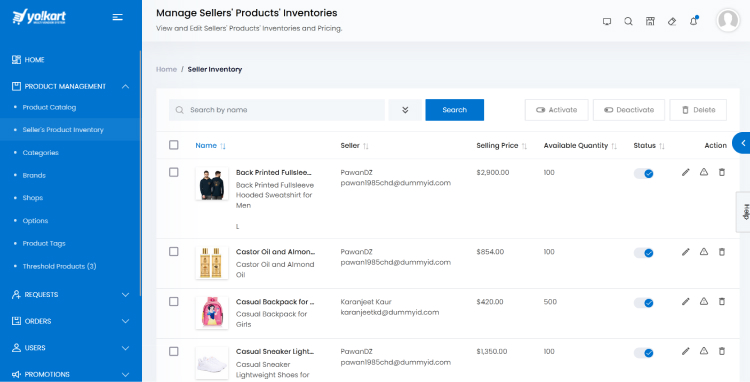
The inventory management module in Yo!Kart addresses every need in supply chain management and allows businesses to expand and grow across multiple sales channels. The suite of inventory management and control features including multi-location inventory management, warehouse and fulfillment management, automated stock replenishment, lot and serial tracking, and cycle counting makes it the perfect eCommerce platform.
It helps businesses to cut down on labor costs through its powerful features by pricing the products effectively while delighting the customers with excellent service. There is a lot more that goes into inventory management than just keeping the track of stock. And, to ensure optimal availability at the right costs, businesses can rely on Yo!Kart.
The inventory management system of Yo!Kart is built with keeping the entire eCommerce process in mind providing a holistic approach to the entire supply chain. Yo!Kart provides visibility and support to your business so you can provide your customers with an incredible shopping experience.
Streamline Your Inventory and Grow Your eCommerce Business With Yo!Kart
The post Role of Inventory Management Module in an Online eCommerce Platform appeared first on YoKart Blog.
]]>The post Building a Marketplace like Poshmark appeared first on YoKart Blog.
]]>The trend of gently used pre-owned items is blowing up across the internet and getting more attention than usual these days. This is the result of growing consumer spending and rising demand for sustainable consumption methods. People are more and more relating to the quote “Make second hand the first choice”.
Traditionally, the thrift industry would rely on customers who would buy the previously-owned goods out of necessity, however, customers today are more aware and wish to contribute towards reducing the carbon footprint on the planet. Besides, thrift shopping also allows shoppers to buy cool and branded stuff on less budget which otherwise costs a lot.
All these factors combined have opened avenues for resale brands like StockX and ThredUP, which are believed to experience an uphill demand curve in the near future. Another popular name in this industry that holds center stage and is operating for 12-odd years is Poshmark.
Table Of Contents
- What is Poshmark?
- How Does a Marketplace Like Poshmark Work?
- How Can a Website Like Poshmark Make Money?
What is Poshmark?
This global online social marketplace allows users to list out their unwanted yet good-quality pre-owned clothes and accessories for the buyers to shop the closet and boutiques at affordable prices. Complimenting the trends of online shopping, Poshmark makes luxury brands more affordable to customers.
Founded by Manish Chandra, Tracy Sun, Chetan Pungaliya, and Gautam Golwala in 2011, the company has over 80 million users and over 200 million available listings. Poshmark has raised a total of $153 million in funding over 7 rounds. The company went public in 2021 at a valuation of over $3 billion and also announced its first acquisition.
If you are an aspiring entrepreneur and interested in the idea of a second-hand clothing app, here is an analysis of the Poshmark business that can help you build a similar marketplace of your own.
How Does a Marketplace Like Poshmark Work?
Before business owners plan to build a platform similar to Poshmark, it is essential for them to understand the working of this marketplace. The working of Poshmark is simple and works just like any other eCommerce marketplace.
- The sellers visit the platform and create an account. Upon registration, the sellers can list the items by adding product images, images, and detailed descriptions.
- Once the order is placed and the payment is made, the sellers take a printout of the shipping details and paste it on the item. The partnered shipping company then either collects it from the sellers’ addresses or gets it dropped off at the nearest mailbox.
- The item is then delivered to the buyer and Poshmark releases the payment to the sellers.
- Buyers can register on the marketplace and browse and search for products based on multiple parameters. Also, they can explore ratings and reviews to make informed decisions regarding the product purchase.
- The buyers and sellers can also attend the posh parties and virtual buying & selling events on the app. These parties have a wide variety of products and there is definitely something for each buyer.
Launch an eCommerce Marketplace Like Poshmark
How Can a Website Like Poshmark Make Money?
Now that we have discussed the working of a peer-to-peer marketplace like Poshmark, let’s discuss how it earns money. Poshmark’s current revenue (TTM) in 2022 is $.35 billion. Firstly, let’s explore the revenue generation streams of Poshmark, and then we can discuss the other possible revenue channels.
Seller Fees
This is one of the most common revenue generation streams of any marketplace. Sellers pay a fixed amount of fee to the marketplace when they sell any item on the marketplace. This fee does not burden the sellers as they only pay when they earn. Poshmark charges $2.95 on all sales under $15 and 20% on sales above $15.
Shipping Fees
Buyers pay a fixed shipping fee for every package they order. Poshmark offers some special discounts and offers on shipping fees on certain occasions.
These are the two ways Poshmark uses to generate revenue. Apart from this, a marketplace like Poshmark can earn revenue in multiple other ways.
Listing Fees
The marketplace can charge listing fees from the sellers to list their products on the marketplace. This is a potential revenue generation channel as every seller will need to list their products every now and then.
Promoted Listing
Marketplace can charge additional fees from the sellers to promote their listed products for more visibility and reach.
Unlock the Full Potential of Your Poshmark-Like Marketplace
USPs That Stack Poshmark Against Its Competitors
Poshmark significantly stands out from other C2C marketplaces in the market because of the assurance of the quality of the products it offers. In terms of features and functionality of the marketplace, Poshmark surpasses its competitors. Let’s have a look at the USPs of Poshmark that differentiate it from its rivals.
Reserve Product
Whenever two buyers are simultaneously moving ahead with the purchase of the same product, the one who makes the payment first owns the product. However, the “Reserve Product” feature in Poshmark helps the buyers to flag the products for 10 minutes to enter details and complete the purchase.
This way, even if a buyer is struggling with a slow internet connection or even abandons the cart, the product will only be available for other buyers after 10 minutes.
Bundle Buy
The bundle buy feature in Poshmark allows the buyers to ask the seller to create a bundle of the products and send the entire package together when purchasing multiple products from a single seller. The buyer receives the entire package as a bulk delivery which provides ease of shopping to the buyers.
Feed Stories
Almost every social media platform has a story section and Poshmark also has a similar feature. Sellers post stories of the products which are visible to the following users in their app feed section for 48 hours. Clicking the tagged item will redirect the buyer to the seller’s closet to make an offer. This feature ultimately increases the organic user engagement of the products and sales.
Essential Features Required to Create a Website Similar to Poshmark
When it comes to building a similar marketplace development, it is crucial to recognize and differentiate between the basic and advanced features of the marketplace. Below we have segregated the features that are required for the MVP development and the features that will make the platform more sophisticated in terms of functionality. Without any ado, let’s proceed.
Features to Build an MVP of Poshmark
- Likes/Comments: Buyers should be able to like the products they wish to buy and can later view all the liked products. They should also be able to comment on the listed products to get more information.
- One-Click Order: Users should be able to buy the products with a single click and be redirected to the payment gateways and check out.
- Notifications: Users should be notified of any message that might be of any interest to them such as order placed, special discounts, etc.
- Registration: Users should be able to register and create an account using their email addresses, phone numbers, or social media accounts.
- In-App Chat: Users should be able to chat with other users on the platform to gain more information on the product.
- Search: Users should be provided with an in-app search option to find the exact product they are looking for.
- Social Media Sharing: Sellers should be able to share their listings on the social media platform to increase their visibility.
Discover the Set of Features for All Stakeholders
- Product Listing: Sellers should be able to list the products on the platform along with the price and description.
- Feed Section: Users will be able to see the listings on their feed from the closets they are following.
- Inventory Management: As soon as a product is sold, it should be updated in the inventory to avoid overselling.
- Multiple Payment Options: To make it more convenient for the buyers, they should be provided with multiple payment options.
- Filters: Buyers should be able to filter the products based on brands, price, category, etc.
- Pre-Addressed Labels: Sellers should be able to print pre-addressed labels to be stuck on the order boxes.
Advanced Features to Create a Website Similar to Poshmark
- Pickup From Home: Sellers can get the orders picked up from home and get them delivered to the shipping address.
- Price Drop Notifications: The buyers should be notified if the price of their liked products drops or if there is a special discount on that product.
- Reviews/Ratings: Buyers should be able to rate and review their bought products.
- Community: Users should be able to connect with each other and have discussions regarding fashion, style, and preferences.
- Love Notes: Sellers’ closet page should be able to publish the five-star ratings received by the buyers as love notes.
- Make an Offer: Buyers should be able to ask for discounts from the sellers on the platform.
- Offer Discounts: Sellers should be able to offer special discounts to the buyers.
- Favorite Seller: Buyers should be able to mark their favorite sellers and get a notification every time the seller lists a new product.
- Order Tracking: Buyers should be able to track their orders to know their status.
How Can Yo!Kart Help to Create a Website Like Poshmark?
Yo!Kart is a leading customizable turnkey marketplace solution that can be used to create a website like Poshmark. The core of more than 5000 eCommerce marketplaces around the globe, this ecommerce platform has robust features for the admin to manage the business effectively, vendors to sell hassle-free, and buyers to shop happily.
The platform has been purpose-built for eCommerce marketplaces and evolved to offer more ease and scalability to business owners. Once live, Yo!Kart manages everything from vendor onboarding to leveraging third-party integrations and order fulfillment to seller payouts, and everything. This platform is a one-stop solution to manage all your products, customers, orders, and everything under one roof.
FAQs
Q1. How much does it cost to build a website/marketplace like Poshmark?
Ans: The cost of building a website like Poshmark depends on multiple aspects including the website’s complexity, the specific set of features required, and the need for technical skills and coding expertise. Besides, the choice between readymade eCommerce software or outsourcing the marketplace building needs to the custom development company will impact the overall cost.
Q2. How much time does it take to build a Marketplace like Poshmark?
Ans: The time required to create a similar marketplace to Poshmark varies based on the development approach followed. The custom development process involved market research, planning, and designing, followed by many other steps impacting the timeline, typically spanning from 6-12 months. On the other hand, leveraging eCommerce software reduces the timelines, taking around a week for setup, configuration, and customization.
Q3. How does Poshmark Work for Sellers?
Ans: Poshmark allows sellers to list items by uploading photos, adding descriptions, and setting prices. Poshmark handles the transaction process, deducting a fixed percentage of earnings as commission fees. The sellers can leverage multiple tools to track sales, manage inventory, and promote listings. Furthermore, sellers can gain exposure to a huge customer base and deliver exceptional shopping experiences to the customers.
Q4. How does Poshmark Work for Buyers?
Ans: Buying on Poshmark includes multiple steps. Firstly, buyers will register on the platform. Upon successful registration, they can browse through a wide range of product listings, filtering by preferences, and wishlist the desired items. Once chosen, the sellers can place the order and make the payment at the time of delivery. Buyers can expect a straightforward buying experience with secure transactions, buyer’s data protection, and a user-friendly interface.
The post Building a Marketplace like Poshmark appeared first on YoKart Blog.
]]>The post Everything You Need to Know About Building a Pet Products Marketplace appeared first on YoKart Blog.
]]>The modern lifestyle has created unprecedented opportunities in various niche markets of which the online pet products business was previously overlooked. However, unlike a few years back, the pet care industry has evolved. Several factors propelled the demand for pet-related products like an increased number of pet owners and a heightened focus on pet health and wellness. Statistics define these trends:
- The pet-related products market continues to evolve with more than 66% of US homeowners owning a pet.
- A report by the American Pets Product Association showcases total pet spending in the US has reached $143.6 billion in 2023.
Besides, the convenience and accessibility offered by smartphones have significantly encouraged the proliferation of online pet product marketplaces. Key players like Chewy, Petco, and more have played pivotal roles in facilitating this market expansion, offering diverse product selections and convenient shopping experiences to pet owners.
So, given the trends eminently driving pet product sales, it seems a great idea for aspiring entrepreneurs to delve into this lucrative market.
How to Start an Online Pet Products Business?
Conclusion
FAQs
Popular Players in the Online Pet Products Industry
Let’s explore some prominent players dominating the online pet products industry.
PetSmart
PetSmart, founded in 1986 stands as a prominent player in the online pet supplies market offering diverse products and online services like grooming and veterinary care in addition to its numerous brick-and-mortar locations. It offers a wide range of pet supplies for birds, cats, fish, dogs, and other small pets.
Their loyalty program, Pet Treats, boosts customer engagement through personalized offers and discounts, setting them apart in customer retention strategies. Moreover, PetSmart provides convenient options like ordering online and picking up items bought from physical stores, and scheduling an appointment at their grooming salons.
PETCO
Founded in 1956, PETCO has positioned itself as a prominent player in the online pet supplies market with revenue exceeding $6 billion. The marketplace is ideally known for its broad array of products along with grooming, veterinary services, and pet adoptions.
PETCO’s subscription-based repeat delivery service simplifies purchases, ensuring customer convenience and loyalty. Additionally, the marketplace provides same-day shipping for most purchases, along with special savings for curbside pickup and recurring deliveries.
Chewy
Chewy is an online pet product marketplace founded in 2011 with a vision of enabling pet owners to shop for their furry companions. With time, it evolved into a comprehensive platform reporting around $10.099B in revenue in 2023.
Chewy emphasizes personalized customer care, including 24/7 support and a wide range of pet-related products like foods, beds, toys, and more. Their auto-ship feature offers scheduled deliveries, ensuring pet supplies arrive on time. Moreover, its dedication to pet wellness, coupled with subscription services and speedy delivery, distinguishes Chewy as a trusted and convenient marketplace for pet owners.
PetFlow
PetFlow, a leading pet products marketplace in the US, has evolved into a comprehensive hub catering to all pet needs. Its beginning stemmed from a desire to simplify pet ownership by offering a wide array of quality products conveniently delivered to doorsteps.
The key aspect that sets PetFlow apart from other marketplaces is its expansive array of pet supplies. Spanning from pet treats and toys to grooming products, the platform offers a wide selection catering to dogs, birds, cats, and other small animals. Exceptional customer service coupled with a user-friendly interface and commitment to pet well-being set it apart as a go-to destination for pet parents everywhere.
How to Start an Online Pet Products Business?
There’s nothing more fulfilling than starting a business in an industry that is in demand and is equally rewarding. The pet products marketplace can be a business that provides entrepreneurs with income for years to come. Let’s look at some critical steps to create a pet products marketplace.
Conduct Market Research
Before entering the business, you must learn about the pet industry. Research and analyze the pet store market to identify the target audience and gain in-depth insights into your competitors. Also, knowing the trends of the industry like the most bought items can offer a competitive edge in the market.
Pick Your Business Vertical
Pet products businesses come in different forms, some provide everyday supplies like food, bowls, and toys that are in demand while others offer unique and innovative products. The goal of every business is to find a niche that is sustainable and distinct enough to let them uniquely brand their business.
Pet Supplies
Every pet owner requires pet supplies like food bowls, toys, and leashes. Although the competition is immense in this domain, entrepreneurs should not get tricked by missing the huge opportunity here. Usually, a market overflowing with options makes it hard for customers to decide what to purchase resulting in no purchase at all.
Startups, in this scenario, can come up with one-of-a-kind brands with a USP putting them in a better position to let customers purchase from them. Pet supplies include:
- Food bowls, leashes
- Houses, cages, beds, litter boxes
- Collars, combs
- Toys
- Birdhouse, bird feeders
- Fish bowls, aquariums
Pet Food/Treats
The pet food market is also growing immensely as pet owners are increasingly becoming health conscious and like to provide their pets with the best kind of food. This provides an opportunity to cater to them with healthier options for their pets. Innovative food products that are nutritious and healthy will surely attract pet owners.
Customized treats for pets with dietary restrictions can also be considered. Soft treats like kibble, dried meats, and a whole lot of things can also be thought of to set your business apart and unique.
Pet Clothes/Apparel
Pet apparel can also be an exciting new avenue to explore as clothing for pets has become increasingly popular over the last few years. Pet owners are particular about their pets’ fashion choices as their own and to cater to these fashion choices there are lots of shirts, outfits, and accessories designed for them. This niche is easy to reign as there is not much competition. Moreover, the nature of this low-risk business venture allows business owners to focus on marketing their businesses.
Build A Successful Pet Clothes Marketplace
Innovative Products
New innovative products in the market based on the needs of pet lovers can also be sold on marketplaces. These products can be anything from creative pet accessories to health care products and luxury pet products.
- Pet GPS tracker
- Car seat for home and travel
- Food-preserving containers/boxes
- Cleansing pet bathers
The numbers and the type of pet products businesses show that there is tremendous growth in the market size and still a huge room for growth. However, a significant thing to consider is which trends will drive the growth. Let’s have a quick look at the trends.
Choose the Revenue Streams
Every business is created to generate revenue through it, so it is significant to have clear revenue streams. There are multiple revenue generation channels and a couple or more can be combined to serve the business better. Here are the options for possible revenue channels:
Commission
A percentage cut from the revenue of sellers on the marketplace. For instance, Petco charges a percentage from sellers for leveraging its platform to reach a larger customer base. Thus, ensuring a continuous flow of revenue while providing a diverse selection of pet products.
Advertisement
Extra percentage cut from sellers to list them on the most prominent places for more visibility. For example, PetSmart uses advertisements as an additional revenue stream. Vendors can pay an extra percentage to have their products displayed on Petsmart’s website. It enhances product visibility, effectively attracting more customers and generating additional income.
Merchandise
Businesses can choose to offer company-themed branded merchandise to boost revenue. For instance, Chewy has its respective branded merchandise, ranging from pet supplies to apparel, creating an additional revenue stream while strengthening brand loyalty among its customer base.
Decide Features to Include
Cutting-edge features in the marketplace make it more unique and feature-rich which ultimately leads to being more liked by the users and target audience. Here are some of the basic features of a pet products marketplace for each of its users:
Customers
- Register via email or social media profile
- Manage Personal Profile and Settings
- Search and view Pet products
- Secure online payments
- Manage Profile
- Push updates/notifications
- Reviews and Ratings
- Mobile wallet integration for quick payments
- Get customer support via Chat or Call
Sellers
- Register and Login
- Create & Manage Profile
- Seller Dashboard
- Manage products
- Accept Payments
- Chat with Customers
- View/Get ratings and Review Alert
- Generate Revenue Analysis Reports
Admin
- Secure Login
- Manage Customers & Sellers
- Manage Purchases/Commission/Offers/Promo/Discounts
- Create/Update FAQ, Term, and Policies
- Provide Technical & Customer Support
- View & Manage Billing/Invoice/Reports
- Manage Reviews, Ratings & Feedback
- Verify Sellers
- Chat Module To Provide Customer Support
In addition to this, below mentioned are some advanced features that can also be integrated into a pet products marketplace.
- Social Media Integration
- Loyalty Rewards
- Product Comparison
- In-app Chat
- Revenue Analytics
- Seller Verification
- 360-degree Products View
- Voice Assistant
- Social Sharing
- Multiple Payment Options
- Multilingual
- Multi-Currency Support
Choose Development Approach
The last and final step is to select the development approach. The two development approaches to building a pet products marketplace are either developing the platform from scratch or investing in a turnkey solution.
1. Custom-Built Approach
Developing from scratch requires a development team that will include designers, developers, testers, and many more. Also, the time and cost of developing from scratch are higher when compared to a readymade solution.
2. Leverage Readymade Software
The readymade eCommerce software is equipped with core marketplace features and functionalities, decreasing the cost and time associated with the development process. Moreover, it reduces the time-to-market of the platform, incorporating the unique capabilities that resonate with the user’s wants.
Now that you have explored the key players in the pet supplies industry and are looking to build a similar marketplace to aforementioned players like Chewy, Petco, and more, it would be ideal to utilize readymade eCommerce software. Yo!Kart is one such off-the-shelf eCommerce solution that can be used to build a pet products marketplace with all the features mentioned above. This is the ultimate customizable solution for business owners who are looking for a feasible product for their pet products store.
Conclusion
There’s a whole world of opportunities in the pet products market with multiple business verticals to hop into, from pet treats to dog grooming and more. However, it is essential to assess the key players and their strategies that help them flourish and position themselves in the industry. Additionally, leveraging Yo!Kart can help build a marketplace that is equipped with essential functionalities and facilitates efficient buying and selling of pet-related products.
Build And Launch A Pet Products Marketplace Today
FAQs
Q1.: What are the essential features of the pet product marketplace?
Ans: The essential features of the pet product marketplace include a product catalog with a diverse array of offerings, a user-friendly interface, personalized recommendations, and secure payment options. Additionally, pet-specific guides, expert advice, and community forums promote engagement and education among pet owners. Also, remember a robust platform with quality assurance and customer support is essential to build trust and reliability.
Q2.: How much does it cost to build a pet products marketplace like Chewy or Petco?
Ans: The cost of creating a pet products marketplace like Chewy or Petco varies on multiple criteria including the specific feature set desired, the intricacy of the website, and the requisite coding proficiency and technical knowledge. Additionally, the selected development approach whether custom-built or utilizing readymade eCommerce software will impact the cost. For detailed pricing, visit here.
Q3.: What type of pet products can I find on the online pet products marketplace?
Ans: An online pet products marketplace offers a wide range array of items catering to various pet owner needs. You can explore essentials such as food, toys, treats, accessories, grooming supplies, beds, and healthcare essentials for cats, dogs, fishes, birds, and more. Additionally, you can explore specialty items such as personalized items, cool clothes, and innovative gadgets designed to enhance your pet’s well-being and happiness.
The post Everything You Need to Know About Building a Pet Products Marketplace appeared first on YoKart Blog.
]]>The post Launching an eCommerce Marketplace Under $2000 appeared first on YoKart Blog.
]]>Table Of Contents
- Factors Influencing the Cost of Building an eCommerce Platform
- Key Features of an eCommerce Marketplace for Different User Types
- Tech Stack Required for eCommerce Marketplace Development
-
1. Back-End
2. Front-End
3. Tools & Integrations
Considering all these factors, this is the right time to invest in the lucrative idea of building an eCommerce marketplace. But the question is – how much does it cost to build an eCommerce platform? The cost varies according to the features, functionalities, customizations, and integrations incorporated into the platform.
Factors Influencing the Cost of Building an eCommerce Platform
Let’s have a look at some of the influential factors that affect the cost of building an eCommerce platform.
Requirements: The eCommerce marketplace building cost depends majorly on the requirements of your business. The regular features which include product listing, payment gateways, marketing features, shipping & delivery, etc. present in currently functioning platforms in the market can be fulfilled readily by leveraging readymade eCommerce software.
However, if the requirements are unique, that are not present in any popular marketplace, additional modules, plugins, and add-ons might be required to meet those needs.
Business Model: The business model selected also affects the cost of building the eCommerce marketplace. A simple B2B or B2C eCommerce platform has multiple options like free, premium, and open-source, etc. available at the disposal, whereas a complex business model requires the development of the marketplace from scratch.
Upfront Investment or In Parts: Investing upfront or in parts also plays a crucial role in influencing the cost of building an eCommerce platform. Going for open source will require upfront investments for purchasing the source code and customizing the modules. However, if one cannot invest a heavy upfront amount, readymade eCommerce software is a great alternative.
Features: Features and functionality are also the key factors highly influencing the cost of building the eCommerce marketplace. UI/UX design, security & authorization, product pages, payment integrations, admin panel, user profiles, sellers functionality, filters & advanced search, notifications, and many others affect the overall cost of the eCommerce marketplace.
Development Approach: The development approach signifies the actual cost of the development. The off-the-shelf development approach is ideal for businesses that wish to build and launch eCommerce stores as soon as possible. Moreover, leveraging already-built products is cost-effective as steps like wireframing, developing, and testing are not required.
On the contrary, developing from scratch is focused on building the marketplace with a personalized business model and requirements. Besides, it also requires testing the platform for all the possible use cases to make sure it is error-free.
Key Features of an eCommerce Marketplace for Different User Types
| Buyer | Seller | Admin |
| Social login | Social login | User management |
| Product listing with filters | Product management | Seller management |
| Product detail page | Inventory management | Product management |
| Favorites | Offers & discounts | Logistic management |
| Sharing | Order management | Banner management |
| Ratings & reviews | Rating & review | Category management |
| Questions & answers | Reports & analytics | Reports & analytics |
| Payments | Feedback & seller report | Feedback & support |
| Delivery status | Settlement module | Offers & discount management |
| Add to cart | Payments | Payments & refund management |
| My cart | Return Management | |
| Checkout page | Notifications | |
| Billing & shipping address | Key features of admin | |
| Recently viewed | ||
| Order history | ||
| Track order | ||
| User profile |
Have a Unique Feature Requirement for Your Ecommerce Platform?
Tech Stack Required for eCommerce Marketplace Development
Tech stack is the necessary tools required for the development of an eCommerce marketplace. It constitutes a significant part of marketplace development cost. An adequately chosen tech stack allows for incorporating desired functionality while keeping the development costs to a minimum. Let’s have a look at the main technologies required to develop an eCommerce platform.
Back-End
- Linux
- Apache
- MySQL
- PHP
- Node.js
- EC2
- Ruby on Rails
- ElasticSearch
- Redis
Front-End
- HTML5
- CSS3
- JavaScript
- React
- Vue.js
Tools & Integrations
- AWS S3
- PayPal
- GitLab
- Stripe
- GitHub
That being said, it is not possible to estimate the accurate cost of the platform without proper details. The cost may vary based on the design and features incorporated.
Don’t Reinvent the Wheel & Use a Readymade Solution
Spending thousands of dollars on developing features that are already available in the market is definitely not a wise decision. The best alternative is to go for ready-made software and invest your time and efforts in building an eCommerce marketplace out of it.
Unless your marketplace will work on a completely unique business model, readymade software can build a successful eCommerce marketplace in a fraction of what will be spent in development from scratch.
How Yo!Kart Can Prove Helpful Here?
Yo!Kart is a multi vendor eCommerce marketplace software that can be used to build a robust and feature-packed eCommerce platform under $2000. Entrepreneurs who require B2B-specific features to launch a B2B eCommerce platform can also build and launch their business for under $1500. With complete ownership of the source code, Yo!Kart comes with the freedom to customize the online marketplace as per business requirements.
This self-hosted software comes with all the standard features required to run an online marketplace. In addition, the software comes pre-integrated with several business APIs like ShipStation, Stripe, MSN Translator, MailChimp, Fixer, Twilio, Google Analytics, and many more to ensure interoperability. To help business owners and vendors for a smooth onboarding, the software comes with guides and manuals.
Free technical support is also offered, in case there is any technical issue/error. To date, Yo!Kart has been used to develop online marketplaces for multi-sized clients ranging from startups to enterprises. It saves time for business owners and delivers an eCommerce marketplace for their venture to meet their expectations.
The major focal point of Yo!Kart remains that it folds the business growth proving a legit asset for the business while being extremely affordable. So if you wish to start small or simply want to test the waters in this ever-growing industry, Yo!Kart is the ideal option with packages starting from $999.
Take a Peek at How Yo!Kart Can Help Turn Your Business Idea Into Reality
The post Launching an eCommerce Marketplace Under $2000 appeared first on YoKart Blog.
]]>The post Most Promising eCommerce Niches With Massive Growth Predictions appeared first on YoKart Blog.
]]>However, many new businesses either struggle to get by, do not turn a profit at all, or simply lose money hand over fist.
There are plenty of markets out there if you know where to look and how to go about building a niche online business. We have compiled a list of high-potential market niches to help guide your future direction. But before that, let’s have a look at the reasons for having a niche for an eCommerce business.
Table Of Contents
Benefits of Building a Niche eCommerce Business
- Less Competition: Finding an eCommerce niche helps to limit the number of competitors that can attract and retain your customers.
- More Loyal Customer Base: Since niche businesses do not strive to appeal to a broad audience, businesses create messaging that is highly targeted towards the specific audience. This type of targeting when combined with the products/services adds value for the consumers making businesses an authority in the niche. Once the customers start trusting the brand, they become loyal to the brand. The fact is that the more niche a product is, the more loyal customers will be to buying from them exclusively.
- More Price For Your Products: A niche product means your product is unique and solves a highly specific problem. Therefore, consumers are willing to pay more for that product, especially if produced in small batches/in a sustainable manner/manually.
Top eCommerce Niches
With all of this in mind, let’s have a look at some of the most lucrative niches for eCommerce store owners and aspiring online retailers:
Pet Products & Supplies
Millennials have become the largest generation of pet owners and therefore, the largest spenders on pets making it a niche that has great eCommerce potential. From pet store to pet care products which includes food, healthcare, grooming, toys, etc., pet owners buy everything for their pets making this a billion-dollar industry.
As people today are concerned about their pets more than ever, they make sure their pets are healthy and content. From organic food and pet wellness products to supplements that can improve gut health to CBD oils that help reduce anxiety and cat brushes, there are many useful items to sell to pet lovers.
Build Your Pet Products Online Store
Health & Wellness
This is one of the most lucrative niches since the inception of the internet. And now with the pandemic in the picture, health has become a primary concern. People want to be happy and healthy, regardless of their background, culture, or economic standing. They are ready to pay premium prices for health & wellness products and services.
People aspire to eat and live healthily and therefore make random efforts to keep their vitals under check and mind and body sound. And now since the competition in this domain is on the higher side, business owners need to check out the current trends and focus on something that no one else has in store.
This can include building interactive communities of health-conscious consumers, supplying premium supplements, or educating about plant-based eating.
Eco-Friendly Products
The world is trying to save the planet, giving eco-friendly products the spotlight. People are trying to preserve nature and eco-awareness is becoming the way of life in the modern world. Therefore, there are endless possibilities in this niche which comprises different products from distinct fields like travel, fashion, home stuff, etc.
People these days not only use renewable energy sources but also make an effort to give up all the non-biodegradables. In addition, public awareness campaigns for eco-friendliness and sustainability in our daily lives to protect the planet are also having a ripple effect on the demand for sustainable and biodegradable products.
Natural Skincare Products
Organic skincare is increasing in popularity and has proven to be one of the most lucrative eCommerce markets. Beauty products are relatively easy to ship and there is a high-profit margin for beauty brands. The market for organic skincare products is predicted to peak at around $22 billion by 2024 which makes it a potential niche to tap into.
Home Security Products
An eCommerce marketplace focused purely on home defense weapons of the non-lethal variety is a good idea, to begin with. Smart home security is not something new as security and control systems have been among the most popular smart home equipment over the last few years.
Home monitoring hardware and software are also gaining popularity, such as video doorbells, Wi-Fi security camera systems, and lights with motion sensors. The demand in this industry has grown in recent years and is becoming very profitable.
Want to Know the Growth Potential of This Niche
Vegan Products
Veganism has gained significant popularity in recent years and has become a lifestyle choice. People are concerned for their health and therefore, are sourcing food free from animal-derived products. Although people adopting veganism has steadily increased in the last two years, however, the availability of related products has not grown at an equal pace, making it quite a profitable niche to capitalize on.
Solar Energy Products
Since a lot of people have started to realize that energy commodities are exhaustible, products working on renewable energy sources have become quite popular. And one of these energies is solar energy. Solar energy-powered products not only care for nature but also save a huge amount of money which is why they are in huge demand.
However, the supply of these products is not as huge making it a great opportunity for budding entrepreneurs to sell solar products and make a fortune with them.
And with this, we wish to conclude our list of the best eCommerce niches for your business. We hope this helped you decide on the right niche for your business.
Grocery Product
With a paradigm shift in consumer’s shopping behaviour, individuals prefer to shop for grocery products through online grocery delivery marketplaces. The diverse payment options for online payments, a huge variety of grocery products, and the quick deliveries of the ordered groceries provided by online grocery delivery marketplace are hugely contributing to the market growth.
Selling grocery products online is one of the most promising eCommerce niches. Entrepreneurs can streamline the process of connecting consumers with grocery product suppliers by launching an online grocery delivery marketplace.
Food Dishes and Cuisines
With the adoption of convenience-driven lifestyles, and technological advancements in the food delivery industry, the millennials and GenZ prefer to eat at home. Delivering the food dishes and cuisines items to customers’ doorstep is another profitable niche in the eCommerce industry. By launching an online food delivery marketplace entrepreneurs can cater to this increasing demand.
Online Courses/Session
Another lucrative eCommerce niche in the industry includes selling online courses and offering live sessions through an online learning platform. The global e-learning market size is expected to reach US$ 75.52 billion by 2029, growing at a CAGR of 5.81%. Online learning platforms provide learners with a convenient and flexible way to acquire new skills and knowledge. By launching an online learning platform, entrepreneurs can offer a wide range of courses and sessions, catering to different learning styles, preferences, and interests.
How Yo!Kart Can Help Bring Your eCommerce Niche
Idea to Life
With so many people turning online to buy rather than in-store, there is undoubtedly great potential for eCommerce businesses in these niches. Yo!Kart is a trusted name to build a feature-packed eCommerce marketplace in any of the niches mentioned above and kick-start your business.
This ready-made marketplace software aids startups and enterprises to enter new markets, decrease time-to-market, build competitive advantage, and accelerate the growth of their businesses. Being self-hosted and completely customizable makes it the first choice to build an eCommerce business in any niche. The multi-vendor features tailored to every niche help businesses stay ahead in this competitive era.
Highlights of Yo!Kart That Helps Businesses Stay Ahead
- The user-centered UI/UX experience helps businesses build a competitive advantage.
- The robust product management module like managing inventory, order management, order tracking, etc. help admins stay away from all the fuss.
- The personalized marketing module includes PPC advertisements, blog integration, rewards & discounts, and many more help business owners maximize their business potential.
- The multiple payment methods integrated into the software account for smooth transactions on the platform.
- The reporting & analytics module integrated into Yo!Kart helps business owners gain insights into the business.
Over to You
With so many eCommerce businesses taking off every day, it is more important than ever for your business to stand out which can only be done by choosing the right niche and building a user-centered eCommerce marketplace. Just make sure you choose the niche you know about and have an interest in.
It will help you in marketing and running your business more efficiently and stay ahead of the big players that have recognition in the market.
Have a New Business Idea in Mind?
The post Most Promising eCommerce Niches With Massive Growth Predictions appeared first on YoKart Blog.
]]>The post Top 10 Disruptive eCommerce Trends to be Considered in 2024 appeared first on YoKart Blog.
]]>For most eCommerce businesses, the period of 2020 – 2022 was about survival and building out the basics of their business operations. The whole eCommerce industry underwent a monumental change in these two years which created its fair share of challenges and disruptions while also generating opportunities for brands to connect with their customers in new ways.
2024 will be as a bumper year for the eCommerce industry with a new set of trends promising to change the eCommerce landscape. From multichannel customer support and the growth of subscription models to video marketing and a renewed interest in brand storytelling, eCommerce experts are looking ahead to some truly exciting changes in 2024.
The latest trends in the eCommerce industry can help in understanding the best approach to ensure that the business has a contemporary appeal for the target audiences. Moreover, to stay ahead of the competition, businesses should keep an eye on them and stay alert to the emerging trends for 2024.
Table Of Contents
Latest eCommerce Trends to Watch Out For in 2024
The latest trends also help update the eCommerce strategy with insights into the latest consumer preferences. This article discusses the top 10 trends of eCommerce for 2024 and what each of them entails for online retailers.
Livestream Shopping
Despite being so convenient, online shopping can many times feel a bit dispassionate. In spite of so many ways to look at the products, check reviews, talk to a chatbot, and even call or email the store, it still feels detached and accounts for a more realistic shopping experience.
Livestream shopping is a smart way to bridge the gap between eCommerce businesses and their customers. It works similar to watching a home shopping network where the host presents a range of products on the screen and customers can buy during the broadcast. The difference, however, is that the customers can not only interact with the host but also with each other.
Social Commerce
An average consumer spends almost two hours on social media every day. This is a great place for eCommerce businesses to place their products in front of potential customers. Businesses should embrace this trend before being edged out by competitors and make the most of this opportunity.
Facebook and Instagram have introduced live streaming which allows customers to interact with brands in real-time. Customers can ask questions and even buy during the streaming without leaving the platform. The use of social commerce has risen and continues to evolve.
It is a powerful tool for eCommerce retailers as it shortens customer journeys, improves conversions, and boosts customer loyalty.
Ready to Embrace All That Social Commerce Has to offer To Your Brand?
Machine Learning & Data Science
AI technology, especially machine learning, has already had a deep impact on the eCommerce industry, which will keep evolving in 2023. The online stores have access to the data and information of the users. They are aware of the insights into the customers’ behavior, reasons for the purchase or abandonment, how they interact with different websites, and much more.
In addition to analyzing large amounts of data, machine learning for eCommerce offers several business benefits such as boosting conversions, curating marketing campaigns relevant to the target audience, managing inventory, and improving other in-house operations.
D2C Sales
The latest trend that peaked over the last year is that businesses prefer to sell directly to customers instead of using a reseller or a shared marketplace. This is called D2C sales. Even though D2C is not a new idea and has been around for a few years now, the last two years during the pandemic really gave it wings, and is going to be a significant eCommerce trend to watch out for in 2024.
Warby Parker is considered the gold standard for D2C brands.
BOPIS
Buy Online Pay In Store (BOPIS) helps consumers to make purchases online and collect the products from the physical store. This helps the sellers in unifying offline and online sales channels. It offers consumers, the best of both worlds. However, this strategy can work only when the sellers on the platform also have brick-and-mortar stores.
Alternatively, distributors with a physical store and ones which cover multiple brands can leverage an eCommerce marketplace to the consumers with a similar strategy.
Sustainability Niches
Change against climate action is gaining steam not just among world leaders, but also among consumers. People are making small changes to reduce the amount of waste produced and carbon footprint making sustainable and eco-friendly products business quite lucrative. Therefore, businesses offering sustainable products are sure to witness growth in the near future.
eCommerce marketplaces like Milk The Sun and Ardent Earth which offer sustainable products on their platform, stand to gain traction amongst consumers.
Augmented Reality
One of the biggest challenges of online shopping is the restriction of trying and interacting with the product as one can do in a physical store. Augmented reality gives this flexibility to the customers to try or visualize the final look before purchasing. Several eCommerce businesses have opted for augmented reality applications to help their customers find the right product.
This new trend is also going to gain pace in 2024.
Want to Learn More About Strategies to Overcome Growth Plateau?
Loyalty Marketing Initiatives
Loyalty marketing programs have an excellent track record of gaining traction among consumers and enhancing customer retention. Cashback, in-wallet offers, discount coupons, reward points, and more ― are some of the many ways of rewarding customers that make purchases on the platform. Such initiatives also increase sales on the platform and can result in higher revenue and foster brand awareness of the eCommerce business.
Finance Options
Offering credit to the customers by way of interest-free installments or buy now pay later options helps in increasing the conversions on the eCommerce platform. Moreover, consumers are more likely to go for high-value products once this facility is made available to them. This helps in increasing the overall revenue generated on the platform. Additionally, it also enhances customer loyalty.
Voice Search
With voice recognition technology getting better with time, consumers are getting eager to explore the capabilities of the technology. Voice search is gaining steam with consumers expecting it across platforms. Voice search saves time and adds convenience. Therefore, its relevance.
Choosing Trends That Suit the Business
Although these trends have revolutionized the industry, not all of them are worth considering. They need to be evaluated to identify which ones require time and effort. While many of them add value to your business, several others might not align with your audience and are costly to implement and maintain.
Consider the below-mentioned pointers to make the final call.
- eCommerce business owners are required to follow blogs, related news, and influencers to stay updated on recent developments.
- Checking industry research reports and data insights can help predict the future.
- Using digital tools and analytics to analyze and identify customer behavior can also help business owners find the right trend suitable for their business.
- Customer feedback provides business-specific insights where customers can suggest some pieces of advice that have not yet broken into the market.
- Observing competitors and identifying the trends adopted by them is also recommended for businesses. However, ensure you do not start following in their footsteps and just analyze how the trends have worked for them.
Conclusion
The eCommerce market is not the same as it was a few years back which is why it is essential to look for future trends continuously. The advancement in technology and changing customer behavior have brought along paradigm shifts that eCommerce businesses should adapt to remain competitive.
To ensure our clients are always on top of their game, we keep up with the latest trends and carefully consider the specifics and needs of the business.
Want to Enter This Billion Dollar Industry With a Future Proof Strategy?
The post Top 10 Disruptive eCommerce Trends to be Considered in 2024 appeared first on YoKart Blog.
]]>The post Yo!Kart V10 – Enhanced Shipping & Payments, Easy Data Migration, and Improved UI/UX appeared first on YoKart Blog.
]]>Yo!Kart has broken new ground as a robust multi-vendor marketplace software with its spectacular capabilities to build and manage eCommerce marketplaces. We are excited to announce the V10 release of Yo!Kart that can add new dimensions to your eCommerce businesses.
From data migration, listing digital products, offering discounts and coupons, streamlining payments and shipping, and defining review parameters, the new version will offer a truly dynamic selling and buying experience. Here’s what to expect in this release in more detail:
New Features
In Yo!Kart V10, business owners now get a unified workspace that connects all the dots of an eCommerce business: seamless shipping, hassle-free data migration, smooth payments, customizable product ribbons, and badges, offering a better interface for sellers and buyers. Let’s check out all the new features Yo!Kart V10 is bringing to enable eCommerce entrepreneurs to serve even better.
Data Migration from Shopify to Yo!Kart
Data Migration from Shopify is now supported in Yo!Kart V10. Admin and sellers can transfer all of their important data including products, customers, orders, sellers, and entities related to them from Shopify to Yo!Kart automatically, accurately, and securely. The software ensures no downtime on the current store, proper data transfer, and dedicated support during and after the migration to Yo!Kart.
Admin Shipped Product Listing Page
Admin can see the list of the sellers who have shipped the Master Products themselves. The master products that are shipped by the admin are also displayed on the listing page. Shipping profiles linked with the products can also be viewed by the admin.
Listing of Digital Products
Sellers/admins can add the preview (audio/video) of digital products like eBooks where buyers can view the sample/preview to get an idea of the product before making the purchasing decision. This trending feature of eCommerce is now available in Yo!Kart V10 by integrating JW Player plugin that gives your store an edge with increased conversion rates and efficient customer experience eventually reducing product returns.
Sellers and admins also have this option to attach the latest updates to the digital products with the orders that are already placed. Enabling this will send an update to the buyers who have already placed their orders.
Product Ribbons
Admin can create product ribbons (colored labels over product photos) for the products that require a spotlight. These ribbons make it easier for the customers to find the products they would truly love and help you to put your store’s best foot forward. Admins will have full control over these ribbons and can monitor and adjust everything from the dashboard.
Product Badges
Yo!Kart V10 comes with product badges which are textual and graphical labels used to highlight items in the store to draw the user’s attention immediately. These badges can be used to tap into powerful psychological triggers such as scarcity, social proof, and urgency to boost sales. The product badges are created by the admin and are of two types – manual and automatic.
Manual badges are needed to be linked with the shop/product by the seller which can with er be done directly or by requesting the admin. Automatic badges are automatically linked with the shop/product if it fulfills the conditions defined by the admin while creating the badge such as ratings, order cancellation rates, order completion rates, and many more.
Have a Walk-Through of all the latest features in Yo!Kart V10
Payment Gateways
With already more than 20 payment gateways integrated into Yo!Kart, Version 10 comes pre-integrated with 4 new payment gateways – Mollie, Payfast, YoCo, and QNB to streamline the sales conversion funnel even more efficiently. These multiple payment gateways ensure that your business is able to collect and disburse payments safely in any corner of the globe.
Additionally, multiple payment gateways would not only satisfy the choice of customers who have a couple of selected payment gateways in their mind but would also serve as a backup when there is downtime in any of the payment gateways. There will be no hindrance in continuing your business with multiple payment gateways that can fill each other’s gaps.
Shipping APIs
With ShipStation and AfterShip already integrated into Yo!Kart, the new version comes pre-integrated with 3 more shipping APIs – Shiprocket, EasyPost, and ShipEngine. The multiple shipping APIs allow you to compare shipping rates across all carriers and choose the best fit.
Reduced checkout abandonment, automatically validating addresses, real-time tracking, less time spent on tedious shipping tasks, and increased efficiency are some of the benefits offering a powerful competitive advantage for your eCommerce platform.
Rating/Reviews
Admin can now define new review/rating parameters at the time of creating a new product category. Additionally, the product, seller, and shipping can be reviewed and rated separately to have more transparency. Buyers can view the separate ratings for every parameter and not based on the average of all the ratings to make an informed decision.
Missing Product Information
There are around 20 parameters defined under the product/inventory module which are to be filled by the admin/seller before listing a product. Failing to fill in all these details of the product will prevent the product from displaying on the front end.
Enhancements
The enhancements and upgrades in Yo!Kart V10 include:
Performance Updates
– Enhanced/updated cache mechanism to make your system optimized and enables you to perform the action quickly.
– Dashboard segregation has been executed at the code level which again enhances the functionality of the system and ensures optimum utilization of resources.
User Experience and Enhancements
– Buyers do not need to set passwords for their accounts, they can register and log in via OTP.
– Fresh and new UI/UX for front end and admin dashboard.
– A help text section has been added on the Admin side for the majority of the Primary Pages explaining the steps and impacts associated with functionalities. It appears on the right side of a page at the Admin’s end.
– A sorting feature has been introduced on the listing pages to perform bi-directional sorting operations.
Alert & Suggestion Text Bar (Admin)
An alert and suggestion bar has been introduced at Admin’s end to display the necessary information to be kept in mind (as a warning/recommendation) while filling/configuring the details related to that module or submodule.
Tax Module Enhancements
Introduced new form fields while setting up Tax rules in order to handle various to-from workflows.
Stripe Connect Enhancements
– The seller onboarding workflow has been updated to a Stripe-hosted platform personalized page.
– Added payout delay settings under the Admin.
– Updated the payment page to the stripe-hosted solution.
– Removed the saved card functionality.
– Enhanced support for EU countries.
Excited to Learn More About Yo!Kart V10
Product Addition Enhancements
– Single Page Flow: Every detail related to a Product can be filled/managed in one go and Admin/Seller does not have to go through multiple tabs.
– Language-specific flow
– Product-specific Options Linking at the Inventory level: Once you have created a product, linked options to it, and then, added the inventory details for all the variants, you cannot go back to the Product Form and link more options to that product. However, you can add more option values for the options that have already been added to that product.
Inventory Form Enhancements
– Updated the inventory addition workflow.
– Once a seller configures product-related details, the system will automatically generate product variants listing depending upon the linked Options’ permutation and combination for that Product. But this will be the case when the Product options combinations count is below 20. If this count is greater than 20 then the user has to manually configure the Product inventories.
– The seller can add additional files while completing a digital order.
Theme and Font Enhancements
– Included Google Font feature in the system facilitating the user experience.
– Enhanced the color theme module with preview options.
Shipping Module Enhancements
– Option for Sellers to configure their own shipping APIs in the Dashboard.
– Option for Sellers to use manual rates with shipping API (Admin configured/Seller configured).
– Option for Sellers to use preferred API regardless of Admin’s side settings.
Note: We have proper documentation for the Shipping module covering multiple case-based scenarios.
User Management Module Enhancements
Admin now can create users in the Platform.
GDPR Enhancements
– Users can set their cookie preferences that can be used by the system based on their consent.
– Guest user data is stored in cookies while registered user data is stored in the database.
– Added management of functional, statistical, and personalization cookies.
Reports Enhancements
- Sales
– Sales over time
– Products
– Product Variants
– Shops
– Customers - Users
– Buyers
– Sellers
– Affiliates
– Advertisers - Financials
– Earnings
– Profit by-products
– Preferred payment methods
– Payout
– Transactions - Subscription
– By plan
– By seller - Discount Coupons
Listing Page Enhancements
– Added maps listing view for Products containing the Shop details and Price details corresponding to the Products available in this Shop.
– Added map view for all Shop listing pages.
– Option to increase the price of a product based on dates (Price Surge – Managed under the Admin>Promotions>Special Price Module).
UI/UX Enhancements
– User experience improved for All Categories page and Seller’s Shop page.
– Intensified the use of SVG sprite images (Vector-based) and grouped its management in a more easy way.
– Increased the number of layouts for Categories, Products, Banner, Brands, etc.
– Comparison of different sellers’ prices on the Product Detail page offering more options to the buyers.
Get a Free Personalized Run-Through of Yo!Kart V10
Over to You!
The core user experience remains the highest priority for us here at Yo!Kart and along with the latest features, this release tackles a bunch of enhancements. That’s all from us for now! We’ll be back again with all the updates that our team is working on currently.Until then, connect with us to have a chat about anything you might want to know about Yo!Kart V10. We’re all ears.
The post Yo!Kart V10 – Enhanced Shipping & Payments, Easy Data Migration, and Improved UI/UX appeared first on YoKart Blog.
]]>The post eCommerce Plugins vs License-Based Software: Which One to Choose? appeared first on YoKart Blog.
]]>Table Of Contents
When building an eCommerce platform has become dead simple either with WordPress plugins or readymade solutions from multiple providers, every aspiring entrepreneur’s dream of building their eCommerce platform has come one step closer to reality. However, one question that has always risen among entrepreneurs – which of the two approaches is better for building an eCommerce platform?
Let’s have an overview of the two to have a better understanding when choosing between them.
eCommerce Plugins
eCommerce plugins are software add-ons that are installed on CMS platforms to enhance its capabilities. As WordPress came into existence as a blogging platform, the eCommerce plugins make it a capable platform to run an eCommerce website within a limited budget and time. Some popular eCommerce plugins for WordPress include – WooCommerce, BigCommerce and many more.
Licensed-Based eCommerce Software
This is a software that helps business owners build and launch eCommerce websites to sell products, manage inventory, and accept & process payments. The software is equipped with all the essential features required to build an eCommerce marketplace. In addition to this, the software is customizable enough to add any specific functionality as per the business requirements.
Purchasing a licensed-based software is a one-time investment and no further recurring charges after that.
Comparing eCommerce Plugins with License-Based Software
Read along to know about the points of comparison between the two approaches.
Security
While eCommerce plugins are well-known for extending the functionality of eCommerce platforms, they do not pay much attention to security. For instance, WordPress has been in the industry for the past many years and therefore, has become the target for hackers all over the world.
Moreover, the platform is open-source making it more vulnerable to malware attacks. As a result, hackers and malicious worms continue to attack the websites using these plugins, disrupting the regular rhythm of the business. Large-scale enterprises cannot afford a security breach on their website, which eventually damages the company’s reputation and leads to the website being removed from Google’s index.
Standalone solutions have a proper development team in place to patch up your system at the earliest should anything go wrong. They are capable to handle any cyber attack and are quite reliable for security. If security is your major concern, you may want to switch to a standalone solution for your eCommerce website.
Learn About the Security Features of our Standalone Software in Detail
Website Performance
eCommerce Plugins can affect website speed as they often require additional CSS and JavaScript files to be loaded on the page. That means the website has to load more assets each time a user visits the page. Moreover, they offer minimum to almost no control over the performance of the platform.
If you keep adding more features to the website, those assets also keep adding up which will eventually impact the website’s performance. One cannot optimize the performance of the system to meet modern standards for speed, UX, and responsiveness. This is another reason to go with standalone solutions when building an eCommerce platform.
eCommerce standalone solutions are built specifically for building eCommerce platforms and hence, come pre-integrated with all the basic and advanced features required in an eCommerce platform.
Compatibility
Though there are a number of useful APIs in the plugins, it sometimes can be problematic to use multiple APIs simultaneously due to compatibility issues. Many APIs also restrict the use of other features in the platform. A skilled developer is required to resolve this issue.
For a readymade standalone solution, all the necessary features are already present in the software and integration of any new feature is easily possible as the software is highly customizable to accommodate any specific requirements.
Core Features
No eCommerce platform is complete unless it consists of features aiding in online buying like product listing, shipping APIs, product search, payment gateways, and many more. Most plugins come with basic functionalities, however, separate plugins need to be installed for all advanced features. On the other hand, standalone solutions include most of the basic and advanced features as a part and parcel of their core package. Since they are built to support eCommerce platforms, this reduces the time and compatibility issues that may arise in websites built using plugins.
Scalability
In view of certain issues like improper server management, cheap infrastructure, lack of decent caching, and incorrect data management, eCommerce plugins cannot be considered if one is planning to scale the business down the line. These plugins are not capable of dealing with thousands of users accessing the platform simultaneously.
Along with this, they also make the website heavy and slow. However, standalone software are built keeping the scalability feature in mind and offer the maximum possibility to scale the platform according to the growing needs of the business.
Ownership Cost
There is a huge difference in cost when it comes to building platforms using eCommerce plugins. The price of the platform increases exponentially with the regular renewal and continued support which forces one to shell out big bucks eventually making it infeasible for the business. Moreover, the forced updates and upgrades in the plugins also add up to the cost of running the platform.
On the contrary, standalone solutions include most of the features and are free of any recurring costs.
Over to You
Choosing between eCommerce plugins and standalone solutions can have significant consequences on your business that can be felt in the long run. These plugins can be customized to boost the performance of the platform, however, one might face compatibility and security issues from time to time.
Standalone solutions have built-in functionalities that are ready at your disposal. They offer a lot of customization options that can suit your eCommerce platform in a better way. One such standalone software is Yo!Kart which is fully customizable and without any recurring fees.
Yo!Kart – A License-Based eCommerce Software
With an array of in-built modules including product management, marketing features, conversion-focused features, reporting & analytics, and much more the software becomes an ideal platform to connect buyers and sellers. The software comes pre-integrated with multiple payment gateways and shipping APIs to streamline the online buying and selling process.
In addition to that, Yo!Kart is capable to support multiple revenue streams helping business owners to accomplish their ROI goals. Providing smooth and uninterrupted transactions between the buyers and sellers, Yo!Kart has proved to be a comprehensive solution to launch a feature-rich eCommerce platform.
Build a Scalable Multivendor eCommerce Platform With Our Agile Standalone Software
The post eCommerce Plugins vs License-Based Software: Which One to Choose? appeared first on YoKart Blog.
]]>