The post How to Start a Furniture Resale Marketplace appeared first on YoKart Blog.
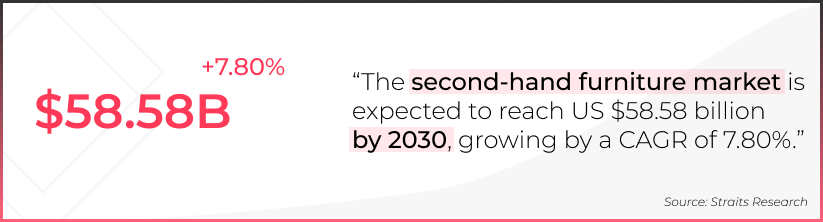
]]>As the rising climate crisis creates more awareness, with changes undeniably visible in the biosphere, more consumers are considering sustainable alternatives by the day. Due to this, pre-owned furniture is gaining momentum with consumers as a more sustainable alternative.
Given the demand, the opportunity for Resale furniture marketplaces is ripe. Encashing in on this opportunity are marketplaces like Kaiyo. Interestingly, a figure of 5,424,019 has been highlighted on the Recommerce platform. This is the pounds of furniture the marketplace has kept out of landfills – indicating a rising consumer sentiment towards sustainable choices.
In this blog let’s read how you can start a furniture resale marketplace conveniently and affordably.
Table Of Contents
Business Sense in Starting an Online Furniture Resale Marketplace
Apart from eco-consciousness, multiple other factors are fueling the growth of the online furniture resale business. Let’s look at the benefits of a furniture resale marketplace for all platform participants.
Benefits for Customers:
1. Affordability: With furniture being a high investment, depreciating commodity, buying resale furniture is financially more viable.
2. Diverse Product Selection to Choose from: With multiple sellers, the chances of finding the more suited product are more.
3. User Reviews and Ratings: eCommerce platforms carry reviews and ratings of peers, helping consumers in their purchase decisions.
Benefits for Sellers:
1. Expanded Market Reach: A wide consumer audience.
2. Easier approach to add online sales: Brands considering online expansion of their operations, have an easier alternative with online marketplaces when compared to starting their own online stores.
3. Brand recognition: Online presence can fuel brand awareness for sellers, and give them exposure.
Benefits for Marketplace Operators
1. Asset light business: Marketplace owners don’t need to maintain inventory independently.
2. Increased User Engagement: Consumers can buy from multiple sellers.
3. Higher Revenue: More transaction volume means higher revenue from multiple channels.
4. Attracting D2C brands: D2C brands can give more value with fewer middlemen involved.
Launch a Platform Tailormade for all Participants
Start a Furniture Resale Marketplace
For starting an online furniture resale business, you will need to understand the industry, its growth drivers, challenges and possible solutions. You can consider adopting the following step-wise approach.
Choosing Operative Mechanisms of the Business
Before starting with building the marketplace, consider the popular ways in which the marketplace can be based. This will define the workflows, target audience, and the USP of the business.
Business Models
An online marketplace creates value by facilitating commerce between the sellers and the buyers on a broader level. However, this can be achieved in a number of ways depending on the market, products to be sold, sellers, and other factors. In the case of a furniture resale marketplace, the following operative business models are more popular.
1. B2B2C
The marketplace acts as an intermediary, digitizing the middlemen, and allowing third-party sellers to reach a customer base of the marketplace. The role of the marketplace operator is to provide the backend infrastructure and services such as shipping fulfillment, payment processing, and others. The sellers in such a setup can build their own brand.
In the furniture resale industry, a B2B2C business model will connect furniture resellers and D2C brands with the consumers on the platform.
2. P2P
A peer-to-peer marketplace like eBay simply connects peers to transact with each other. Buyers here can be sellers and vice versa.
3. Aggregator Marketplace
This business model combines the virtues of the B2B2C and the P2P business model. It connects sellers to the buyers, however, in this case, the marketplace business plays a more active role. The buyers here engage with the marketplace and not the sellers.
In some cases, like Kaiyo, the marketplace buys from the sellers and sells it to the buyers. This business model solves a key pain point in the resale industry. Sellers are typically people who simply want to get rid of their furniture and find an easy way to do it. Similarly, buyers get a reliable source, as the furniture has been verified by Kaiyo.
Cover Business Model Workflows Efficiently – With your Platform
Revenue Models
A marketplace typically provides multiple revenue-generation opportunities. Let’s consider the following:
1. Commissions: Marketplace businesses can charge commissions on every sale on the platform.
2. Advertisements: Website real estate assets like banner images can be monetized to display sellers’ adverts in lieu of a fee.
3. Subscriptions: Additional subscription services like booking a high-demand product, buy-back schemes, and others can be offered to increase the revenue of the platform business.
Essential platform functionalities – Navigate industry challenges
Like any other industry, the furniture industry comes with its challenges. However, these challenges can be met by including the platform with the necessary functionalities.
| CHALLENGE | SOLUTION |
| Shipping: Furniture shipping can be challenging. With greater weight and fragile components, the shipment has to be delivered with care. |
Automate with third-party API: The shipping can be outsourced to specialist logistics providers. The whole process can be automated by integrating their API with the platform. The automation will further facilitate accurate product shipment, correct invoices, and others. |
| Careful purchase decisions: Resale furniture can be more affordable than new, still, it is not an impulse buying decision for most consumers, especially in Western households. So the decision process can be lengthy. |
Detailed Product Descriptions: A rich-featured CMS within the platform will allow the addition of detailed product descriptions to assist the buyer to make the purchase decision. Inclusions like videos further can be helpful. Moreover, an engaging website UI further helps buyers to find what they are looking for and commit to the purchase. |
| No in-person feeling: Buyers can have additional queries regarding the style or feel of the product. Especially when it comes to the use of fabrics. |
Reviews with Parameters: Along with detailed product descriptions, user reviews can be helpful for buyers to gain trust and help them to commit to the purchase. If parameters are added to the reviews, allowing the buyers to rate the product based on the most critical parameters of the product. For instance, the feel of the fabric – the buyers will get additional information to arrive at the decision faster. |
Apart from these industry-specific pain points, other needs can be addressed by including the right set of features in the platform.
Create The eCommerce Platform
We discuss the process to build a furniture resale eCommerce platform below.
Market Research
The above-discussed variables give an insight into the preparation required in understanding the market dynamics. Moreover, these can vary with each market. So the success of your business depends on a thorough understanding of the market ― the existing competition, user needs, and other factors.
Moreover, if the business can solve user needs with the business, it stands a better chance of gaining user interest and eventually, a share in the market.
Build the Furniture Resale eCommerce Platform
There are two popular approaches available with you to build the eCommerce platform.
1. Custom made eCommerce platform: The marketplace platform will be built from scratch. This can be done either by hiring an in-house team or by outsourcing development to an eCommerce development company. Each aspect of the platform will be coded and further tested by the developers. This process can take time. Moreover, generally, companies will charge on an hourly basis, so this process can be resource-intensive as well.
2. Turnkey/Readymade solution: The alternative to the above-mentioned process is using a turnkey solution made for Furniture resale eCommerce marketplace.
How to choose which process suits you better?
If your envisioned eCommerce platform needs specific functionalities on multiple levels that are different from popular eCommerce platforms like Kaiyo, it may be better to opt for the former method.
On the contrary, leading furniture marketplace turnkey solutions are built with essential eCommerce features for the domain. Further, any customization needed can be done on the solution.
It might be difficult to decide on your own. It is better to discuss your plan with a company that offers both development approaches and find out the approach that suits you the best.
How Can Team Yo!Kart Help
Yo!Kart is a leading eCommerce marketplace platform that has powered more than 5000+ global e-marketplaces. It is self-hosted and customizable, giving entrepreneurs complete freedom to launch a platform to suit their business goals.
Yo!Kart has been built from the ground up to offer dedicated features for all platform participants. Likewise, Yo!Kart has holistic underpinnings to build a furniture resale marketplace. Furthermore, any specific customizations, for instance, an auction module, can be customized by availing in-house customization services.
Discover the Development Approach that Best Suits your Plan
The post How to Start a Furniture Resale Marketplace appeared first on YoKart Blog.
]]>The post Top Selling eCommerce Products: Shifting Consumer Behaviour And Changing Product Demand Amid COVID-19 appeared first on YoKart Blog.
]]>The numbers are increasing rapidly, and so are the rules for people gathering in public places. Businesses like restaurants, bars, shopping malls are on the verge of shutting down as people maintain social distance.
To say that we are living in unprecedented times feels like an understatement.
One very particular trend that marketers have seen in recent times is how isolation and uncertainty have had a significant impact on the shopping behaviour of people around the globe. Some terms that we have heard so much recently is bulk shopping, panic shopping, and all this is sourcing from online shopping. People are changing what they are buying, how they are buying, and what they are buying during the COVID-19.
As cities are being more stringent in avoiding crowding in public places, they are imposing lockdowns. Lockdown is thus ruining the business of non-essential commodities, thus leading them to close down. Buying essential items through the online medium has become the new normal. Offline businesses have to adapt to this change and become flexible in putting their efforts. Even after the pandemic is over, people will become habitual of this lifestyle; they will not prefer to go out unnecessarily. Essential commodities or commodities they widely purchase will be purchased online only. Shopping online will become the new normal even after the pandemic is over.
Impact On Global Online Retail Bifurcation
In these modern times, retailers and brands are facing daunting short term challenges. These challenges revolve around health, safety, supply chain, labour force, cash flow, consumer demands, and marketing. Successfully navigating through these challenges will not ensure a profitable future for the business, because when we emerge from this pandemic, which we will for sure, we will appear in a completely different world as compared to before lockdown.
To make your business survive but be profitable post-pandemic, it is essential to understand the trends and base your decision on them.
“Retail platforms have undergone a six percent global traffic increase between January and March 2020. Overall, retail websites generated 14.34 billion visits in March 2020, up from 12.81 billion global visits in January 2020.”
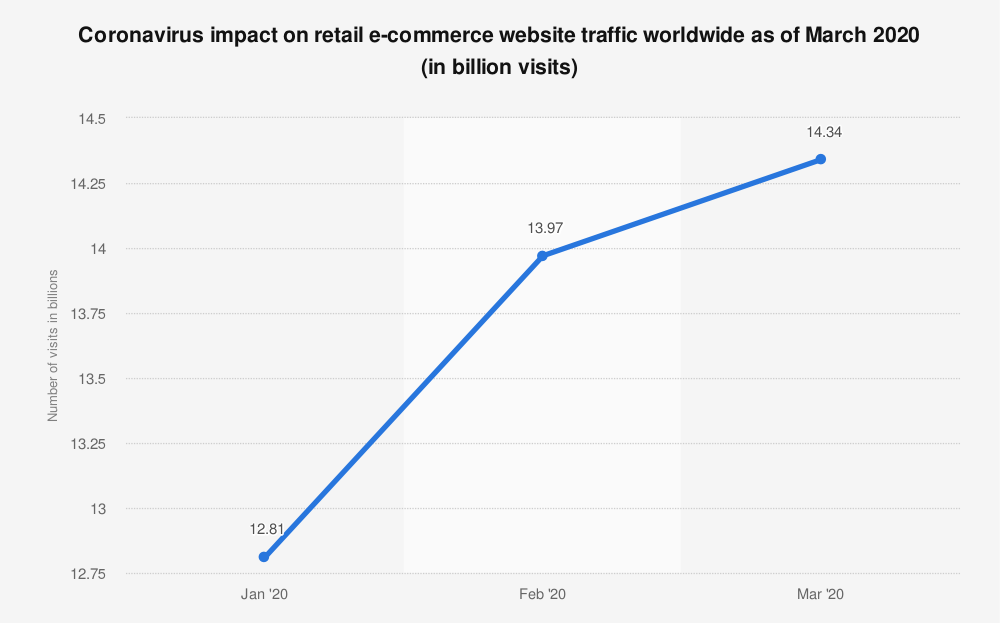
Source: Semrush (Statista 2020)
Consumer Behaviour Has Changed Permanently
The need is to understand that consumer behavior throughout the globe might change permanently. Even before the pandemic hit the world, people’s shopping behavior was shifting to digital. Many product categories are disrupted by digital-like books and entertainment, whereas some products like apparel and consumer electronics are moving towards digital since the pandemic. The most notable transformation is of the grocery industry, before the pandemic in the nascent stage, people worldwide have widely ordered their groceries from eCommerce websites. Understand the impact of COVID on the change in consumer behaviour through this Image.
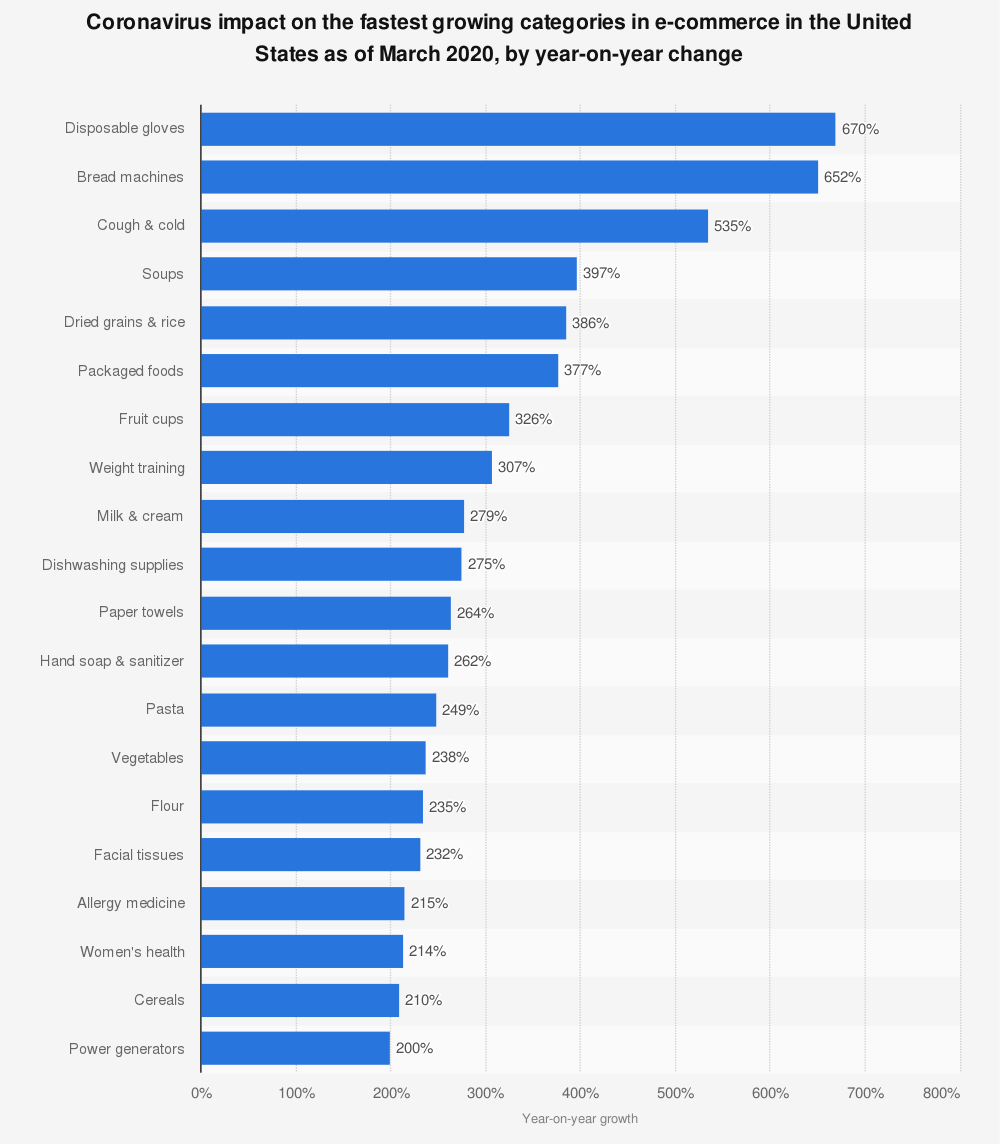
Source: Stackline (Statista 2020)
Increased Terror Of Germs And Proximity
If you think that the COVID-19 effect will end once the vaccine is made, then you are wrong. First, COVID-19 could re-emerge after some time, and now we are more vulnerable to any such virus. High time that entrepreneurs and consumers accept the new reality. People are going to be more cautious about germs and prefer contact-less delivery for a long time. Buffets, trying clothes, and wherever more people are present will completely be avoided. Retailers have to strategize now on no-touch experience and emphasis heavily on hygiene. Germophobia will be a more heard term in future which will impact the eCommerce industry. Check the statistical representation to understand the impact.
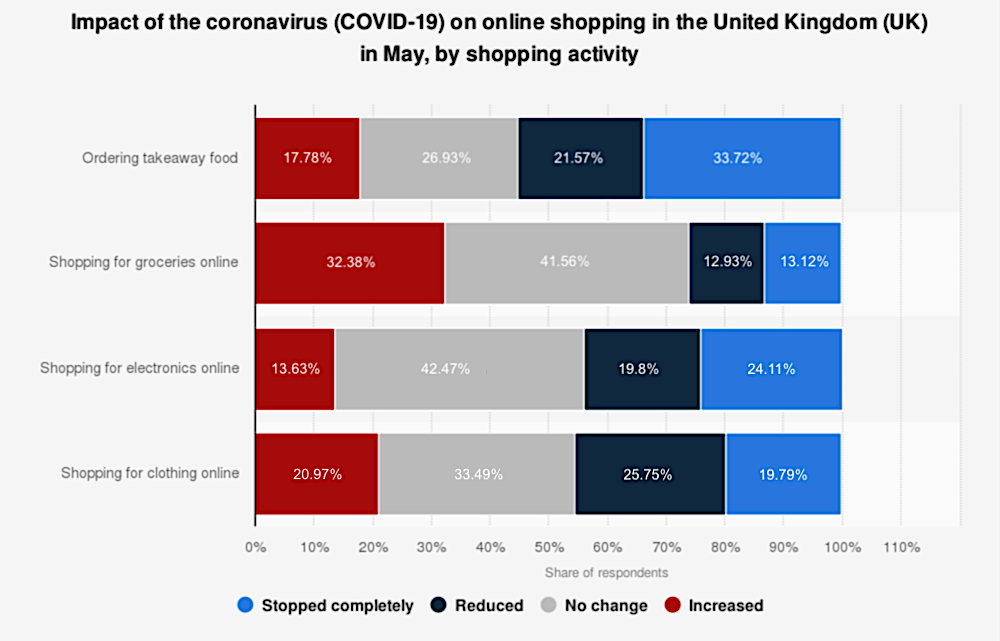
Source: Internet Retailing; RetailX (Statista 2020)
Planning to launch a niche-based eCommerce business
Continuity
Consumers who have bought gym equipment will not prefer to go to the gym, and Consumers who have purchased a streaming media subscription will continue paying it. People who started enjoying home-cooked meals or started cooking new delicacies at home prefer to do so even after the lockdown is over. A considerable amount of the workforce will shift from working in an office to working at home. Businesses have to understand the impacts and create a need for their business right now to become profitable even after the pandemic. Check how consumers in Italy are widely ordering products online.
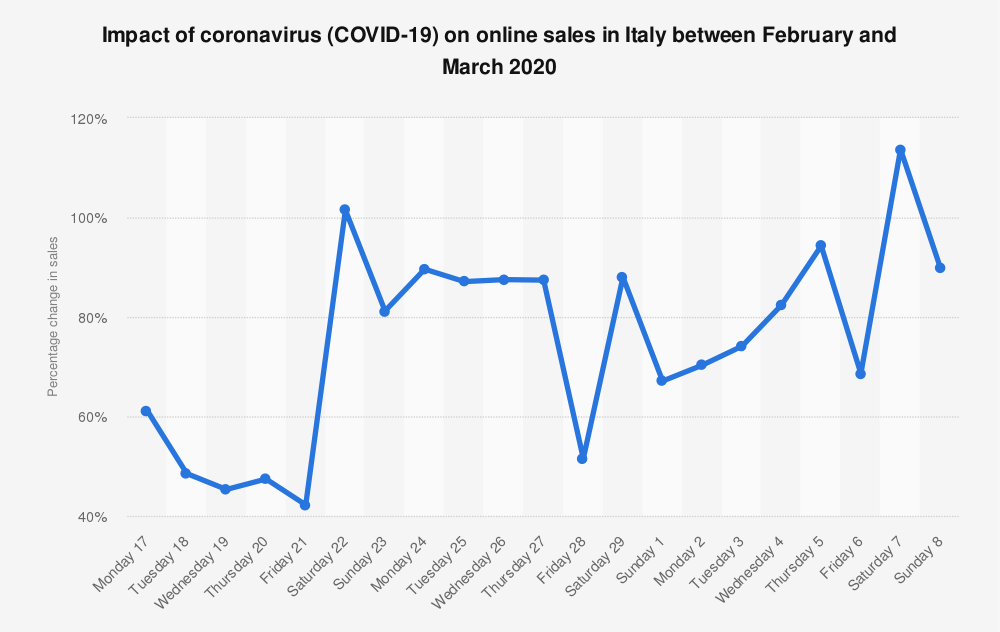
Source: GDO News (Statista 2020)
New Economic Reality
The United States and many other countries may recover from the pandemic to face the worst recession. Japan has fallen into recession due to COVID-19. A Morgan Stanley report also projects American gross domestic product to land at an annual rate of 30.1% in April-June, and that unemployment could average 12.8% over the period. Goldman Sachs is projecting a 24% annualized drop in output in the next quarter.
Consumer spending is dramatically curtailed during the pandemic. People have become financially more conservative. Thus leading to consumer’s credits less available, and a large cohort may go into default by their debt. Graphically check how the coronavirus will impact your business.
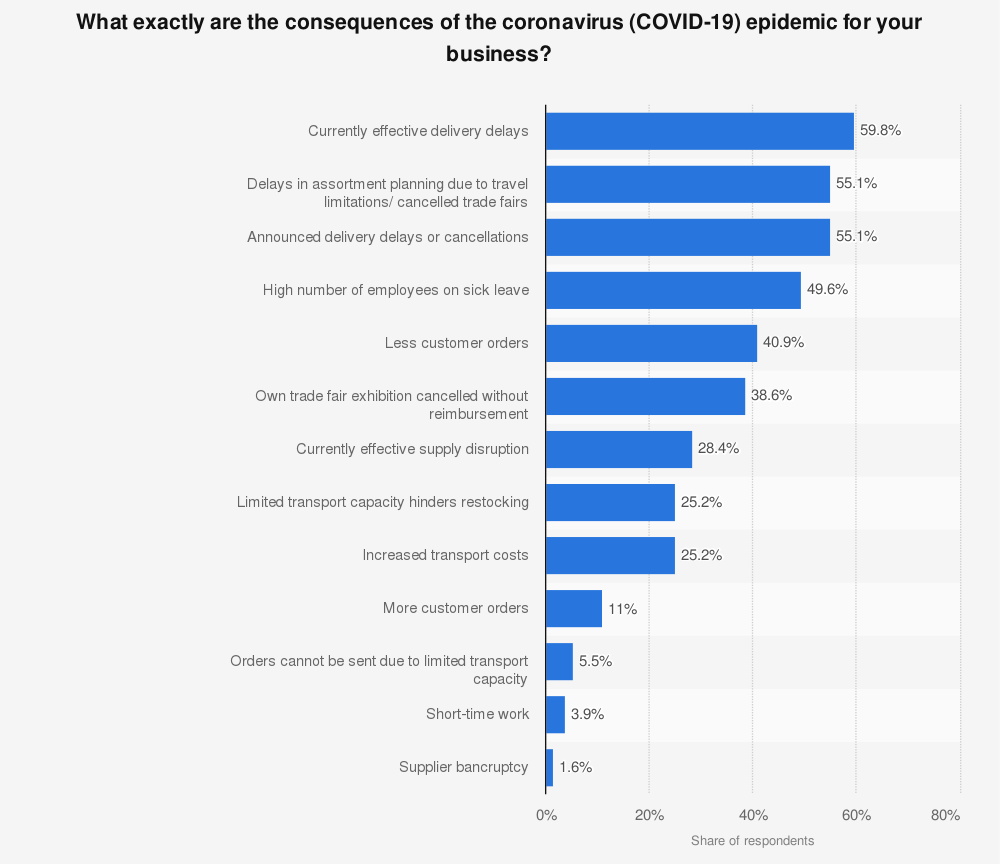
Source: Bevh (Statista 2020)
Competitive Landscape
The Economic impact of this pandemic will not impact every retailer and brand alike. The brands that enter the lockdown with a weak-balance sheet are loaded with debts or may have risen from their current balance. The economy is so uncertain for businesses that many are retracting their earnings governance and are unable to provide the investors estimate for the performance this year.
The emergence of high retail bifurcation will impact which businesses are profitable. The brands selling high demand Pandemic necessity on Amazon and other eCommerce websites will not be affected by the pandemic. Learn how eCommerce activities have developed in France.
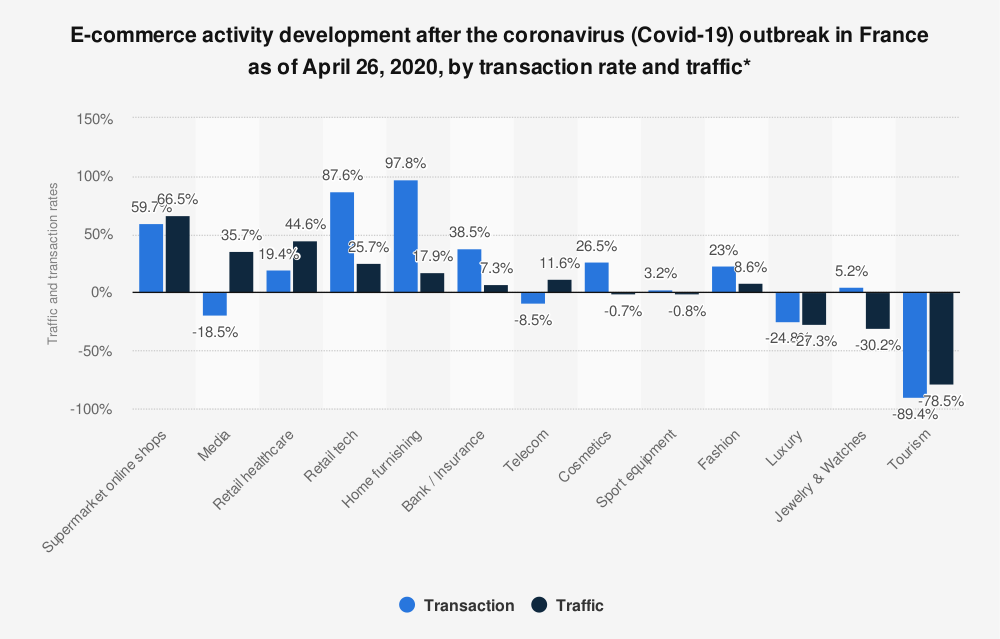
Source: Content Square (Statista 2020)
These Products Are Seeing The Most Sales Growth During The Pandemic
- Grocery and food – People are understanding that going out to grocery stores to buy package goods can also be a worry as maintaining social distance can be difficult. So people are resorting to websites to purchase these goods. People also prefer packaged goods as they feel they are safer and less contacted by humans as compared to vegetables and fruits.
- Wine and Alcoholic Beverages – While many cities are still facing the lockdown, the local bars and alcohol shops are not opening. Many people feel the Wine and Alcohol marketplace as an essential commodity that has become a boon for marketplace owners. Wine and Alcoholic marketplace are delivering wine and alcohol at least to the local cities where delivery is not prohibited.
- Health and Household – The Health, medical, and household industry have seen a considerable demand, specifically during the pandemic. In this sector itself, people are doing panic shopping and preferring to buy items in bulk. We all know about toilet paper incidents that happened all across the globe. Most offline businesses were not able to handle the crowd, especially when the supply was on the lower side. Online eCommerce businesses dealing in health and household items are seeing huge traffic.
- Lawn and Garden Accessories and Tools – As people are spending more and more time in the household unaware of spending most of their time. People have taken up more and more to their hobbies, which they could not pay attention to during a busy time. Gardening being another such hobby, people need the equipment and tools to work around in the garden. Marketplaces that provide lawn and garden accessories are also seeing a lot of traffic, and the conversion rate is too high.
- Personal Care – There rate at which people purchase personal care items were already on a high. Now since the lockdown, the only thing that changes is that people now prefer to buy personal care items online. Especially when the country starts reopening the economy, the personal care items will be sold in huge numbers.
- Entertainment, Recreational Toys, and Games – Since people are in lockdown and do not have any other way to entertain themselves. They are ordering Toys, Games, and other entertainment items online. Going out to buy these unessential items are strictly prohibited in some cities. Delivery is still open as businesses are resorting to contactless delivery options.
- Gym and Weight Training & Fitness Equipments – Gymaholics are still not able to go to the gym or even a park to walk or jog. Some people are using this time to come back to shape and need the equipment and tools to do so. Launching a Gym and weight training & fitness equipment marketplace can be profitable during and after the pandemic.
- Digital Products (ebooks/photograph/etc.) – for a long time now, people will avoid receiving physical products, or necessary products they will use but with proper care and sanitization. For the products that can be converted to digital products, people I’ll prefer to buy digital products online.
Top Declining Product Categories
For now, People have become accustomed to the word ‘essential.’ During the pandemic COVID- 19, customers are buying essential products, stepping out of your house for vital work only, necessary travel. Also, Governments of different countries have imposed essential gatherings with a minimum number of people, and many more such rules.
- Luggage and Travel Gear – For a long time, people will not be able to think about leisure travel. Traveling only to reach their hometown or no traveling at all will be the new trend for a few months, if not years.
- Jewelry – Though many will argue, jewelry is not an essential product. The sales of jewelry and accessories have declined ever since the pandemic has hit countries in the worst way. People will not go to physical stores to buy jewelry for months to come, but people will still prefer to order jewelry via online websites.
- Costumes – Though during the holiday season, the costume industry boomed. But this year is all about staying indoor and staying safe. Dresses and other clothes that people rent out will not be used even after the pandemic is over for a long time due to sanitation issues.
- Gifts – Though we all like to receive gifts since we are confined to our own homes, we will not be able to buy or give gifts. This industry may not be finished due to COVID-19 but can revive once this lockdown period is over. People will not be visiting crowded places to buy gifts, so launching a gift marketplace can be a fruitful idea for aspiring entrepreneurs.
- Party Decoration and supplies – Since gathering will not be more than a limited number of people. Parties and gatherings will be a thing of the past. So party decorations and supplies will also not be bought and sold in large numbers. There will be customers who want to buy these things online, but offline stores will not see the same number of customers as they did earlier.
Source: Top & Flop 50 Products On Amazon Amid Coronavirus Pandemic
Conclusion
For entrepreneurs who were planning to launch their online business, now is the right time. They also need to understand carefully regarding the industry or the product niche they want to start their business. In-depth market research of the current scenario, checking the google trends, and other tools to find out what people are looking for right now will help launch a profitable business.
Read how COVID-19 has impacted the eCommerce Industry
The post Top Selling eCommerce Products: Shifting Consumer Behaviour And Changing Product Demand Amid COVID-19 appeared first on YoKart Blog.
]]>The post Designing an Omni Channel Strategy? Consider this First appeared first on YoKart Blog.
]]>In a world, where experience determines the extent of customer satisfaction, omnichannel is a much-needed factor that influences the experience. Providing the perfect omnichannel experience depends on multiple factors. Before designing an omnichannel strategy, business owners should ask the following questions:
- How to gain analytical information on omnichannel and forecast trends?
- How to ensure customers receive the same message through each channel?
- How to ensure a smooth transition from online to offline?
- Which omnichannel policies to formulate for customer-friendly experience?
To educate business owners and help them devise the perfect omnichannel strategy, we have tried to answer the above questions in this blog post. Without further ado, continue reading to know more about designing an omnichannel strategy.
How to gain analytical information on omnichannel and forecast trends?
For more return on investment (ROI), one is required to measure and make changes in the omnichannel strategy. To enable a business owner to do so, analytics applications such as Pointillist and SAS provide meaningful information on relevant key performance indicators (KPIs). Such applications can help a business owner keep a close eye on omnichannel analytics be it offline or online interaction with a potential customer.
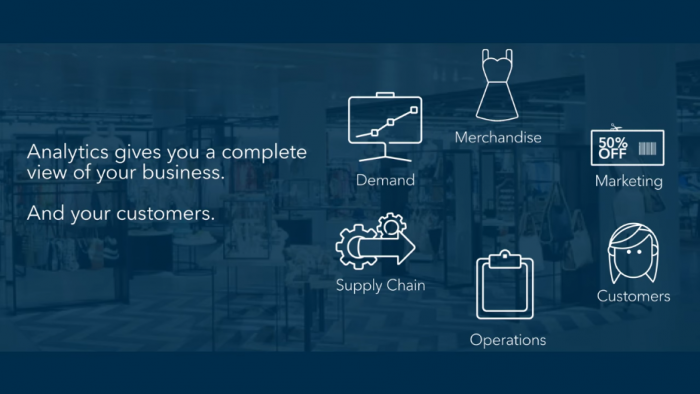 SAS Analytics
How to ensure customers receive the same message through each channel?
Offline and online channels represent different marketing avenues. It can be a banner advertisement in a brick and more store, storefront, Twitter banner or post, Facebook banner or post, etc., no matter which platform it is, the core messaging goal should be consistent.
Using the same brand imagery across different channels is highly recommended. A more recent innovation in the internet of things (IoT) has enabled brands to introduce personalization in the offline world using beacons. The core messaging should be the same and by introducing personalization in an ecommerce website for better conversion.
How to ensure a smooth transition from online to offline and vice-versa?
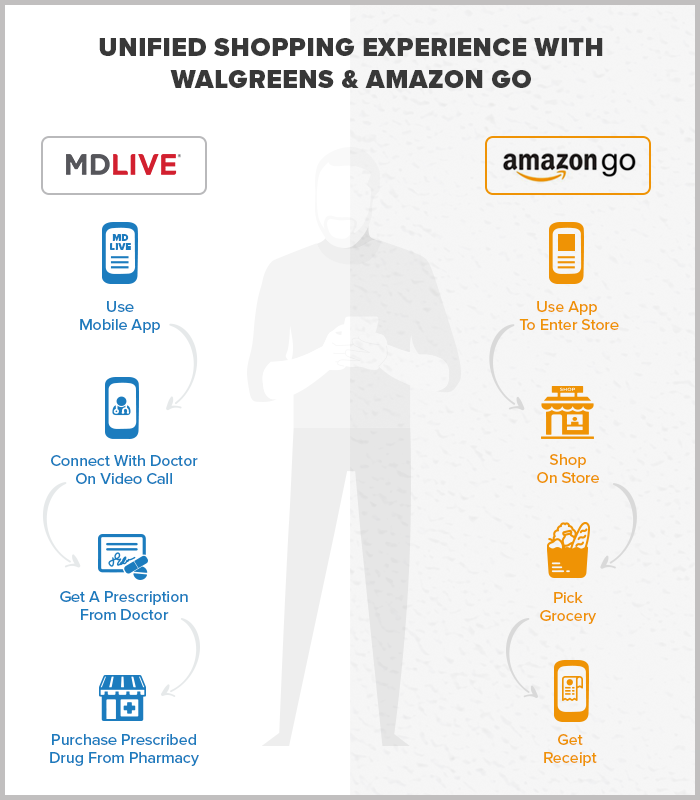
After a meticulous analysis of the use case, one needs to find important touchpoints and ensure that the flow is directed towards user experience and conversion. To elaborate this further, we would like to mention two examples – Walgreens and Amazon.
Walgreens – The second largest pharmacy store chain in the United States, Walgreens has introduced an MD Live app through which a user can pay to have a live chat with a physician. And if necessary, the physician can also directly write a prescription. The prescribed drugs can be purchased at one of the store locations.
Amazon – Amazon launched the cashier-free chain of grocery stores known as Amazon Go, which gives the best experience with the amalgamation of online and offline commerce. A person can walk into the Amazon Go store and buy anything he/she wants. Once a product is picked, the billing is done automatically.
As in the above two examples, mobile is the epicenter for real-time interaction. Amplifying the customer behavior, the culture of immediacy is driving mobile first interactions. Customers expect businesses to participate in the culture of immediacy through mobile services. Mobile has provided customers with unprecedented access to information, simplified the way customers can evaluate and buy products.
Although customers still value the human connection and want technology to enhance the connection and not replace sales and service representatives.
Which omnichannel policies to formulate for customer-friendly experience?
The transition from offline to online can reduce sales in the long run, if omnichannel-friendly policies are not formulated. In our research, we came across several brands that are working towards improving their omnichannel experience but lack policies to impart a superior omnichannel experience. Be it any policy such as privacy, return, refund, reward points, etc., relevant changes are to be made that blur the distance between offline and online.
Elaborating some strategies for a successful omnichannel transformation:
Outline a strategy and design principle
In order to deliver an excellent customer experience, businesses should scheme the customer service journeys by striking an optimal balance of speed, transparency, and interaction with each channel or the multiple touchpoints. Every point of the customer journey needs to be optimized rather than focussing on individual touchpoints. The success of the omnichannel strategy entirely depends upon rightly understanding the customer based on their digital behaviors and then offering the right channels. Acc. to research by Mckinsey, digital customers can be identified onto four different personas:
- Those consumers who are digital by lifestyle ie. those consumers who have their life integrated into digital completely and don’t easily perceive the difference between a traditional channel and digital.
- Those consumers who keenly enjoy the advantages of digital. These consumers are free willing to choose digital channels. These consumers are highest in numbers.
- Then there are those consumers who only engage with digitals channels, only when it is necessary.
The least percentage of consumers who prefer to live in the non-digital world shop in brick and mortar stores.
Devising customer journey services primarily for each segment and persona profile helps to differentiate the engagement strategies and the necessary investment for each channel.
Test, Fail, Adopt Methodology
To successfully accomplish the omnichannel strategy, the business should resolve these areas first:
- Which is the most important customer journey in terms of the cost to the business?
- Determine the complexities involved in enhancing the customer journey
- Importance of the specific journey to the customer
Companies should apply test, fail, adapt the methodology to design the customer journey. The methodology involves tactics like design thinking, live testing of prototypes, ideation with customers to jointly build customer journeys.
Administer Economic Realities
Besides defining the customer journeys and segregating the role of each channel, it is very important to have a strong hold on the economic implications. The economic implications could include cross channel assortments, pricing decisions, customer relationship management and finally handling the delivery scenarios.
Crafting a balance between these factors and optimizing them to achieve a winning strategy becomes complex. Follow the guidelines to ensure it:
- Businesses need sophisticated models that cater to all relevant factors like price, shipping costs, end of season discounts, etc.
- Set clear directions for dynamic pricing based on what competitors are doing and the amount of inventory left in the stock.
- Modifications to the supply change like automated picking technologies at distribution centers, more friendly and sturdy packaging, variations in the click and collect formats, etc.
In all, the most essential key requisites for a successful omnichannel experience:
- Brick complementary to click
- Enhance mobile purchasing experience
- Exploit the return channel as a sales opportunity
- Put user’s and their needs at the center of the business.
Craft a Perfect Omnichannel Strategy with Our Experience
The post Designing an Omni Channel Strategy? Consider this First appeared first on YoKart Blog.
]]>The post Tips and Tactics to Develop a Marketing Strategy for Using Product Videos appeared first on YoKart Blog.
]]>Here are detailed answers for questions that e-commerce marketers will have before they start shooting a product video. It’s very important to have a clear understanding of these things so that you step in the right direction for your video marketing.
How a product video can help in marketing and brand awareness?
First of all, you need to be sure about where the video has to be uploaded. Define the target before creating the video. There could be various platforms on your mind but you have to choose the most appropriate. For example,
Businesses usually have multiple email nurture streams, so you should form different groups for them.
A product video for a new registration and the one for an abandoned cart must have different messages. In a welcome email, you need to introduce your brand through the video. You must hit the psychological trigger of the customers while sending an abandoned cart email.
Understand which type of video works best for your brand- when and where. Below are the few focus areas where a video can, and should be used.
- Product page
- Welcome series email
- Paid advertisements
Purpose of product video on e-commerce websites
Now marketers would be wondering, what are the benefits of these videos for our e-commerce website? What’s the efficacy of a product video for their business? The sole purpose of a video depends on where and what video content is uploaded.
Here are the different purposes of product video on an e-commerce website.
- Increase Conversion
- Increased AOV
- Attract new customers
Deploy Product Videos on Different Platforms for Distinct Goals
Now comes the most debated question, will video content be able to generate ROI? Video shoots can take up a lot of resources, most important ones being time and money. Moreover, creating video content is a tedious task too. All this can be easy with a well-planned research before creating the video.
You need to determine where the video will be used and also understand the purpose of each video. Then, you need to gather viable resources if you are making the video on your own, or give it to an agency to save yourself from the trouble.
On Product Page
Purpose: Helps in increasing AOV/Conversion
Mandatory Requirements:
- Shots of products being displayed
- 360-degree view of the product
- Benefits of the product
- Features of the product
Tips:
- The Video needs to have a clean, plain background with no extra stuff. Mostly, product videos have a black or white background. It’s important because a clean video builds trust among the customers.
- Make sure the product page video is simple. It should be easy to understand and does not need to be elaborate. The time limit of the video should not exceed 1 minute.
- Try to include shots of its usage with commonly paired product as this will help in increasing the AOV of the business.
- Use YouTube’s annotation feature to add a product link to the video for better conversion.
- If you haven’t yet launched your ecommerce website, then launch it with a platform which offers you option to upload your video on the product page. There are many platforms on which you can upload a video but make sure that this platform is SEO optimized for global reach. Like on Yo!Kart you can upload your product video directly on the page so that you can engage your customer effectively.
Also Read: Conversion Rate Optimization for Ecommerce Websites
In Welcome email
Purpose: Increase Conversion and Average order value
Mandatory requirements:
- Give an intro to new customers about your brand.
- Show off your brand’s best-selling product. Showcase it in numerical form.
- Video must have all the categories of products you sell and USP of your business
Tips:
- Use your welcome video email to build a sense of trust among the newly registered members of the website. Include content that engages your clients and builds trust.
- Provide a quick and crisp intro to your brand. This can be easily created using a voice over or an introductory slide depending on the type of video you are creating.
- Once this video is created, you can use it as the main video for your YouTube Channel. This should be the first video that people should see on your YouTube brand.
- You can either send this video to your newly registered customers or you can add the YouTube link to your subscription page where people can see it before they register on the website.
For Paid Advertisement on Facebook & Instagram
Purpose: Increase conversion, increase AOV, and attract more customers.
Mandatory Requirements:
- Check the time frame of the video which can be accepted by the platform and then create the video.
- Encourage conversion by giveaway or discounts.
- Showcase best-selling product(s) or new product release(s).
Facebook Advertisement
Tips:
- If you plan to add text content at the beginning of the video, keep it up to 90 characters.
- The aspect ratio as preferred by Facebook is 16:9 or 9:16. Create the video in this aspect ratio to avoid any blurry output.
- Video: H.264 video compression, high profile preferred, square pixels, fixed frame rate, progressive scan.
- The format should be MP4.
- Audio: Stereo AAC audio compression, 128kbps + preferred.
- Include links to your video. When you include the link, Facebook gives you the option to choose among several CTA button.
Also Read: Promoting Your Content On The Right Social Media Platform
Instagram Advertisement
Tips:
- The Aspect ratio must by 1:1 for best user experience
- Video: H.264 video compression, high profile preferred, square pixels, fixed frame rate, progressive scan
- Recommended Caption must be around 125 characters as it engages the clients better.
- The Format of the video must be the Mp4.
- Audio: Stereo AAC audio compression, 128kbps + preferred
Conclusion
Looking at the latest trends, video marketing is taking the world by a storm. Most marketers understand the importance of video marketing but have few basic questions in mind. The above article covers how product videos can be beneficial for e-commerce business, their purpose, tips for creating a different type of product video, etc. Go ahead explore the video marketing world and see how things pan out for your business.
The post Tips and Tactics to Develop a Marketing Strategy for Using Product Videos appeared first on YoKart Blog.
]]>The post How To Choose The Most Profitable Dropshipping Products To Sell Online appeared first on YoKart Blog.
]]>Although dropshipping does provide for a hassle-free way of conducting business, there are several things one must consider before planning on starting a dropshipping business. Choosing the right product is all you need to be a part of this business model, but it is easier said than done.
If you are an e-commerce veteran or an amateur entrepreneur/startup planning to start your own dropshipping business, we bring you the art of finding the right products to dropship.
Let’s get started…
Research Right
A dropshipping business definitely offers freedom but only if you understand well in advance how to source your products. A good market research goes a long way in helping you select suitable products to offer to your customers.
But where to start from?
Well, trust your gut and start brainstorming for ideas. Look around and ask people around you to contribute as well. Another great technique that almost always works is to browse other stores and compare their best-selling lists, promoted products and other offerings. Keep an eye out on Amazon Best Sellers, eBay Deals, Google Trends, Kickstarter and look for trending products in the market.
Read More: How To Choose A Perfect Domain Name?
Know Your Criteria
Dropshipping can be a tough cookie to crack if you don’t know what you’re doing. Your product journey may last a thousand miles in the future, so it is significant to choose a product that is feasible to sell. The first question you need to ask yourself when looking for a product should be,
“Will it sell?”
To answer this, make use of the market research you are conducting and find popular products. No two businesses choose the same method for dropshipping but there are several parameters that can help you find your way.
- Keep in mind the size, distinction, risk and scarcity of the product you want to sell.
- Record data that is relevant like the name of the item, lowest & highest listed price, sales volume and other general observations.
- Use recorded lists to determine the profit margin that you can make on every sale. By buying products at wholesale rates you can sometimes find products with a markup of 1000% even.
- Reflect on your products by asking yourself questions like:
‘How is my product different from my competitors?’
‘Are my products popular?’
‘Are they available at big brick-and-mortar retailers?’
‘Will I sell on my own e-commerce website or via a marketplace like Amazon or eBay?’
These questions can help you be critical about product choices that you have made and see if there are still any roadblocks left down the road.
Launch your own drop shipping business with Yo!Kart
Understanding The Market Demand
Back in the day, market research was a tedious process done via phone interviews, focus group discussions and questionnaires. But now, thanks to the vast/colossal horizons of the internet, most of the information is at our fingertips with just a few clicks.
Keyword research tools are a very good way to find out what is in demand. Some great tools you can use are Google Keyword Planner, SEO Book, Ubersuggest, WordPot and Wordtracker. And how does this help you?
For example, if you search for laptop bags, it may suggest ‘Wildcraft Laptop Bags’ or ‘Samsonite Laptop Bags’, which can make you analyze the specific brands that are in demand and help decide what specific product to sell accordingly.
Check the performance of your chosen product in real time by monitoring how they are doing on various online marketplaces. This gives you an idea of the profit potential of your product.
Read More: How To Customize E-Commerce Website Images & Improve Sales?
Ensure A Steady Supply
The process of choosing a product to dropship doesn’t end with researching the market and demand trends. Because every dropshipper has the flexibility to choose what they want to sell, remember that at the same time you can also be at the mercy of your supplier.
It is very important that your wholesaler ships products in a timely manner to your customers in order for your business to grow and maintain its credibility. Finding a supplier who stocks your product thus is not sufficient. You need to make sure that they are reliable and professional as well. Make sure you check all the things in the list below before you finalize on a supplier.
- Make sure your supplier has an inventory monitoring system so you can track your sales.
- See if the supplier is easy to get in touch with. When operating a dropshipping business, regular communication can help you overcome language and distance barriers with ease.
- A bogus dealer can manage the delivery process poorly and this directly affects your business. It’s okay to work with a supplier who is reliable even if you end up with a smaller profit margin.
- Lastly, make sure you get the best deal out there. Most wholesalers offer deals and discounts on bulk orders, so agree on a price that suits you and your dealer.
Conclusion
Dropshipping products can be a tricky business because it isn’t just about choosing the right product only. As the demand and supply go hand in hand out here, finding a good wholesale company is also of prime importance. You must also be aware that as your supplier will directly ship to the customer, thus it can be nearly impossible for you to keep a check on the shipping and product quality.
Now that you know how to go about finding the right product and dealer when considering to dropship, make sure you undergo a thorough vetting process when establishing your supply chain. Make use of research for making sound decisions and remember sometimes an initially high upfront investment cost may save you a ton of money in the future.
The post How To Choose The Most Profitable Dropshipping Products To Sell Online appeared first on YoKart Blog.
]]>The post 20 Powerful Marketing Words That Can Make Or Break Your Conversion & Sales appeared first on YoKart Blog.
]]>Wondering for a long time what words can help you increase your conversion? While few words have to power to help you convert better, there are few that can prove counterproductive. Every word that a business uses and is portrayed in front of the audience has an impact. Like reaching the summit of a tall mountain, business owners have to strategically plan each word of their marketing campaign.
We did an in-depth research and compiled a list of 20 words – 10 which will boost conversion and 10 which are commonly used but repel the customers from the e-commerce website.
Read along to analyze the list and understand how you should plan the content for your next e-commerce marketing campaign.
Words That Boost Sale
Sale
Though it may seem clichéd, it works. “Sale” is an old faithful marketing word to attract customers to your website. Sale has the power to motivate customers to buy a product from you. When customers read the word “Sale” on your advertisement, they are more likely to convert.
Off
Try adding the word “Off” to your advertising campaign as it catches the eyes of the users quickly. Try using the word “Off” to denote a particular sale or offer you advertise. “25% off” or “10% off for first time user” are some of the ways you can use the word for your e-commerce website. Take a look at the image below for clearer understanding.

Now
This word is a part of this list because it encourages people to act. It gives away a feeling of urgency and desire to act immediately. “Now” is usually used as a part of a Call to Action. Example: Shop Now, Act Now, Register Now, Subscribe Now. Whatever action you want your customers to take, add the word “now” with it. Refer to the image above for a practical usage of the word now.
New
If you see the trend on internet people prefer to check new items, gadgets, electronics and even electronics. People are intrigued by the word new and usually grab attention to it. So when you a new collection let your customers know using appropriate wordings. Go ahead try the word “new” in your next email to your customer and you will see the difference.
Bestseller
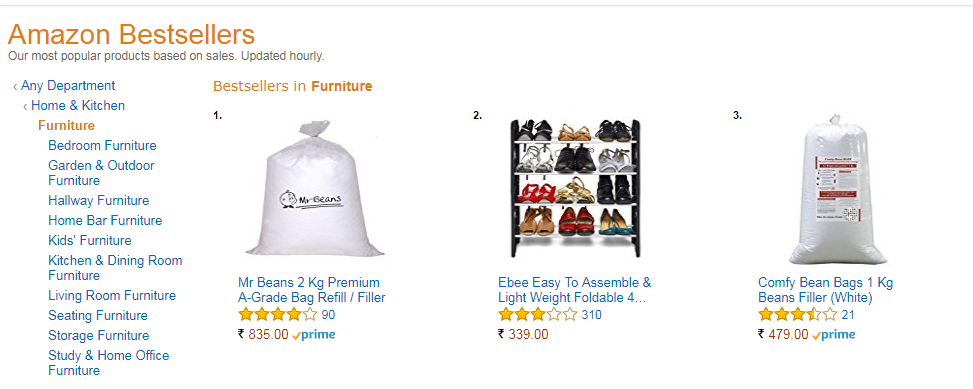
Word of mouth and other people’s opinion on a specified product has always been the best marketing tactic for any e-commerce website. A “Bestsellers” section is a good option to boost your sales. This section has products that are bought the maximum. “Bestsellers” is an amazing marketing strategy, as a word as well as a section.
Be the first
People have a strong urge to be exclusive and unique and ahead of others. Adding the words “be the first” to your marketing campaigns and advertisements will induce the feeling of being ahead. Include advertising words that sell your product in your marketing campaigns.
Your
Addressing customers in second person is beneficial for conversions. Make sure you make them feel as if you are directly selling the product to them. This simple trick gives them a sense of personalization which results in increased sales. Take a look at the subject lines of the emails below.

Remember
Your customers are super busy with their daily routine; it is a good thing if you mind them after some time about your existence. Just sending out an email that there is an event is not enough; remind them that the event is going to happen. You can also remind them of a certain time to use reward points they would have accumulated. One very good example that you can use is: “Remember, you have few hours left to redeem the offer”.
Thank You
Appreciating your customers will go a long way for e-commerce business. Show your customers a little love by appreciating them when they perform an action on your website. You can also appreciate your customer with a new deal when you achieve a particular goal. Sending a kind email to the customer appreciating them for registering on your website can also help in boosting sales.
Tips
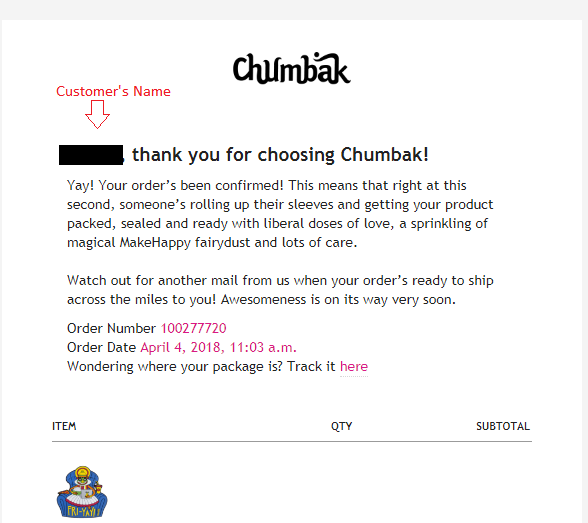
When a person reads the word “Tips”, people prefer reading the article as they associate tips to quick and highly informative reading. Plus, it seems as if the e-commerce website is extending a hand to help when they write “Tips” in their content. Send an email to your customers regarding how to use a specific product and add the word “Tip” to it.
Also Read: How to Optimize Ecommerce Website Images and Improve Sales
Words that push away customers
Hurry
It is totally understandable that you want your customers/visitors to act immediately but using this word does not justify that. “Hurry” is an overused word and does not engage customers to act. Try using “Act Now” or “Limited-Period Offer” for the desired effect instead of using hurry.
Look inside
You must have read a lot of subject lines of emails for e-commerce website saying “Look inside for promotional offers”. This phrase not just states the obvious but also annoys the readers. The first thing a reader does when they receive an email is open it and read the content. Better skip this phrase and get to the point. Usually, such emails are treated like bulk by the customers.
Guaranteed
The word Guarantee is a very strong word. An e-commerce website owner cannot take guarantee of anything. So it is best to refrain from using such powerful sales words. If you want your customers to know that your product is good quality try to back it up with testimonials, statistics or even glitter words on the website. But do not use the word “Guarantee”.

Also Read: Attract Valentine Lovers to Your Store with These AdWord Strategies
Groundbreaking
Similar to the words above, “Groundbreaking” is also a very strong word. Try to steer your brand clear of it. While this word might sound appealing to you, it does not connect with the customers. Unless you are selling a product that actually breaks the ground, try not to use this word on your marketing channels.
Huge
Trump’s favorite word! For a brand, every sale/ event/ offer is huge, then why to categorize just a few under the huge category. So if you are writing huge for a specific sale, customers would assume other sales are not huge thus not important. So try finding alternatives. One way to portray it is “Biggest Sale of the year”.

Cyber-space
This is just an example, avoid using words which are outdated and people do not use it. Cyber-space is a term referring to the internet; most people would not even understand the meaning of the word. Words like cyberspace, information superhighway are obsolete. So unless you are trying to ironic and you think your target audience will understand it, do not use this word.
Hassle-Free
Sure it does sound engaging but you are still associating the word hassle with your business. So try using synonyms of this word like “Easy” to give out the same meaning to customers. Just carefully pick the words that you associate with your brand.

Once in a lifetime
It is not a fairy tale, plain and simple. This phrase only suits in a fairy tale but does not go well in an e-commerce website’s marketing. Plus, make sure every word/phrase you use is true and makes sense. It is very clichéd word which has been overused marketers. Use original phrases for your brand.
SAVE UP TO XX% RIGHT NOW!!!
This phrase (Exactly how it is written) has a lot of mistakes and can specifically hamper your e-commerce websites conversion. One of the problems is most marketers do not even know that writing in capital letters does not mean creating more impact. Instead, it portrays an idea that you are imposing the statement on the person reading it. The second problem in the phrase is the 3 exclamation marks. If you exclaim too much, you lose the charm. Just keep the phrase plain and simple.

Final days to save
This phrase is vague. If customers see these phrases late and start shopping from your website, they would be disappointed to know they arrived a day too late for discounts and other offers. When you offer a discount or sale make sure you provide a specific time frame as to when the sale is going to end.
Include the words that increase the conversion of your marketing campaign and let go of the counterproductive words from your website. Share other such amazing words you have in your arsenal, let’s know what words we need to learn and what we should better forget.
Engage Your Customers and Increase Conversion Easily
The post 20 Powerful Marketing Words That Can Make Or Break Your Conversion & Sales appeared first on YoKart Blog.
]]>The post How To Write E-commerce Emails That Convert – Ideas & Examples appeared first on YoKart Blog.
]]>Emails are a very effective and successful marketing tactic and are a part & parcel of every marketing campaign. It is 61% more effective than other platforms like social media, paid search, display ads etc. With that said, this is something that most marketers already know about.
So where is the problem?
Remember, an email can only be successful if it contains the right message. Repetitive and bad emails can annoy your readers and prove to be disastrous for your e-commerce business. If your emails are not getting appropriate response then definitely you are not going somewhere.
Let’s explore where most businesses go wrong when it comes to sending emails. After looking into these details, we will help you with tips that can help you counteract this problem. Get out of those endless recurring passive-aggressive messages, chain emails and read along to see how to write emails that don’t annoy your customers anymore.
Also Read: E-commerce Conversion Rate Benchmarks: Where does your online marketplace stand?
How Can Your Readers Get Annoyed?
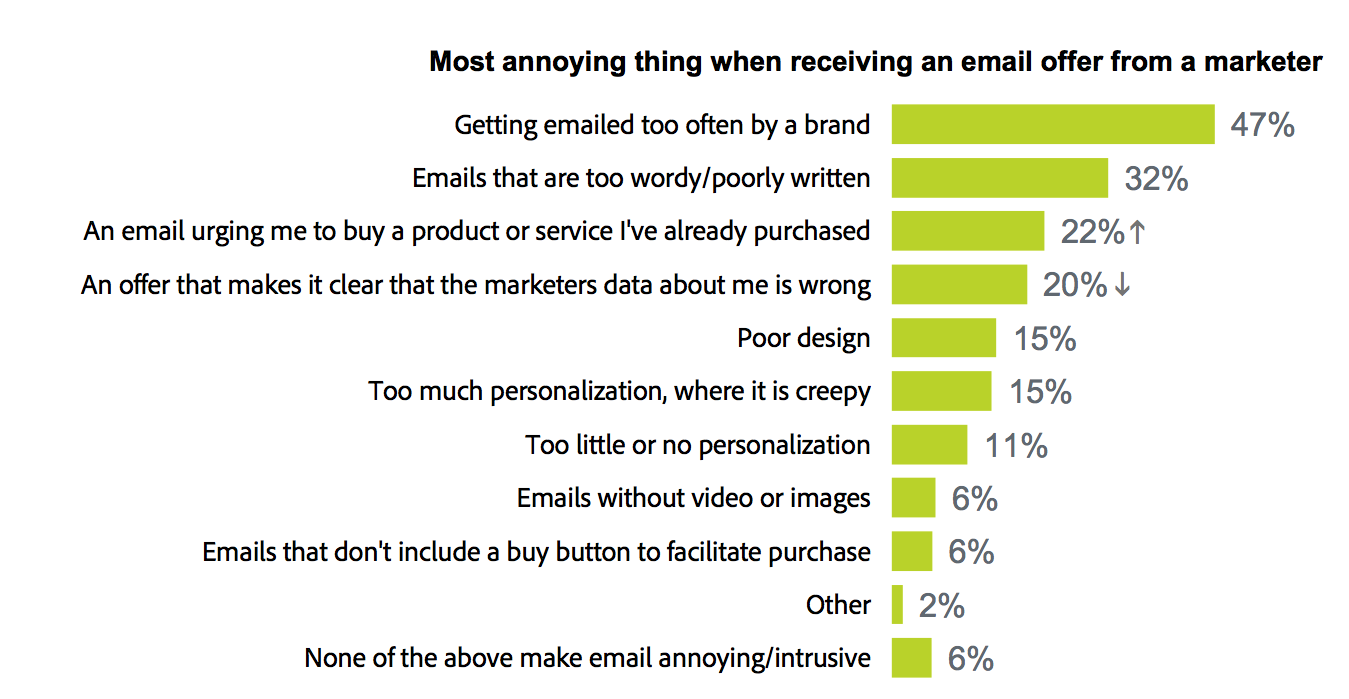
There are many ecommerce email examples out there that have irritated and confused the readers. Lengthy and wordy email content tops the list, followed by emails urging customers to buy a product that they have already purchased. People also often complain about false information given out on promotional emails. The graphic below shows some of the most common reasons that will make readers want to go away from your email offer.
How to Begin Responding?
You can only start sending emails to your customers if you know the objective behind the same. Make sure you figure this out ahead of time so that your message is eventually conveyed via your email. There are many occasions that may call for a short email and a good thing out here would be to decide in advance and approach your goals accordingly.
There are numerous instances when one can plan to send out mails like when launching a new product, sale or event promotion, newsletters, cross-selling on previous purchases, shopping card abandonment issues etc.
Once you know what your email is for, try to focus on sending the message directly. Skip all the unnecessary information that may overwhelm or confuse your visitors. Suppose you want your customers to purchase from an ongoing sale. What sense would it make to write an email informing them about the latest blog post that you published? Let’s take another example to illustrate this point.
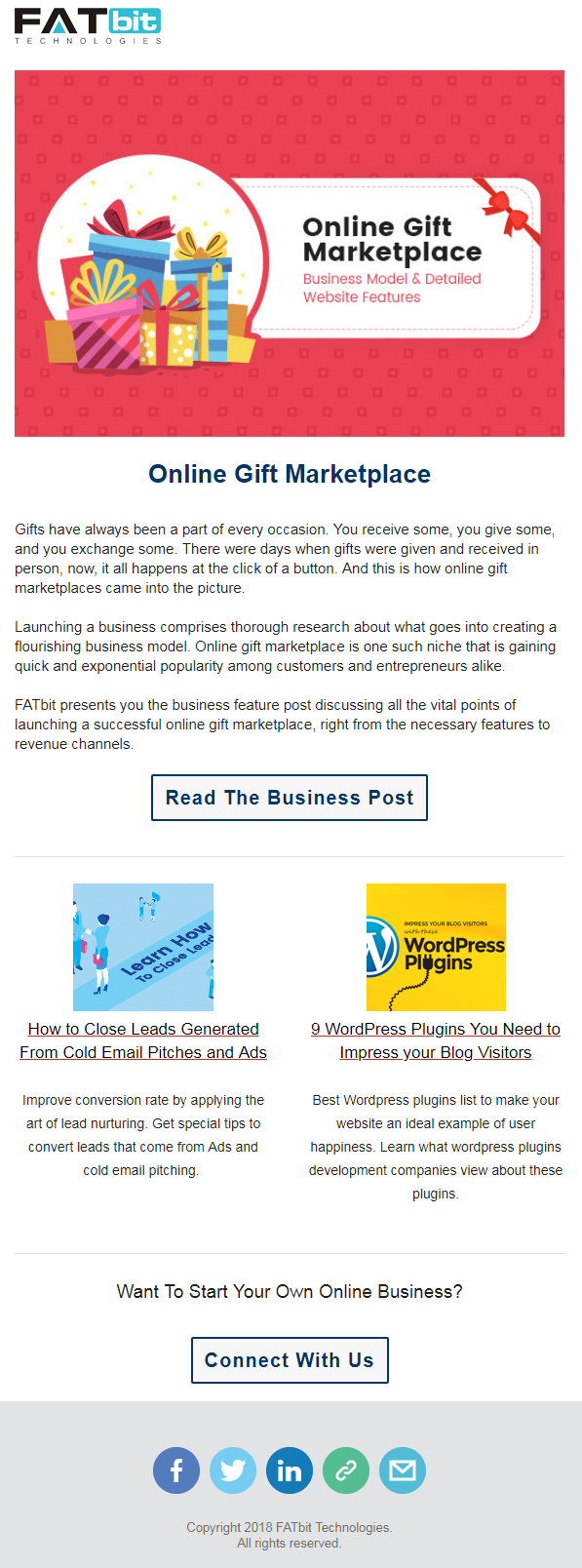
This newsletter has a clear and concise objective. It is not trying to either sell or promote any product. FATbit wants their readers to simply read the latest posts and this newsletter precisely does the same. A clear CTA will take you to the post in a single click and a few suggested reads are listed in case they interest the users. Finally, a CTA beneath defines the service FATbit provides, rather than the entire post trying to tell customers the same.
Capturing Leads the Right Way
Now that we have established that emails need to be specific and customer centric, the next question is:
What is the right way to go about targeting your potential customers via email?
If you want your emails to reach clients, well first you need to start by understanding how mailing lists work. It is important to segment those with parameters suitable to your business model. For example, you can send early bird offers to customers who are loyal and are waiting for products to come online on your store. There are many ways to make visitors subscribe to your channel and these can help you define different email lists for different events.
Whichever method you choose to adopt will significantly affect user experience, so make sure you decide something that is simple, easy and happens in just a few clicks.
Here are a few tips to help you increase a subscription base and only require minor design and web development changes on your website:
- Present a pop-up at the end of the page or as the user shows exit intent. This serves as a call to action by giving them a direction on where to go next.
- Slide in a subscription request at different page scroll percentages as these are gentle yet eye-catching to your website audience.
- Sticky bars on top of the navigation bars are quite noticeable and are a high conversion spot for your subscription form. Make the most out of it.
- Add a newsletter opt-in form in the sidebar of your blog . To make it prominent and noticeable, have an attractive modular email templates design.
- Offer content upgrades in the form of free PDFs and readables to your customers when they subscribe. Rewards are a good way to attract more subscribers.
- Make use of a home featured box on the homepage and leverage it to get more subscribers. The homepage attracts the most traffic and this way you can make sure your traffic can start subscribing.
- Provide additional navigation to the subscription page with the help of sidebars. They are informative, appealing and can be one of the best converting positions on a webpage.
- Making a separate optimized landing page and use it to your advantage by integrating an attractive design, images, insights and reviews to help gain user trust.
Also Read: How to capture market you could not in 2017?
Offer Something Valuable to Your Reader
Why do we need to send emails to our customers?
To answer this, we don’t really want to send our users emails because everyone in the e-commerce sector does these days. Right?
It is imperative to understand that value is something every online customer will look (directly or indirectly) for when they see your email in their inbox. It has to be worth their time and effort; only then the money part may come later in the picture. If your users feel canned because you are being desperate by sending the wrong emails at the wrong intervals, expect them to unsubscribe considering it spam mail.
Your customers, in such a situation, are also not entirely at fault as they get nothing out of the entire experience. Offer value to subscription holders with every email that you send them. Give them information that is useful, discounts, best price match, daily deals, contest invitations, free shipping, free returns and anything under the sun that makes them excited.
Craft emails in a way that they focus on delivering value and promote your product or service along with it discreetly.
Tips to Create Emails that Hit the Jackpot
Apart from focusing on the value that you are offering your customers, there are many considerations to look out for when creating email workflows. Thanks to advanced data analysis and machine learning, we now have the stats to understand user behavior better and proceed accordingly. Use these tricks and create emails that your customers can never say no to:
- Create appropriate subject lines. They should be short, catchy, clear and actionable. They should stimulate curiosity and make the email feel personalized. Remember, the email subject line will be the first thing that a reader will notice so make sure its compelling enough to make them want to open your email.
- Make use of drip campaigns or lifecycle emails to provide your customers with appropriate information at all times. For example, they should receive an email once they place an order, followed by one when the item ships and another when the customer finally receives the package. Once this is done, you can send a fourth mail in some time asking a reader to fill in an easy feedback form. Automating such email campaigns can help send informative content and make life easier for you.
- Pay attention to cart abandonment emails and remind your readers that they still need to check out. Add value for your reader by giving away a promotional discount just so that they can complete their purchase.
- Embed more audio visual media in your message. If you are promoting a product, put in a video telling the same. Show off your products and services with some great images and videos. Blocks of content are dull and boring and people look forward to something more interactive. Create collages and informative video messages for your readers to get more conversions.
- Create CTAs that mirror the objective of your email campaign. Make sure they are not lengthy and misleading. Try to address the topic and add value to the CTA.
- Remember, your readers do not need to hear from you three times a day. It is very easy to frustrate them with the same and this usually leads to unsubscription. Time your emails in a way that you give customers a gentle nudge every now and then to keep them informed about what’s happening at your end.
Wrapping up, you should now be able to identify where you are going wrong. Email marketing, if used smartly can help you convert more leads into paying customers with just a few emails. You should choose one of the best SMTP Service Providers to ensure the success of your email marketing campaign. Follow the trail and figure out what you can do to keep customers on the lookout for your next email.
Use these tips and tricks to engage your audience instead of frustrating them. Turn your readers into viewers and eventually buyers with the right email.
Can’t find the right message to lead a marketing campaign?
The post How To Write E-commerce Emails That Convert – Ideas & Examples appeared first on YoKart Blog.
]]>The post How to Capture the Market You Could Not in 2017 appeared first on YoKart Blog.
]]>They must have formed a plan to market their product to a larger audience and to tap into the untapped market. Also, they must have researched trends and recent innovations to use during the coming year. Some of them did, some didn’t.
One question would often pop up in the head of the entrepreneur while deciding the marketing for the coming year: How to capture the market which our business could not in 2017?
Below are the 5 R’s that most marketers should have used in their marketing plan last year. If they haven’t, they should inculcate them this year.
Retargeting
Most of you would be wondering how retargeting helps capture the market and increase sales. However, retargeting has been a proven way to attract repeat visitors, an audience category that is more likely to convert than first time visitors.
According to a study by CMO, almost all online shoppers who visit a website for the first time leave without buying a product. Numerically, only 2% shoppers will actually buy something the first time they come to your website.
So, 2018 is the time to capture those visitors who visited your website but left for some or the other reason. One of the top reasons why visitors do not convert is because of the checkout page.
Retarget your marketing strategies for those customers who are already aware of your brand but did not convert due to some reason. Remind these customers about yourself. Relevance of retargeting is high because there higher chances of conversion compared to other ways that target online browsers.
Also read: Essentials of Content Marketing for E-commerce Marketplace
Repurposing
Repurposing content is an excellent way to use the existing resources to create something unique.
According to a study by Curata, only 29 percent of leading marketers make repurposing a systematic part of their content marketing strategy.
If you are one of the 71% of marketers, then 2018 is the time to repurpose your content to make maximum use of your resources by spreading the content to maximum channels.
Create a methodical approach to repurpose your content; start by accumulating enough content to reuse. Identify your top performing content, update it as per current requirements, adjust its length, and streamline it with your future campaigns.
Repurposing is a smart way to reach new and existing audiences, create a brand name, and increase conversion without draining the resources.
Report and Analysis
If you are an ecommerce marketplace owner and are not using a reporting and analytical tool yet, you are missing out on really important things. These tools are helpful in to tracking your traffic and conversions.
An ecommerce website that does not strategize its marketing on the basis of the reports and analysis lacks a direction. As a result, marketing campaign won’t be leading anywhere.
An extensive reporting tool on your ecommerce marketplace will help you improve the efficiency of your operations.
These tools are helpful in understanding the success rate of a marketing campaign and the overall ecommerce website.
Also Read: Why Analytics Is Important for an Ecommerce Business
Ecommerce stores must have Analytic and Reporting Features
Reviews and Testimonials
Not many marketers understand the importance of reviews and testimonials on their online business website.
One way to convince new visitors about the quality and service of your website is by praising yourself on your own website. The other way (proven to be better) is your clientele praising your services.
People would rather prefer reading past customers’ reviews than self-praise. So the authenticity, quality and service depend on the review and testimonials of previous customers.
In 2018, make sure that you are also listed on other review websites. One of the top places visitors check is Google reviews. But depending on your niche they may also check other review websites like Yelp, Glassdoor, etc.
Reward and Recognition
Every marketer is well aware of the fact that it is better to retain older clients rather than acquire new ones.
Every ecommerce business longs for loyal customers who keep doing business with the website on regular basis. To attract these customers and make them loyal to your brand, make sure you give them some kind of incentive.
Ecommerce website can and must have a reward and loyalty program where customers earn some points or special discounts on certain purchases. This provides them with the best shopping experience, thus making them loyal to your website.
This is a must have for all ecommerce website as this gives the customers a reason to stay loyal to one brand for a long period of time.
Conclusion
All the points mentioned above in the post are a must have for any ecommerce business. For those of you who did not inculcate these marketing tips in their plan: now is the right time to do it.
These 5R’s will not just help in increasing the conversion rate but also in retaining customers for a longer time.
The post How to Capture the Market You Could Not in 2017 appeared first on YoKart Blog.
]]>The post Conversion Rate Optimization for Ecommerce Websites appeared first on YoKart Blog.
]]>Target Your Ideal Customer
If you have a conversion problem, knowing about your user’s browsing behavior can indeed help you with CRO. Use analytical tools like Mixpanel, CrazyEgg, Inspectlet and Google Analytics to utilize quantitative data efficiently. Also, make way for qualitative data in the form of customer feedback and site reviews. Analysis can help you set benchmarks for the conversion rate of your online store. They also provide invaluable data beneficial to understand CRO basics. Read More: The Hybrid Theory of Progressive Web Apps and Their PracticalityMake Your Purchase Funnel Easy To Navigate
It’s pointless to have an impressive online store if your users cannot find what they are looking for easily. Site navigation must always be clear and all click-throughs must work. Investing in responsive web design is a must as most users visit your e-store on a smartphone or tablet. Use detailed high definition product images and make sure your store’s checkout process is easy and straight. List product categories and descriptions in a way that the shopping experience feels like a piece of cake. Provide guest checkouts and allow customers to review your products.Use data-driven decisions to optimize your website
Analytics do help us figure out what customers like and dislike on our website. Use this data to invest in software’s and techniques that can help you overcome several such issues. Cart abandonment software works with users who abandoned carts or the checkout process without completing the purchase. Such softwares create follow-ups with incentives to persuade the customer to purchase from your site eventually. Live chats allow you to solve user queries 24/7. It not only gives you the ability to serve customers all the time but also helps build a personal connection with them. Use tools such as Optimonk, Sleeknote, MaxTraffic and OptinMonster to collect customer data and increase subscription base. Read More: What Makes A Product Go Rave?Deploy Clear & Meaningful CTA’s
Because most submission forms result in unnecessary subscriptions and junk emails, online customers are becoming more and more skeptical about giving away their personal information. Multiple options and CTAs can often overwhelm your visitors. It is good to have CTAs like ‘Add to cart’, ‘Proceed to checkout’, ‘Add to wishlist’ and social media share buttons placed in the same area within a webpage. Use CTAs to give value to your customers by inserting them only where needed.Always Lookout for Your Customers
E-commerce is all about providing maximum value to your customers these days. Focusing on your user’s browsing experience and safety can definitely help you with CRO in the long run. Build trust by letting your customers know your store is genuine and safe. Show users your website is legitimate and provide them with secure payment gateways. Give loyal customers perks every now and then. Surprise them with discount coupons, easy access to latest products, referral deals and sweepstakes. Offer right prices and also free shipping if possible. Also, focus on providing free product returns and exchanges. This sends in the right message and makes sure that customers always return to purchase from your website in the future.Make Use of Relevant Content
Give your users rich and informative content that includes articles, pictures, blog posts and videos. Supplement your product descriptions and landing pages with content targeting keywords used in an organic way. The right content can help you market your brand and educate your audience about getting maximum value from your products or services. Develop and strategize your content around your unique value proposition and aim to educate your users about the same.Social Media Trends
Social media gives you an opportunity to establish personal relationships with your customers. Share stories, case studies and company announcements with your followers. Show them that you are as human as them and how you eventually learn from your mistakes too. Celebrate milestones and offer incentives to your users every now and then. Social media has the potential to make your product/service go viral on the internet and gain huge fan following.Conclusion
These few practices are bound to get you a clear sense of how conversion rate optimization works for e-commerce websites. Be relentless when it comes to testing new ideas and monitor how it affects the conversion rate. Analyze user data to propose changes that may help you increase conversion. Test your hypothesis to see whether your research is relevant or not. Remember, you do not need more traffic to sell more on your online store. What you need is to get more site visitors to make purchases and move quickly through the sales funnel. Although there is no formula set in stone to help you with CRO, these tips can help you constantly iterate targeted practices and increase conversion ultimately.The post Conversion Rate Optimization for Ecommerce Websites appeared first on YoKart Blog.
]]>The post Payments in Ecommerce marketplace – Things to Keep in Mind appeared first on YoKart Blog.
]]>Consider this, if you are running an ecommerce marketplace, but do not offer easy to use and secure payment options, how would your consumers buy from your marketplace?
Here’s the good news: Consumers are getting accustomed to online payments
In the last couple of years, the number of online shoppers has risen by almost 20 million. One of the reasons behind such a huge acceptance is the shopping experience being offered. And all these online shoppers are spending an exorbitant amount on ecommerce websites. The total amount spent online grew from $61 billion to $68 billion last year. What is more interesting is the fact that number of online transaction has increased by 115 million during that time. This means that consumers are using online payments as a mode of making transactions.
Types of payment options that you can offer
Traditionally, there are few payments options that are imperative for an ecommerce marketplace. These include:
Credit/Debit Cards – Card payments is one of the most popular modes of payment for consumers. Globally, almost 42% of consumers do online transaction via credit cards, while that of debit card stands at 28%. Adding these two takes the figure to 70%. This makes it crucial for your ecommerce marketplace to include credit/debit cards as a payment option.
One benefit of incorporating this payment option is that consumers can easily save the payment details (card details), making it easy for them to make repeat purchases without requiring them to enter their details manually.
Bank Transfer – This payment option is one the most widely used mode of payment with one-fifth of the consumers doing transactions via bank transfer. There are several countries where penetration of credit cards is not optimal, and thus, making bank transfers the only option.
Electronic Payments – Ever since ecommerce has come to the forefront, several electronic payment options have become popular. This includes digital payments like PayPal that allows you to do wire transfers. Over 39% of online consumers prefer electronic payments. Many technology evangelists claim that in a few years, electronic payments will overtake card payments to become the most popular mode of transaction.
It is crucial to note that every geographical region has their own electronic payment provider that customers prefer. Therefore, it becomes important to provide option that is popular among the consumers.
Mobile payments – Nowadays a new wave of payments architecture is coming up in the form of Android Pay and Apple Pay. These payment methods are prominent on smartphones platform as they offer an integrated way to make automated payments. Around 14% of the global consumers prefer to make online payments using this method. Additionally, messaging platforms like Facebook messenger, WhatsApp, line etc. are also moving into mobile payments arena. Integrated payments options are hugely popular in China.
COD (cash on delivery) – A lot of consumers, especially in the developing nations, still prefer to use cash-on-delivery option. Another aspect to this payment option includes the security in the minds of the people who still prefer to physically feel the product before making the purchase. Almost 23% of online consumers still use cash-on-delivery as their preferred mode of payment. Although this mode of payment is on the decline, still it offers immense convenience to the consumers. This is what makes it an essential payment option on your ecommerce marketplace.
Gift Card/Vouchers – Ecommerce marketplaces are now offering an option to consumers where they can purchase gift vouchers, allowing them to present it to someone else. Almost 15% of the global consumer use this payment service which shopping online.
Cryptocurrency – Nowadays a new wave of online payments methods have come to the forefront in the form of cryptocurrency. Its usage has been on the rise and the best part about it is that it is totally anonymous, offering the much needed privacy to the consumers. Several ecommerce marketplaces are now incorporating the option to make payments via cryptocurrency like Bitcoin.
Suggested Read – Top 10 purchase drivers of online shoppers
In 2015, the total number of non-cash payments in U.S. alone is estimated to exceed 144 billion, with a transaction value of almost $178 trillion. Globally, non-cash payment methods are on the rise for online shopping. By offering all these payment features you can easily enhance the consumer experience.
Other than payment options, ecommerce marketplace owners must also focus on payment gateways.
Are you looking to add multiple payment options into your ecommerce marketplace
Payment gateways- Payment gateways allow you to carry out your electronic transactions securely. The information shared across a payment gateway is encrypted to keep your financial and personal information safe from malicious elements on the internet. There are several popular payment gateways like:
- Authorize.net
- PayPal
- Pay U Money
- CCAvenue
- Omise
- Citrus
- Khipu
- Paytm
- RazorPay
- Amazon
- Stripe
- 2checkout
As per your convenience and trust in the service provider, you can add one of the above mentioned payment gateways in your ecommerce marketplace.
Bonus Options
There are some additional payment options that not only enhance the consumer experience but also create a better marketplace – seller relationship. Let us take a closer look:
- PayPal Adaptive System – It is a revolutionary payment system that handles one-to-many payments easily. It enables both admin and vendors to split the order total with secondary receivers, such as affiliates or partners. This removes the hassle where the admin has to individually divide the payments received from the buyer and send it to the vendor.
- Multi-Currency Support – As most ecommerce marketplaces work on the global scale, it becomes essential for them to have multi-currency support. This makes it easy for consumers to deduce the final rate without the need for conversion. Also some banking institutions impose a currency conversion fee, which is not user friendly. Features like self-service in banking further enhance user convenience by allowing customers to manage currency preferences and transactions independently through digital platforms.
Conclusion
The fact of the matter is that ecommerce has become a behemoth in the current market dynamics. Online payments are rising and in order to make your online marketplace highly consumer friendly, you need to incorporate best practices when it comes to digital payments. YoKart is one readymade ecommerce solution that has all of the above payment options making it a powerful and complete package. All you need to do is simple check the payment features YoKart offers.
Looking for an ecommerce solution with wide range of integrated payment options?
The post Payments in Ecommerce marketplace – Things to Keep in Mind appeared first on YoKart Blog.
]]>