The post How to Build a Multi-Vendor E-commerce Platform for Startups? appeared first on YoKart Blog.
]]>The potential of multi-vendor platforms for startups is immense and offers a strategic leap toward creating an inclusive, scalable ecosystem that benefits both sellers as well as buyers. A research states that $8.7 trillion of sales are forecasted by the beginning of 2025. However, the major concern is how entrepreneurs can ensure that their multi-vendor platforms stand out amidst the competition and what critical steps they need to focus on to turn their vision into reality.
This comprehensive will cover the nuances of multi-vendor platforms; from their definition and benefits to the essential steps required to build one that best aligns with your business requirements.
Table Of Contents
- What is a Multi-Vendor E-commerce Platform?
- Types of Multi-Vendor E-commerce Platforms
- Benefits of Launching a Multi-Vendor E-Commerce Platform
- How Does a Multi-Vendor E-commerce Platform Work?
- Essential Features of a Multi-Vendor E-commerce Platform
- Steps to Build a Multi-Vendor E-commerce Platform for Startups
- Our Recommendation
- Wrapping Up
- FAQs
What is a Multi-Vendor E-commerce Platform?
A multi-vendor e-commerce platform is a digital marketplace that allows multiple sellers to list and sell their products or services on a single platform. Multi-vendor platforms enable buyers to browse and purchase products/services from various sources. Thus, offering a more centralized space. Here are the names of some of the popular multi-vendor e-commerce platforms that you can take reference from:
- Amazon
- eBay
- Etsy
- Alibaba
- AliExpress
- Walmart
- Flipkart
- Shopee
- Target
- Best Buy
Unlike single-vendor platforms, where only a single seller offers products or services, a multi-vendor platform hosts numerous sellers—each offering unique products or services. Thus, creating a competitive environment. According to a research, 57% of net online sales are done through a multi-vendor platform worldwide.
Businesses benefit with an access to a large customer base, as multi-vendor platforms bring together a variety of customers under one single platform. Apart from this, these platforms additionally offer tools for businesses to manage their product catalog, process orders and handle logistics. This makes it easier to scale operations.
Types of Multi-Vendor E-commerce Platforms
Categorized by their offerings and target audience, multi-vendor e-commerce platforms provide businesses with versatile solutions to engage customers, expand reach and drive growth.
Based on Offerings:
1. Product-based Platforms: These platforms primarily focus on physical goods, offering a range of products from various vendors. Popular examples include Amazon, eBay, Etsy, Walmart, etc.
2. Service-based Platforms: Through these platforms, vendors offer various services such as freelancing, bookings, consultation and more. Popular platforms are: Fiverr, Upwork, TaskRabbit, Thumbtack and more.
3. Hybrid Platforms: These platforms offer a broader selection to customers, offering a combination of products and services both. For Instance, Amazon, Sephora, etc.
Based on Audience:
1. Business-to-Business (B2B) Platforms: These platforms facilitate transactions between businesses. This allows vendors to sell their products or services to other businesses. Example: Alibaba, Amazon Business, ThomasNet, IndiaMart.
2. Business-to-Consumer (B2C) Platforms: B2C platforms connect multiple vendors with end consumers, focusing on delivering a broad range of products or services to individual buyers. For Instance, Amazon, eBay, Etsy, Walmart and Target.
3. Consumer-to-Consumer (C2C) Platforms: These platforms enable individuals to sell directly to other individuals, typically for second-hand goods or peer-to-peer services. Popular Platforms include eBay, Craigslist, Poshmark, Depop and more.
These distinctions help tailor the platform’s design, user experience and functionality to best suit the needs of vendors and their target audience.
Curious to Build Your Own Multi-Vendor E-Commerce Platform?
Benefits of Launching a Multi-Vendor E-Commerce Platform
Building a multi-vendor e-commerce platform for startups extends a suite of benefits, which are as follows:
1. Zero-Inventory Business Model
Multi-vendor e-commerce platforms operate without the need to maintain any inventory. This significantly reduces capital investment and storage costs. Such platforms act as an intermediary that connects vendors and buyers directly. Thus, minimizing overhead costs, focusing on streamlining transactions and user experience.
2. Global Reach
Multi-vendor platforms break geographical barriers, allowing businesses to connect with a worldwide audience. Vendors can tap into diverse markets, which ultimately helps in expanding customer bases and enhancing sales potential. This global accessibility fosters cross-border trade and drives growth for all stakeholders.
3. Low Operational Costs
The operational costs for platform owners are substantially reduced with vendors handling inventory and logistics. Multi-vendor e-commerce platforms leverage advanced technology to automate processes such as order management, payment handling and customer support. Thus, ensuring cost efficiency and scalability.
4. Increased Revenue Streams
One notable advantage of a multi-vendor e-commerce platform is that it unlocks multiple revenue streams through commissions, subscriptions, advertisements and more. This diversified approach ensures consistent income while providing flexibility to optimize and innovate monetization strategies.
5. Reduced Risk
Multi-vendor e-commerce platforms mitigate risks associated with market fluctuations and unsold stock by diversifying vendor offerings and eliminating inventory liabilities. This shared responsibility model fosters stability and adaptability. Thus, ensuring long-term stability for the business.
How Does a Multi-Vendor E-commerce Platform Work?
A multi-vendor e-commerce platform consists of three primary stakeholders that work collaboratively in order to provide a unified experience, which are as follows:
- Vendor/Seller: The seller who registers on the platform to sell goods or services.
- Buyer: The customer who explores the platform to buy any goods or services.
- Admin: The marketplace owner who keeps track of all the actions.
Here’s how the ecosystem works:
Step 1: Firstly, vendors register on the platform by creating their profiles and listing their products or services with detailed descriptions, prices and images.
Step 2: The platform blends all vendor offerings into a centralized marketplace, enabling customers to browse, search and compare products.
Step 3: Customers explore the platform, add items to their cart and proceed to checkout after selecting the desired products or services.
Step 4: The platform processes orders and forwards them to the respective vendors, who then prepare and fulfill the orders.
Step 5: The delivery of the products is coordinated through integrated logistics or vendor-managed systems. Apart from this, the platform then manages the payments, dividing them between all the stakeholders.
Step 6: Customers leave reviews & ratings on the platform.
Step 7: In case of any issue, vendors or the platform provide customer support, handle returns and manage payments to build credibility.
Revenue Generation Model
In order to ensure consistent income flow and maximize profitability, a multi-vendor platform offers multiple revenue generation schemes. Understanding these revenue channels is beneficial for your platform’s growth.
Below are some of the dominant revenue streams:
- Commission Per Order
- Third-Party Advertising
- Subscription Offers
- Strategic Partnerships
- On-demand Specialized Services
- Featured Product Listings
Maximize Business Profitability with a Robust Multi-Vendor Platform
Essential Features of a Multi-Vendor E-commerce Platform
A robust multi-vendor platform must cater to the needs of both vendor and admin while ensuring a seamless experience for customers. Below, we outline the essential features required for a successful platform:
From Vendor Perspective:
1. Individual Seller Storefronts: Vendors should have their own dedicated storefronts to showcase their products and establish their brand identity.
2. Real-Time Inventory Updates: This feature ensures that vendors can update the stock levels immediately in order to reduce the chances of overselling.
3. Bulk Purchasing: Allow vendors to manage bulk orders efficiently by enabling tiered pricing and bulk purchase discounts to attract manufacturers or businesses as well.
4. RFQ Module: A Request-for-Quote (RFQ) module empowers vendors to interact directly with buyers for customized orders or special pricing agreements, which is particularly beneficial in B2B multi-vendor platforms.
5. Order Management: This feature is crucial for tracking, processing and fulfilling orders promptly.
6. Track Earnings: Allow vendors to track their earnings in real time, including reports on sales, refunds and commissions deducted.
From Admin Perspective:
1. Complete Admin Control: Empowers admin with a centralized dashboard to oversee all the platform operations.
2. User Management: Admin can oversee customer and vendor profiles on the platform, their activities and take action in case of any disputes to ensure compliance.
3. Commissions Management: Empower admins with flexibility in setting and managing commission rates based on product categories, vendor profiles or sales volume.
4. Content Management System (CMS): Allow admins to manage and update platform content with a built-in CMS to keep the platform dynamic and relevant.
5. Master Catalog Management: Admins should be able to maintain control over the master product catalog, ensuring consistent categorization, standardization and quality across listings.
6. Discounts & Promotions: Enable admins to offer discount coupons, special offers and more to attract more vendors and customers over the platform and drive sales.
7. Reports & Analytics: Comprehensive analytics provide insights into vendor performance, customer behavior and overall platform performance. These insights enable data-driven decisions to optimize platform operations.
Launch a Feature-Loaded Multi-Vendor E-Commerce Platform
Steps to Build a Multi-Vendor E-commerce Platform for Startups
Building and launching a multi-vendor e-commerce platform involves careful planning, research and execution to ensure a successful and scalable business.
Below are the key steps to guide you through the process:
1 Identifying a Gap in the Industry
Pinpointing an unaddressed problem or an underserved segment in the market is the foundation of your platform’s success. Understanding such gaps is an essential step before diving into the development phase. Analyze the market and identify unmet needs or inefficiencies that will, ultimately, carve out a unique space for your platform.
2 Conduct Market Research and Analysis
Thorough market research is critical to understanding your target audience, competitors and industry trends. Thus, assess market trends to identify potential opportunities and threats. Deeply analyze your target audience, including their buying behavior, preferences and pain points. As a result, this research will help you tailor the platform’s features and offerings to suit the demands of your audience.
3 Identify a Niche
Rather than catering to a general audience, focus on a specific niche. This way you can focus on a more focused audience and cater to their unique needs. A well-defined niche ensures targeted marketing and a clear value proposition. Consequently, this will help in building platform credibility and trust among users. Popular niches may include:
- Fashion: Clothing, accessories and footwear
- Digital Goods: Templates, e-books and software
- Handicrafts: Artisanal products and handmade goods
- Electronics: Gadgets, appliances and tech accessories
- Health Supplements: Vitamins, minerals, probiotics and botanical supplements
4 Define Your Business Model
Identify the business model that best suits your business requirements. Equip your platform with something unique to what others offer. Finally, determine how your platform will generate revenue and operate to ensure a consistent flow of income. Choose a business model and monetization strategies that aligns with your long term goals and market trends.
5 List Down Your Requirements
Create a list of the features and functionalities that you require in your platform. Mention in detail. This may include individual vendor storefronts, inventory updates, order management, 24/7 booking, diverse payment gateways or some other specialized features. A well-defined list will, thus, help later in the development process by avoiding any unnecessary delays and leading to a smooth flow.
6 Choose a Development Approach
Generally, there are two key development approaches when considering to build a multi-vendor e-commerce marketplace. Each offers unique advantages and considerations. Here is a detailed overview of both the approaches:
- Custom Development: Custom developing a multi-vendor e-commerce platform includes building it from scratch. Although this approach offers admins with complete flexibility to tailor the platform according to their requirements, it may take up to a year or so to build your platform. In effect, this will delay your platform’s market entry.
- Readymade Software: Utilizing a readymade software to build your multi-vendor e-commerce platform involves a pre-built software solution equipped with essential features and functionalities to get your platform up and running. This approach takes comparatively less time and investment than custom development and allows for extensive customization to build your app as per your business requirements. Moreover, readymade software reduces the time to market and launch your app in no time. Thus, helping you to capitalize on the market trend as quickly as possible.
Our Recommendation
Although both custom development and readymade solutions have their unique advantages, utilizing a readymade software to build your multi-vendor e-commerce platform for startups is an optimal choice. This is because readymade software requires relatively less time, resources and investment. As a result, entrepreneurs can establish their presence in the market quickly and focus on growth.
Among various solutions available, Yo!Kart is a premier choice to build a multi-vendor e-commerce platform for your startup. Yo!Kart is an avant-garde multi-vendor e-commerce software that helps entrepreneurs to build their own platforms quickly in no time. The software offers advanced features, business APIs and payment gateways right from the beginning to handle multi-vendor operations of your business.
Built to automate your multi-vendor business processes, Yo!Kart offers businesses with unique advantages, which are as follows:
- 100% White Label
- Self-Hosted and Secure
- Source Code Ownership
- Highly Scalable and Customizable
- Native Mobile Apps (Android & iOS)
- One Year of FREE Technical Support
With a robust experience, Yo!Kart has powered a lot of multi-vendor e-commerce platforms across various regions. They are:
- Voyij – Multi-Vendor Tour and Activities marketplace
- B2B Liquor Selling Platform
- Bozinga – B2B Wholesale Marketplace For Distributors & Manufacturers
- TransporTECO – Multi-Vendor Marketplace for Electric Vehicles
- OGI – Multi-Vendor One-Stop-Shop for Machinery Parts
Secure a One-on-One Personalized Demo to See Yo!Kart in Action
Wrapping Up
Building a multi-vendor e-commerce platform offers startups a profitable business model with global reach and minimal operational costs. By leveraging the right strategy, tools and features, startups can cater to diverse audiences and create a seamless shopping experience. Furthermore, success in this space depends highly on a thorough market research, a clear niche and a robust platform with features that cater to all the stakeholders.
Whether you are targeting B2B or B2C audiences, invest in a multi-vendor e-commerce platform that sets the foundation for a thriving business.
FAQs
Q 1. How much does it cost to build a multi-vendor platform for startups?
Ans. Building a multi-vendor platform by utilizing a readymade software costs comparatively two-three times less than custom development which may cost anywhere between $20,000 to $100,000 or more.
However, you can build your multi-vendor platform with Yo!Kart starting from $499. For more detailed information, kindly refer to our pricing plans.
Q 2. Can Yo!Kart be customized to build a multi-vendor platform with a unique business identity?
Ans. Yes, Yo!Kart is a highly customizable readymade software that allows you to customize your platform according to your business requirements. From unique branding to adding niche-specific features, Yo!Kart empowers businesses to create a distinctive identity in this competitive space.
Q 3. Is Yo!Kart a scalable solution?
Ans. Absolutely! Yo!Kart is designed with scalability in mind, ensuring that your platform can handle increased traffic, vendors and transactions as your business grows. Its robust architecture and flexible features make it suitable for startups aiming for long-term success.
Q 4. Does Yo!Kart offer complete ownership of the software?
Ans. Yes, Yo!Kart provides complete ownership which allows businesses to manage infrastructure without depending on third parties. The software demands a one-time cost for a lifetime license and provides the flexibility to host and manage the software on your in-house server or some third-party server. This ensures data security, flexibility for modifications and full control over operational aspects.
The post How to Build a Multi-Vendor E-commerce Platform for Startups? appeared first on YoKart Blog.
]]>The post How to Start a Furniture Resale Marketplace appeared first on YoKart Blog.
]]>As the rising climate crisis creates more awareness, with changes undeniably visible in the biosphere, more consumers are considering sustainable alternatives by the day. Due to this, pre-owned furniture is gaining momentum with consumers as a more sustainable alternative.
Given the demand, the opportunity for Resale furniture marketplaces is ripe. Encashing in on this opportunity are marketplaces like Kaiyo. Interestingly, a figure of 5,424,019 has been highlighted on the Recommerce platform. This is the pounds of furniture the marketplace has kept out of landfills – indicating a rising consumer sentiment towards sustainable choices.
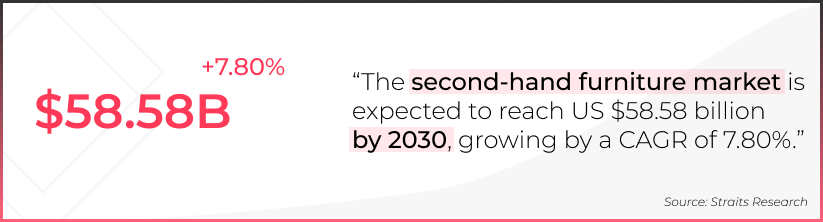
In this blog let’s read how you can start a furniture resale marketplace conveniently and affordably.
Table Of Contents
Business Sense in Starting an Online Furniture Resale Marketplace
Apart from eco-consciousness, multiple other factors are fueling the growth of the online furniture resale business. Let’s look at the benefits of a furniture resale marketplace for all platform participants.
Benefits for Customers:
1. Affordability: With furniture being a high investment, depreciating commodity, buying resale furniture is financially more viable.
2. Diverse Product Selection to Choose from: With multiple sellers, the chances of finding the more suited product are more.
3. User Reviews and Ratings: eCommerce platforms carry reviews and ratings of peers, helping consumers in their purchase decisions.
Benefits for Sellers:
1. Expanded Market Reach: A wide consumer audience.
2. Easier approach to add online sales: Brands considering online expansion of their operations, have an easier alternative with online marketplaces when compared to starting their own online stores.
3. Brand recognition: Online presence can fuel brand awareness for sellers, and give them exposure.
Benefits for Marketplace Operators
1. Asset light business: Marketplace owners don’t need to maintain inventory independently.
2. Increased User Engagement: Consumers can buy from multiple sellers.
3. Higher Revenue: More transaction volume means higher revenue from multiple channels.
4. Attracting D2C brands: D2C brands can give more value with fewer middlemen involved.
Launch a Platform Tailormade for all Participants
Start a Furniture Resale Marketplace
For starting an online furniture resale business, you will need to understand the industry, its growth drivers, challenges and possible solutions. You can consider adopting the following step-wise approach.
Choosing Operative Mechanisms of the Business
Before starting with building the marketplace, consider the popular ways in which the marketplace can be based. This will define the workflows, target audience, and the USP of the business.
Business Models
An online marketplace creates value by facilitating commerce between the sellers and the buyers on a broader level. However, this can be achieved in a number of ways depending on the market, products to be sold, sellers, and other factors. In the case of a furniture resale marketplace, the following operative business models are more popular.
1. B2B2C
The marketplace acts as an intermediary, digitizing the middlemen, and allowing third-party sellers to reach a customer base of the marketplace. The role of the marketplace operator is to provide the backend infrastructure and services such as shipping fulfillment, payment processing, and others. The sellers in such a setup can build their own brand.
In the furniture resale industry, a B2B2C business model will connect furniture resellers and D2C brands with the consumers on the platform.
2. P2P
A peer-to-peer marketplace like eBay simply connects peers to transact with each other. Buyers here can be sellers and vice versa.
3. Aggregator Marketplace
This business model combines the virtues of the B2B2C and the P2P business model. It connects sellers to the buyers, however, in this case, the marketplace business plays a more active role. The buyers here engage with the marketplace and not the sellers.
In some cases, like Kaiyo, the marketplace buys from the sellers and sells it to the buyers. This business model solves a key pain point in the resale industry. Sellers are typically people who simply want to get rid of their furniture and find an easy way to do it. Similarly, buyers get a reliable source, as the furniture has been verified by Kaiyo.
Cover Business Model Workflows Efficiently – With your Platform
Revenue Models
A marketplace typically provides multiple revenue-generation opportunities. Let’s consider the following:
1. Commissions: Marketplace businesses can charge commissions on every sale on the platform.
2. Advertisements: Website real estate assets like banner images can be monetized to display sellers’ adverts in lieu of a fee.
3. Subscriptions: Additional subscription services like booking a high-demand product, buy-back schemes, and others can be offered to increase the revenue of the platform business.
Essential platform functionalities – Navigate industry challenges
Like any other industry, the furniture industry comes with its challenges. However, these challenges can be met by including the platform with the necessary functionalities.
| CHALLENGE | SOLUTION |
| Shipping: Furniture shipping can be challenging. With greater weight and fragile components, the shipment has to be delivered with care. |
Automate with third-party API: The shipping can be outsourced to specialist logistics providers. The whole process can be automated by integrating their API with the platform. The automation will further facilitate accurate product shipment, correct invoices, and others. |
| Careful purchase decisions: Resale furniture can be more affordable than new, still, it is not an impulse buying decision for most consumers, especially in Western households. So the decision process can be lengthy. |
Detailed Product Descriptions: A rich-featured CMS within the platform will allow the addition of detailed product descriptions to assist the buyer to make the purchase decision. Inclusions like videos further can be helpful. Moreover, an engaging website UI further helps buyers to find what they are looking for and commit to the purchase. |
| No in-person feeling: Buyers can have additional queries regarding the style or feel of the product. Especially when it comes to the use of fabrics. |
Reviews with Parameters: Along with detailed product descriptions, user reviews can be helpful for buyers to gain trust and help them to commit to the purchase. If parameters are added to the reviews, allowing the buyers to rate the product based on the most critical parameters of the product. For instance, the feel of the fabric – the buyers will get additional information to arrive at the decision faster. |
Apart from these industry-specific pain points, other needs can be addressed by including the right set of features in the platform.
Create The eCommerce Platform
We discuss the process to build a furniture resale eCommerce platform below.
Market Research
The above-discussed variables give an insight into the preparation required in understanding the market dynamics. Moreover, these can vary with each market. So the success of your business depends on a thorough understanding of the market ― the existing competition, user needs, and other factors.
Moreover, if the business can solve user needs with the business, it stands a better chance of gaining user interest and eventually, a share in the market.
Build the Furniture Resale eCommerce Platform
There are two popular approaches available with you to build the eCommerce platform.
1. Custom made eCommerce platform: The marketplace platform will be built from scratch. This can be done either by hiring an in-house team or by outsourcing development to an eCommerce development company. Each aspect of the platform will be coded and further tested by the developers. This process can take time. Moreover, generally, companies will charge on an hourly basis, so this process can be resource-intensive as well.
2. Turnkey/Readymade solution: The alternative to the above-mentioned process is using a turnkey solution made for Furniture resale eCommerce marketplace.
How to choose which process suits you better?
If your envisioned eCommerce platform needs specific functionalities on multiple levels that are different from popular eCommerce platforms like Kaiyo, it may be better to opt for the former method.
On the contrary, leading furniture marketplace turnkey solutions are built with essential eCommerce features for the domain. Further, any customization needed can be done on the solution.
It might be difficult to decide on your own. It is better to discuss your plan with a company that offers both development approaches and find out the approach that suits you the best.
How Can Team Yo!Kart Help
Yo!Kart is a leading eCommerce marketplace platform that has powered more than 5000+ global e-marketplaces. It is self-hosted and customizable, giving entrepreneurs complete freedom to launch a platform to suit their business goals.
Yo!Kart has been built from the ground up to offer dedicated features for all platform participants. Likewise, Yo!Kart has holistic underpinnings to build a furniture resale marketplace. Furthermore, any specific customizations, for instance, an auction module, can be customized by availing in-house customization services.
Discover the Development Approach that Best Suits your Plan
The post How to Start a Furniture Resale Marketplace appeared first on YoKart Blog.
]]>The post How To Build An Online Resale Marketplace Like StockX appeared first on YoKart Blog.
]]>Introduction – StockX
StockX is an online resale marketplace platform for sneakers founded by Dan Gilbert, Josh Luber, Greg Schwartz, & Chris Kaufman and launched in 2016. Also termed “the stock market of things” this real-time trading marketplace primarily resells authentic and unworn limited-release sneakers online. It is a breeding ground for young resellers like Joe Hebert turning Yeezys and Jordan sneakers into a bonafide asset.
The business earned $3.8 billion in revenue in 2022 and has received a total funding of $690 million in 10 rounds. The daily active users on the platform are more than 1,140,000. While the platform resells premium designer clothes, gaming consoles, smartphones, and other products as well, sneakers accounted for the majority of sales, capping at around 7.5 million trades last year.
With an immediate focus on power sellers* and recording the highest amount of unique visitors per month according to SimilarWeb’s market insights – StockX is edging out its competitors like GOAT and Stadium Goods and drawing inspiration to entrepreneurs to build resale marketplace platforms like it.
Table of Content
StockX Success In Numbers
- StockX achieved the distinction of becoming the first sneaker resale platform to reach a unicorn status (valuation of $1 billion).
- StockX is one of the world’s largest sneaker resale marketplaces, boasting over 500 brands and a vast selection of over 125,000 product listings.
- StockX has attracted investment from several prominent investors, including GV (previously known as Google Ventures) and Salesforce founder and CEO, Marc Benioff.
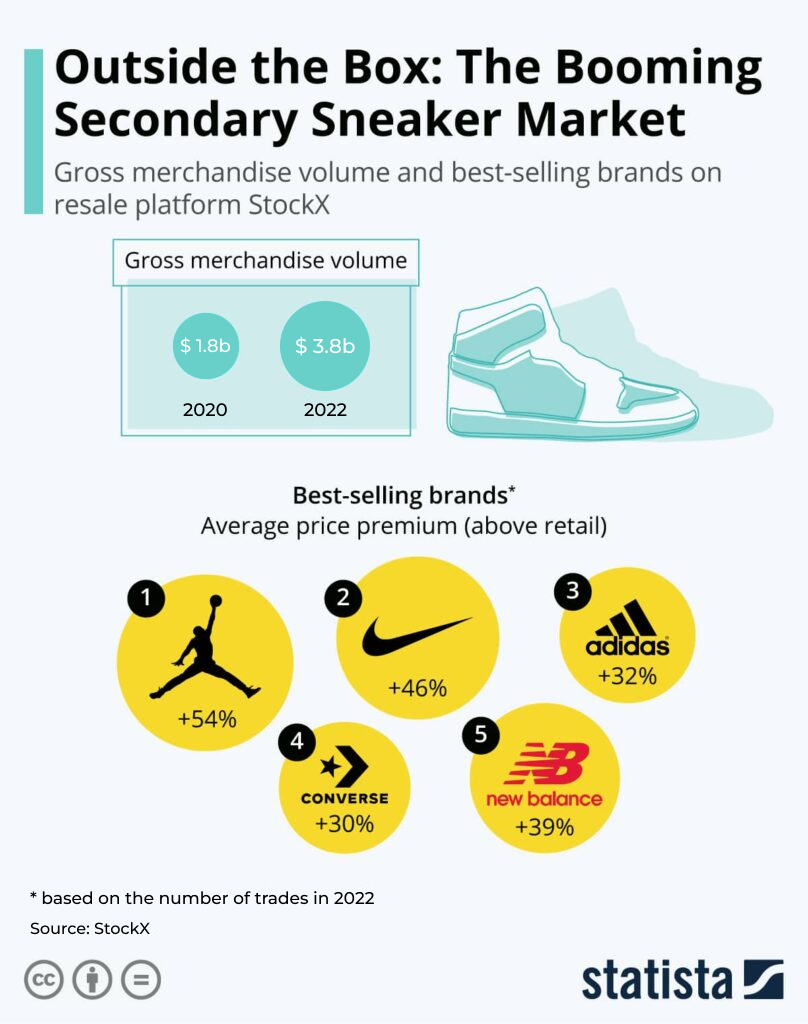
| Luber and newly named CEO Scott Cutler, formerly a Senior VP at eBay and President of StubHub, joined Yahoo Finance’s “On The Move” to discuss the site and burgeoning resale market. “We are a marketplace; we are an evolution of eBay but the way we connect buyers and sellers is the exact same way the world’s stock connects buyers and sellers,” said Luber.Buyer places Bids, Seller places Asks, and when a Bid & Ask meet, the transaction happens automatically – across a true market price. Source: Yahoo Finance |
How to Build An Online Marketplace Like StockX: Things To Learn
1. StockX’s Business Model
StockX’s Business Model StockX is based upon a real-time trading market similar to an equity or stock market. Here, the seller lists in-demand items (in excellent condition) on sale and the buyer determines the appropriate price for trading. The marketplace enables buyers to bid and purchase coveted items at real-time prices, denoting the current demand.
This is an excellent business model for aspiring business owners to build resale marketplace platform. StockX offers access to highly sought-after products like the hottest sneakers, the coolest electronics, or the coveted accessories online. Unlike Amazon, eBay, and other e-commerce giants, expert authenticators verify each item sold on StockX through a multi-step verification process.
Want to Join StockX’s revolution to deliver a seamless buying and selling experience?
Once the package arrives at StockX, the team recommends a minimum of three business days to pass the verification process. To sell on StockX, sellers place an ask for their coveted items, determining the price at which the seller is willing to trade their items.
- The Ask is set to an expiry date of anywhere between 1 to 60 days.
- The seller can update or cancel the Ask anytime before it finds a matching bid.
- In case, the seller does not wish to wait, he/she may opt to sell immediately to the highest bid by selecting “Sell Now” on the product page.
Buyers, on the other hand, can place their bid – making a financial offer for the item on StockX.
- Like Ask, bids also have an expiry date and can be easily updated or canceled by the buyer before it finds a matching Ask.
- A buyer may purchase the item at the current lowest Ask without any waiting time by selecting “Buy Now” on the product page.
A successful transaction occurs on the marketplace when the seller and buyer find a matching price, i.e. buyer places the highest bid, and the seller agrees with the price. In case, the seller has the lowest Ask – then the item is automatically sold to the buyer with the matching bid.
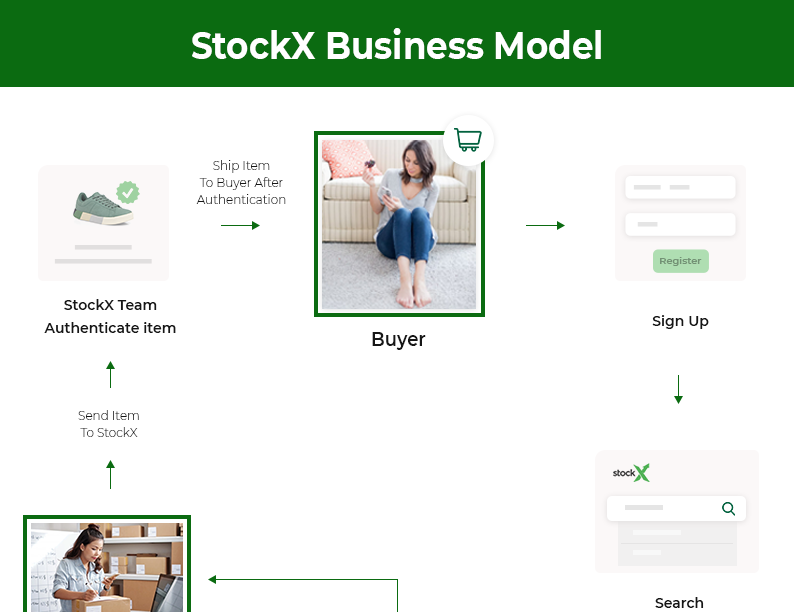
All the Asks, Bids, and Sales related to the particular item can be viewed on the product page – ensuring truly transparent pricing. Also, the marketplace is more inclined towards Power Sellers*, offering them benefits like bulk shipping, bonus discounts, early payouts, VIP account management, and access to more advanced tools.
2. Revenue Model: How is StockX earning money?
StockX charges a flat 3% payment processing fee as well as a transaction fee ranging between 8% – 10% on every successful sale on the platform. The transaction charges are based on seller levels, i.e. better the seller level, the lower the transaction fee. These seller levels are determined by the number of sales completed, as shown in the figure below.
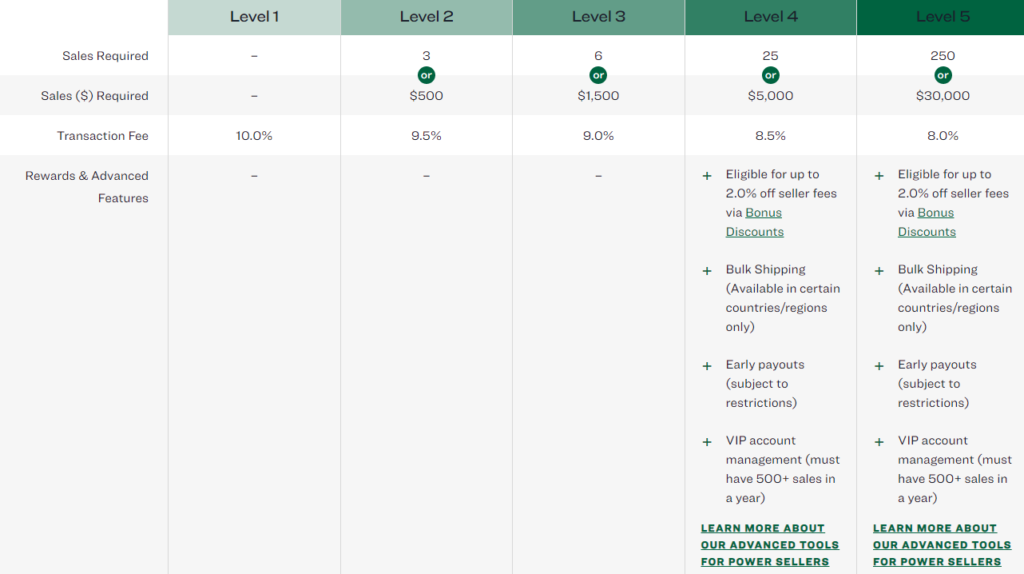
Its seller program rewards sellers with great performance in a calendar quarter, hence encouraging more sales in the marketplace. Business owners looking to build resale website like StockX will benefit from its sustainable revenue model.
3. Features of StockX Marketplace

The unique resale marketplace platform, StockX boasts several essential marketplace e-commerce features – adding convenience to the buying and selling experience. Some of the most notable features include:
- Filtering – With over 25,000 sneakers and a healthy collection of streetwear, Electronics, collectibles, handbags, and watches from popular brands – StockX gains a lot of traction. The marketplace has a robust filtering system to streamline the buying and selling process where users can sort each category by popular brands, most popular items, new lowest ask, and the new highest bid. Also, general filters for size, price range, gender, and season are available as well.
- Payment method – While the individual buyers are requested to fill out the payment information when placing a bid, they are charged only when the bid has been accepted. This prevents any pointless offers or transactions. StockX accepts all major credit cards, debit cards, PayPal, Alipay, and more.
Want to Experience the StockX-like Features in Action?
- Mobile App – Intuitive mobile apps have been a huge selling point and an incremental feature in the platform’s instrumental rise. The mobile apps have garnered an overall rating of 4.6 (from 215.3K reviews) on the App Store and 4.5 (from 52.3k reviews) on Google Play Store.
- Real-time order tracking – From product shipping by the seller, and authentication in-process to product delivery – the marketplace enables buyers to track their product arrival with real-time updates. It requires sellers to ship their products within two business days once the Bid meets your Ask.
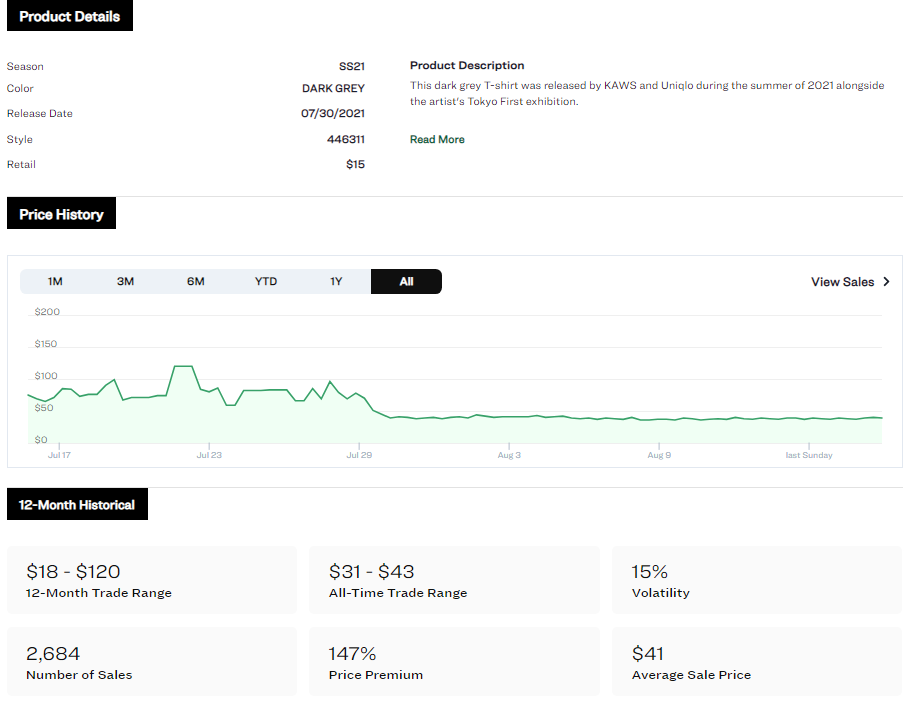
- Historical Price Data – The marketplace provides complete product details, price history, and a 12-month historical price chart for every listing to help buyers/sellers check the competitiveness of their pricing.
4. StockX: Marketing Strategies
In 2020, the majority of sales on the popular secondhand marketplace – StockX came from outside the US – particularly in Europe and Japan, according to StockX CMO Deena Bahri. These international sales grew by nearly 200%, accounting for over 30% of all StockX gross merchandise volume (GMV), thanks to their marketing strategies. The marketing team at StockX comprises a core US team and local marketing teams.
| Our approach is to leverage the mothership team in the U.S. who has the breadth of experience and just the horsepower of a bigger team, then to balance that with the nuance and cultural context of a local team,” Bahri said. “The understanding that the local team has of the specifics of the region [is key] — [knowledge of] things like who the key influencers are is hard to get from a distance. Source: Glossy |
StockX Marketing Approach: Step-By-Step
StockX’s team typically kickstarts their marketing campaign with SEO and paid advertisement – since most first-time consumers discover the brand online. These are the two mainstream digital channels to increase the brand’s reach and target the right audience. Next, the StockX marketing team focuses on creating a cultural marketing campaign to generate interest among its target audience.
For instance, in the fall of 2020, StockX partnered with Jackson WANG – a Hong Kong rapper with a global fan base – to create a Team WANG IPO campaign. The campaign was a huge success, with over 40% of all bids originating from outside the US – the highest share of international bidders for any StockX IPO.
Similarly, in 2016, to kick off one of its elite partnerships with Detroit native Marshall Mathers (a.k.a., Eminem), StockX started a unique contest to give away three coveted prize packages, including Air Jordan 4 Retro Eminem Carhartt – sneakers that once sold for almost $30K on eBay.
The influencer campaign was a huge success resulting in – a 100% week-over-week increase in sales, 1,614 new customers from referrals, and generated $441,488 in revenue in less than 3 weeks, according to getambassador.com. Lastly, the marketing team retargets using paid digital ads to convert one-time customers into recurring customers.
Take the First Step Towards Building Your Own Successful Marketplace
Alongside cultural marketing, paid search and Instagram ads will always remain a primary focus of the marketing team. Recently, they started streaming TV ads in the US – a fruitful experiment that Deena says her team will continue to explore even in the future.
Focus on New StockX Categories
Deena Bahri reflects on how the addition of new categories such as electronics and collectibles has significantly impacted the current marketing tactics. For instance, the newly launched Sony Playstation 5 – sold within seconds on all other platforms after its launch – was available for purchase at StockX albeit at a higher price.
The increasing interest due to in-demand or limited-edition products available in various categories means that the focus is not just on sneakers. There are products in multiple niches alongside sneakers for the StockX marketing team to focus upon.
| “We have definitely started to think of the customer in a holistic way, not just on a category-by-category basis,” Bahri said. “Sneakers, electronics, gaming — those are all part of the same bullseye. The customer is engaged by all of them, so while we still do product-centric creative just focusing on sneakers or just gaming, we’ve been shooting a lot more cultural content that includes all of these categories.” |
For now, the main focus is on international expansion and growth in 2021. Outside Detroit, StockX has a physical presence in England, China, the Netherlands, and Canada. Also, it ships products to nearly 200 countries – with international shipping and payment processing fees applicable.
5. Cost of Development
Developing a StockX-like marketplace from scratch requires a team of expert designers/developers, hundreds of thousands of development hours, and anywhere between USD $100K to millions of dollars in capital investment. Plus, there’s a maintenance fee, hosting fee, additional customizations, marketing cost, and a lot more.
Instead, it is recommended to choose a turnkey multi-vendor marketplace solution like Yo!Kart, whose pricing starts at $999 – a one-time license fee. Yo!Kart’s base package includes all standard essential e-commerce features and integrations necessary to build resale marketplace platform like StockX successfully.
It is a fully customizable multi-vendor e-commerce platform for aspiring business owners, startups, as well as enterprises to integrate new features/modules as per their business requirements and gain a competitive edge.
Get Your Hands on Our Readymade Platform to Build Resale Website Like StockX
Conclusion
With a current valuation of nearly $4 billion USD, a trusted product authentication system, thousands of high-ticket products, and many loyal users (customers and sellers) in just 5 years – StockX has swiftly emerged as the leader in the sneakers and clothing resale market.
Amid this disruption, the secondhand products industry is also growing at a tremendous pace, tipped to reach a staggering $77 billion by 2025, according to Statista. To capture the growing market segment, aspiring business owners need a readymade marketplace builder to build resale marketplace platform like StockX.
FAQs
Q1. What is a resale marketplace or reseller platform?
Ans: A resale marketplace is one where sellers resell coveted items/accessories online. Also termed as secondhand products marketplace, here products with greater demand in the market can be sold albeit at a higher price than the face value. StockX, for instance, is a prime example of a reseller platform/marketplace.
Q2. What is the best platform to resell on?
Ans: From reselling limited-edition sneakers to clothing and electronics, StockX has emerged as one of the best platforms to resell your coveted items. The marketplace offers excellent returns to sellers with its unique business model. Aspiring business owners who wish to build resale website like StockX can choose Yo!Kart -multi-vendor platform.
Q3. What does resale market price mean?
Ans: The price at which an item is resold by the retailer or business in the market is termed as resale market price. Many sellers usually purchase in-demand items at face value and resell them afterward on marketplaces like StockX at a greater price.
Q4. How big is the resale market?
Ans: From Etsy’s acquisition of Depop (a P2P social sharing marketplace) to Levi’s Secondhand marketplace, the resale market is growing rapidly. For instance, the secondhand apparel market globally is projected to reach $77 billion in 2025, up from $27 billion in 2020, according to Statista.
Q5. Can you resell items on the Marketplace?
Ans: Marketplaces like StockX, Poshmark, Depop, and others enable vendors to resell coveted items/accessories online. Such marketplaces have become a breeding ground for resellers to build resale marketplace platforms that are sustainable.
Q6. Which resale app is best?
Ans: Poshmark and StockX are the two best unique resale marketplace apps worldwide. Both marketplace applications are available on the iOS and Android platforms with their intuitive UI design and a larger audience base.
Q7. What’s the best platform to sell used clothes?
Ans: ThredUp is the leading fashion resale marketplace followed by Depop, Poshmark, and eBay. You can easily register to either buy or sell used clothes online at a competitive price.
Q8. How can I build a marketplace like StockX?
Ans: To build a marketplace like StockX, you need a reliable marketplace builder like Yo!Kart that offers all essential e-commerce features and integrations. The platform is highly customizable and can be personalized to cater to your business requirements.
Q9. Is StockX a marketplace?
Ans: Yes, StockX is an online resale marketplace where users (sellers and buyers) register to either buy or resell authentic items/accessories such as sneakers, clothing, electronics, and more. The entire marketplace operation is streamlined by the StockX team.
Q10. Who are StockX competitors?
Ans: GOAT and Stadium Goods are among the leading competitors of StockX. Yet, the marketplace has managed to edge them out with its strong focus on power sellers and a record number of unique visitors per month.
Q11. How do I build a marketplace like GOAT or Stadium Goods?
Ans: Popular eCommerce platforms like Goat, Stadium Goods or StockX are competitors in the eCommerce domain, so they are constantly vying for user attention. For this reason, most eCommerce platforms are similar in a number of ways. This can be said for most eCommerce platforms as well. For instance, if a feature is introduced by one of these platforms, others follow suit.
This is why eCommerce marketplace software like Yo!Kart, with a comprehensive feature list, and convenient customization options – offers universal applicability. To build a marketplaces like GOAT & Stadium Goods, you can use the versatility of Yo!Kart, and customize, if needed, as per your specific business goals. Also, since, Yo!Kart is self-hosted, you get the flexibility to add a feature in the long run as well.
Looking to build a custom resale marketplace in your region?
The post How To Build An Online Resale Marketplace Like StockX appeared first on YoKart Blog.
]]>The post Coronavirus (Covid-19) Impact on the eCommerce Industry & Yo!Kart Offers Help appeared first on YoKart Blog.
]]>- It has affected people on the global level, while writing this post the figures are 367,457 number of people affected and 16,508 number of deaths due the coronavirus (COVID-19). These numbers are likely to rise significantly higher in the coming days.
- The increased level of uncertainty and insufficient action plan has resulted in financial market volatility which was last seen during the global financial crisis in 2008. The virus has regrettably borne out analysts’ downside scenarios, with investors comprehending the implications of disrupted supply chains, official containment measures, and spillovers from the real economy to financial markets.
While Media channels and others are discussing wildly according to the health impact. Let us step into the mind of budding entrepreneurs and address their concern about the Virus and its impact.
How has COVID-19 impacted the world economy
The extent of the impact will depend on three things
- How long will it take to contain the virus
- Economic support government is ready to deploy
- Steps authorities take to contain the pandemic
We can only take the example from China who was once the epicentre of the pandemic and has successfully curbed the impact of coronavirus as of now. The impact on Chinese economy was much more than they had expected.
The Virus has now spread to Europe, South Korea, USA, Iran, and globally; where authorities are increasingly taking protective measures to contain the virus. Europe and Japan are likely already in recession territory given their weak fourth-quarter performance and high reliance on trade.
Estimates of the global impact vary: early last week, the Organisation for Economic Co-operation and Development (OECD) predicted that COVID-19 will lower global GDP growth by one-half a percentage point for 2020 (from 2.9 to 2.4 percent); Bloomberg Economics warns that full-year GDP growth could fall to zero in a worst-case pandemic scenario.
Which Sectors Will be Affected?
It is a scenario where one sector loses profit highly but some other are gaining immense popularity.
The travel and tourism industry will be the hardest hit as social distancing has become mandatory and people are preferring to be indoor. Among others will be the entertainment sector, food and beverage, sporting and agriculture.
There are some sectors which have faced double the amount of revenue when coronavirus has not affected the world. These sectors are: telecom, healthcare and the most promising one is the eCommerce marketplace sector.
Why the e-commerce marketplace is the most promising is because it adheres to every norm that the government has announced and still empowering other local businesses which have lost its prominence due to the lockdown period.
Let’s explain further the benefits of eCommerce sector posses in today’s scenario:
- Most countries are under lockdown or people are still not preferring to step outside their houses. Which is why, the eCommerce marketplace delivering essentials and other items to doorsteps is important.
- Most local and small businesses have shut down, a marketplace owner can provide opportunities to sell off their inventory.
- Making it a win-win situation for both customers and vendors as customers will get essential items and vendors will be able to earn money even during coronavirus.
- People who are in quarantine are sitting and spending most of their time on the internet. According to stats, internet usage has increased by 50%, entrepreneurs do not have to worry too much about their viewership.
Become a helping hand in your region by launching an eCommerce marketplace
Ecommerce Industry will bring impactful change during the Quarantine
According to research, More than eight in 10 (85.6%) respondents ages 60 and older said they were likely to avoid shopping centres and malls. That’s not surprising given that COVID-19 has hit older people the hardest, but it may have an unintended consequence on their shopping habits. Even after the virus has been contained people will still avoid going to the shopping centre to buy essential products. People are still preferring to shop online for their essential products.
Luckily for some entrepreneurs, eCommerce activity related to health and grocery is still seeing a boom. Entrepreneurs are just rethinking ways to capture the demand of consumers. According to data from eCommerce ad tech provider Pacvue, there have been surges in Amazon searches for products like hand sanitizer and antibacterial soap. Digital shoppers are also willing to convert on products that they need with longer delivery windows in order to avoid going to stores, where inventory may be limited anyway.
This scenario is providing a benefit to e-retailers like Amazon to leverage but there will be an issue in managing the supply chain which is why entrepreneurs are trying to reduce the spending on marketing.
Like Amazon, other eCommerce marketplaces are gaining prominence as vendor’s on-boarding has become easy. Many offline vendors are desperately looking to sell their products online. Leverage this industry to capture the market as the demand is high and pricing is low.
Entrepreneurs now have to focus on finding innovative approaches to their business, though there are numerous but the market is still unpredictable.
Some countries will be able to control the impact of the Virus but as a preventive measure the government will still impose Social distancing for the next 4-5 months.
How Entrepreneurs can use lockdown time for business growth?
While the whole country is on lockdown, people are finding it hard to be productive. Business owners can use this time productively for the branding and marketing of their business. Few business owners might be scared about their survival after this pandemic but taking up this time to enhance the quality of experience you provide to your customers.
Some businesses are still flourishing at double the rate, expand and widen your horizon. Move to the sector which is performing. Here are some tips on how to utilize your time during the lockdown.
- Select the niche which has shown increase during the pandemic like delivery groceries and medical supplies.
- Set Up a business which will focus on delivering commodities rather than self-pick .
- Spend time on choosing the right platform who has all the features to launch your eCommerce business.
- Do intensive market research and understand what your competitors are offering during the pandemic time.
- Enhance the user experience to keep the checkout simple for people.
- Change seller policies to make it easy for sellers to sell their commodities on your marketplace.
- Leverage the power of mobile and mobile notifications as your target audience would want to easily connect with your brand.
Yo!Kart is with You Against Covid-19
We at global level are facing uncertain times due to the outbreak of COVID-19. We pray for the good health and prosperity of everyone around the globe especially those who have been directly impacted by the virus. The whole world together is dealing with the health crisis and will together rise after all this is over. We the Yo!Kart understands our commitment and responsibility towards the growth of the community, which is why we are working tirelessly to cater to your demand.
Let us prepare together to deal with this pandemic. The Yo!Kart team after studying the market thoroughly would suggest aspiring entrepreneurs to invest in the future. We understand the market has become unpredictable which is why we suggest you invest money on something which will give you benefits later too.
Considering the on-going demand for eCommerce, the online survival tactic is to launch your eCommerce marketplace. Our team is working to fulfill the growing demand by giving one to one client demo and handling clients and their queries diligently.
We are trying to aid eCommerce entrepreneurs in this crisis time, we are accelerating businesses during the outbreak by offering:
1) Our Yo!Kart for startups is available at $500. In this package, we offer free one year hosting with 2GB server space, all the essential features needed for the marketplace, tech support for Yo!Kart experts. All the functionalities that a startup would need to launch their online marketplace is available on the platform. The entrepreneur can also anytime upgrade to GoQuick or GoCustom Lite or GoCustom package during or after expiry of the startup package.
This will be beneficial for anyone who wants to launch their marketplace as they can test the market during this pandemic and also shift to customizable packages when all this is over and they have gathered enough customers.
2) Yo!Kart Consultants have understood the volatility and unpredictability of the marketplace. We will assist our clients to decide which is the best niche which will give you fruitful results during and after the pandemic. They are also highly experienced to share knowledge on the profitability, business model, revenue model that a business should choose during the outbreak.
Yo!Kart Team Wishes You Health, Peace, and Safety.
The post Coronavirus (Covid-19) Impact on the eCommerce Industry & Yo!Kart Offers Help appeared first on YoKart Blog.
]]>The post How to Choose an eCommerce Platform – Everything to Know appeared first on YoKart Blog.
]]>The eCommerce ecosystem has witnessed steady growth over the past 2 decades. According to Statista, the global eCommerce market valued $2.3 trillion in 2023 with 21.2% of retail sales. The statistics given here are “good news” for entrepreneurs looking forward to starting their online venture.
The ecommerce sphere is currently packed with opportunities for new online businesses. If you have an innovative business model that can meet the demands of experience-hungry society, it’s time to take a step forward with an ecommerce website.
Although there are various online business models, the core agenda is to sell online. New entrepreneurs who are looking to build their online presence need to review every factor that a specific business model delivers. It is a challenging decision to select an ecommerce platform with the right tools and technology, especially for new entrepreneurs. To help businesspersons, there are free online demos that enable you to access a particular platform. Also, you can go through user-reviews for better understanding.
What is the Importance of Choosing the Right eCommerce Platform?
A well-suited eCommerce platform facilitates seamless business operations, enhancing user experience and customer satisfaction. It directly influences website performance, speed, and security. Furthermore, the right platform accommodates business scalability, adapting to growing demands. All you have to do is to make a wise and balanced choice keeping the essential factors in mind shared below.
How to Select the Right eCommerce Platform?
While looking for a perfect eCommerce marketplace solution, you need to consider supreme factors that are important from a customer as well as a business perspective. Being a part of the IT industry for more than 14 years, We have mentioned crucial factors that should be considered while choosing an ideal platform to set up your eCommerce website.
Different Solutions
For entrepreneurs, the real struggle is to choose the right website solution for your business. There are mainly 3 types of website solutions available in the ecommerce ecosystem. The businesspersons need to do research about each solution as well as have proper business model. A clear vision to respective business desire will make it easy for an entrepreneur to select a website solution. The different solutions to build an ecommerce website are:
- SaaS-based Solution
- Ready-to-launch Solution
- Custom Solution
SaaS-Based Solution:
SaaS is an optimal solution for small vendors who need to target local audience and have limited requirements. There is no additional maintenance cost for your website as the hosting service providers are responsible for the same. The ideal examples are Shopify and Bigcommerce.
Opting a SaaS-based solution means that you don’t completely own your ecommerce website. Instead, you pay the hosting service provider at regular intervals to run your online store. You enjoy the functionalities and services as long as you pay the subscription fees. To add custom features such as Payment Gateways and Analytics, you need to pay an additional cost.
SaaS-based solutions don’t support all business needs. Also, it lacks the ability of complex customization. Moreover, many SaaS based solutions charge a transaction fee, which means effective revenue is reduced.
Ready-to-Launch Solution:
The limitations faced by entrepreneurs who run their online store on a SaaS-based solution paved a way for ready-to-launch website solutions. These readymade solutions offer the perfect balance of features and budget. If you check over a few of them, you will find out a vast array of benefits. The major ones are as follows:
- Excellent features at affordable prices
- No annual or monthly subscription fee payments
- Freedom to choose the hosting service provider
The ready-to-launch options, such as YoKart, are quite suitable for certain segments, like startups, micro businesses, and small and medium-sized enterprises. Value for money and easy options to scale up are the reasons why these solutions are preferred over custom or SaaS.
For the success of your ecommerce marketplace venture, it is very important that your chosen hosting provider is secure, stable and provides 24 Hours support. You should rely upon a hosting service provider which comes with the following advantages/benefits.
– Easy Scalability (upgrade or downgrade)
– 24/7 On-site Support via Phone/Chat/Email
– Transparent Pricing
– Server Secure Advanced Security
– 100% Network and Power Uptime
Yo!Kart recommends Liquid Web hosting services which comes with the above mentioned benefits and much more.
- Custom Solutions: A custom ecommerce solution is most suitable for the stores that need to address specific operational challenges. If your business model demands high-end customization, then there are solutions like Shopify Plus, Magento (For Mid and Enterprise Businesses) and YoKart’s GoCustom.
Custom solutions are expensive and require an experienced service provider. So if you choose this solution for your upcoming store, I recommend business persons to complete the business analysis process first. Analyze the functional requirements before investing in a custom solution as it will help you define the requirements and demarcate your budget, which may otherwise stretch out due to undefined cost.
Revenue Channels
Beginnings are always hard, as for startups both profitability and growth are crucial. “How can I earn profit?” is the very first question that comes to the mind of an entrepreneur who is at the verge of putting money for new online venture. The generated revenue signifies business growth. Therefore, I advise the new entrepreneurs to decide beforehand which revenue channels will benefit their business. The common revenue generating streams are:
- Direct sale
- Commission
- Subscription
- Advertisement
Also, I recommend opting “affiliate management” feature when starting an ecommerce website. Adding affiliates at the initial stage of the business will help to improve sales as well as create brand awareness. To boost up your profits, one can integrate features like
- Featured product listing – List select vendor products on the homepage.
- Advertisement Management – Display vendor advertisement.
Which Revenue Stream is Better for your Ecommerce Venture?
SEO Friendliness
Always choose an ecommerce platform that follows SEO-friendly technology. It is very important for your website to appear on top of search pages. SEO-friendly design helps your target audience find you easily and enhance sales. In addition, it provides user-friendly experience that engages traffic and improves the lead conversion rate. Some of the features include:
- Control over URL rewrites
- Search engine friendly functionalities
- Blog section on ecommerce website
- Customer review management
Flexibility and Scalability
At the point of starting a new venture, it’s nearly impossible to predict when the business will outgrow the expectations. Flexibility in a solution is gauged to keep up with changing times. The ecommerce platform that you choose today should be flexible and scalable enough to meet the future requirements. Planning now will help to add such features with the least investment of time, effort and money in future.
The three different solutions discussed above offer varying flexibility and scalability. Although SaaS-based solutions allow you to change the design and add new features, you cannot change the hosting service. Conversely, owned readymade and custom solutions provide the best of both flexibility and scalability. You can choose your own hosting service provider, get the design of your choice, and change the business model as required.
Technical support
Imagine that you have successfully launched your ecommerce website. But after a span of time, you may face some technical issues. To resolve the bugs and errors, you definitely need technical support for the flawless functioning of your website. Otherwise, you may suffer huge order loss which will of course hit your business. In worse condition, you may even lose loyal customers and their trust. Therefore, a team of technical experts must be there to help you out immediately.
Most SaaS-based solutions offer support primarily via forums, email, and live chat. Basically, what it means is – roll up your sleeves and get to work. If you go for ready-to-launch or custom solutions, screen sharing-based or on-site support is provided to address the problem in real time. Furthermore, you can sign up for an annual maintenance contract and avail discount, if applicable. In a few cases, you can expect the technical support to be free initially but in the long run, you need to sign up for an annual maintenance contract.
Know these 100 Elements of an Ecommerce Website
Conclusion
Choosing a solution is the key factor in determining the profitability of any eCommerce business. While there are numerous eCommerce platform options to choose from, ease of use is prioritized. However, beyond them lies long-term goals, sustenance, and of course your budget. So, with changing market dynamics, you should choose a solution that suits your pocket and satisfies your business model.
Frequently Asked Questions:
Q1: What are different types of eCommerce?
Ans: eCommerce businesses can be classified into different categories namely B2B (Business-to-Business), B2C(Business-to-Consumer), B2B2C (Business-to-Business-to-Consumer), and C2C (Consumer-to-Consumer). Additionally, categories have been added to the list named social commerce and mobile commerce.
Q2: What are the essential features of an eCommerce platform?
Ans: An eCommerce platform comprises several essential features including product catalog management, secure payment processing, inventory management, and marketing and analytics tools. In addition, eCommerce platforms, Yokart, Shopify, and more go the extra mile by providing functionalities such as multilingual support and integrated third-party APIs. All these features help deliver enhanced and secure online shopping for businesses and their clientele.
Q3: How much does an eCommerce platform cost?
Answer: The pricing of an eCommerce platform usually depends on varying features and functionalities, intricacy of business operations, and business size. Certain eCommerce software solutions are either free of cost or charge a nominal fee. However, software like YoKart, Shopify, and others require substantial investments, owing to their features, capabilities, and integrations. In a nutshell, the cost of an eCommerce platform may vary from hundreds to thousands of dollars.
The post How to Choose an eCommerce Platform – Everything to Know appeared first on YoKart Blog.
]]>The post Why Startups Fail? Addressing the Top 5 Reasons appeared first on YoKart Blog.
]]>According to a survey conducted by Forbes, 90 percent of startups fail. Yes, this is a hard and bleak truth. But, when it comes to reasons behind failure, different experts shared different anecdotes.
Below are not so common reasons behind startup failure that you can use to evaluate your own startup strategy.
Business Model Failure (CAC and LTV Rule)
A sustainable business model is a blueprint for success. Many startups fail to clearly demonstrate the following:
- How they will create value?
- What problem are they solving and for whom?
- How the business will stay competitive and of course resilience to change
With a vague business model, startups are unable to understand the ecosystem they are operating in and how technology will impact their business.
Example
A Boston-based startup, Riot Vine, was founded in 2009 by Kabir Hemrajani. Unfortunately, the company dissolved in 2010 and the reason is absence of a business model.
Kabir, himself gave an interview to a local publication in which he said, “We spent three months head down developing Riot Vine without a business model. I think I didn’t realize what we were building at the beginning. Riot Vine is closing. I genuinely want to thank everyone who signed up, posted an event, or used Riot Vine to discover what was happening around town.”
The Right Approach
In the above example, we have seen that a startup was trying to establish itself without a business model. On the other hand, there is a market mantra around which a business model should be developed – Cost of acquiring the customer (CAC) must be less than the lifetime value of that customer (LTV).
Acquiring customers takes money, resource and time. The best tricks to gain your customers for a lifetime are:
- Know your ideal customers
- Invest in customer retention
- Reduce customer attenuation
An American multinational computer software company, Adobe, saved its business through subscription revenue which significantly improves LTV.
The company offered Photoshop for $9.99 USD per month. This amount is 100X less than the cost of the perpetual license but Adobe now has two benefits:
- More number of customers
As price is less, more people will go for Photoshop.
- Lifetime customers
With $9.99 USD per month, customers stay with the company for a lifetime.
Wrong MVP
Minimum Viable Product (MVP) allows an entrepreneur to test his idea by exhibiting an early release of the product to target audience. The next step is to collect customer’s feedback and make necessary changes.
MVP is more like a risk reduction tool as it gathers feedback about the product and avoids the possibility of wasting time and money. Many startups fail because they focus on building the product while minimizing their contact with target audience. In simple words, they don’t implement the MVP concept.
Example
A startup named, Devver, failed because “they made a mistake of focusing on engineering first and customer development second.”
Ben, founder of Devver, said, “We should have asked, is there an even simpler version of this product that we can deliver sooner to learn more about pricing, market size, and technical challenges? We should have focused more on customer development and finding a MVP.”
The Right Approach
While creating a MVP, one should find out the right balance between maximum value and minimum design. Few but most important functions are added during the MVP phase. MVP gives the required data that confirms the interest of users in a product. Steps that should be kept in mind during the development of MVP:
- Keep the product quality high with only few important features
- Track user behavior
- Don’t think about the overall sustainability of a product
- Study the competition deeply
Here’s an example of a company that started as MVP:
In 2004, MySpace was the most popular social network. But then, Mark Zuckerberg entered Harvard University with the basic model of his product, Facebook. The MVP had only those features that would ensure its success.
After its incredible triumph, the students at University of Columbia, Yale, and Stanford started using it. Students, who used MVP, gave Mark the essential feedback that he later used to improve the product.
Internals of a B2B Ecommerce Marketplace Website
Problem with MMP
Minimum Marketable Product (MMP) – The most basic product that dwells on user experience. MMP addresses requirements of a user, with the correct level of UI that can be sold and marketed successfully. Many companies failed as they targeted the wrong market segment and envisioned the wrong product or features.
Example
In 1957, the American multinational automaker, Ford, manufactured Edsel which was considered as an automobile marque. The company invested heavily in this car but Americans wanted smaller and more economic vehicles at that time.
Thus, Edsel never gained popularity.
On November 19, 1959, Ford announced the end of the Edsel program and the company lost $350 million or the equivalent of $2.3 billion in 2016.
According to the Associated Content – “Pundits have blamed its failure on Ford Motors execs, who never really defined the model’s niche in the car market. The pricing and market aim, of most Edsel models, were somewhere between the high-end Ford and the lowest-end Mercury.”
Ford had absolutely no idea that the failure was going to happen until after the vehicles had been designed and built.
The Right Approach
Under MMP, it’s all about creating a product for minimum number of people with the minimum number of features.
Many startups try to develop over-engineered products with lots of features that provide little or almost no value to users. The concept of MMP helps to focus on what really matters.
Take an example of original iPhone that was launched in 2007. Apple selected a narrow set of customers for its product. iPhone had less number of features than its competitors. But these limitations did not hinder its success. The public reaction to the launch of the iPhone resulted in media calling it as “Jesus phone”.
Experts believe that the staggering success of iPhone is because the company focused on those features that made difference to users and developed a product for specific target audience.
Founders’ Ego and Power Struggle
Founders fail because they can’t admit that they are wrong. They want to be seen as the smartest person in the company. They get stuck in their egos. Ego can actually be fatal for a startup. Ego is self-admiration and it prevents a founder from seizing innovative and beneficial opportunities.
Example
GovWorks was founded in 1998 by two childhood friends. It was built to help government clients keep track of their contracts and citizens can apply for jobs and book tickets.
The company experienced an initial success but due to a power struggle between founders, personal ego and disagreements within management, it was sold in 2001.
An award winning documentary was made on GovWorks’ demise i.e. “Statup.com.” The bottom line was, “when working with friends: egos need not apply.”
The Right Approach
Founders usually stick with their original idea even if it doesn’t work. They should learn to pivot whenever needed. However, pivoting should only be considered when absolutely necessary. There are many companies that pivoted and experienced massive success.
How to pivot?
- Pick up new goals
- Listen to your customers (what they want)
- Align goals with your vision
- Adopt features or changes whenever needed
A brand that pivoted successfully is YouTube, an American video sharing website. It started as a video-based dating service where people introduced themselves and recorded what they were looking for.
This concept didn’t work and the founders decided to open it up for any video. It pivoted slowly and grew into a video empire.
Other reasons such as lack of passion, pricing of products, intra-team conflict, poor marketing strategies, and no or bad after sales service lead to startup failure.
Get your Startup off the Ground in no time with YoKart
In this vibrant ecosystem, it’s important to understand and appreciate the reason behind failure of startups. Don’t get demotivated by seeing what happened with others, instead follow your heart and write your own story of success.
The post Why Startups Fail? Addressing the Top 5 Reasons appeared first on YoKart Blog.
]]>The post 10 Startups Based On Ecommerce Subscription Model appeared first on YoKart Blog.
]]>One such requirement is of convenience. Be it baby boomers, generation x, xennials, millennials, or generation z, convenience is the first and foremost requirement across different age groups. The subscription ecommerce model brings value and convenience in following ways:
- Once a buyer subscribes, there is no need to place an order again.
- Online food subscription box enables the subscriber avoid food they are allergic to.
- The element of surprise is a welcome move as the subscriber may not know the content of the box.
To show you how entrepreneurs are using the subscription ecommerce model to satisfy the market demand, we have compiled a list of brands that teaches us important business lessons. In the list, we have mentioned different subscription ecommerce businesses that are operating in different industries such as cosmetics, fashion, personal care, dietary supplements, etc.
Industry – Cosmetic
Birchbox
 (Source – Birchbox)
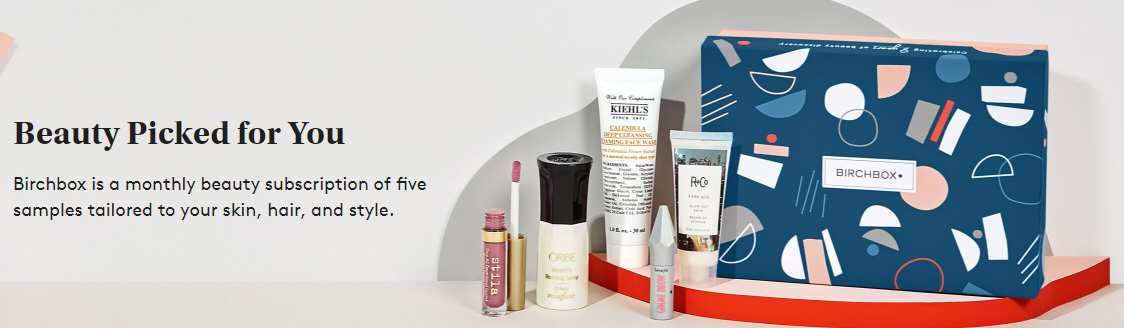
Birchbox’s $10 per month subscription consists 5 beauty products. For a superior personalized experience, products are chosen after collecting information using a form. Each box that subscribers review fetches them points that they can eventually use to buy full sized products from Birchbox shop.
Key Highlights:
- Nominal subscription cost and free shipping
- Subscribers can earn points
Ipsy
 (Source – Ipsy)
Founded in 2011, MyGlam was soon renamed to Ipsy. Ipsy brings you a box full of 5 beauty product samples for a subscription of $10 per month.
Key Highlights:
- Nominal subscription cost and free shipping
Industry – Fashion
TechStyle Fashion Group
 (Source – TechStyle Fashion Group)
What started as JustFab in 2010 turned into TechStyle Fashion Group, a subscription based online fashion store for women.
Key Highlights:
- New handbag and a pair of shoes every month
Bombfell
 (Source – Bombfell)
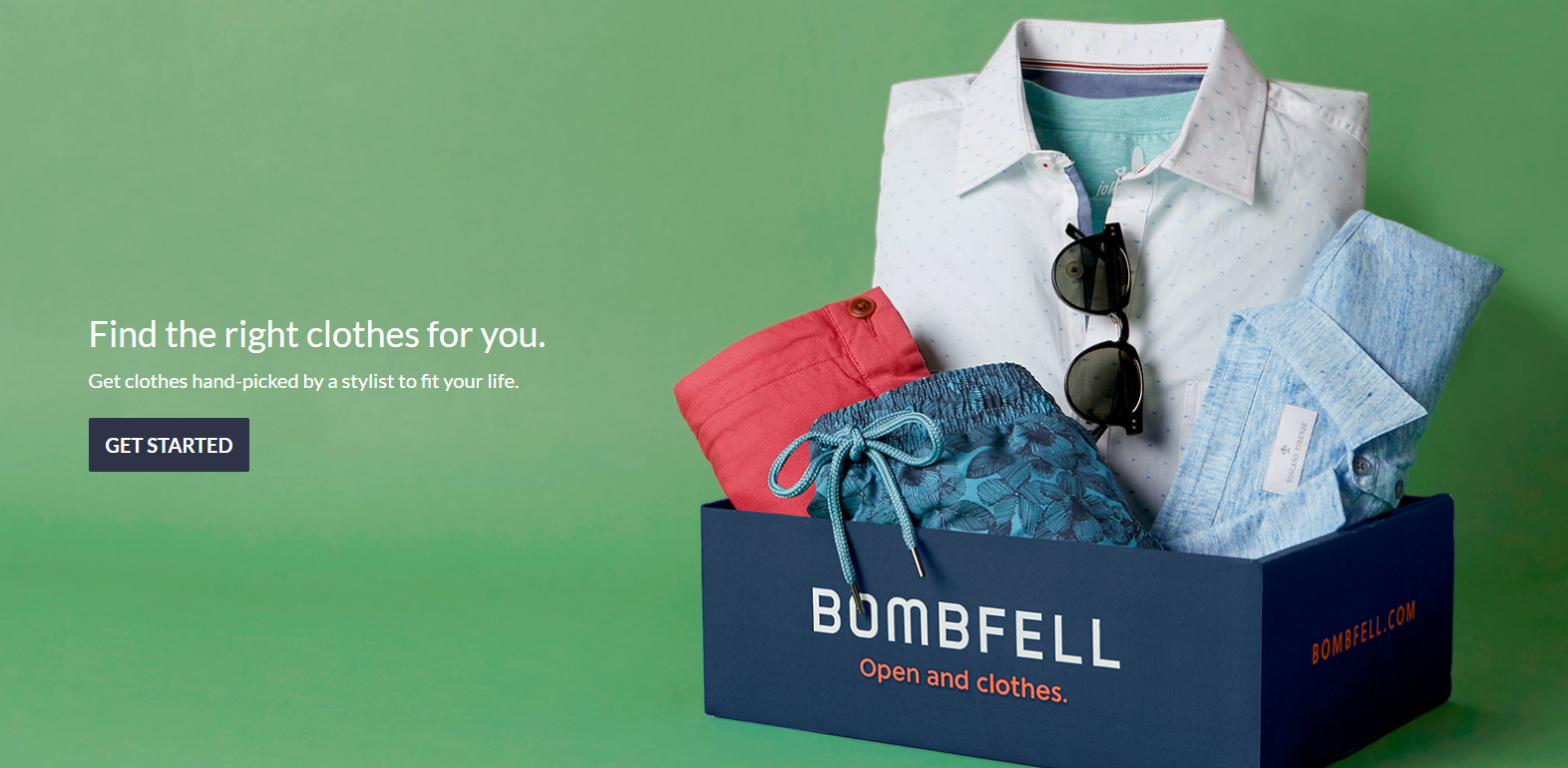
Bombfell is a fashion subscription service directed towards men. The subscription box contents are selected by a personal stylist, who curate and handpick each item based on the profile of the subscriber.
Key Highlights:
- Personal stylist takes care of the subscription box
- Carefully curated and handpicked apparels are sent
Industry – Personal Care
The Honest Company
 (Source – The Honest Company)
Co-founded by famous hollywood celebrity, Jessica Alba, The Honest Company sells non-toxic products for personal care. From diapers to baby wipes to home cleaning, healthcare and wellness products, The Honest Company clearly lets parents take care of their kids and their home in a safe and affordable manner.
Key Highlights:
- Eco-friendly and nontoxic family products
Monthly Gift

A subscription service focused towards making things easier for women during their periods.
Key Highlights:
- Automated system monitors ovulation and menstrual cycle
- Subscriber gets tampons, pads and liners before periods start
- They also send chocolates
Industry – Dietary Supplements
HVMN
 (Source – HVMN)
Previously known as Nootrobox, HVMN (pronounced human) is a subscription based wellness firm that focuses on improving human cognitive abilities. It is done by creating well-researched nootropics that can help customers focus better and be more attentive during work.
Key Highlights:
- Chewable coffee cubes
- Ketone Ester Superfuel
- Helps mental focus and boost in energy
Multiply Labs
 (Source – Multiply Labs)
To help consumers take care of themselves in a better way, Multiply Labs creates customized supplements in pills as per the subscription.
Key Highlights:
- High-quality ingredients
- Capsules are made through cutting-edge technology
- Trial pack costs one dollar
Industry – Pet Care
BarkBox
 (Source – BarkBox)
When it comes to taking care of your pampered pooches, BarkBox ensured tight schedules shouldn’t bother you and your dog. Every subscription box consists of at least 2 toys, 2 bags of all-natural treats and a chew.
Key Highlights:
- BarkBox follows a theme every month
- All the toys, treats and chews are different every month
The Farmer’s Dog
 (Source – The Farmer’s Dog)
No more generic dog feeds that are far from their claimed nutritional value. The Farmer’s Dog brings healthy pet food right at their customer’s doorstep.
Key Highlights:
- Customized food for dogs depending on their breed, age and many other health factors
- The meals are home cooked and offer high-quality ingredients
Start your Ecommerce Journey in a Day with Yo!Kart
The post 10 Startups Based On Ecommerce Subscription Model appeared first on YoKart Blog.
]]>The post Attract Valentine Lovers To Your Store With These AdWords Strategies appeared first on YoKart Blog.
]]>Whan euery bryd comyth there to chese his make”
(For this was on St. Valentine’s Day when every bird cometh there to choose his mate)
If you have recently visited any local market, then you have a clear idea as to which annual holiday is coming up. You are guessing it right! The one that makes the market change its color to red, the one that involves chocolates, flowers and teddy bear, Valentine’s Day.
Most businesses think that the holiday where they can shoot up the sales is around the time of Christmas and New Year. But Valentine’s Day is a huge opportunity for businesses too! It is not just a lucrative event for flower delivery and stuffed toys businesses, but an opportunity for all e-commerce businesses if they strategize correct. It’s just another prospect to optimize your returns on festive investment.
Let’s dig into the following pay per click strategies that businesses can use on Valentine’s Day and maximize their advertising effort.
Should you advertise on Valentine’s Day?
Unlike the common belief, Valentine’s Day is not just about buying flowers, chocolates and cute cards. There are people who want to spend the day out, shop something new, spending a day at the spa, grabbing drinks with friends.
If Google trends and keyword planner are optimally used, you will realize there is a vast market for Valentine promotion, so businesses should pay special attention to their advertising.
Take a look at the floral industry; it dominates AdWords on Valentine’s Day. Try using Floral Delivery on your Google search and you will notice that the first fold does not have any organic search results.
There are plenty of opportunities to capitalize for e-commerce as well as local restaurants, promote your business beyond the typical search terms.
Capitalizing Unusual Terms
We would probably associate flowers chocolates with Valentine’s Day but has anyone of us thought of men’s elephant pants as a Valentine Day Gift? I am sure the answer is going to be NO.
Elephant pants sell like hot cakes during Valentine’s Day, and so do the hot cakes. These are great examples of capitalizing on unusual terms.
There are tons of seasonal keywords that are missed because the search volume numbers in Google keyword planner are averaged out over a 1 year period. Businesses who want to advertise during festive seasons have to keep an eye on monthly search volumes and plan their ads accordingly.
There is a special benefit for e-commerce websites that sell handmade craft as there is high search volume of DIY Valentine’s Day Cards; precisely 15.6 million searches.
Also Read: Brand Marketing V/S Direct Marketing: The Early Stage Ecommerce Startup Dilemma
Plan your date
Once you have analyzed the trending keywords during Valentine’s Day and identified the products and services that you can promote, you need to start evaluating your marketing approach.
It is very important to strategize before you invest time and money in advertisements. If you are selling Valentine’s items for men, your target audience would be women with a higher bid in January than February, and similar will be the case with women’s gift.
Once you find the search volume trend, set your AdWords rules and schedule your bid adjustments ahead of time.
Gather the right data
While publishers work on AdWords, one of the most overlooked strategies is gathering the right data. Though it takes up only a few dollars per day, running a consistent campaign for the brand and key terms give you a warehouse of data with unlimited applications.
One of the best ways to leverage keywords for Valentine’s Day is by using historical data inside your search terms report.
In AdWords, navigate your search term to dates around 14th February, adjust your date range 3 weeks before the Valentine’s. The search term shows all searches your ad is displayed on, so you should make a note and analyze valentine-related searches that can be helpful.
It’s possible that you may find it hard to isolate your seasonal campaign performance and these yearly holidays are important for the sale of your product/service. In such scenario, consider a separate campaign for Valentine’s Day and other seasonal festivals.
This technique will make it super easy to control the budget, analyze historical data and improve your campaign’s performance year after year.
Target the right audience
If you are a business that has been dealing in displays ads on Gmail and YouTube, you would know that you can target your ad based on demographics, interest and whether the person is in-market for a certain product. There are additional options to consider.
- Demographic
- Affinity audience
- In-Market audience
- Life events
If the campaign goes according to the desired results, you can analyze your placement report. Look for a correlation between targeting segments who convert and the website where they see your ads.
Also Read: Various Channels to Catapult eCommerce Marketing
Schedule site links & promotional extensions
Sitelinks and promotional extensions will help your campaign stand out, which is really helpful for your business.
If you do not want to create an entire campaign, you can schedule AdWords sitelinks to pop up every holiday season. This will help during Valentine’s Day as you can add any information you want, including business working hours or direct link to a specified product.
The promotional extension can be helpful as they can be specifically designed for holiday sale and take the customer directly to the special offer page. The advertiser should promote their campaign from January 15 to February 28 (for late shoppers).
Some of the ways to attract are discount on the first purchase, discount on the total shopping, certain discount if shopping is done within a specific time window, etc. Promotional extensions grab searchers’ attention as they also have a set of expectation when they land on your shop after the click.
Add a countdown clock
Adding a countdown clock to your advertisement or your product page is a very effective for sales as it encourages the users to click and convert.
In your search ad, you can input an end-date to your campaign which Google AdWords will use to change the copy of your ad depending on the length of the deal.
For example, if 1 day is left for your deal to end, your ad will show “This deal ends in 1 day”. This drives a FOMO (Fear of missing out) effect in the user and drives them to your website.
 Source: Searchengineland.com
Conclusion
We hope all the e-commerce businesses have used these techniques to advertise their brand on Valentine’s Day. Every holiday has to be planned perfectly and beforehand to get maximum ROI from their marketing and promotion attempts. Every holiday season finds people looking for easy ways to get gifts for their loved ones. If you think your business offers what the Valentine’s market is looking for, plan your PPC campaign accordingly. Good Luck to all e-commerce marketers.
The post Attract Valentine Lovers To Your Store With These AdWords Strategies appeared first on YoKart Blog.
]]>The post Top Chatbots to integrate with your ecommerce store for improved conversion rate appeared first on YoKart Blog.
]]>By automating certain part of the ecommerce, using machine learning, the overall consumer experience can certainly be enhanced. One aspect of this AI shift is Chatbots, which have been paramount in minimizing the gap between online business and consumers.
Chatbots are basically automated programs that can perform a pre-programmed task based upon inputs from the consumers in the form of text or voice. Basically, consumers can talk to these chatbots on messaging platform or as a website module.
The ultimate goal of Chatbots is to offer a better shopping experience and foster a wider gamut of interactions. It will not be farfetched to state that chatbots are the future of whole ecommerce sector.
The best part of AI-driven chatbots is that it is always on the learning curve and with more and more information integrating into its backend, its services get more refined. The bottom line is that it learns from the interactions it has with the consumers, making it better with each communication. Let us now take a closer look at top chatbots that can be integrated with an ecommerce website.
1.IBM Watson
One of the pioneers in the Artificial Intelligence community, IBM Watson is often touted as the most popular chatbot building platform across the globe. It is built on a neural network and uses machine learning to offer a state of the art conservation service.

2. Microsoft Bot Framework
It is another popular chatbot builder, offering its own SDK for businesses to create a unique chatbot. It also offers an API, which can be used to host a bot either on a mobile application or a website. The best part is that it is open source and also allows integration of other services like LUIS for natural language understanding, Cortana for voice and Bing API for search.
Also Read: Expanding Your Ecommerce Business to a New Market? Learn How to Overcome These Common Challenges
3. Botcommerce
It is an on-demand customer service bot, which can be integrated with any website. This bot comes in handy for offering order status updates, tracking number requests or any form of FAQs.
4. Letsclap
It is an innovative chatbot platform allowing a personalized experience for consumers by adding images, audio, video and location information to the chat. This not only results in rich conversation but also adds authenticity to the conversation.
5. Yellow messenger
This chatbot platform can offer service for a gamut of categories from airline tickets to mobile recharges. Due to its wide array of purchasing interactions, it requires some advanced knowledge of coding for implementation.

Want your ecommerce store to have future oriented features?
6. Operator
It is an exclusive bot that revolves around helping global consumers shop online with ease. It is one of the true ecommerce bots that simplifies ecommerce enabling users to browse curated products, make purchases, and initiate chats with experts in navigating customs and importing processes.
Also Read: Future-proof Your Ecommerce Marketplace: Applications of Machine Learning
7. Wit.ai
This bot incorporates natural language processing that helps in simplifying complex queries into entities, intents, contexts, and actions. Along with mobile apps, this bot can also be incorporated into any ecommerce website using javascript.
8. Dialogflow
Earlier known as api.ai, this is another conversational platform where the bot matches the query to the most suitable intent based on information contained in the intent. This bot platform transforms the query text into actionable data and returns output as a response object.

9. Semantic Machines
The core features of this bot platform includes a conversation engine, speech synthesis, deep learning, reinforcement learning, speech recognition, semantic intent extraction, and language generation (NLG) technology. This allows the ecommerce bot to better understand conversations and offer corresponding solutions.

10. Digital Genius
This chatbot platform uses CRM to extract data about the consumers and train the neural network to build a historic customer service transcript. This results in faster and accurate customer replies.

11. Pypestream
This bot platform includes a smart messaging platform that offers natural language processing and keyword parsing. As it works on an API it allows for better integration with custom third party plugins.
12. Pandora Bots
It is a bot platform that works using an API to integrate with other mobile applications as well as websites. It uses AIML (Artificial Intelligence Markup Language) and includes A.L.I.C.E. (The Artificial Linguistic Internet Computer Entity) — a natural language processing chatbot.
13. Aivo
This bot platform uses customer information to deliver customized solutions which are paramount for the success of ecommerce websites. The best part about Aivo is that it can integrate with any given application and website because of the use of API.

14. Msg.ai
This chatbot integrates with customer service offering and works around deep learning to enhance the services. This means that it takes into account each and every interaction between the customer service representative as well as consumers and creates intents which are helpful in the future services.

15. Engati
This chatbot platform is useful for ecommerce store that wants to expand and deepen their customer touchpoints. Chatbots built using this platform can work across a wide array of services like catalog search, product ordering, payments, order tracking and fulfillment.
Conclusion
The fact of the matter is that conversation commerce is becoming a norm in the current marketing dynamics and chatbot will be playing a key role in that phenomenon. It is all about providing a wholesome shopping experience to the customers. Additionally chatbots also fulfill the need of consumers for instant gratification which not only builds trusts but also increases eCommerce conversion rates. The only thing you need to worry about is making sure your ecommerce marketplace is compatible with chatbots. If not then YoKart is an award winning multivendor ecommerce marketplace builder that offers services like chatbots to be integrated into its core architecture. Learn about the ecommerce features of YoKart.
Want an ecommerce solution that can integrate chatbots
The post Top Chatbots to integrate with your ecommerce store for improved conversion rate appeared first on YoKart Blog.
]]>The post How to Effectively Design Social Media Post for eCommerce Marketplace appeared first on YoKart Blog.
]]>Although launching an ecommerce website has become easy, how to keep the traffic on the website is the real big challenge. Social media is one such powerful tool that can not only be used by ecommerce marketplaces to increase the traffic on website but also allow customers to directly buy from it.
After the emergence of social commerce, social media has been a great help for ecommerce websites. Social media platforms have released various features and tools that have contributed a great deal in how e-commerce business will market their product.
Like everything in the world, there is rule book to be followed while creating posts on social media. Here are some strategies to keep in mind when designing a social media post for ecommerce websites.
User-generated content
User-generated content and social media marketing always go hand in hand. When you create a profile on social media you are getting easy access to audiences. It is very important to remember that you will not be able to market your brand single-handedly. Users will contribute their opinion on what you are doing, their complaints and how much they like the products that you sell.
When you share user-generated content on your social media channel it makes your business more credible, as other people are vouching for your brand. It is better that your existing customers give thumbs up to potential customers rather than you singing your own praise.
Using user-generated content usually leaves an impact that your existing customer value what your business offers. Anyway, sharing content is far less challenging than writing social media post, both being important to engage the audience on social media.
Snackible, an e-commerce website that sells healthy snacks have optimally leveraged user-generated content on their twitter handle.

Visual Content
When an ecommerce marketplace wants their social media posts to have maximum effect on the audience they need to plan it accordingly. Visual content has become an important aspect of a marketer’s social media strategy. The interest of consumers is growing for visual content as evidenced by popular social media platforms like Instagram, Snapchat, and Pinterest.
Just clicking a picture of your product and posting it on social media will not entice the audience to visit the website. Instead, craft your image/video in a way that it sparks a conversation with the viewer.
There are different ways a product can be displayed on social media: – Image/video of product creation, creative pictures of the product, graphical planning of the product etc.
Note: – It is important to keep in mind the allowed dimensions of visual content by social media platform as you do not want the image/video’s frame to be trimmed or distorted.

Also read: – How should ecommerce business market on Instagram to gain maximum benefits
Recent event
Social media has become a major source to gather latest news and people often rely on few platforms for any news updates. People also use social media platforms to interact with business. Try combining the two, you will be able to grow the followers and engage with more audience.
Using recent events for effective social media marketing can be best used on Twitter as brands can leverage the trending hashtag. Keep a track on the trending news and hashtags, see which suitable hashtag can fit in your niche and take the opportunity and use it in your social media posts.
Linking your products with latest events will expose you to a bigger audience on the social media platform other than your own audience.
Facebook trending and Google trends can also be used similarly to expose your social media post to a larger audience. To brainstorm content that is either related to a current event or will get more buzz on social media, Google trends can be leveraged.
For example – A social media post of an e-commerce website that sells beauty products can be effectively planned during a ManiPediDay.
Contest
The main motive of creating a social media profile for an ecommerce marketplace is to engage the customer and drive them to the website. Launching a social media contest can help in meeting the end motives.
There are few basic tips which a brand needs to remember before they launch a contest.
- Know the end goal beforehand
- Be creative and entice customers to participate in the contest
- If you are conducting the contest on one social media make sure you announce it on others too.
- Do not let the contest run for too long and have a fixed time limit
- After the contest is over it is important to measure how the contest affected your marketing.
There are tons of contest running on social media, what makes your contest different from them is innovative thinking. Promote your contest in a way that more and more audience would want to participate in it. To lure the audience to participate make sure to keep the prize something which everybody would want. The contest should create a sense of urgency among the followers of the business page by stating that the offer is valid till specific date/time.

Also Read: – Various Channels to Catapult ecommerce marketing
Use influencers
Leveraging influencers has been a marketing technique for a long time especially since social media has taken the front seat in marketing. To market your brand successfully you need to build close relations with influencers as they can promote your business and make you the talk of the town.
Step one is to find apt influencer for your business. It is important to search for influencer according to your business’s niche. Once you find an influencer make sure you check how many people follow them and how much is their reach. Before you market your product through them make sure you market your product to them.
Find innovative ways to reach your audience with the influencer marketing. Do not make it obvious that an influencer is just promoting your product, find innovative ways to do it.

Want to build a ecommerce platform that succeeds in competitive market
Conclusion
Social media is changing for the better every day, which is opening opportunities for businesses to market their brand easily. Social media allows brands to directly interact with potential customers and vice versa. For brands to gain more and more followers and to engage the existing ones, brands have to make sure that they think innovatively. The above-mentioned tips will help you keep yourself in the social media momentum.
The post How to Effectively Design Social Media Post for eCommerce Marketplace appeared first on YoKart Blog.
]]>