The post Build a B2B Marketplace for Office Supplies and Services appeared first on YoKart Blog.
]]>The digital revolution has completely reshaped how businesses operate, especially when it comes to sourcing essential resources. Companies are no longer bound by local distributors or fragmented catalogs. Furthermore, the rise of the Business-to-Business (B2B) marketplace has introduced an era of efficiency, transparency, and choice, particularly in the multi-billion-dollar sector of office supplies and services.
This blog will provide you with a comprehensive, expert-level guide to understanding, planning, developing, and launching a successful B2B marketplace specifically tailored for the office environment. Further, you will explore how B2B differs from B2C, essential features, revenue strategies, and compare the most viable development paths.
Table of Contents
- What is a B2B Marketplace for Office Supplies & Services?
- Top B2B Marketplaces for Office Supplies
- Types of B2B Marketplaces for Office Supplies and Services
- How to Build Your B2B Marketplace for Office Supplies & Services
- Yo!Kart: A Readymade Software to Build a B2B Marketplace for Office Supplies in a Week
- Conclusion
- FAQs
What is a B2B Marketplace for Office Supplies & Services?
A B2B marketplace is an online platform where multiple businesses (suppliers/sellers) transact with other businesses (buyers/procurement teams) on a single, aggregated digital channel.
Specifically, a B2B Marketplace for office supplies and services acts as a central digital hub connecting manufacturers, wholesalers, and specialized service providers, such as IT support, cleaning services, and office coffee/snack delivery, directly with corporate buyers, small and medium enterprises (SMEs), and educational institutions.
Key Differentiators of B2B and B2C Marketplaces
B2B and B2C marketplaces operate on different business models and have unique features tailored to their target audiences. Understanding these key differentiators helps entrepreneurs and businesses build platforms that effectively cater to the specific needs of corporate buyers or individual consumers.
| Aspect | B2B Marketplace | B2C Marketplace |
| Transaction Size | Large-volume orders, bulk pricing | Small-volume, individual purchases |
| Pricing Structure | Custom quotes, tiered pricing, negotiated contracts | Fixed retail prices |
| Buyer Structure | Multiple users, approval workflows, and company roles | A single user makes purchase decisions |
| Payment Methods | Purchase Orders (PO), credit accounts, and custom terms | Instant payment (credit card, digital wallets) |
| Product Range | Specialized products and services (e.g., MRO, office furniture, IT services) | Standard consumer products (e.g., clothing, electronics) |
| Order Process | Multi-step process with approvals and negotiations | Quick, direct purchasing |
| Customer Support | Dedicated account management, personalized service | Standard customer service channels |
Top B2B Marketplaces for Office Supplies
While many of the world’s largest B2B marketplaces are horizontal, covering a vast range of industries, they often feature a strong office supplies segment. Notable players include:
- Amazon Business: A leading platform, leveraging its B2C logistics and tech stack to offer B2B-specific features like quantity discounts, tax exemption programs, and multi-user accounts for streamlined purchasing.
- Alibaba/1688 (Global/China Focus): Known for connecting international buyers directly with manufacturers, Alibaba offers extreme bulk pricing and sourcing capabilities, including for office supplies, furniture, and more, making it a go-to platform for large-scale procurement.
- Specialized Vertical Players: Platforms focused purely on specific B2B categories like industrial MRO (Maintenance, Repair, and Operations) or managed print services, which can include office-adjacent supplies.
Ready to Create a Global Marketplace like Amazon Business or Alibaba
Different Types of B2B Marketplaces for Office Supplies and Services
The market landscape allows for several strategic models when building your B2B platform. However, it becomes essential to align the chosen model with your business objectives, operational capabilities, market demands, and customer expectations. Hence, below are several strategic marketplace models you can consider, each offering distinct advantages and catering to different business needs and goals :
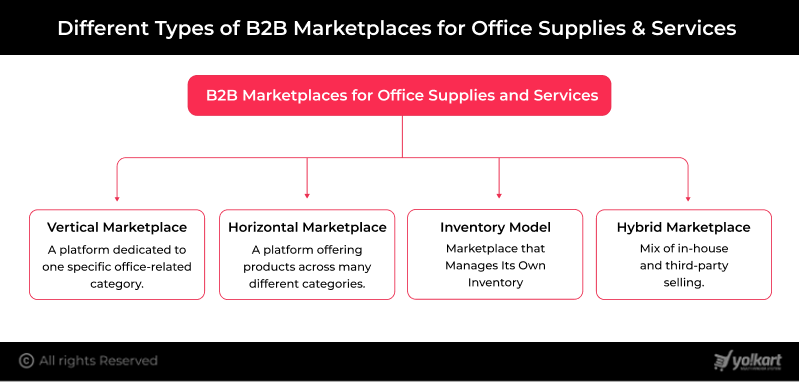
- Vertical Marketplace: Focuses on a single industry or category. For a B2B office supplies and services marketplace, this would mean exclusively listing products, such as paper, pens, furniture, and services, like cleaning, IT support for office consumption.
- Horizontal Marketplace: Offers a wide range of products across multiple industries. Two popular examples are Alibaba and Amazon Business. Your platform might start with office supplies and then expand into general industrial MRO or professional services.
- Inventory Model (First-Party): The marketplace owns and manages the inventory and logistics, like a traditional eCommerce store (e.g., Staples online). However, it requires significant capital for warehousing and stock.
Non-Inventory/Pure Marketplace (Third-Party): The marketplace only connects buyers and sellers; it never takes ownership of the goods. It facilitates the transaction and communication (e.g., a pure service-based marketplace or a platform connecting large distributors). Lower capital cost, greater scalability, but lower control over seller quality.
- Hybrid Marketplace: Combines the inventory and pure marketplace models. This is the most common and often most effective B2B model. The platform can sell its own high-margin/high-demand items, such as proprietary office furniture, while allowing third-party sellers to list their specialized catalogs (e.g., niche ergonomic supplies).
How to Build Your B2B Marketplace for Office Supplies & Services
Launching a successful B2B marketplace requires a structured approach that prioritizes market fit, feature depth, and a scalable development strategy. Additionally, B2B transactions often require handling large volumes, detailed purchasing steps, and multiple stakeholders, making it essential for your platform to provide dependable performance. Further, let’s have a look at the steps to build a B2B marketplace:
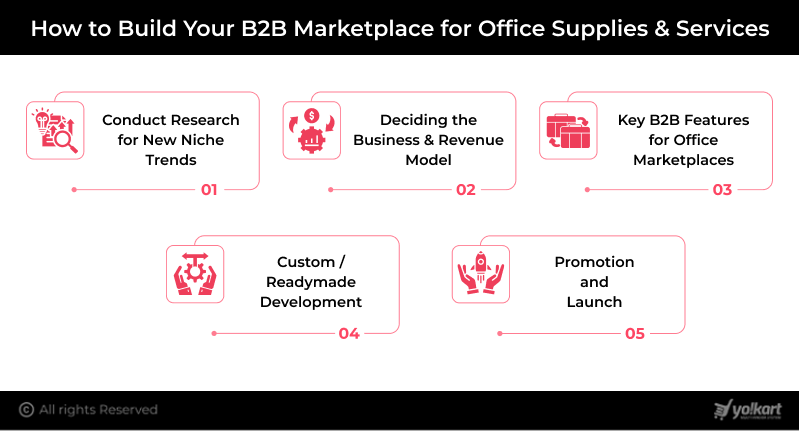
Step 1: Conduct Research for New Niche Trends
The first step is to identify the market gap. The generic office supplies market is saturated. Thus, the key to success lies in targeting underserved niches. Hence, you can focus on:
- Eco-Friendly/Sustainable Supplies: Focus on certified carbon-neutral paper, recycled plastic pens, biodegradable packaging, and suppliers with demonstrable ESG (Environmental, Social, and Governance) commitments.
- Remote Work Solutions: Cater to the modern hybrid workplace. This includes dropshipping services directly to employees’ homes, managing stipends for home-office setups, and selling collaborative software subscriptions.
- Managed Services: Go beyond simple product sales. Offer curated services like subscription-based coffee/snack delivery, managed printing contracts, and on-demand IT helpdesk support listed by vetted service providers.
- Vertical Specialization: Target a specific type of office, e.g., co-working spaces (bulk amenities, flexible leases for furniture) or medical offices (specialized supplies, compliance services).
Step 2: Deciding the Business & Revenue Model
Monetization in the B2B space is significantly more diverse and complex than the simple transaction-based commission model common in B2C eCommerce. A mixed marketplace model that combines several strategies is typically the most effective and profitable approach, ensuring multiple, stable income streams.
- Commission on Each Transaction: This remains the foundational revenue model, where the marketplace charges a percentage of the total value of each successful transaction. The commission rate is often variable, adjusted based on the specific product category, reflecting different margin profiles (e.g., lower commission on high-volume, low-margin items like paper, and higher commission on niche furniture or specialized services).
- Subscription/Membership: The platform can charge a recurring fee to either buyers or sellers for accessing enhanced features or a premium status.
- For sellers, this might unlock better visibility (lower commission rates or access to bulk order reports).
- For corporate buyers, a premium membership could grant access to exclusive bulk pricing tiers, dedicated account management, or advanced procurement analytics.
- Featured Listings/Advertising: This involves allowing sellers to pay for strategic promotional placement within the marketplace. Sellers can purchase banner advertisements on category pages to have their products appear at the top of search results, or gain a premium status that highlights their store.
- Lead Generation Fee: Specifically relevant for the “Services” side of the marketplace (e.g., cleaning, catering, IT support), this model charges service providers a fee for receiving a qualified business lead, such as a formal Request for Quote (RFQ) submitted by a vetted corporate buyer. The marketplace earns a commission simply for connecting a business opportunity to the provider.
- Value-Added Services: This involves charging for supplementary, non-core services that enhance the B2B procurement process. These are major profit centers and can include offerings like integrated logistics management, warehousing, trade financing, or corporate credit options.
Step 3: Essential B2B Features for Your Office Supplies and Services Marketplace
A B2B platform must handle complexity. Additionally, the feature set must cater to the corporate procurement process, not a consumer shopping trip. Thus, it should include:
| Feature Category | Core Features | B2B Rationale |
| Account Management | Corporate Account Hierarchy: Admin, purchasing manager, employee roles with custom spending limits. | Enables internal budget control and approval workflows essential for business buying. |
| RFQ (Request for Quote) Module: Allows buyers to request custom pricing for bulk orders or specialized services. | A standard B2B practice for large-volume, non-catalog purchases, enabling price negotiation. | |
| Order & Pricing | Tiered/Quantity-Based Pricing: Automated discounts applied based on volume, visible only to logged-in B2B users. | Incentivizes bulk purchasing, the cornerstone of B2B transactions. |
| Minimum Order Quantity (MOQ): Sellers can set minimum purchase requirements. | Protects vendor margins on wholesale deals. | |
| Quick Reorder & Shopping Lists: Saves frequently purchased items for one-click reordering. | Streamlines repetitive purchases, improving efficiency for procurement teams. | |
| Integrations | ERP/CRM Integration (APIs): Seamless connectivity with buyers’ and sellers’ existing Enterprise Resource Planning or Customer Relationship Management systems. | Ensures smooth data flow for inventory, invoicing, and logistics tracking. |
| Service Integration | Bookable Service Listings: Enables sellers to list bookable services (e.g., printer repair) with integrated scheduling and quote requests. | Expands the platform beyond physical goods into the high-margin services sector. |
Create a Feature-Packed B2B Marketplace for Office Supplies and Services
Step 4: Development Approach: Custom vs. Readymade
Choosing the right development path determines your time-to-market, initial investment, and long-term scalability. It also shapes how quickly you can validate demand, adapt to customer needs, and differentiate your platform in a competitive B2B landscape. Moreover, the approach you choose will influence your technical flexibility, operational efficiency, and overall ability to scale sustainably. Let’s explore both approaches for a better understanding:
1. Custom Development
This involves building the entire platform from scratch using an in-house team or a development agency. No doubt, this approach provides control and flexibility, but it also takes:
- Longer Timeline (8 – 18+ months): This longer timeline includes requirements gathering, wireframing, UI/UX design, front-end and back-end coding, testing, and deployment.
- High Cost($30,000 – $100,000+): Varies significantly based on the complexity, geographic location of the development team, and the full feature set.
- Deeply Tailored Process: Allows for the creation of unique, proprietary features that perfectly match your niche business model.
2. Readymade Solutions (Off-the-Shelf Software)
This involves purchasing a customizable, pre-built marketplace software solution that already includes the core multi-vendor and B2B functionality. Furthermore, solutions like Yo!Kart also provides source code ownership and comes at one time cost, with no recurring fee or any hidden cost. Moreover, it takes:
- Less Time (a few days to a few weeks): The core framework is already built, allowing for rapid deployment and focus on branding, customization, and vendor onboarding.
- Low to Medium Cost ($1,000 – $10,000+): Typically a one-time license fee or an annual subscription, plus costs for basic customization and setup.
- Rapid Launch: Offers a proven, robust foundation with core features. Additionally, offers customization and is easy to scale.
Comparison of Both Approaches
| Feature | Custom Development | Readymade Solutions |
| Speed to Market | Slower, requires full development, testing, and deployment | Quick Setup, Ready-to-Launch with Minimal Configuration |
| Initial Investment | High upfront cost for development, design, and maintenance | Low to moderate, based on subscription or licensing fees |
| Feature Uniqueness | Fully customizable, supports any niche or specialized feature | Relies on pre-built modules. |
| Ownership & Control | Full code ownership; complete control over updates and data | Depends on the licensing model; often, code-level access is provided. |
| Ideal For | Well-funded enterprises with a unique, complex business model | Startups, SMEs, and entrepreneurs prioritize fast launch, low risk, and core functionality. |
Step 5: Promotion and Launch
The success of a B2B marketplace hinges on attracting both buyers and sellers from the outset. A well-executed promotion and launch strategy ensures early adoption, builds credibility, and sets the foundation for long-term growth.
- To attract Sellers (Suppliers/Service Providers):
- Focus on Value: Highlight the ability to reach new, high-value corporate buyers that they couldn’t acquire otherwise.
- Low Friction Onboarding: Offer a simple, fast process for bulk product uploading and account verification.
- Incentives: Waive commission or offer a free premium subscription for the first three months.
- To attract Buyers (Companies/Procurement Teams):
- Targeted Outreach: Partner with industry associations or focus on specific geographic or industrial verticals.
- Value Proposition: Emphasize cost savings (bulk pricing), efficiency (streamlined reordering/approval), and compliance (sustainability reporting, preferred vendor lists).
- Launch Incentive: Offer a significant discount on the first large order or a credit towards a new service booking.
Yo!Kart: A Readymade Software to Build a B2B Marketplace for Office Supplies in a Week
For entrepreneurs and businesses aiming for a fast, cost-effective, and feature-rich launch, a readymade platform like Yo!Kart provides a compelling solution. It is specifically designed as a multi-vendor eCommerce platform that supports complex B2B needs.
Yo!Kart eliminates the need for months of custom coding by providing a fully functional, scalable, and white-labeled marketplace. Its architecture is built to handle the simultaneous needs of multiple sellers and complex buyer transactions, making it an ideal choice for the B2B office supplies and services sector. It allows you to launch the marketplace in a matter of weeks, thus you can focus on market validation and user acquisition rather than development headaches.
Inbuilt Features Supporting B2B Marketplace Models for Office Supplies and Services
Yo!Kart is equipped with the specific features required to handle the rigorous demands of B2B procurement:
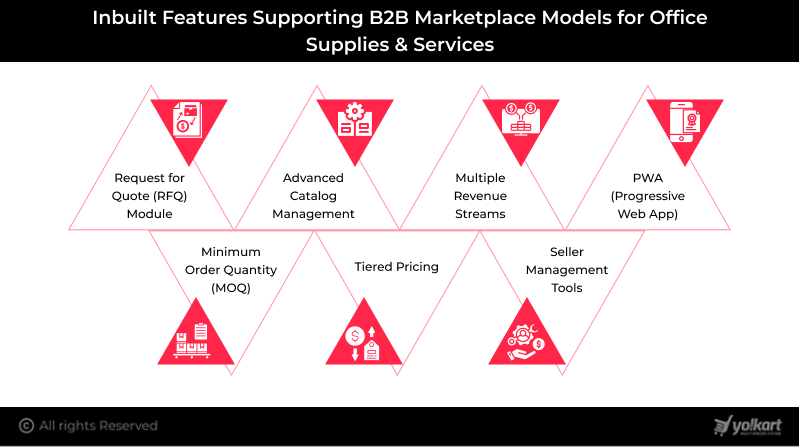
- Request for Quote (RFQ) Module: This is a crucial B2B feature, allowing buyers to submit detailed quote requests to multiple vendors for custom pricing on bulk or special orders.
- Minimum Order Quantity (MOQ): Sellers can set mandatory minimum order limits to ensure profitability on wholesale transactions.
- Advanced Catalog Management: Offers tools for sellers to easily manage a large number of SKUs, including bulk uploads and product variations.
- Tiered Pricing: Facilitates the implementation of B2B pricing models, enabling sellers to offer different prices based on the order quantity.
- Multiple Revenue Streams: Supports all the key monetization models, including commission, subscription, banner ads, and featured listings. Hence, it allows you to have a diverse and stable income strategy.
- Seller Management Tools: Provides dedicated dashboards for vendors to manage inventory, view analytics, process orders, and control their storefront presence.
- PWA Compliance (Progressive Web App): Ensures a fast, app-like experience on mobile devices without requiring separate mobile app development, crucial for on-the-go procurement teams.
B2B Marketplaces Powered by Yo!Kart
Yo!Kart powers diverse B2B marketplaces, offering tailored solutions for diverse industries ranging from flexographic printing to wholesale eCommerce. Listed below are some standout examples of businesses that have successfully launched their platforms using Yo!Kart:
1. Anyflexo
Industry: Flexographic Printing Supplies
Anyflexo revolutionizes the flexographic printing supplies market by transitioning from a legacy industry to a modern, scalable eCommerce solution. Powered by Yo!Kart, the platform, supports custom product catalogs, real-time inventory tracking, and automated restocking, making it easy for suppliers and buyers in the printing industry to connect and transact efficiently.
2. Bozinga
Industry: Wholesale B2B Marketplace
Bozinga, powered by Yo!Kart is a wholesale B2B marketplace that connects manufacturers, wholesalers, and bulk buyers in various industries. The platform’s multi-vendor support, customizable product listings, and efficient order management streamline the bulk buying process. By offering a secure, seamless platform, Bozinga simplifies transactions, improving operational efficiency for wholesale buyers and suppliers.
Experience Yo!Kart Firsthand
Conclusion
The B2B office supplies and services market is evolving rapidly, driven by rising demand for eco-friendly products, remote work solutions, and integrated services. Building a successful B2B marketplace is not about reinventing the wheel but about executing a strategy that addresses the complex needs of corporate procurement.
Moreover, by following a structured path-from identifying a profitable niche to selecting a robust, B2B-ready platform like Yo!Kart, entrepreneurs can significantly accelerate their time-to-market. The goal is to create a digital ecosystem that delivers not just products, but a superior, efficient, and cost-effective procurement experience.
FAQs
Q 1. What are the key features of a B2B marketplace for office supplies?
Ans. A B2B marketplace for office supplies should include features, such as:
- Bulk ordering
- Product catalogs
- Custom pricing
- Invoicing
- Purchase order management
- Payment gateways
- Multi-user accounts
- Real-time inventory tracking.
Q 2. What is the difference between B2B and B2C marketplaces?
Ans. B2B marketplaces cater to businesses selling to other businesses, involving larger transactions, customized pricing, and longer sales cycles. Whereas, B2C marketplaces serve individual consumers with smaller, standardized purchases, typically featuring retail products and faster sales processes.
Q 3. How long does it take to build a B2B marketplace for office supplies and services?
Ans. The timeline to build a B2B marketplace for office supplies and services typically takes 4 to 6 months, depending on features, design complexity, and whether you’re using a custom or ready-made platform.
However, readymade solutions reduce this timeline and allow you to enter the market within a few weeks.
Q 4. How can I ensure my B2B marketplace is scalable?
Ans. To ensure scalability, you should focus on a flexible architecture, use cloud-based hosting, integrate modular features, plan for high transaction volumes, and allow third-party integrations. Other than that, it is also essential to choose a platform that supports multi-currency and multi-language support to cater to a global customer base.
The post Build a B2B Marketplace for Office Supplies and Services appeared first on YoKart Blog.
]]>The post How to Build a Website Like Alibaba: Features, Costs and Monetization Strategies appeared first on YoKart Blog.
]]>However, before we dive deep, let’s explore why build an eCommerce platform similar to Alibaba?
According to Statista, Alibaba Group recorded revenue of approximately $137.3 billion (996.35 billion yuan) in the fiscal year ending March 31, 2025. You can see a continuous growth in Alibaba’s revenue from 2015 to 2025.
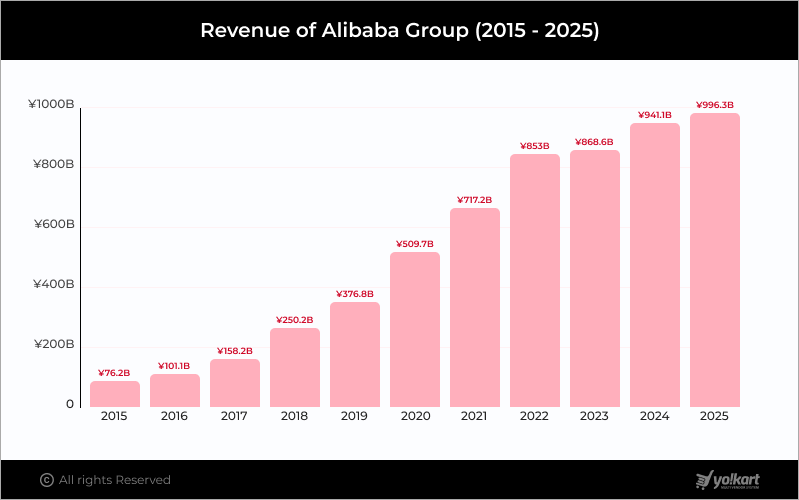
What attracts entrepreneurs more to build a marketplace like Alibaba is its diversified revenue channels and business models. It generates revenue through multiple sources and drives consistent growth via its strategic business model.
Moreover, by building a marketplace like Alibaba, you will not just create a centralized digital platform to connect buyers and sellers, but can extend your business beyond. Let’s explore how to create a website like Alibaba.
Table of Contents
- What is Alibaba?
- Alibaba History: Key Milestones and Achievements
- Business Model: How Does Alibaba Work?
- Top Well-Recognized Subsidiaries/Businesses of Alibaba Group
- Alibaba Revenue Model: How Does Alibaba Make Money?
- Revenue Distribution of Alibaba by Segment
- Key Features of Alibaba B2B Multi-Vendor eCommerce Platform
- How Much Does it Cost to Build an eCommerce Platform Similar to Alibaba?
- How to Build a Website or Marketplace Like Alibaba?
- Build a Multi-Vendor Marketplace Like Alibaba at an Affordable Cost
- Final Thought
- FAQs
What is Alibaba?
Alibaba is a leading B2B multi-vendor marketplace that enables buying and selling products in bulk. The platform is specially designed for B2B trade. It connects businesses (buyers) that prefer good margins with suppliers (vendors) seeking large quantity orders.
There are millions of active buyers, manufacturers, suppliers and wholesalers listed and registered on Alibaba. The marketplace handles approximately 300,000 trades daily. On the one hand, vendors connect with millions of global buyers. On the other hand, buyers also gain access to a wide variety of products from distinct categories and niches.
Alibaba’s offerings are not limited to products; it also extends to services, cloud computing, entertainment, logistics, finance, artificial intelligence, and more.
In short, Alibaba Group is a one-stop destination for individuals and businesses that offers a comprehensive digital solution, from selling products in bulk to selling to individual customers, providing cloud computing services to leveraging AI products, enabling a payment system to offering loans and providing a video streaming platform to making films.
- Parent organization: Alibaba Group
- Founded: April 4, 1999
- Headquarters: Hangzhou, China
- Company Type: Private
- Geographical Presence: Global
Alibaba History: Key Milestones and Achievements
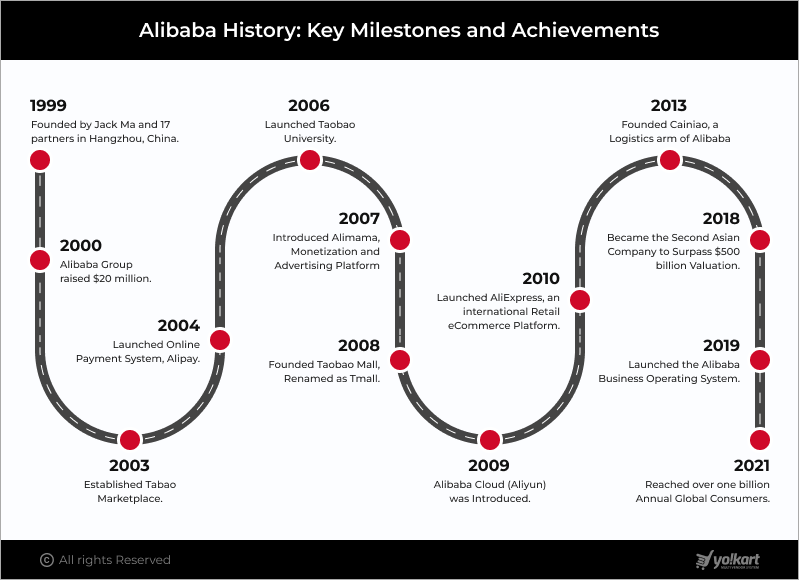
- 1999: Founded by Jack Ma and 17 partners in Hangzhou, China.
Launched China Marketplace (Currently 1688.com) - 2000: Alibaba Group raised $20 million.
- 2003: Established Tabao Marketplace
- 2004: Launched Online Payment System, Alipay.
- 2006: Launched Taobao University
- 2007: Introduced Alimama, Monetization and Advertising Platform
- 2008: Founded Taobao Mall, Renamed as Tmall (2011)
- 2009: Alibaba Cloud (Aliyun) was Introduced.
- 2010: Launched AliExpress, an international Retail eCommerce Platform.
- 2013: Founded Cainiao, a Logistics arm of Alibaba
- 2018: Became the Second Asian Company to Surpass $500 billion Valuation.
- 2019: Launched the Alibaba Business Operating System.
- 2021: Reached over one billion Annual Global Consumers
Business Model: How Does Alibaba Work?
Alibaba is a dedicated B2B multi-vendor marketplace that works as an intermediary between businesses. It connects businesses, including buyers and sellers, to trade in bulk. Manufacturers, distributors and suppliers primarily from China list their products and connect with buyers across the world. Buyers, on the other hand, visit the marketplace and find products at a good value.
Vendors’ Journey on Alibaba
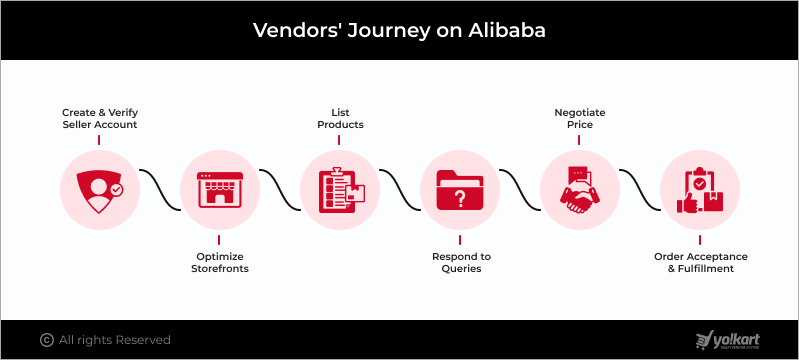
- Create and Verify Seller Account
- Optimize storefronts
- List Products
- Respond to Queries
- Negotiate Price
- Order Acceptance and Fulfillment
Buyers’ Journey on Alibaba
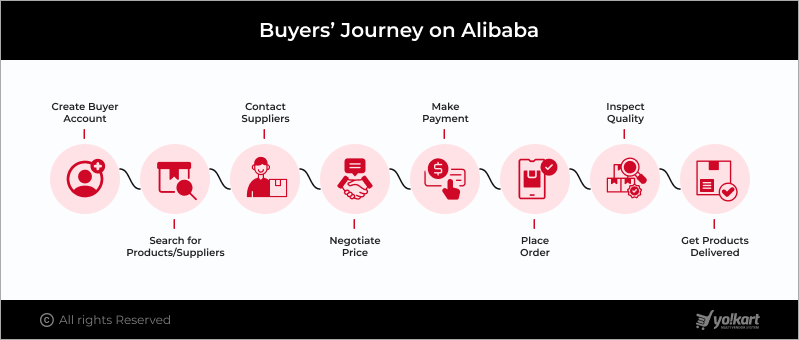
- Create Buyer Account
- Search for Products/Suppliers
- Contact Suppliers
- Negotiate Price
- Make Payment
- Place Order
- Inspect Quality (Through Alibaba Third-party Inspection Services or by Yourself
- Get Products Delivered
Buyers can also take post-delivery actions, such as providing feedback on the product or supplier, or contacting customer support for any complaints, concerns, or queries.
| Admin controls and manages the entire marketplace’s operations, including user management, payment management, order management, role management, return and complaint management, marketing, promotions and much more. |
Top Well-Recognized Subsidiaries/Businesses of Alibaba Group
However, alongside product sales, the Alibaba Group follows a diversified business model that makes it an ideal inspiration for entrepreneurs and business owners who tap into the eCommerce world and extend their offerings beyond. Let’s explore some widely recognized subsidiaries or businesses operated by Alibaba Group that contribute to its growth and expansion.
| Subsidiary | Founded Year | Key Offerings |
| 1688.com | April 1999 | A Chinese B2B eCommerce platform focused on the domestic market. |
| Taobao | May 2003 | A consumer-to-consumer (C2C) marketplace popular across China. |
| AliPay | February 2004 | A widely used digital payment service in China. |
| Youku | December 2006 | A major online video platform, often compared to YouTube. |
| Alimama | November 2007 | A digital marketing and monetization platform by Alibaba Group. |
| Tmall | April 2008 | A B2C platform featuring high-quality products from top brands. |
| Aliyun (Alibaba Cloud) | September 2009 | Global cloud computing solutions provider. |
| AliExpress | April 2010 | A global B2C eCommerce platform connecting buyers with Chinese suppliers. |
| Lazada | May 2012 | A leading Southeast Asian eCommerce marketplace. |
| Cainiao | May 2013 | A smart logistics network enabling fast domestic and cross-border deliveries. |
| DingTalk | December 2014 | An enterprise communication and collaboration platform. |
Want to Build an eCommerce Website Similar to Alibaba or its Subsidiaries?
Alibaba Revenue Model: How Does Alibaba Make Money?
Whether you are a buyer or a seller, user registration and product listing on Alibaba are free. However, its diversified revenue models ensure steady income for the business.
The platform primarily generates revenue through advertising, membership fees, and commission on transactions. While some platforms like Tmall and AliExpress charge commissions on sales, others like Taobao and Alibaba itself rely more on advertising and subscription fees.
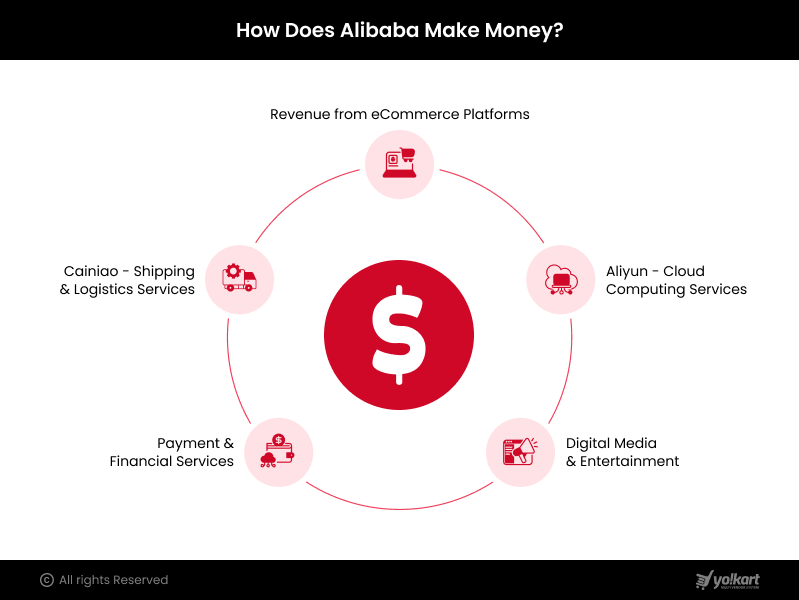
In addition, Alibaba Group earns money from its extended services such as cloud computing, logistics, and more. Let’s get an overview of the revenue model of Alibaba below:
Alibaba’s Revenue from eCommerce Platforms
Alibaba and its sister eCommerce platform enable the selling of products in retail and wholesale. These platforms generate revenue from multiple revenue streams. Tmall and Taobao are leading eCommerce platforms that generate a vast amount of revenue for Alibaba. Below are a few revenue streams that contribute to the company’s revenue.
- Commission: Alibaba itself doesn’t charge commission on sales. However, its sister platforms, such as AliExpress, Tmall and Juhuasuan, charge a percentage of GMV (Gross Merchandise Value) on transactions initiated or settled via Alipay.
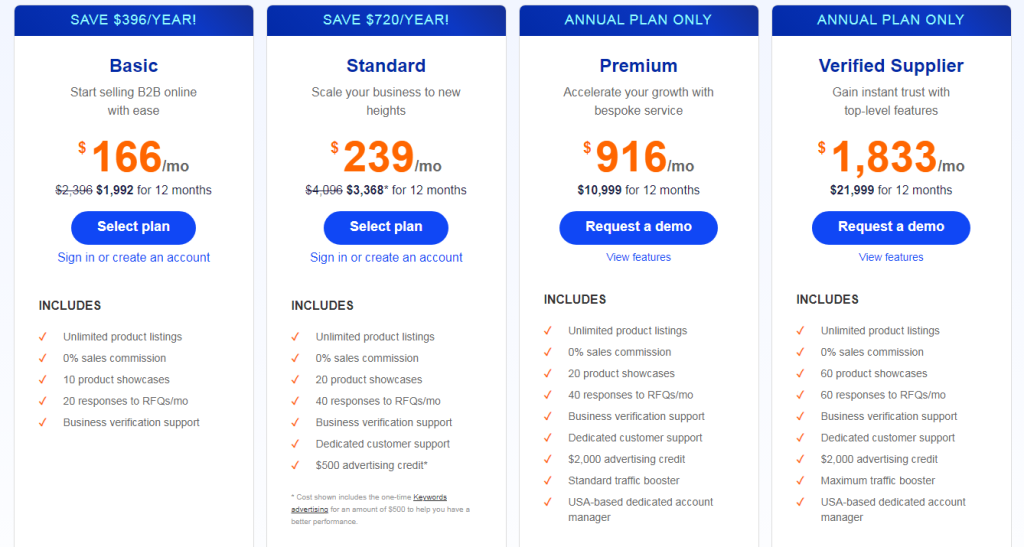
- Membership and Subscription Fees: Membership and subscription-based services are another revenue generation source for Alibaba. Subscription prices varied by plans and offerings.
Primarily, Alibaba offers two different pricing plans: basic and standard. The subscriber can choose either a quarterly or an annual plan. These membership plans provide access to premium services and features, offering subscribers several exclusive benefits. Alibaba’s premium membership program 88VIP has continued to gain traction among its members.
- Advertisements and Sponsored Ads: A significant percentage of Alibaba’s revenue comes from marketing services (advertising and sponsored ads). Merchants and third-party advertisers pay Alibaba in order to promote products, increase visibility, display banner ads, rank keywords and more.
Alimama is the advertising platform that analyses data across platforms and enables targeted marketing across the Alibaba ecosystem.
Suggested Read: How Does Alibaba Make Money : A Detailed Guide
Alibaba’s Revenue from Aliyun (Cloud Computing Services)
Aliyun, Alibaba’s cloud computing arm, has reported year-on-year revenue growth. It provides services like computing, storage, data management and AI solutions. It enables businesses to choose subscription plans or incur charges based on services used, pay-as-you-go.
AI-related products remain key growth drivers for Alibaba Cloud. In the first year of 2025, Alibaba Cloud reported revenue of $16.26 billion. Moreover, by analyzing the rapid adoption of AI products, Alibaba has planned to invest in cloud and AI infrastructure to sustain its growth and expansion.
Alibaba’s Revenue from Cainiao (Shipping and Logistics Services)
Cainiao is one of the world’s largest cross-border eCommerce logistics services providers. It’s one of Alibaba’s leading revenue sources. At the same time, Cainiao is also one of the fastest-growing units.
Cainiao generates revenue from services including warehousing, transportation, pick-up services, last-mile delivery and more. The highlight is that Cainiao generates a significant portion, about 70% from external sources and the remaining 30% of revenue comes from serving Alibaba’s internal needs.
Alibaba’s Revenue from Payment and Financial Services
Alibaba generates revenue from Alipay and other financial services. However, Alipay is now part of Alibaba’s financial services known as Ant Financial. It offers a range of payment and financial services. These services include payment processing, micro-loans, digital banking, wealth management and more. Moreover, Ant Group generates revenue via a combination of fees, interests, and transactional charges.
- Transaction Fees (Alipay): Alipay incurs transactional charges on transactions that take place through the platform. Moreover, utility payments, credit card services, insurance and other services also contribute to Alipay’s revenue.
- Loan Interest: The company also offers loans to customers and earns interest on them.
- Revenue from other Services: In addition to the above-mentioned revenue channels, Ant Financial charges fees and commissions to offer services like wealth management, digital payment and others.
Alibaba’s Revenue from Digital Media and Entertainment
Alibaba Digital Media and Entertainment is another source that generates revenue through subscription fees, licensing, and advertising. This segment of Alibaba includes Youku, a video streaming platform; Alibaba Music, a music division focusing on copyrights and more related to the industry; Alibaba Pictures produces films and TV shows; AliSports, UC web and more.
They all drive revenue for Alibaba in several ways. Such as Youku generates revenue through subscriptions and advertisements and Alibaba Pictures generates revenue by producing films and TV shows.
Revenue Distribution of Alibaba by Segment
The table below defines the revenue share of the Chinese eCommerce conglomerate Alibaba Group by segment. You can see the percentages of Alibaba’s revenue in the second quarter of 2025.
| Alibaba’s Segment/Subsidiary/Business | Revenue Percentage |
| China Commerce Retail | 47.88% |
| All others | 23.66% |
| Cloud Intelligence Group | 13.49% |
| International Commerce Retail | 11.47% |
| Quick Commerce | 5.7% |
| International Commerce Wholesale | 2.56% |
| China Commerce Wholesale | 2.46% |
Key Features of Alibaba B2B Multi-Vendor eCommerce Platform
Operating an online multi-vendor marketplace requires the necessary features and functionality to ensure a seamless and hassle-free experience for users. Similarly, being a leading B2B multi-vendor marketplace, Alibaba offers advanced out-of-the-box features and functionality.
It enables users to navigate complete transactions effortlessly. On Alibaba, two different users primarily participate: buyers and sellers. Let’s explore user-wise key features of Alibaba below:
Features for Buyers
Buyer is the first; at the same time, it’s the end user on the marketplace. The role of a buyer begins with a product search to end with leaving a review and ratings. Below are buyer-specific features of Alibaba:
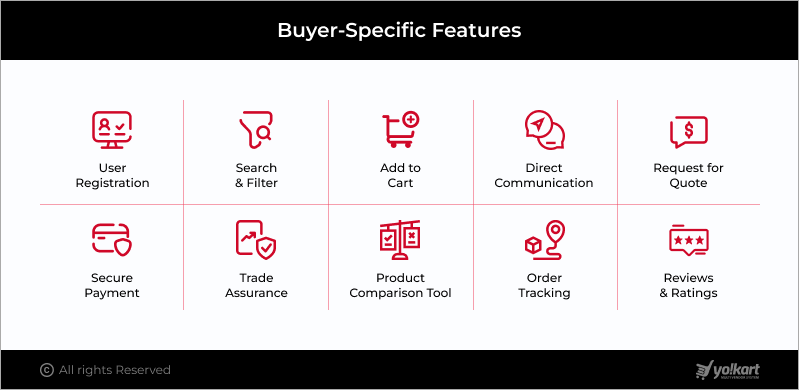
- Easy Registration and Login: Alibaba enables easy registration for buyers. They can register in just a few steps.
- Create an account by providing details like name, email address, location, and phone number.
- Complete security verification by verifying phone and email, entering the verification code.
- Add and verify payment details.
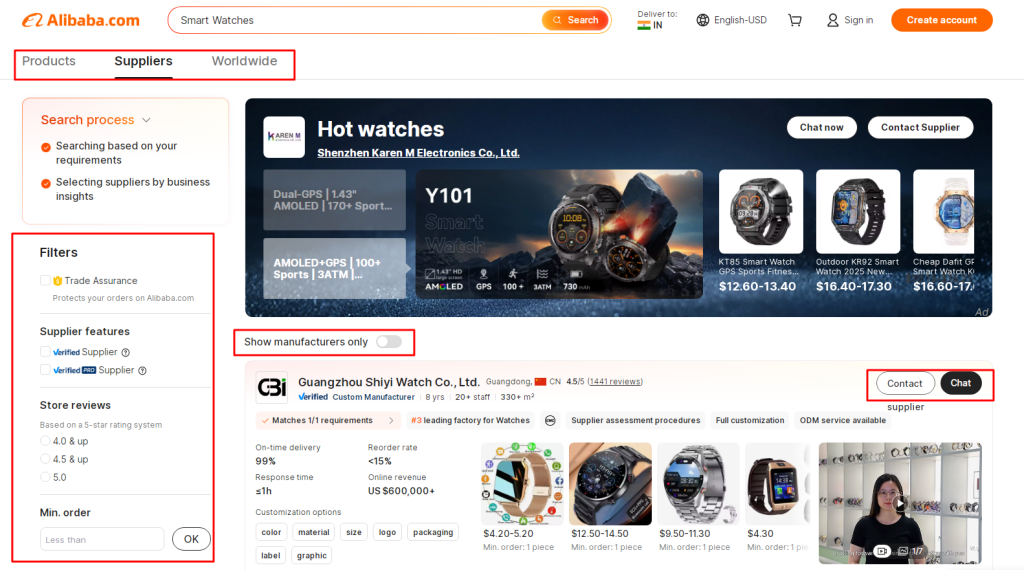
- Search and Filter: Buyers can find the results they are looking for. They search and view results by product, supplier, or worldwide. Buyers can also short products by enabling a toggle ‘Show manufacturers only’.
In addition, buyers on Alibaba can filter products at multiple levels to get more precise and relevant search results. These filters may include supplier country/region, supplier features, store reviews, certification and more. However, the filters can vary depending on the product category and types.
Alibaba also enables product search using images. Buyers can upload, paste or drag and drop images to search. They can even take snaps using Alibaba Lens to find results.

- Add to Cart: Buyers can collect and save items to the cart they want to buy or view later. The add to cart option also helps buyers to streamline the ordering process by enabling buyers to check out multiple products altogether.
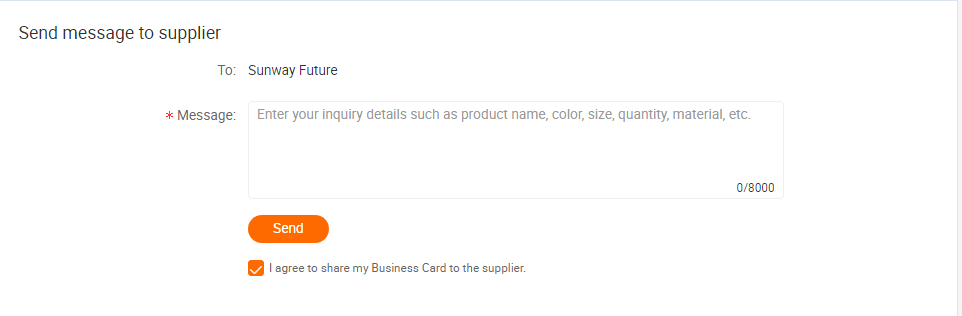
- Chat/Contact Seller: Alibaba provides direct messaging tools with real-time translation to negotiate deals, share customized order requirements, and discuss terms such as pricing, quantity, and shipping. These options may include direct charting and contacting the supplier.
- Request for Quote (RFQ): Using this feature, buyers send and receive RFQ (Request for Quote). They can either raise a request to a particular seller or raise a universal request in order to grab the best possible deal, and any of the sellers can counteroffer.
- Secure Payment: Alibaba offers multiple and secure payment options for buyers. Each payment made on Alibaba is secured with strict SSL encryption and PCI DSS data protection protocols. Moreover, buyers can make payments using their preferred methods.
- Trade Assurance: Works as a protective shield for buyers on Alibaba. It safeguards payments, ensures on-time shipment and guarantees buyers receive the product delivered with optimal quality.
- Product Comparison Tools: Alibaba offers a feature that lets buyers compare products and suppliers simultaneously based on features, performance, and popularity. Buyers can compare up to 20 products or suppliers and choose.
- Order Tracking: One of the important features for buyers on any platform. Order tracking allows buyers to track orders and get updates on their current statuses. Alibaba allows its buyers to track orders using the built-in order tracking system.
- Reviews and Ratings: Buyers on Alibaba can post a review and rate using this feature. However, reviews and ratings on Alibaba are of different types that include:
- Verified purchase reviews: Buyers post reviews 90 days after the transaction is completed.
- Unverified purchase reviews: Buyers may leave reviews without a fully completed transaction on the platform.
- High-level buyers: High-level buyers who have had multiple interactions with a seller may post reviews on the seller’s service within 180 days after such an incident.
Looking for a Feature-rich Multi-Vendor Marketplace Solution?
Features for Suppliers
Vendors on Alibaba are manufacturers, suppliers and wholesalers who list and sell products on the platform. Alibaba brings all the necessary features for vendors. Enabling them to create unique storefronts to process and deliver orders, they perform all the tasks seamlessly. Let’s explore vendor-specific features of Alibaba below:
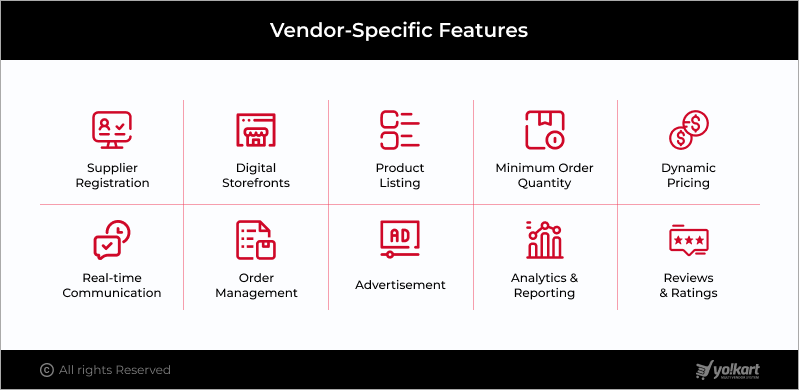
- Supplier Registration: Whether you are a manufacturer, wholesaler or supplier, Alibaba makes onboarding easy. You can register your business on Alibaba by simply providing and verifying the necessary details related to your business. Once registered, you can get started.
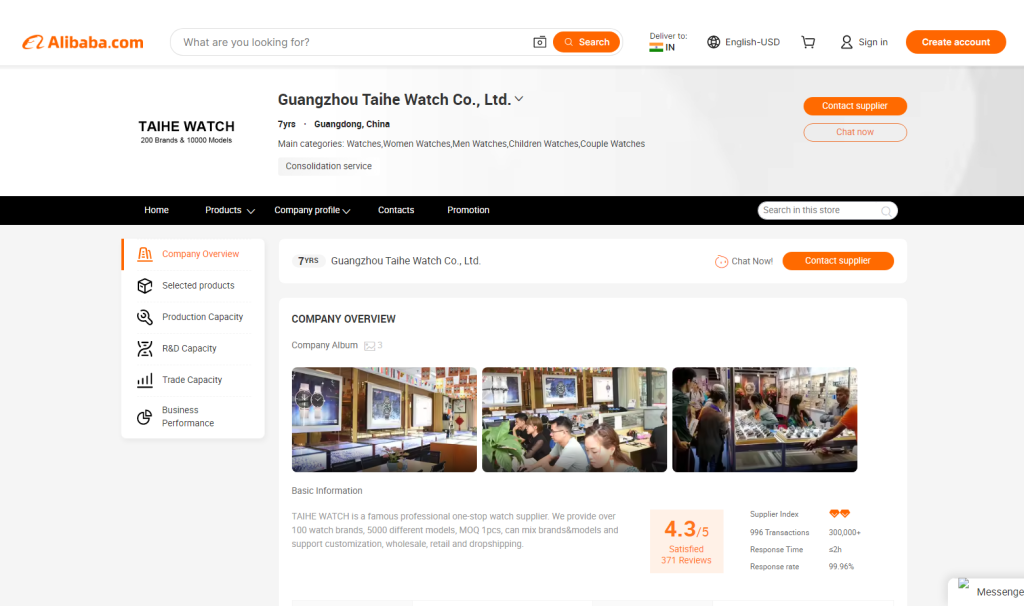
- Digital Storefronts: Alibaba provides an option for vendors to set up their own digital storefronts on the marketplace. They can customize and set up their online store, inclusively showcasing their products and businesses.
- Product Listing: Suppliers on Alibaba can either list products in bulk using the import export option or can list a single product, providing all the necessary details.
- Minimum Order Quantity: Using this feature, suppliers can restrict buyers from placing orders less than the quantity set. As Alibaba is a B2B focused marketplace, MOQ encourages bulk ordering and lets the suppliers handle order fulfillment, operations and efficiency.
- Dynamic Pricing: Alibaba enables vendors to make maximum profit using the dynamic pricing feature. This feature automatically adjusts pricing by analyzing various factors such as demand, competition and other market conditions.
- Direct and Real-time Communication: Each sales journey begins with a query. Alibaba’s direct and easy communication channels enable suppliers to directly interact with buyers on their queries in 18 languages, offering real-time translations.
In order to enable real-time communication, Alibaba also provides the AliSupplier app that allows suppliers to respond to buyers immediately, contributing to higher conversion chances.
- Order Management: Order management features on Alibaba allow suppliers to complete the ordering process. Starting from accepting orders to updating their statuses and communicating with buyers to ensure doorstep delivery, they can manage every aspect of the order.
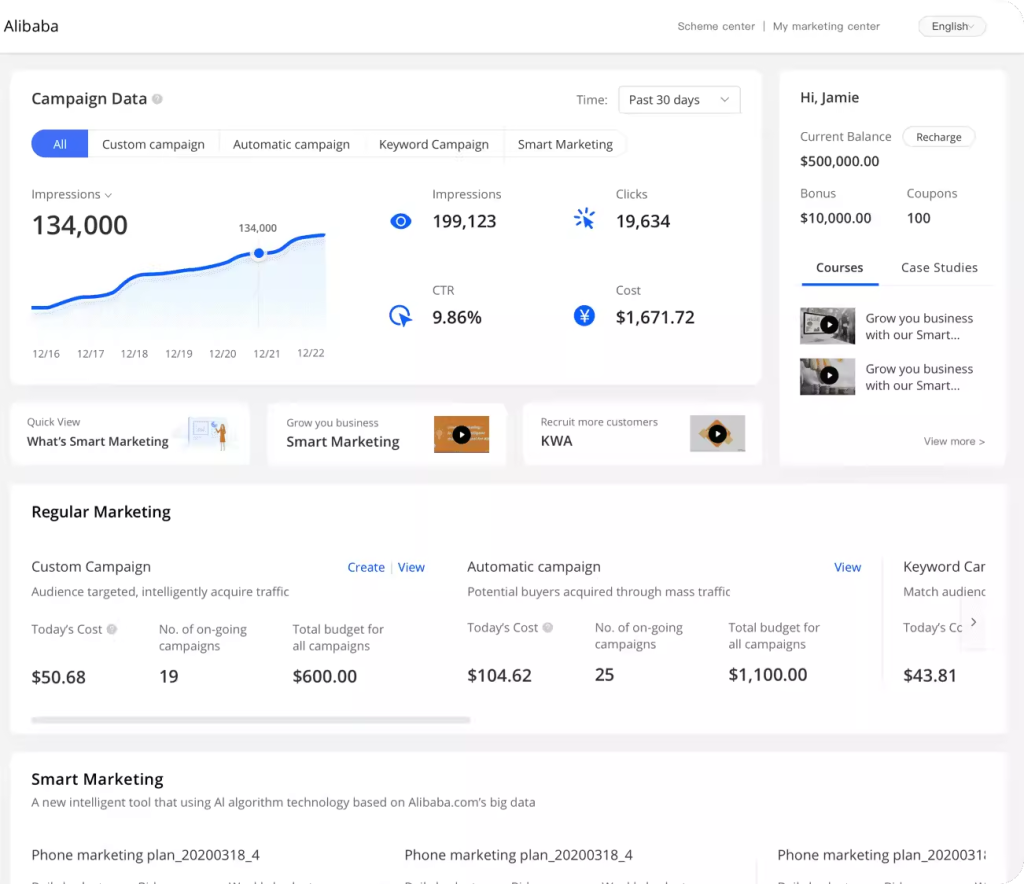
- Advertisement: Alibaba allows suppliers to increase visibility of their products via paid ad campaigns. They can precisely target potential buyers through keywords, increase visibility in search results and boost conversion rates.
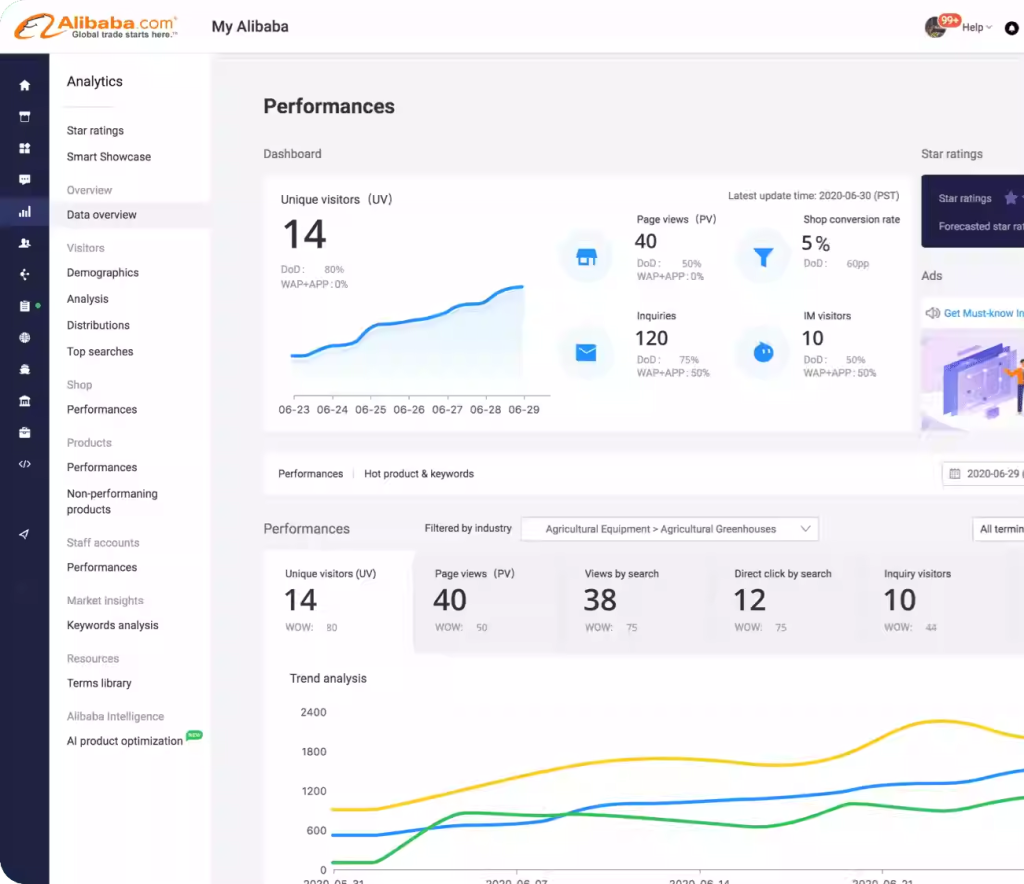
- Analytics and Reporting: Accessing the analytics and reporting dashboard, the supplier can get a complete overview of valuable data and insights, including order details, users’ behavior, search queries, conversion rates, the number of visitors and more. By analyzing these reports, suppliers can plan further strategies and implement them to drive more sales.
Features for Admin
Admin is the marketplace operator that operates, manages and grows the platform. From managing users to ensuring seamless operations, analyzing reports to processing payments, promoting business to acquiring users, implementing emerging technologies to taking care of updates, the admin requires all the necessary features to handle these operations.
Similarly, a B2B multi-vendor marketplace like Alibaba supports all the admin features that ensure seamless marketplace operations. However, Alibaba’s admin features are not officially available. Yet, you can check out these features required for the B2B marketplace admin:
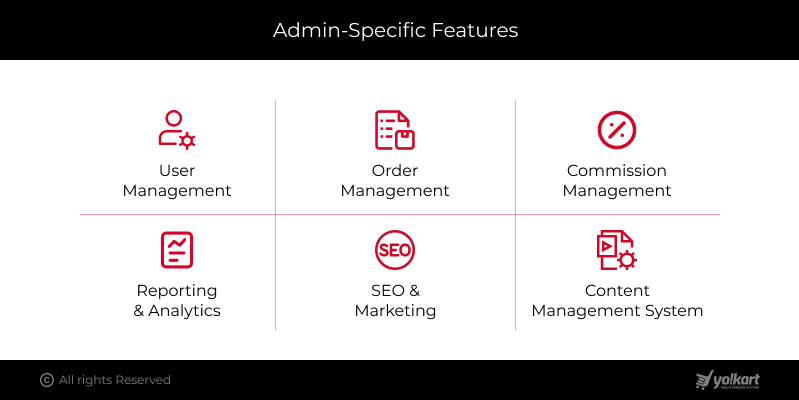
- User management: User management is an option that allows admins to manage the roles of different users including suppliers and buyers. In addition, the admin can also assign a sub-admin role to distribute workloads.
- Revenue/Commission Management: Admins need features to implement and manage multiple revenue streams such as commissions, subscription charges and more.
- Order Management: The order management feature provides complete control over the order-related operations to the admin. They handle everything, including refund and return management.
- Reporting and Analytics: Reporting and analytics in the Admin dashboard provide a complete overview of valuable data and insights of the marketplace.
Whether it’s about the number of users, transactions, tax, commission, or more, the reports showcase everything they need. In addition, by analyzing these data and insights, the admin can plan strategies and grow the marketplace.
- SEO and Marketing: In this highly competitive world, growing businesses require smart strategies, continuous effort and the right tools. SEO and marketing tools enable admins to drive more traffic, engagement and sales organically and through paid campaigns. They plan several marketing
- Content Management System: CMS is another important feature/tool that helps customize the marketplace, enhance user experience and tailor the platform as per the specific requirements without the need for coding expertise. They can easily create, manage, organize, and publish digital content on the marketplace.
How Much Does it Cost to Build an eCommerce Platform Similar to Alibaba?
Deciding on the cost to build a marketplace like Alibaba requires several considerations. The price can vary widely depending on factors such as the approach, technological requirements, features, functionality, integrations and other specific needs or complexity of the marketplace. In short, building a marketplace like Alibaba can cost anywhere between $10,000 – $1,00,000 or more.
However, you can build a B2B marketplace like Alibaba in two popular ways: build from scratch or choose a readymade solution.
Cost to Build an Alibaba-like Marketplace from Scratch
In this approach, you build an Alibaba-like marketplace from the ground up, which requires a significant amount of time, resources and money.
- Cost to Build from Scratch: Anywhere between $50000 – $100000 or more.
- Timeline: 6 to 12 months or more.
Cost to Build a Marketplace like Alibaba Using a Readymade Solution
Choosing a readymade B2B marketplace software can significantly reduce costs and timelines. Suppose you’re building an Alibaba-like eCommerce platform using Yo!Kart B2B, a readymade and dedicated B2B solution. The price can drop unexpectedly from thousands of dollars to a few hundred dollars.
- Cost to Build Using Readymade Solution (Yo!Kart B2B): Starting at $1249 (One-time)
- Timeline: 2 – 4 weeks
| Our Recommendation: Building a B2B marketplace using a readymade solution like Yo!Kart B2B can significantly reduce the cost. What makes it a preferred choice is that it offers a similar level of control and customization flexibility to custom development. |
Build a Marketplace like Alibaba at an Affordable Cost
How to Build a Website or Marketplace Like Alibaba?
B2B eCommerce has shown substantial growth. According to the International Trade Administration, the global B2B eCommerce market size is expected to reach $36 trillion by 2026. The data indicates it’s the right time for entrepreneurs and startups to take advantage of this ever-growing eCommerce landscape.
If you are planning to build an eCommerce platform like Alibaba, it can be a game-changing decision. At the same time, you need to be careful to avoid potential threats to your business, investment and marketplace idea.
Below are a few time-tested steps suggested by industry experts to help you build a marketplace similar to Alibaba.
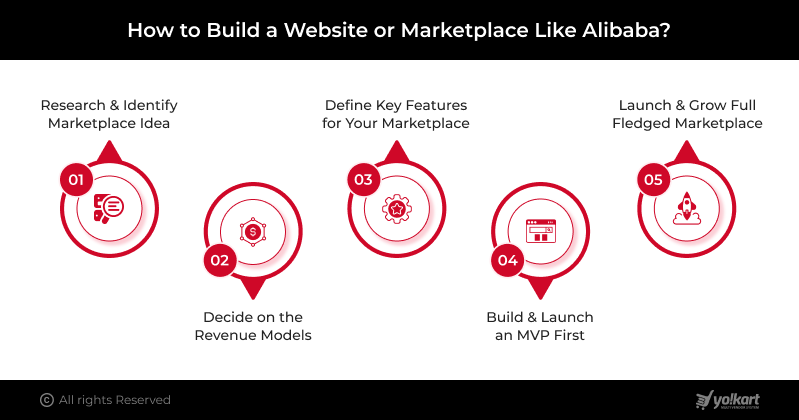
Step 1: Research and Identify Marketplace Idea
Alibaba is a dedicated B2B marketplace platform that connects manufacturers, suppliers, and wholesalers with global businesses that want to buy products in bulk at affordable rates. When planning to launch a marketplace like Alibaba, you need to discover a unique idea that can give your marketplace a competitive edge.
Hence, conduct thorough market research, analyze competitors, identify gaps, discover pain points, find an emerging market, understand targeted customers, and define a niche.
Moreover, conduct in-depth market research on Alibaba. It will also help you understand the areas and offerings where Alibaba itself is lacking and its customers are looking for an alternative that can meet their specific needs.
In addition, conducting market research will also give you an idea about the technology, budget and timeline required to build a B2B multi-vendor marketplace like Alibaba.
Step 2: Decide on the Revenue Models (Business Model)
If you want to build a marketplace like Alibaba, it clearly indicates a B2B eCommerce platform. However, when it comes to generating revenue for your eCommerce business, careful consideration is required. You can not simply decide on revenue generation streams that others are following.
Every business idea is unique. Hence, it requires a distinct approach to its monetization model considering the target audience, transaction type, users’ journey and more. Deduce with the revenue model that best suits your marketplace and its audience.
However, below are a few well-known revenue models marketplaces generate revenue from:
- Commission on Each Sale
- Subscriptions/Membership Fees
- Product Listing Fees
- PPC and Third-party Advertising
- Freemium Services
- Leads fees
You can choose any of the following or can implement a unique money-making idea that can help your business stand ahead and grow.
Step 3: Define Key Features for Your Marketplace
Operating a multi-vendor marketplace like Alibaba requires a comprehensive set of features and functionality to ensure seamless transactions on the platform. You need to define all the necessary features, functionality and services considering all the marketplace participants, their roles, operations and processes. The features listed below are critical when building a multi-vendor marketplace like Alibaba:
Features for Buyers:
- Easy Sign-up and Registration
- Search and Filter
- Add to Cart:
- Request for Quote (RFQ)
- Direct Communication
- Secure Payment:
- Trade Assurance:
- Product Comparison Tools:
- Order Tracking:
- Review and Ratings
Features for Suppliers
- Supplier Registration
- Digital Storefronts
- Product Listing
- Minimum Order Quantity
- Dynamic Pricing
- Direct Communication
- Order Management
- Advertisement
- Analytics and Reporting
Features for Admin
- User management
- Order Management
- Shipping Management
- Reporting and Analytics
- SEO and Marketing
- Content Management System
- Tax Management
- Ad Management Tool
- Dispute Handling/Customer Support
In addition to the above features, you can incorporate features and functionalities required specifically according to your business requirements.
Step 4: Build and Launch an MVP First
Building an MVP is a great way to validate your marketplace idea with a minimum investment. MVP (Minimum Viable Product) is the basic version of your full-fledged marketplace. It’s primarily designed to validate an idea, understand the user’s journey, and identify improvement areas.
It supports all the necessary features and functionality required to complete transactions for all user types. It significantly reduces the cost and time and helps entrepreneurs and business owners avoid potential threats to their ideas and investments.
An MVP is primarily intended to introduce its early adopters who explore and provide valuable feedback. Businesses implement feedback in order to improve the final product. MVPs are generally scalable platforms that can be expanded and grown as per the specific requirements. Ultimately, it contributes to saving time, money and resources alongside validating the marketplace idea.
Yo!Kart can be one of the best turnkey solutions to introduce your marketplace MVP, like Alibaba. It helps reduce the money and time required to launch a marketplace.
Step 5: Launch and Grow Full-Fledged Marketplace
In the final step, if you are satisfied with your marketplace MVP results, you can expand it into a full-fledged marketplace and launch. However, the job is not done yet. Operating a multi-vendor marketplace similar to Alibaba or any other requires a continuous effort.
From onboarding the maximum number of vendors to attracting more buyers and implementing new features to incorporating trends, your active participation is critical. Moreover, marketing and advertising are also one of those critical requirements that help you gain a competitive edge.
However, being a marketplace operator, you should always keep an eye on the users’ feedback, trends, and competitors to stay relevant, engaged and competitive.
Build a Multi-Vendor Marketplace Like Alibaba at an Affordable Cost
Yo!Kart is a white-label multi-vendor marketplace software. This readymade solution is primarily focused on providing entrepreneurs with a solution that enables them to build and launch a multi-vendor marketplace at an affordable price. It comes with all the necessary features and functionality required to operate an eCommerce platform.
If you are one of those entrepreneurs who is looking for a dedicated B2B marketplace software to build a platform like Alibaba, Yo!Kart B2B is right there for you. It’s a dedicated B2B multi-vendor marketplace software that supports B2B specific features and allows businesses of all sizes to trade seamlessly.
Moreover, choosing Yo!Kart as your marketplace software offers more than just a digital platform. The solution is fully customizable and scalable. Hence, you can tailor the platform to your specific needs and expand your eCommerce business without worrying about infrastructure and additional expenses related to expansion.
In addition, Yo!Kart’s source code ownership and self-hosted nature offer complete control over your marketplace and data, making it an ideal and better alternative to building a marketplace from scratch.
Launch a Fully Customizable and Scalable B2B Marketplace with Yo!Kart
Final Thought
In this informative guide on how to create a website like Alibaba, you have gone through every single detail about Alibaba. Starting from its history to understanding its business model, exploring Alibaba’s subsidiaries, features, and decoding its multiple and diversified revenue models.
In short, as an entrepreneur, you can collect all the necessary information about Alibaba that one should be aware of when building a B2B multi-vendor marketplace similar to it, including a step-by-step guide, costs and approaches to build.
I’m sure that if you are an entrepreneur planning to build a multi-vendor marketplace similar to Alibaba, you’ll consider YoKart, one of the most affordable and best readymade multi-vendor marketplace solutions.
FAQs
Q 1. Does Alibaba charge a commission on sales?
Ans. No, Alibaba doesn’t charge commission from sellers on sales. However, it charges payment processing fees on payments that take place through Alibaba.
Q 2. What are the revenue channels of Alibaba?
Ans. Alibaba generates revenue from other revenue streams like subscription charges, revenue from eCommerce subsidiaries, shipping services, payment and other financial services.
Q 3. Can I build an Alibaba-like B2B multi-vendor marketplace with Yo!Kart?
Ans. Yes, you can build an Alibaba-like B2B multi-vendor marketplace with Yo!Kart easily. Yo!Kart is a 100% white-label and readymade eCommerce solution that allows entrepreneurs and businesses to build their own eCommerce platform.
Q 4. Is Alibaba a B2B multi-vendor marketplace?
Ans. Yes, Alibaba is one of the top B2B multi-vendor marketplaces that enables businesses to trade in bulk online.
Q 5. Does Yo!Kart charge a recurring fee?
Ans. No, Yo!Kart doesn’t change any recurring fees or transactional charges. The solution is available at a one-time payment option. You can get a lifetime license to use Yo!Kart by paying once in a lifetime.
Q 6. How many buyers, sellers, listings and product categories are there on Alibaba?
Ans. Alibaba has over 40 million active B2B buyers, over 200K suppliers, 200 million+ listings and 5,900 product categories according to Alibaba.
Q 7. Is Alibaba a global B2B eCommerce platform?
Ans. Yes, Alibaba is a global B2B eCommerce platform. It operates across 200+ countries.
Q 8. How much does it cost to build a multi-vendor marketplace like Alibaba with Yo!Kart?
Ans. Building a multi-vendor marketplace similar to Alibaba starts at $1249 one-time. However, the final cost varies depending on your specific requirements.
Q 9. What are the subsidiaries of Alibaba Group?
Ans. AliExpress, 1688.com, Tmall, Juhuasuan, Lazada, and Taobao are popular eCommerce subsidiaries of Alibaba. Other than these, eCommerce platforms Alipay, Alimama, Alitrip, Aliyun and many other Alibaba subsidiaries are also contributing to its growth and expansion.
Q 10. Does Yo!Kart offer source code ownership?
Ans. Yes, Yo!Kart offers source code ownership, proving you have complete control over the platform.
The post How to Build a Website Like Alibaba: Features, Costs and Monetization Strategies appeared first on YoKart Blog.
]]>The post Top 10 B2B eCommerce Platforms in the USA appeared first on YoKart Blog.
]]>The B2B eCommerce industry in the United States is experiencing an explosive transformation. With digital-first buying behavior becoming the new norm, businesses are rapidly adopting online platforms to manage bulk orders, streamline supplier relationships, and automate operations.
According to reports by Statista, the U.S. B2B eCommerce market is expected to generate over 3 billion dollars sales by 2027. This rapid growth is driven by digital procurement and wholesale marketplaces, meaning companies can no longer rely solely on traditional sales channels. They need scalable, tech-driven platforms to stay competitive.
Whether you’re a wholesaler, manufacturer, or enterprise distributor, choosing the right B2B eCommerce platform can make all the difference. In this guide, we’ll explore the top B2B eCommerce platforms in the USA, their key features, pros, and cons.
Table of Contents
What is a B2B eCommerce Platform?
A B2B (Business-to-Business) eCommerce platform is a digital system that allows businesses to sell products or services directly to other businesses online. Unlike B2C platforms that target individual consumers, B2B systems cater to bulk purchasing, tiered pricing, quotation requests, custom catalogs, and multiple user roles within organizations.
A robust B2B eCommerce platform typically includes:
- RFQ (Request for Quote) and negotiation workflows
- Customer-specific pricing and discounts
- Corporate accounts with multiple buyers
- Inventory and order management
- Payment flexibility (credit limits, net terms, etc.)
In essence, a B2B eCommerce platform is not just a storefront, but a complete ecosystem designed to handle complex business operations efficiently.
Further, let’s explore the top B2B eCommerce Platforms in the USA.
Top 10 B2B eCommerce Platforms in the USA
The U.S. B2B eCommerce software landscape is rich with solutions catering to different business models, from SaaS-based platforms for quick setup to fully customizable self-hosted systems built for scalability.
Below are the 10 best B2B eCommerce platforms in the USA, ranked for functionality, customization, and overall business value.
1. Yo!Kart – Best Overall B2B eCommerce Platform for Marketplaces
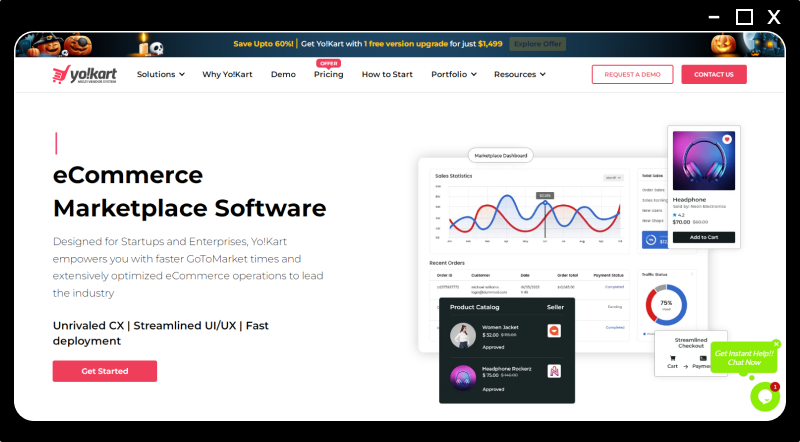
Yo!Kart stands out as a purpose-built, self-hosted B2B and multi-vendor marketplace software designed to help businesses build scalable, secure, and fully customizable B2B ecosystems. It empowers entrepreneurs and enterprises to launch feature-rich marketplaces with complete ownership and zero recurring fees. With full source code ownership and a lifetime license, enterprises and startups gain complete control over customization, hosting, and long-term growth without recurring fees. Hence, it’s an ideal choice for businesses aiming to create a robust, scalable digital marketplace ecosystem.
Key Features:
- Advanced RFQ (Request for Quote) module
- Tier-based pricing and MOQ (Minimum Order Quantity)
- Multi-vendor & multi-storefront management
- Custom buyer groups and catalog restrictions
- Multi-language, multi-currency, and tax management
- Source code ownership with a lifetime license
Best For: Enterprises and startups aiming to launch a B2B marketplace with full customization control and scalability.
Schedule a Free Personalized Demo to see Yo!Kart in Action?
2. Shopify Plus
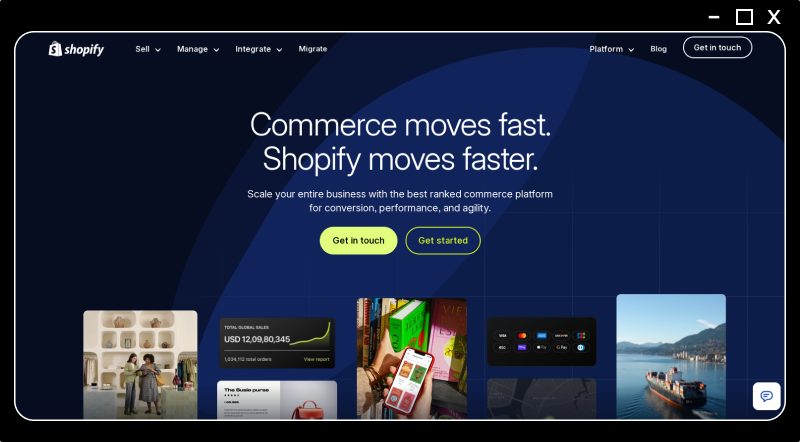
Shopify Plus is the enterprise version of Shopify, designed to handle high transaction volumes and global operations. It’s a fully hosted SaaS solution that simplifies store setup but offers limited backend flexibility for complex B2B workflows. However, recurring payments add to the cost, and compared to other platforms, customization options are more limited.
Key Features:
- Easy setup and intuitive interface
- Multi-channel sales support (Amazon, eBay, social)
- Integration with ERP and CRM tools
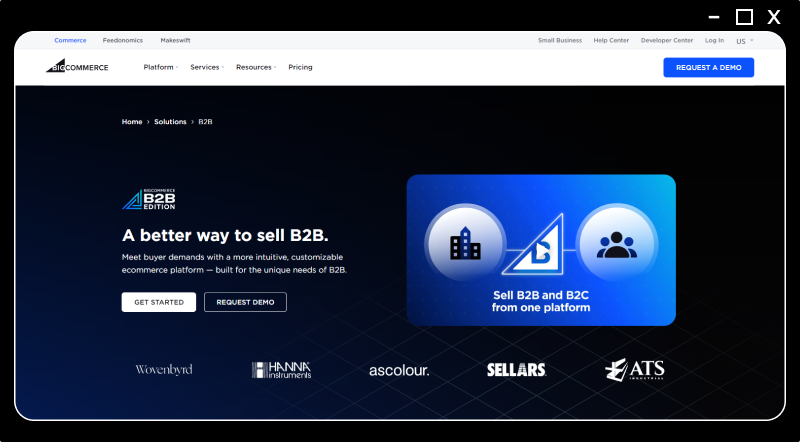
3. BigCommerce B2B Edition
BigCommerce B2B Edition offers a cloud-based eCommerce framework tailored to wholesalers, manufacturers, and distributors. It combines scalability with essential B2B tools such as corporate accounts, quote requests, and custom pricing. Additionally, some advanced B2B features, such as quoting, complex purchase workflows, and more, require third‑party apps, which raises integration complexity and cost.
Key Features:
- Advanced pricing and catalog segmentation
- Corporate buyer management
- Integration with major ERP systems
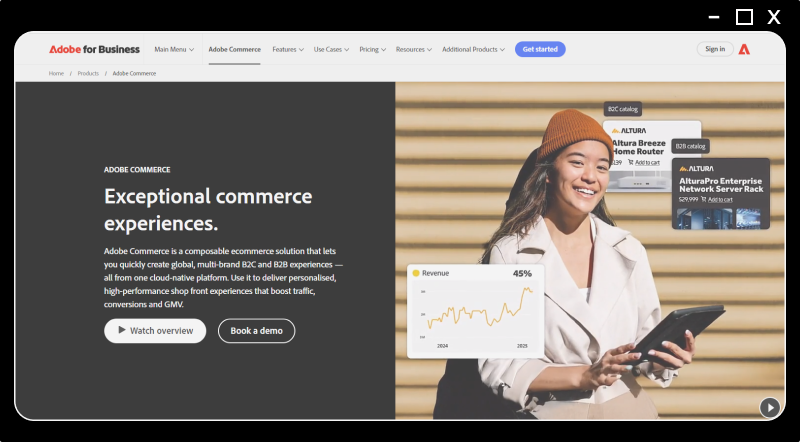
4. Adobe Commerce (Magento)
Formerly Magento, Adobe Commerce is a highly flexible, open-source solution ideal for enterprises needing deep customization and complex workflows. It offers customization through API-driven integrations, allowing businesses to create tailored experiences for corporate clients, manage inventory at scale, and automate B2B processes. However, implementation and maintenance are resource‑intensive, with a high total cost of ownership and steeper technical demands.
Key Features:
- Multi-store and multi-language capabilities
- API-driven integrations
- Advanced pricing and catalog rules
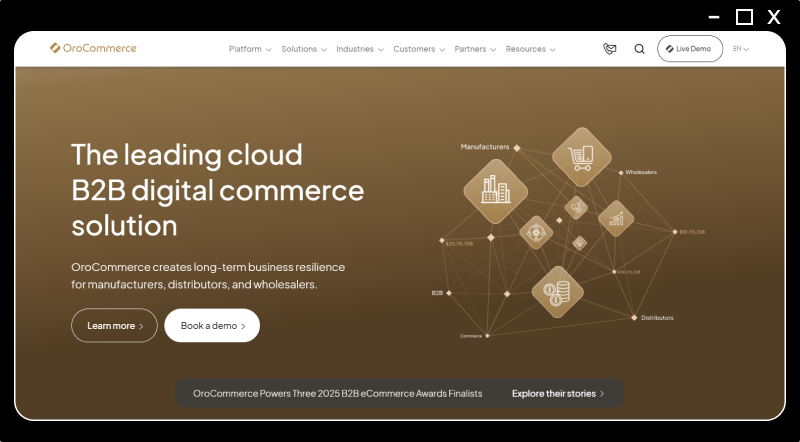
5. OroCommerce
OroCommerce is a B2B-specific open-source platform built for complex enterprise needs. It provides workflow automation, corporate account management, and robust CRM integration. Designed for complex B2B use cases, it has a steep learning curve, longer rollout timelines, and higher infrastructure demands.
Key Features:
- Corporate account hierarchies
- Advanced user roles and access control
- Built-in OroCRM for relationship management
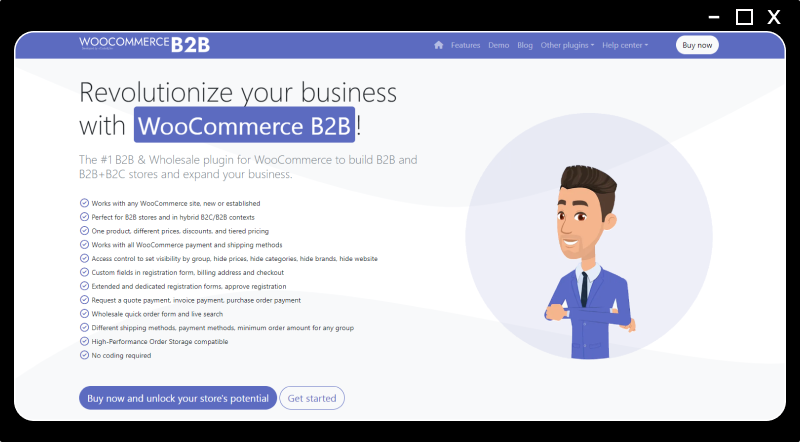
6. WooCommerce B2B
WooCommerce, built on WordPress, can be extended using B2B plugins to handle wholesale sales. It’s cost-effective and provides a straightforward solution for managing smaller-scale digital wholesale operations, but less suited for high-scale B2B marketplaces. Moreover, it requires many plugins for full B2B functionality, which can lead to performance, security, and scalability issues.
Key Features:
- Quick setup with B2B extensions
- Tiered pricing and bulk order management
- Integration with the WordPress ecosystem
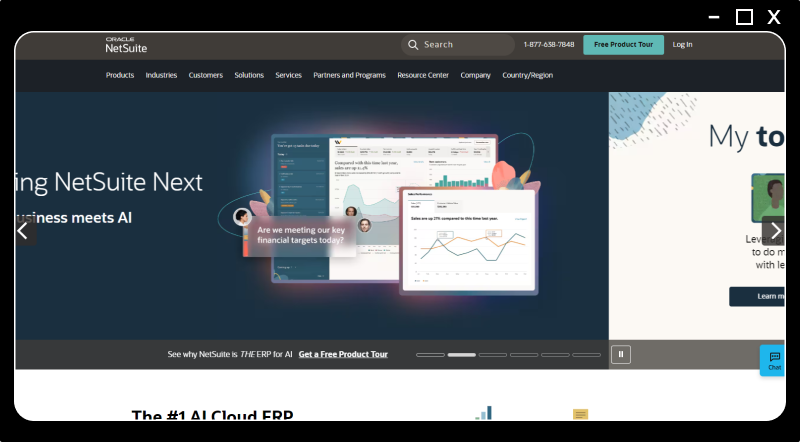
7. NetSuite SuiteCommerce
NetSuite SuiteCommerce, part of Oracle’s NetSuite ERP ecosystem, combines ERP and eCommerce capabilities in a single platform. It offers deep integration between online sales and backend business operations. It manages end-to-end operations, from procurement to fulfillment, while gaining insights into customer behavior and operational performance.
Key Features:
- Unified ERP and eCommerce system
- Real-time inventory and order management
- Support for multiple brands and channels.
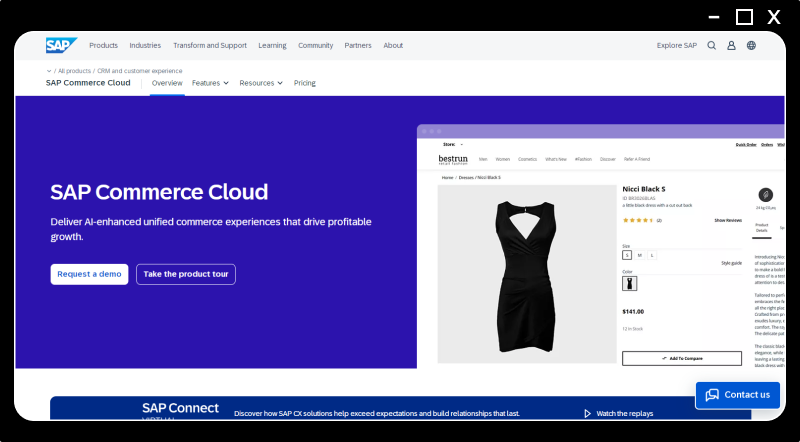
8. SAP Commerce Cloud
SAP Commerce Cloud (formerly Hybris) is a robust enterprise-grade solution known for handling complex B2B operations, procurement workflows, and multinational commerce. It provides centralized product and content management, AI-driven personalization, and advanced pricing capabilities. However, it requires significant technical expertise and resources to implement and maintain.
Key Features:
- Centralized product and content management
- Built-in personalization and AI-driven recommendations
- Advanced integration with SAP ERP and CRM
9. Mirakl
Mirakl is a cloud-based marketplace solution built for enterprises that want to operate third-party B2B or B2C marketplaces.. Ideal for businesses aiming to operate large, multi-vendor digital ecosystems with minimal manual intervention, Mirakl integrates with major ERP and CRM tools. However, it is important to note that setup can be time‑consuming and complex, especially when integrating with existing systems.
Key Features:
- Marketplace orchestration for multiple sellers
- Automated onboarding and vendor payout systems
- High scalability for global operations
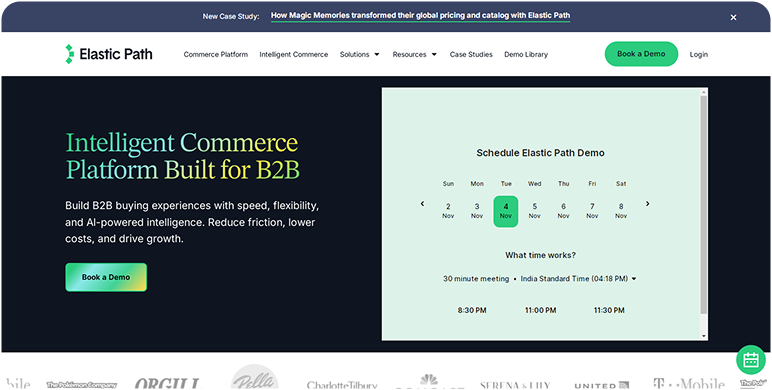
10. Elastic Path
Elastic Path offers a headless commerce platform that decouples the front end from the back end, allowing businesses to create custom, API-driven digital commerce experiences. Its composable architecture supports integration with diverse technologies, allowing businesses to create unique workflows, pricing models, and storefronts. Although its API‑first and headless architecture offers flexibility, but often demands heavy developer involvement and lacks intuitive tools for non‑technical teams.
Key Features:
- Composable commerce architecture
- Headless API integrations
- Freedom to use custom frontend technologies
Comparison: Best B2B eCommerce Platforms
| Platform | Type | Best For | Customization | Recurring Fees | Marketplace Support |
| Yo!Kart | Self-Hosted | B2B Marketplaces | Full | No | Yes |
| Shopify Plus | SaaS | Fast Launch B2B | Limited | Yes | No |
| BigCommerce B2B | SaaS | Mid-sized Wholesalers | Moderate | Yes | Partial |
| Adobe Commerce | Open Source | Enterprises | High | Optional | Add-on |
| OroCommerce | Open Source | Complex B2B Workflows | High | Optional | Add-ons |
| WooCommerce B2B | Plugin-Based | Small Wholesalers | Moderate | Add-ons | Partial |
| NetSuite SuiteCommerce | ERP + Commerce | Large Enterprises | Moderate | Add-ons | Partial |
| SAP Commerce Cloud | Cloud | Global Corporations | High | Yes | Add-on |
| Mirakl | SaaS Marketplace | Enterprise Marketplaces | Limited | Yes | Native |
| Elastic Path | Headless | Custom Enterprise Commerce | High | Optional | Add-on |
Choose a Platform that Fits Your Business Requirements
How to Choose the Right B2B eCommerce Platform
Selecting the right B2B eCommerce platform is a critical decision that defines your marketplace’s long-term scalability, customer experience, and operational efficiency. With so many platforms available and each promising flexibility, speed, or affordability, – it’s important to evaluate your options based on your business model, growth ambitions, and technical needs.
Hence, below are the key factors you should consider before finalizing your B2B eCommerce software:
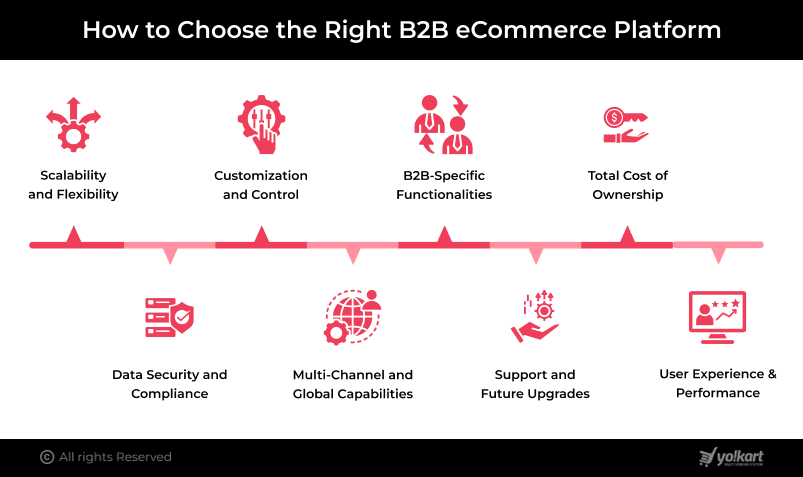
1. Scalability and Flexibility
Your platform should grow with your business. As order volumes increase and vendor networks expand, scalability becomes essential. Choose a system that supports:
- Unlimited vendors and product SKUs
- High-traffic handling without performance lag
- Easy integration with new modules and APIs
Self-hosted platforms like Yo!Kart offers unmatched scalability because it can be customized to meet both current and future business demands, without recurring SaaS limitations.
2. Customization and Control
Every B2B business operates differently. Whether it’s unique pricing structures, custom catalogs, or workflow automation, your platform must adapt to you, not the other way around.
Thus, opt for solutions that:
- Offer access to the source code
- Allow modification of core features and UX
- Support integration with ERP, CRM, and accounting systems
Platforms such as Yo!Kart and Adobe Commerce are ideal if you want full backend and frontend control to build a marketplace aligned with your brand identity and operational goals.
3. B2B-Specific Functionalities
Unlike B2C stores, B2B platforms must accommodate complex buying behaviors such as bulk orders, price negotiation, and tier-based pricing. Hence, it becomes essential to ensure that your platform includes:
- RFQ (Request for Quote) management
- Corporate account hierarchies with multiple buyer roles
- MOQ (Minimum Order Quantity) settings
- Tier-based or customer-specific pricing
- Quote-to-order workflows
These features are non-negotiable for efficient B2B transactions. Yo!Kart, for instance, integrates all these natively to help wholesalers and manufacturers replicate real-world business dynamics online.
4. Total Cost of Ownership (TCO)
While SaaS solutions appear affordable initially, subscription and transaction fees can significantly increase operational expenses over time. Hence, you should evaluate:
- License model (subscription vs. one-time cost)
- Customization and hosting expenses
- Maintenance and upgrade costs
A one-time licensed solution like Yo!Kart ensures predictable costs and long-term ROI, without vendor lock-ins or escalating fees.
5. Data Security and Compliance
In B2B transactions, safeguarding corporate and financial data is non-negotiable. The platform must comply with U.S. data protection and international eCommerce standards, such as:
- PCI-DSS for payment data security
- GDPR and CCPA compliance for data privacy
- Regular security audits and SSL encryption
Self-hosted solutions allow greater control over your data environment, ensuring complete transparency and compliance.
6. Multi-Channel and Global Capabilities
As B2B buyers diversify their procurement habits, your platform should support multi-channel selling and global expansion. Therefore, you must look for a solution that provides:
- Multi-language and multi-currency support
- Localization of content, taxes, and shipping rules
- Seamless API integrations for marketplaces and logistics providers
Yo!Kart simplifies global selling by offering out-of-the-box multilingual and multicurrency capabilities, making it ideal for businesses expanding beyond U.S. borders.
7. Support and Future Upgrades
The best B2B platforms aren’t just about features; they’re about a reliable, long-term partnership. Hence, evaluate the provider’s commitment to:
- Regular updates and version releases
- Dedicated technical support
- Smooth migration and scalability assistance
Yo!Kart’s team offers one year of free technical support and ongoing upgrade options, ensuring your platform evolves with technology and market trends.
8. User Experience (UX) and Performance
B2B buyers now expect the same seamless digital experience as B2C shoppers. Thus, look for platforms that prioritize:
- Mobile responsiveness
- Fast loading speeds
- Streamlined navigation for quick ordering
- Real-time inventory and shipping visibility
A well-optimized B2B UX not only drives repeat purchases but also builds long-term business relationships.
Why Yo!Kart is the Best B2B eCommerce Platform in the USA?
In the highly competitive U.S. B2B eCommerce landscape, businesses need more than just an online store. They need a scalable digital infrastructure that can evolve with market trends, buyer expectations, and operational complexity. This is where Yo!Kart leads the way.
Designed specifically for B2B and multi-vendor marketplaces, Yo!Kart provides a robust foundation for enterprises to digitize wholesale operations, streamline transactions, and deliver seamless buyer-seller experiences, all while maintaining complete control and ownership of the platform.
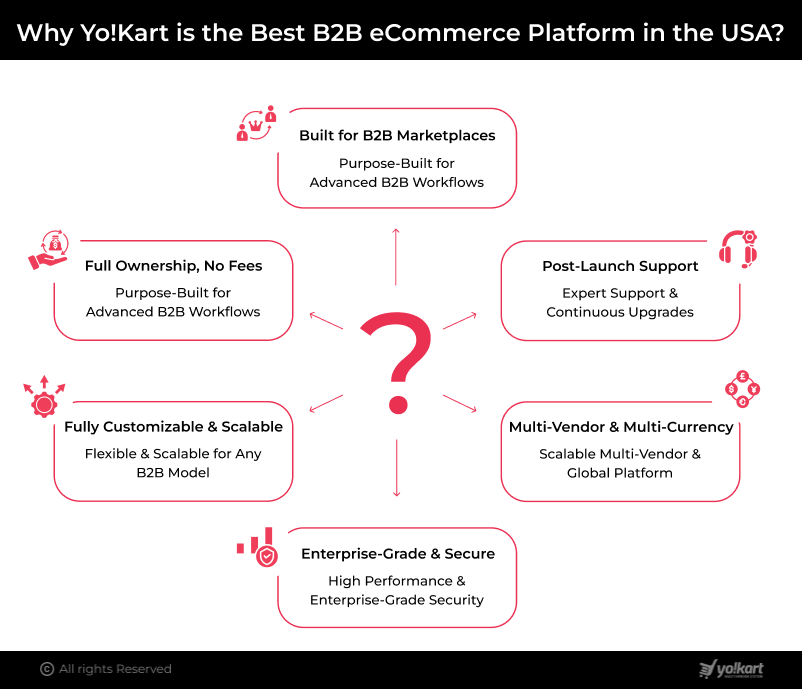
1. Built Exclusively for B2B Marketplaces
Unlike generic eCommerce systems that need heavy plugin dependencies, Yo!Kart is purpose-engineered for B2B transactions. Its core architecture supports complex features like:
- RFQ (Request for Quote) workflows for negotiated pricing
- Tier-based and volume-based pricing to encourage bulk buying
- Custom buyer groups and catalog visibility rules
- MOQ (Minimum Order Quantity) settings for wholesalers
- Corporate account management with multiple user roles
These features replicate real-world wholesale processes, enabling businesses to run digital operations exactly as they do offline, but faster and smarter.
2. 100% Ownership with No Recurring Fees
Most SaaS-based platforms charge ongoing monthly or transaction fees that eat into margins. In contrast, Yo!Kart follows a one-time licensing model, ensuring complete ownership of your B2B platform, which not only reduces long-term operational costs but also gives you the freedom to:
- Customize the system without SaaS restrictions
- Host it on your own server for enhanced data control
- Avoid vendor lock-ins and third-party dependencies
For U.S. enterprises focusing on data sovereignty and cost efficiency, Yo!Kart provides a future-proof solution.
3. Deep Customization and Scalability
B2B business models vary by industry; what works for a manufacturing marketplace may not fit a raw material supplier. Furthermoer, Yo!Kart’s open architecture allows extensive customization across workflows, design, and integrations.
Whether you want to integrate an ERP, build a private procurement network, or launch a multi-seller marketplace, Yo!Kart scales effortlessly with your vision.
4. Enterprise-Grade Performance and Security
Built on a strong technology stack, Yo!Kart ensures high performance, fast load times, and PCI-DSS-compliant transactions. Additionally, security layers include:
- SSL certification and data encryption
- Secure payment gateways
- Multi-level user authentication
- Regular code audits and system updates
For U.S. businesses handling sensitive client data and bulk transactions, Yo!Kart delivers enterprise-grade reliability.
5. Seamless Multi-Vendor & Multi-Currency Capabilities
Yo!Kart empowers you to onboard unlimited vendors while maintaining centralized administrative control. Each vendor can manage their own storefront, inventory, and pricing.
With multi-language and multi-currency support, it’s ideal for businesses aiming to serve both domestic and international buyers, all from one powerful B2B platform.
6. Dedicated Post-Launch Support
Yo!Kart is backed by a team of expert developers and B2B consultants who provide one year of free technical support and regular upgrades. This ensures your marketplace continues to evolve with emerging technologies and business needs.
Build Your Scalable B2B eCommerce Platform With Yo!Kart
Conclusion
The U.S. B2B eCommerce ecosystem is booming, creating vast opportunities for digital-first enterprises. Whether you’re looking to digitize wholesale operations or launch a large-scale B2B marketplace, the foundation of your success lies in the platform you choose.
While SaaS tools like Shopify Plus or BigCommerce offer quick setups, they fall short in ownership, flexibility, and long-term scalability.
For businesses that prioritize control, customization, and profitability, Yo!Kart is undoubtedly the best B2B eCommerce platform in the USA, empowering them to launch their marketplace with confidence and grow without limitations.
Frequently Asked Questions (FAQs)
Q 1. What is the best B2B eCommerce platform for startups in the USA?
Ans. Yo!Kart is the best choice for startups or entrepreneurs looking to build a B2B eCommerce platform. With its affordable pricing, full ownership, and built-in B2B modules, it is helping new businesses launch and grow efficiently.
Q 2. How much does it cost to build a B2B marketplace with Yo!Kart?Leverage the Best B2B eCommerce Software to Build Your
Ans. The cost to build a B2B marketplace with Yo!Kart depends on the addition and customization. However, Yo!Kart offers packages starting from around $999, making it cost-efficient for long-term operations with no recurring subscription or transaction fees.
Q 3. Can I customize my Yo!Kart marketplace?
Ans. Yes, Yo!Kart supports customization and offers complete access to the source code, which enables you to customize your marketplace as per your business model. Hence, you can customize design, workflows, integrations, and more.
Q 4. Does Yo!Kart support international B2B operations?
Ans. Yes, Yo!Kart supports international B2B operations. It supports multiple languages, currencies, and tax configurations, which makes it an ideal choice for businesses expanding across the globe.
Q 5. Is Yo!Kart suitable for enterprises?
Ans. Yes, Yo!Kart is suitable for enterprise-level businesses. Its modular architecture and enterprise-grade security make Yo!Kart a reliable solution for both growing SMBs and large enterprises.
The post Top 10 B2B eCommerce Platforms in the USA appeared first on YoKart Blog.
]]>The post How to Build a B2B Marketplace like Abraa appeared first on YoKart Blog.
]]>According to a report by Grand View Research, the global B2B eCommerce market size is projected to reach $57,578.97 billion by 2030, growing at a CAGR of 18.2% from 2024 to 2030. Moreover, the success of Middle East and North Africa (MENA) powerhouses like Abraa has clearly demonstrated the immense potential of connecting global suppliers, manufacturers, and buyers on a single, feature-rich B2B platform. If you’re looking to capitalize on this trillion-dollar industry, understanding the blueprint for creating a B2B wholesale marketplace, with the right B2B Marketplace Solution, is the first critical step.
This blog delves into the core mechanics of Abraa’s business model, winning formula, outlines the essential features, and provides a comprehensive roadmap for development, ultimately recommending the most strategic approach to launch your own dominant B2B Marketplace Platform.
Table of Contents
- What is a B2B Marketplace?
- Key Difference Between a B2B and B2C eCommerce Marketplace
- Understanding Abraa: A Model of Regional Dominance
- Must-Have Features in a B2B Marketplace Like Abraa
- Steps to Build a B2B Wholesale Marketplace
- The Best Approach to Build B2B Marketplace : Choose Self-Hosted Solution
- Conclusion
- FAQs
What is a B2B Marketplace?
A B2B Marketplace is an online platform that is exclusively designed for commercial transactions between businesses. Unlike a B2C (Business-to-Consumer) marketplace, which focuses on small, individual purchases, a B2B platform facilitates:
- Bulk Ordering: The core function revolves around large minimum order quantities (MOQs) and high-value transactions.
- Wholesale Pricing: Pricing is often tiered, volume-based, and personalized for specific business accounts. Prices may even be hidden and only visible to registered, verified business buyers.
- Complex Logistics: It handles more intricate shipping, payment, and logistics processes, often involving freight, customs, and international compliance.
- Long-Term Relationships: The emphasis is on building long-term, repeatable contracts and supply chain partnerships, rather than one-time sales.
In essence, a B2B wholesale marketplace acts as a digital procurement hub, replacing traditional trade shows and manual sales processes with an efficient, transparent, and scalable online environment.
Turn Your B2B Wholesale Marketplace Vision into Reality
Key Difference Between a B2B and B2C eCommerce Marketplace
While both B2B and B2C marketplaces are digital platforms for buying and selling, they fundamentally differ in their target audience, transactional nature, and operational requirements. Understanding these distinctions is crucial for designing a successful B2B platform.
| Feature | B2B (Business-to-Business) Marketplace | B2C (Business-to-Consumer) Marketplace |
| Buyer Profile | Professional procurement managers, resellers, or manufacturers. | Individual end-consumers. |
| Order Volume | High-volume/Bulk orders with Minimum Order Quantities (MOQs). | Low-volume, typically single-item or small-batch purchases. |
| Pricing | Negotiated, tiered, and customized (often hidden or accessible only via RFQ). | Fixed, visible retail prices with occasional seasonal discounts. |
| Payment Terms | Complex options including Net 30/60, bank transfers, and Letters of Credit (LCs). | Immediate payment via credit /debit card, digital wallet, or COD. |
| Sales Cycle | Longer, more formal cycle involving quotes, contracts, and approvals. | Short, instant transaction cycle. |
| Logistics | Complex, requiring freight, customs, and a coordinated supply chain delivery. | Simple parcel shipping to residential addresses. |
Understanding Abraa: A Model of Regional Dominance
Founded in Dubai, Abraa has established itself as a leading B2B wholesale marketplace connecting businesses across the MENA region and beyond. Its success is rooted in a clear and compelling business model that specifically addresses the unique challenges of cross-border wholesale trade.
Abraa’s Business Model: The Multi-Sided Platform
Abraa operates on a multi-vendor, commission-based marketplace model with a strong focus on trust and logistics facilitation.
1. Connecting the Ecosystem: It attracts and rigorously evaluates a diverse range of suppliers (manufacturers, wholesalers, distributors) and buyers (retailers, resellers, other businesses) from various industries, including electronics, machinery, and industrial equipment.
2. Monetization through Commission: The primary revenue stream is a commission charged to the seller on every successful transaction conducted through the platform. This commission can vary based on the product category and the vendor’s subscription tier.
3. Value-Added Services (The Trust Factor): Crucially, Abraa adds significant value by mitigating the risks associated with international trade. These services often include:
- Secure Payment Options: Offering payment protection to buyers until goods are received and inspected.
- Product Inspection: Providing third-party services to ensure product quality matches the description before final payment is released.
- Logistics Facilitation: Assisting with complex cross-border shipping, customs clearance, and freight forwarding.
- Premium Subscriptions: Offering premium tiers to suppliers for enhanced visibility, lead generation tools, and higher sales volume.
By integrating these services, Abraa moves beyond being a mere directory to become a trusted, end-to-end B2B trading partner.
Ready to Replicate a Wholesale Marketplace Like Abraa
Must-Have Features in a B2B Marketplace Like Abraa
To replicate the success of a top-tier platform, your B2B Marketplace must have a specialized suite of features that cater to the distinct demands of wholesale commerce. Let’s explore some of the features:
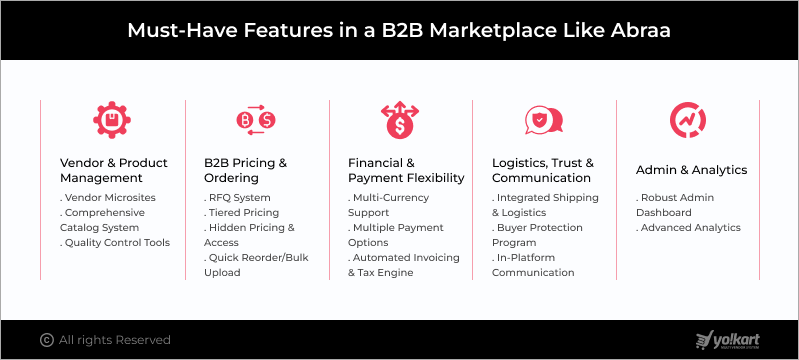
1. Advanced Vendor & Product Management
- Vendor Microsites: Dedicated, customizable storefronts for each supplier to establish their brand and showcase their catalog.
- Comprehensive Catalog System: A powerful backend that allows for rich product descriptions, multi-tiered categories, product variations, and the ability to upload bulk product data (crucial for wholesalers).
- Quality Control Tools: Features for the admin to assess, approve, or reject vendor registrations and product listings to maintain the marketplace’s quality and trust.
2. Specialized B2B Pricing & Ordering
- Request for Quotation (RFQ) System: A mandatory feature allowing buyers to request custom pricing, terms, and MOQs from sellers, facilitating the negotiation that defines B2B trade.
- Tiered Pricing: The ability for vendors to set different price tiers based on order volume (e.g., 100 units at $5 each, 500 units at $4.50 each).
- Hidden Pricing & Controlled Access: Restricting product pricing and catalog visibility only to registered and verified business buyers.
- Quick Reorder/Bulk Upload: Enabling buyers to easily upload a list of SKUs and quantities for quick, large-scale reorders.
3. Financial & Payment Flexibility
- Multi-Currency Support: Essential for global trade, allowing transactions in different currencies with real-time conversion display.
- Multiple Payment Options: Support for traditional methods like wire transfers and Letters of Credit (LCs), alongside modern options like corporate credit cards and secure payment escrow services.
- Automated Invoicing & Tax Engine: Seamless generation of tax-compliant invoices, factoring in multi-tier taxation, VAT, and international tax laws.
4. Logistics, Trust & Communication
- Integrated Shipping & Logistics: Seamless API integrations with major shipping carriers and freight forwarders, allowing for real-time rate calculation and shipment tracking for bulk orders.
- Buyer Protection Program: An escrow-like function that holds payments until the buyer confirms satisfactory delivery, mirroring Abraa’s trust mechanism.
- In-Platform Communication: Built-in messaging or chat functionality to facilitate direct, secure negotiation between buyers and sellers regarding quotes and terms.
5. Admin & Analytics
- Robust Admin Dashboard: A single, centralized control panel for managing vendors, commissions, payments, disputes, and marketplace settings.
- Advanced Analytics: Real-time reporting on key B2B metrics, such as Gross Merchandise Value (GMV), vendor performance, buyer behavior, and conversion rates for RFQs.
Ready to Build a Feature-Rich Wholesale Marketplace
Steps to Build a B2B Wholesale Marketplace
The process to build a B2B marketplace and bring a complex B2B marketplace platform to life can be broken down into five critical phases.
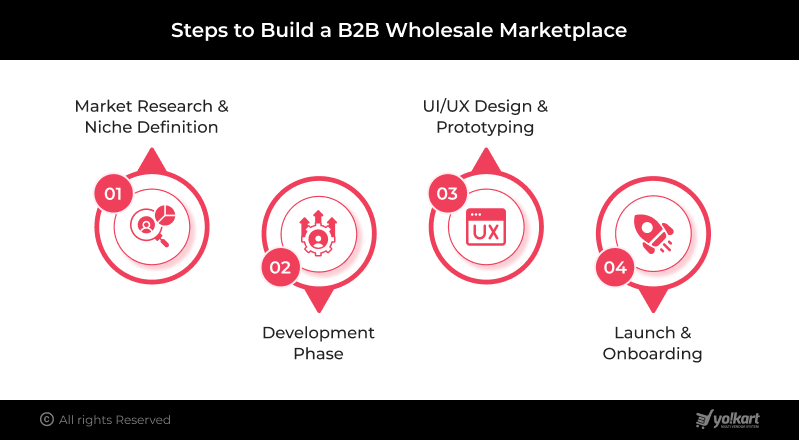
Step 1: Market Research and Niche Definition
Before building your B2B marketplace, you must conduct market research and define your Unique Value Proposition (UVP). Effective market research combines qualitative approaches like in-depth interviews and focus groups with quantitative methods such as surveys and data analytics to gather actionable insights on industry trends, customer pain points, and buying behaviors. This comprehensive understanding enables you to identify:
- Target Niche: First thing that you must decide is on what specific industry (e.g., industrial chemicals, specialized auto parts, MENA-region textiles) you will focus on? Moreover, defining a niche often leads to faster early traction.
- Business Model: After deciding on the niche, confirm your business model/ monetization strategy, which can include various income generation channels such as commission, subscription, listing fees, in-app promotion, or much more.
- User Personas: Define the needs of your ideal buyer (procurement manager) and seller (wholesaler/manufacturer) to ensure your platform effectively addresses their unique requirements. Additionally, understanding these personas enables you to design tailored features and user experiences that facilitate seamless interactions, support negotiation workflows, and provide robust account management.
Step 2: Platform Strategy and Technology Selection (Development Phase)
In this rapidly evolving digital landscape, selecting the right approach to build your wholesale platform is the most critical decision and the core of your investment. This will not only determine the cost but operational efficiency of your platform. You can develop your B2B Marketplace platform using various approaches; however, let’s explore three popular ones below:
A. Custom Development (Building from Scratch)
- This approach includes hiring an in-house team or a software development agency to write every line of code specifically for your platform from the ground up.
- Pros: Complete control over functionality, design, and scalability; perfect alignment with unique business logic.
- Cons: Highest cost (typically $150,000+), longest development timeline (6-12+ months), and high risk (the platform must be maintained and updated exclusively by you), requires a technical team to fix unexpected technical issues and bugs.
- Best For: Companies with massive, complex needs, unlimited budgets, and a long timeline (e.g., an established industry giant).
B. Ready-made SaaS (Software-as-a-Service)
This approach allows you to rent a pre-built, cloud-hosted platform (like Shopify Plus with marketplace add-ons). However, you need to pay a monthly subscription fee.
- Pros: Low upfront cost, fastest time-to-market (weeks), zero maintenance responsibility.
- Cons: Limited customization; you don’t own the source code, which creates vendor lock-in; recurring subscription fees can become very expensive as you scale.
- Best For: Startups testing an unproven concept with a minimal budget, requiring rapid deployment.
C. Ready-made Self-Hosted Solution (License Purchase)
Leveraging this solution, you can purchase a pre-built, complete B2B Marketplace Solution and install it on your own server. Moreover, you own the software license and the source code.
- Pros: Significant cost savings and fast launch compared to custom development; 100% source code ownership provides full control and deep customization capability; No recurring transaction fees; Market-tested solution.
- Cons: Requires your own hosting server.
- Best For: Ambitious, scalable ventures like Abraa, which require full ownership, deep customization, and high-security standards without the long-term burden of subscription fees.
Step 3: UI/UX Design and Prototyping
Effective and intuitive UI/UX design is crucial to user adoption and satisfaction in B2B marketplaces. Moreover, designing intuitive, role-based interfaces tailored for Admins, Vendors, and Buyers ensures that all user groups can navigate and operate the platform efficiently. Additionally, focus on:
- Clear product filtering and advanced search by specifications.
- An efficient, friction-free RFQ and negotiation interface.
- User-friendly dashboards for managing inventory, orders, and finances.
Step 4: Launch and Ecosystem Onboarding
A marketplace is useless without participants. Thus, post-development, the focus shifts to attracting and onboarding both vendors and buyers to create real value. Thus, you must:
- Seed the Supply: Focus aggressively on onboarding a high-quality initial cohort of vendors and a comprehensive product catalog.
- Attract the Demand: Use targeted marketing (SEO, PPC, trade show presence) to bring in the first batch of verified business buyers.
- Iterate: Launch the Minimum Viable Product (MVP), gather user feedback, and continuously update the platform based on real-world usage.
The Best Approach to Build B2B Marketplace : Choose Self-Hosted Solution
For a scalable, professional, and high-control B2B Marketplace Platform like Abraa, the Ready-made Self-Hosted Solution provides the optimal balance of speed, cost-effectiveness, and ultimate control. This approach leverages existing, industry-tested software while granting you the freedom to customize and scale infinitely.
A leading example in this category is Yo!Kart. It is a multi-vendor ecommerce marketplace solution that is highly customizable and scalable for businesses, including retail, B2B, digital products, liquor, and more. It supports multi-currency and multilingual functionalities, backed by an advanced product catalog and a powerful search system to enhance user experience. Further, this robust solution includes real-time analytics, smart product recommendations, and over 20 pre-integrated payment gateways.
Why Yo!Kart is a Preferred Self-Hosted Solution:
1. Lifetime Ownership & Source Code: With a one-time purchase, you receive a lifetime license and 100% ownership of the source code. This eliminates recurring subscription fees and the threat of vendor lock-in, giving you a valuable, proprietary asset.
2. Built for B2B: Unlike many platforms adapted from B2C models, Yo!Kart is engineered from the ground up to support critical B2B features like the Request for Quotation (RFQ) module, tiered pricing, bulk ordering, and separate buyer/seller dashboards.
3. High Scalability: It is architected to handle large product catalogs, high traffic volumes, and a growing number of vendors and transactions, a non-negotiable requirement for an international wholesale marketplace.
4. Complete Customization: Full source code access means that while you launch quickly with a ready-to-use solution, you retain the ability to fully tailor every feature, design element, and integration to match your unique industry requirements, effectively bridging the gap between a quick-launch solution and a fully custom build.
By choosing a robust, self-hosted B2B Marketplace software like Yo!Kart, you are investing in a future-proof foundation that allows you to focus on the business, onboarding high-value vendors, and attracting verified buyers, rather than reinventing the entire technical wheel.
Schedule a One-on-One Demo Session to Know More About Yo!Kart
Conclusion
Building a successful B2B wholesale marketplace platform akin to Abraa is not merely a technical challenge but a strategic exercise in trust-building, logistics management, and digital transformation. It requires a dedicated focus on the distinct needs of business buyers, particularly in facilitating bulk orders, custom pricing, and secure, cross-border transactions.
By selecting a powerful and flexible B2B Marketplace Solution, ideally a self-hosted platform that provides full source code ownership, you can accelerate your launch, drastically reduce long-term costs, and retain the comprehensive control necessary to scale your platform into a dominant force in the global wholesale economy. The opportunity to digitize the global supply chain is vast, and with the right platform strategy, your B2B marketplace can be the next major hub for commerce.
Frequently Asked Questions (FAQs)
Q 1. What is the main difference between a B2B and a B2C marketplace model?
Ans. The primary difference lies in transaction volume and relationship.
- B2B (Business-to-Business) focuses on large, bulk orders, negotiated pricing (often via RFQ), high order value, and long-term contractual relationships. Moreover, B2B platforms require specialized features for tax, logistics, and account-based management.
- B2C (Business-to-Consumer) focuses on small, individual orders, fixed retail pricing, and single-transaction customer relationships.
Q 2. What is “vendor lock-in” in the context of Whitelabel B2B Marketplace Software?
Ans. Vendor lock-in occurs with SaaS (Software-as-a-Service) solutions. It means you are entirely dependent on the software provider and their subscription model. You do not own the code, and if you stop paying the monthly fee or the provider goes out of business, your marketplace ceases to exist. On the other hand, a self-hosted solution eliminates this risk by giving you 100% source code ownership.
Q 3. Is the Request for Quotation (RFQ) feature essential for a wholesale marketplace?
Ans. Yes, the RFQ system is arguably the most essential B2B feature. Wholesale transactions are rarely fixed-price; they involve negotiation based on quantity, delivery terms, and custom specifications. An RFQ system provides the digital framework for buyers to request custom prices and for vendors to submit tailored bids, formalizing the core negotiation process of B2B trade.
Q 4. How much does it cost to build a B2B marketplace like Abraa?
Ans. Costs vary significantly based on the development approach:
- Custom Development: $50,000 to $100,000+ with ongoing maintenance.
- Ready-made SaaS: Low upfront cost (e.g., $500-$2,000/month) but high recurring costs that scale with your business volume and include transaction fees. Moreover, it offers limited customization and charges an additional fee for advanced feature integration.
- Self-Hosted Solution (e.g., Yo!Kart): A one-time license purchase ranging from 999 USD to 6499 USD, offering a strong feature set with full ownership. This is often the most cost-effective path for high-growth ventures.
Explore the packages offered by Yo!Kart
Q 5. What are the key revenue streams for a B2B wholesale marketplace?
Ans. The primary revenue streams typically include:
1. Commission: A percentage charged on every successful seller transaction.
2. Subscription/Membership Fees: Charging sellers (and sometimes buyers) a monthly/annual fee for premium tools, higher visibility, or access to the platform.
3. Advertising/Featured Listings: Allowing vendors to pay for prime product placements or banner ads on the site.
4. Value-Added Services: Charging for services like logistics coordination, payment protection (escrow), and third-party product inspection.
The post How to Build a B2B Marketplace like Abraa appeared first on YoKart Blog.
]]>The post How to Build a B2B eCommerce Marketplace Like Grainger appeared first on YoKart Blog.
]]>Building a platform that can compete in this space is not just about creating an online store. It’s about architecting a robust ecosystem that caters to the nuanced needs of industrial buyers and suppliers and is integrated with advanced features such as AI-powered search, predictive inventory, and seamless ERP integration. Moreover, success in this market demands deep insight into buyer behavior, supplier management, and industrial procurement workflows.
Furthermore, this blog will provide you with the blueprint for developing a successful B2B industrial marketplace, exploring everything from understanding the core business model to selecting the right B2B marketplace software and executing a flawless development strategy.
Table of Contents
- What is a B2B Industrial eCommerce Marketplace?
- About Grainger: Its Business Model
- Top Marketplaces Like Grainger
- Must-Have Features in a B2B eCommerce Marketplace
- Steps to Build a B2B Industrial eCommerce Marketplace
- Yo!Kart: Best B2B Marketplace Software to Build a Marketplace Like Grainger
- Conclusion
What is a B2B Industrial eCommerce Marketplace?
A B2B (Business-to-Business) industrial eCommerce marketplace is a specialized online platform where multiple businesses (vendors) sell industrial goods, equipment, MRO supplies, components, and raw materials directly to other businesses (buyers). Unlike a single-vendor eCommerce site, the marketplace acts as an intermediary, facilitating transactions, managing logistics, and ensuring quality control across a vast catalog of diverse products.
The “industrial” aspect highlights the platform’s focus on goods used in production, manufacturing, construction, and operational maintenance, items that are often complex, require high-volume transactions, involve precise specifications, and demand rigorous compliance. Key characteristics of an industrial eCommerce marketplace include:
- Multi-Vendor Model: Hosts numerous independent sellers.
- Targeted Inventory: Focuses on MRO, PPE (Personal Protective Equipment), tools, electrical components, fasteners, hydraulics, and general plant upkeep.
- Complex Transactions: Handles features like bulk pricing, Request for Quotation (RFQ), contractual pricing, and integration with Enterprise Resource Planning (ERP) systems.
- High-Touch Service: Requires robust support for technical product specifications, compliance, and complex shipping logistics (e.g., hazardous materials).
This structure offers immense benefits, as buyers gain a single source for a vast range of products, consolidating procurement, and vendors access a broader market without the overhead of building their own high-traffic digital infrastructure.
About Grainger: Its Business Model
Any aspiring industrial marketplace must first study the undisputed heavyweight champion: W.W. Grainger, Inc.. Grainger’s business model is a masterclass in industrial distribution. Originally and primarily, Grainger operated as a single-vendor distributor, but now its current operation is a hybrid of a traditional distributor and an emerging marketplace.
Grainger purchases inventory from manufacturers, stores it in a massive network of distribution centers and branches, and then sells it directly to businesses. This model relies on:
- Massive Inventory & Reach: Maintaining a stock of millions of SKUs (Stock Keeping Units), ensuring product availability for immediate fulfillment.
- Logistical Excellence: Owning and controlling the end-to-end supply chain, ensuring fast, reliable delivery, often same-day or next-day.
- Customer Relationships: Providing expert technical support, sales, and account management to large institutional and industrial clients.
The Shift to a Marketplace Hybrid
In recent years, Grainger has moved toward a marketplace-like structure, particularly through its digital properties. While their core business remains distribution, they have started to strategically integrate third-party vendors and drop-ship programs to:
- Expand the “Long Tail”: Offer a wider selection of specialized or less frequently requested items that don’t warrant stocking in their own distribution centers.
- Increase Capital Efficiency: Reduce the need to hold inventory for every possible item, shifting that burden to the third-party seller.
- Maintain Dominance: Ensure that, regardless of the buyer’s need, Grainger’s site is the first and final destination.
The key takeaway from the Grainger model is the absolute prioritization of reliability, availability, and customer trust. Industrial buyers cannot afford downtime; they need the right part, right now, and Grainger delivers on that promise, whether the product is sourced directly or through a verified partner.
Top Marketplaces Like Grainger
The success of the Grainger model has inspired numerous competitors and innovators in the industrial B2B space, each with a slightly different focus or geographical strength.
| Marketplace Name | Primary Focus | Key Differentiator |
| Amazon Business | General B2B/MRO/Office | Global reachIntegration with consumer experienceVast product depth. |
| McMaster-Carr | Industrial, MRO, Tools | Unmatched product detailExcellent logisticsHighly reliable catalog. |
| Alibaba (1688/International) | Manufacturing/Raw Materials/Global Sourcing | Connects buyers directly with manufacturersFocus on bulk and custom sourcing. |
| Global Sources | Electronics, Components, Fashion | Focus on cross-border tradeConnects Asian suppliers with international buyers. |
| Zoro (Grainger Subsidiary) | MRO/Small Business | A digital-first, low-touch modelOffers competitive pricing on many Grainger items. |
| MSC Industrial Supply Co. | MRO and Metalworking | Strong focus on high-value itemsMetalworking toolsSupply chain solutions. |
The lesson from these competitors is that specialization matters. A new marketplace cannot simply mimic Grainger’s expanse. Hence, it must find a niche, perhaps focusing exclusively on sustainable industrial materials, heavy equipment parts, or a specific geographic region, and dominate that segment by providing unparalleled service and inventory depth.
Launch a Multi-Vendor B2B Marketplaces to Leverage this Proliferating Industry
Further, let’s explore some of the must-have features of a B2B eCommerce marketplace.
Must-Have Features in a B2B eCommerce Marketplace
Building a B2B ecommerce platform for industrial buyers requires a feature set far more robust than a standard consumer eCommerce site. The architecture must support complexity, scale, and compliance. Let’s have a look at some of the must-have features that you should incorporate in your B2B eCommerce marketplace:
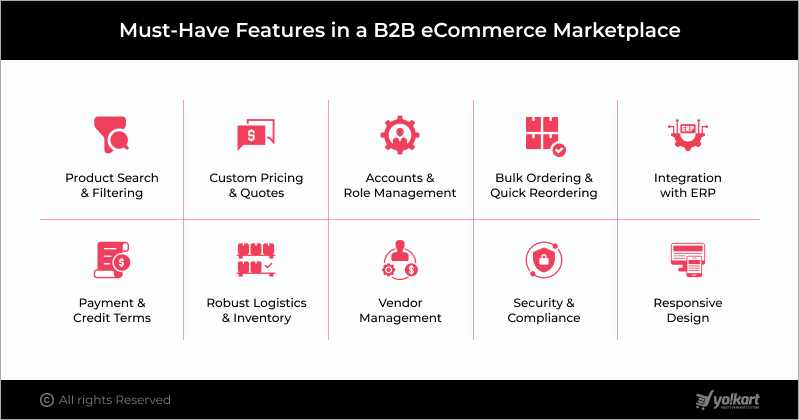
1. Advanced Product Search & Filtering
- Enables users to filter the products based on specifications such as size, material, brand, and compatibility standards.
- SKU-level search functionality allows precise sourcing of industrial components.
- Category-based navigation for an organized browsing experience across diverse product catalogs.
2. Custom Pricing and Quotes
- Offer dynamic tiered pricing based on volume, customer segment, or contractual agreements.
- Integrate a Request for Quote (RFQ) functionality for large, specialized, or complex orders.
- Allow in-platform negotiations, quote revisions, and contract management features for seamless transactions.
3. Multi-User Accounts and Role Management
- Support multiple users with different permissions and customizable roles.
- Enable approval workflows for purchase requests.
- Facilitate controlled access, ensuring that decision-makers authorize purchases while maintaining operational agility.
4. Bulk Ordering & Quick Reordering
- Allow easy upload of bulk order CSV files.
- Provide real-time order status updates, ensuring efficient procurement management.
- Offer quick repurchases based on previous purchases, saved favorites, or frequently ordered items.
5. Integration with ERP and Procurement Systems
- Provide robust API access for smooth synchronization of inventory, order processing, and invoicing.
- Support punch-out catalogs integrations for direct purchases through buyer procurement portals.
- Enable seamless communication between the marketplace and enterprise systems for end-to-end digital procurement.
6. Payment and Credit Terms
- Incorporate various payment options such as credit/debit cards, PO, internet banking, and more.
- Offer credit management tools to define limits, manage outstanding balances, and automate invoicing workflows.
- Facilitate transparent financial transactions with automatic tax and discount calculations.
7. Robust Logistics and Inventory Management
- Display real-time stock availability to prevent order delays and backlogs.
- Offer multiple shipping options with tracking.
- Include return, replacement, and warranty claim management to ensure buyer satisfaction.
8. Comprehensive Vendor Management
- Simplify supplier onboarding and verification through a digital guided process.
- Provide performance dashboards and analytics for vendors to monitor sales and service efficiency.
- Allow vendors to manage product listing, update prices, and track fulfillment performance easily.
9. Security and Compliance
- Implement role-based access controls to manage data visibility and operational permissions.
- Ensure data protection and secure payment standards with GDPR and PCI DSS compliance.
- Use encrypted data storage, SSL certificates, and secure payment gateways to safeguard transactions.
10. Mobile-Optimized and Responsive Design
- Deliver a mobile-friendly interface, ensuring accessibility and fast performance on all devices.
- Optimize page layouts and navigation for hassle-free browsing and ordering on smartphones and tablets.
- Enable mobile-requested quotes, one-click reorders, and real-time notifications for enhanced convenience.
A well-developed B2B industrial marketplace blends technological sophistication with buyer-centric functionality to drive operational efficiency and long-term engagement. By integrating the above features, businesses can create a robust ecosystem that streamlines procurement, strengthens supplier collaboration, and scales seamlessly with industry demands.
Build a Feature-rich Industrial eCommerce Marketplace
Next, let’s explore Steps to Build a B2B Industrial eCommerce Marketplace to turn this feature-rich concept into a market-ready digital platform.
Steps to Build a B2B Industrial eCommerce Marketplace
The construction of an industrial marketplace is a multi-faceted process requiring meticulous planning, strategic investment, and technological expertise. However, to make it simple for you, a step-by-step guide is provided below:
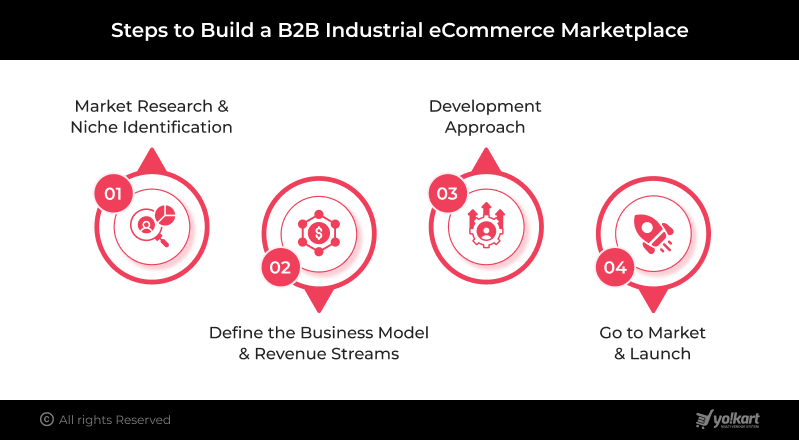
Step 1: Market Research and Niche Identification
The first mistake is trying to be “the next Grainger.” A new marketplace must target a specific, unserved market segment. Moreover, before entering the growing eCommerce landscape, thorough market research is crucial. The following are a few factors that you should cover while doing the market research.
- Identify the Niche: Will your industrial eCommerce marketplace focus on specialized metal components, regional construction supplies, or perhaps only sustainable MRO? It is suggested to focus on one specific niche as it will allow expert service, easier vendor acquisition, and more.
- Validate Demand: Conduct detailed analysis of Google search trends, competitive gaps, and direct surveys of potential B2B buyers in the chosen vertical.
- Feasibility Study: Determine the total addressable market (TAM) and the estimated cost of vendor acquisition, logistics, and technology.
Step 2: Define the Business Model and Revenue Streams
The choice of business model dictates the entire platform’s functionality and monetization strategy. Hence, below are some of the business models and revenue streams based on which your B2B industrial eCommerce marketplace can operate:
- Commission Model: The most common model, where the marketplace takes a percentage cut of every transaction. This should be tiered based on the product’s gross margin, complexity, or competitive landscape.
- Subscription/Listing Fees: Charging vendors a monthly fee to host their storefront, in addition to or instead of commission. This is useful for attracting high-volume, low-margin suppliers.
- Value-Added Services: Offering premium services such as Fulfillment by Marketplace (FBM), advertising/promotional slots, technical support, or data analytics to vendors for an additional fee.
Step 3: Development Approach
This is the make-or-break stage, deciding how the platform will be built. The options range from a custom build to using specialized B2B marketplace software.
A. Custom Development
Custom development means building your B2B marketplace entirely from scratch, tailored precisely to your business model, workflows, and integrations (e.g., a proprietary ERP or complex pricing engine). This route is often taken by enterprises with highly specific or innovative requirements that cannot be met by existing platforms.
Pros:
- Total flexibility to design the platform around your unique business processes.
- Absolute control over features, roadmap, security, and integrations.
- Perfect fit for highly specialized industries or use cases that off-the-shelf solutions cannot address.
Cons:
- Extremely high upfront cost due to the need for a full engineering team (UX/UI, backend, DevOps, QA).
- Very long development cycle, typically 18 to 36 months to build and stabilize a working product.
- High ongoing maintenance with a need to manage bug fixes, updates, server scaling, and infrastructure.
- Significant technical risk, including delays, underestimation of complexity, and team dependency.
- Delayed feedback loop from real users due to the long build time, which increases product-market misfit risk.
B. Ready-Made B2B Marketplace Software
Ready-made marketplace software significantly reduces the time and effort needed to launch a marketplace by providing built-in features like vendor management, multi-vendor checkout, and commission systems. These solutions come in two primary forms:
1. SaaS-Based (Software-as-a-Service)
These are cloud-hosted, subscription-based marketplace solutions managed entirely by the vendor (e.g., Mirakl, Arcadier, Sharetribe Flex, Marketplacer). Ideal for teams wanting a low-code or no-code solution.
Pros:
- Fastest time-to-market (often 3–6 months or less).
- Lower upfront investment, with predictable monthly or annual costs.
- Market-tested features like order routing, vendor onboarding, and commission logic.
Cons:
- Limited customization: You are bound by what the platform allows, often with few deep customization options.
- Vendor lock-in, makes it hard to migrate away if the platform no longer fits your needs.
- Limited control over performance and scalability makes you rely on their infrastructure entirely.
- Restricted access to code, meaning complex features such as B2B workflows, unique pricing rules, and more may be difficult or impossible to implement.
- Dependent on the vendor’s roadmap, which may not align with your growth or industry-specific needs.
2. Self-Hosted Ready-Made Solutions(e.g., Yo!Kart)
These are full-featured, self-hosted marketplace software solutions, which you can install and host on your own servers or cloud infrastructure. Designed for scalability and configurability, they combine the speed of a ready-made solution with the power of code-level access.
Pros:
- Comes with comprehensive B2B marketplace features such as multi-vendor, RFQ, commissions, role-based access, and much more.
- Full control over hosting and infrastructure, thus, you can scale and secure it your way.
- Code access for deeper customization, often included or available at an additional cost.
- Vendor independence: You control the code and platform without being locked into a hosted service.
- Faster launch than custom development, typically within 3–6 months with basic customization.
Con:
- Learning curve for entrepreneurs new to such systems, due to the extensive feature set and administrative complexity.
Suggest Read: List of Best White-Label B2B Marketplace Software
Step 4: Go to Market & Launch
After development, focus on launching with an MVP that includes only essential features like search, RFQ, tiered pricing, and basic vendor management. Moreover, securing a few high-quality vendors early on is crucial to ensure a strong product catalog, as quality matters more than quantity. Use targeted outreach via LinkedIn, trade groups, and email to attract both vendors and buyers. Further, start with simple logistics, preferably vendor-managed shipping, to reduce operational overhead.
Post-launch, it is important to closely track user behavior to identify friction points and collect feedback to make improvements. Gradually roll out advanced features like ERP integrations and vendor analytics. Additionally, ensure ongoing investment in security and compliance to support scalable, long-term growth while maintaining buyer and vendor trust.
Transform Your Industrial Business with a Tailored eCommerce Marketplace
Yo!Kart: Best B2B Marketplace Software to Build a Marketplace Like Grainger
Among the leading dedicated B2B marketplace software solutions, Yo!Kart stands out as a strong candidate for building an industrial marketplace. This white-label, self-hosted, multi-vendor eCommerce software is specifically designed to handle the complexities of industrial B2B marketplaces, similar to giants like Grainger..
Furthermore, with its seamless integration of multiple payment gateways and ERP systems, it ensures smooth inventory, order, and financial management. In addition to it, Yo!Kart offers comprehensive support, including source code ownership and ongoing technical assistance, ensuring long-term success and control for marketplace operators.
Additionally, built-in SEO, marketing capabilities, and mobile optimization empower businesses to create a professional, efficient, and user-friendly marketplace tailored to industrial buyers and suppliers.
Let us discuss some key reasons that make Yo!kart suitable for a Grainger-like venture:
1. Dedicated B2B Functionality: It includes crucial B2B features like separate B2B/B2C storefronts, bulk purchasing, tiered pricing, RFQ management, and multi-user corporate accounts built into the core system, not as an insubstantial third-party extension.
2. Scalability: The architecture is designed to handle a vast number of SKUs and high transaction volumes typical of industrial MRO.
3. Ownership and Customization: Unlike pure SaaS models, Yo!Kart is a one-time purchase with the source code provided, offering complete ownership and the freedom for developers to integrate proprietary systems without ongoing licensing limitations.
4. Vendor Management: It provides comprehensive, dedicated dashboards for vendors to manage their inventory, commissions, tax settings, and shipping profiles independently, easing the burden on the marketplace operator.
By using a platform like Yo!Kart, an entrepreneur, bypasses the two-to-three-year timeline and multi-million-dollar cost of a custom build, allowing them to rapidly establish a minimum viable product (MVP) and focus resources on acquiring reliable vendors and large corporate buyers.
Schedule a Personalized Demo to Explore Yo!Kart
Conclusion
Building a B2B industrial eCommerce marketplace like Grainger is not an overnight task; it demands a clear and focused vision, which goes beyond merely selling products. The goal is to establish the platform as the most reliable, trustworthy, and efficient gateway within the industrial supply chain. However, success requires thorough market research to identify real business needs and pain points, followed by defining a robust, sustainable business model tailored for the industrial sector.Moreover, by prioritizing must-have features like advanced RFQ and ERP integration, and selecting the right B2B marketplace software (such as a solution like Yo!Kart), ambitious entrepreneurs can carve out a dominant niche. The future of industrial commerce is digital, and now is the right time to architect the platform that will power the world’s next generation of manufacturing, maintenance, and operations.
The post How to Build a B2B eCommerce Marketplace Like Grainger appeared first on YoKart Blog.
]]>The post How to Build a Horizontal B2B Marketplace appeared first on YoKart Blog.
]]>The B2B marketplace landscape is evolving rapidly. With businesses seeking efficiency, wider reach, and diversified sourcing options, online B2B marketplaces are emerging as powerful platforms that facilitate online trade.
While vertical B2B marketplaces focus on a single industry, horizontal B2B marketplaces serve multiple sectors under one roof. They help businesses discover new suppliers, diversify their offerings, and explore markets they might not traditionally access.
In this blog, we will explore what a horizontal B2B marketplace is, the benefits it offers, real-world examples, and a step-by-step approach to building one.
Table of Contents
- What is a Horizontal B2B Marketplace?
- Examples of Horizontal B2B Marketplace
- Benefits of Launching a Horizontal B2B Marketplace
- Steps to Build a Horizontal B2B Marketplace
- Different Approaches to Build a Horizontal B2B Marketplace
- Choosing the Right Approach
- Cost to Build a Horizontal B2B Marketplace
- Conclusion
- FAQs
What is a Horizontal B2B Marketplace?
A horizontal B2B marketplace is a platform that connects buyers and sellers across multiple industries rather than focusing on a specific niche. Unlike vertical marketplaces that cater to particular sectors—such as electronics, apparel, or industrial goods—horizontal marketplaces offer a broad range of products and services spanning different categories. It can serve as an everything marketplace like Amazon, where sellers sell products from diverse industries and on the other hand, buyers can buy products from different categories on a single platform.
Key characteristics include:
- Cross-industry product catalog: Businesses from multiple sectors can buy and sell diverse products.
- Multi-vendor support: Allows multiple sellers from diverse industries to list and sell their products on the marketplace.
- Dynamic pricing: Supports bulk orders, special deals, and B2B-specific pricing models.
- Integrated payment and logistics systems: Ensures smooth and secure transactions via third-party integrations.
- Advanced search and filtering: Helps buyers find products efficiently across industries.
Horizontal marketplaces create ecosystems where businesses from different sectors can interact, collaborate, and grow.
Examples of Horizontal B2B Marketplace
Horizontal B2B marketplaces are not just a concept. Several global B2B marketplace giants fall under this marketplace type and are thriving in the eCommerce industry. These top B2B horizontal marketplaces are serving exceptionally and, of course, leading the industry for years.
1. Alibaba: One of the most prominent examples of a B2B multi-vendor marketplace that connects global businesses and enables them to trade products across diverse industries.
2. Amazon Business: Amazon Business serves around 8 million buyers and sellers across the industry. The main product categories include: Industrial & scientific supplies, office supplies, healthcare & lab supplies, facility maintenance, professional services, IT & electronics. Amazon Business carries a broad “business-grade” selection and has added more industrial/medical items in recent years.
3. eWorldTrade: It is another popular example of a B2B horizontal marketplace that enables multi-category B2B listings. These categories include agriculture and food, apparel, industrial machinery, electronics, consumer goods, and more.
4. Global Sources: Global Sources is also a prominent player in the B2B multi-vendor marketplace category. It connects a large number of verified suppliers with buyers selling products across diverse industries. Electronics, home and gift products, fashion and textiles, auto parts, and medical are a few categories that Global Sources serves. However, the marketplace is primarily known for offering electronics.
Benefits of Launching a Horizontal B2B Marketplace
Launching a horizontal B2B marketplace offers numerous advantages for businesses, investors, and vendors alike. By catering to multiple industries, these platforms create opportunities that go beyond the limitations of traditional B2B operations. Here’s a detailed look at the key benefits:
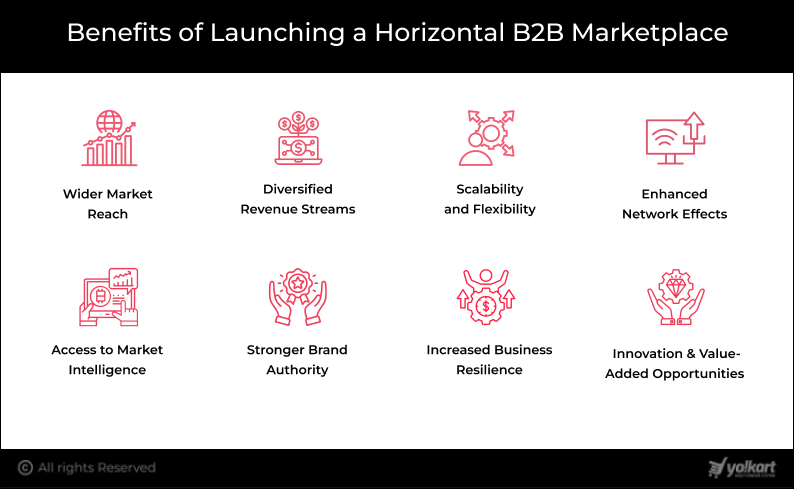
1. Wider Market Reach
Horizontal marketplaces allow businesses to connect with clients and suppliers across multiple industries. This broader reach not only increases visibility but also creates opportunities for cross-industry collaborations, partnerships, and trade that would be difficult to achieve in a single niche.
2. Diversified Revenue Streams
Serving multiple industries means revenue isn’t dependent on a single source. A horizontal marketplace can earn through transaction commissions, subscription fees, listing charges, premium services, and advertising across a diverse set of verticals. This diversification reduces financial risk and ensures sustainable growth.
3. Scalability and Flexibility
Horizontal marketplaces are inherently scalable. Businesses can add new categories, onboard vendors from new industries, and introduce innovative services without overhauling the platform. This flexibility allows the marketplace to adapt to market trends and evolving buyer needs.
4. Enhanced Network Effects
As more vendors join the platform across industries, the value of the marketplace increases for buyers. Similarly, a larger buyer base attracts more sellers. These network effects create a self-sustaining ecosystem where growth accelerates naturally over time.
5. Access to Market Intelligence
Operating across multiple sectors provides valuable insights into industry trends, buyer behavior, and supply-demand patterns. This intelligence can be utilized when making strategic decisions, help identify emerging opportunities, and give your marketplace a competitive edge over operating a vertical marketplace.
6. Stronger Brand Authority
Being a one-stop destination for B2B trade positions your marketplace as a market leader and an authoritative source for businesses seeking reliable suppliers. A well-managed horizontal marketplace builds trust, credibility, and long-term relationships with both buyers and sellers.
7. Increased Business Resilience
By diversifying across industries, horizontal marketplaces are less vulnerable to economic fluctuations in any single sector. If one industry slows down, others can compensate, making the business model more resilient and sustainable.
8. Opportunities for Innovation and Value-Added Services
With a diverse vendor and buyer base, horizontal marketplaces can introduce innovative features such as AI-driven product recommendations, cross-industry analytics, logistics optimization, or integrated financing options, creating additional value for users.
Launching a horizontal B2B marketplace is not just about connecting buyers and sellers; it’s about creating an adaptable, diversified, and intelligent platform that thrives on cross-industry collaboration, insights, and innovation. It provides diversified opportunities to grow and expand across industries.
Want to Launch a Thriving B2B Multi-Vendor Marketplace?
Steps to Build a Horizontal B2B Marketplace
Launching a successful horizontal B2B marketplace requires a careful blend of market research, business strategy, operational planning, and the selection of the right technology platform. Unlike vertical marketplaces that focus on a single industry, horizontal marketplaces span multiple sectors, which adds complexity but also increases growth opportunities. Here’s a detailed, step-by-step approach to building one:
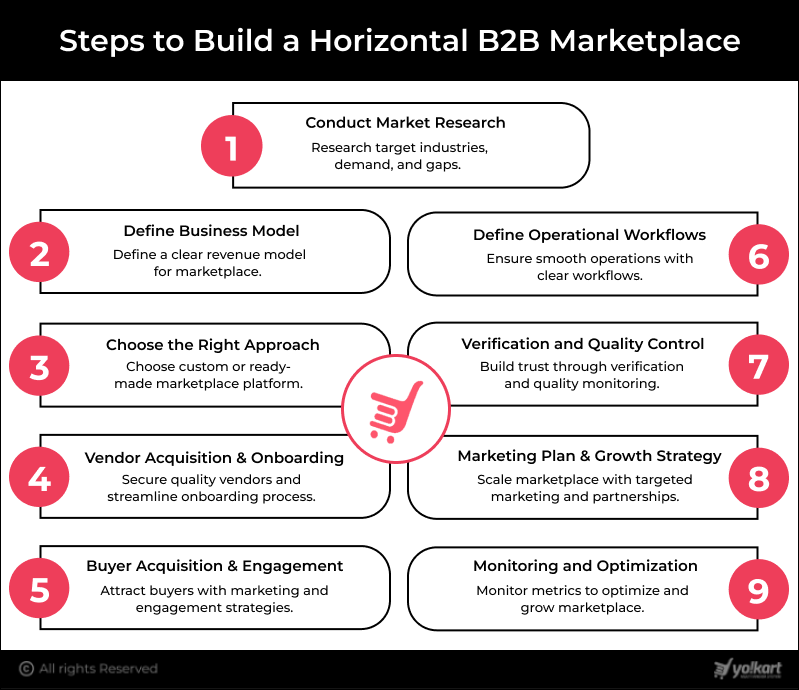
1. Conduct In-Depth Market Research
Before starting, it is essential to understand the industries you want to target. Identify the demand patterns, supply gaps, and pain points for buyers and sellers across different sectors. Analyze competitors to see what works and where the market is underserved. This research helps determine which industries to prioritize first, what types of products or services to offer, and how to position your marketplace effectively.
2. Define Your Business Model
A clear business model is critical for sustaining and scaling a horizontal marketplace. You need to decide how your platform will generate revenue. Common approaches include:
- Transaction-based fees: Charging a commission for every successful order processed through the marketplace.
- Subscription plans: Monthly or annual fees for vendors to access premium features, listing options, or analytics.
- Listing and promotional fees: Charging vendors to highlight products or services.
- Value-added services: Offering services like logistics, financing, analytics, or marketing support.
Choosing the right revenue model helps balance profitability while keeping the platform attractive for vendors and buyers.
3. Choose or Build the Right Platform
Technology is the backbone of any horizontal B2B marketplace. At this stage, you need to decide how the platform itself will be built:
- Custom Platform Development:
Build a solution from scratch tailored to your exact requirements. This allows full flexibility in features, workflows, and integrations. However, it requires a higher investment of time, resources, and technical expertise. - Ready-Made Marketplace Solutions:
Utilize pre-built platforms like Yo!kart B2B, dedicatedly designed for B2B marketplaces. These solutions come with multi-vendor management, cross-industry catalogs, secure payment gateways, and analytics features. They are cost-effective and allow faster time-to-market.
Selecting the right platform ensures your marketplace can scale efficiently, accommodate diverse products, and support a seamless experience for both buyers and sellers.
4. Vendor Acquisition and Onboarding
The success of a horizontal marketplace depends heavily on the quality and diversity of vendors. Identify suppliers across different industries who can deliver consistent quality and reliability. Develop a streamlined onboarding process, providing guidance on how to list products, set prices, and manage orders. Offering training, support, and incentives for early vendors can help build a strong foundation.
5. Buyer Acquisition and Engagement
Attracting buyers is equally important. Highlight the marketplace’s diversity, ease of use, and competitive pricing. Use targeted marketing campaigns, partnerships with industry associations, and early adopter incentives to attract buyers from multiple industries. Maintaining high engagement through newsletters, promotions, and personalized recommendations ensures buyers keep returning.
6. Define Operational Workflows
Efficient operations are crucial for building trust and ensuring smooth transactions. Create clear processes for:
- Order management
- Payment processing
- Returns and refunds
- Customer support
Well-defined workflows help reduce friction for both buyers and sellers, improve satisfaction, and foster loyalty.
7. Implement Vendor Verification and Quality Control
Maintaining trust is essential, especially in a horizontal marketplace that spans multiple industries. Verify vendors before onboarding, monitor product/service quality, and establish a rating or review system. Regular audits and compliance checks help maintain credibility and minimize disputes.
8. Develop a Marketing and Growth Strategy
Marketing is key to scaling your marketplace. Focus on:
- Industry-specific campaigns targeting multiple sectors
- Strategic partnerships with trade organizations
- Participation in trade fairs or exhibitions
- Referral programs and loyalty incentives for buyers and vendors
The goal is to create strong network effects: as the number of vendors grows, it attracts more buyers, and a larger buyer base encourages more vendors to join.
9. Monitor Performance and Continuously Optimize
Finally, track critical performance metrics such as transaction volumes, vendor engagement, buyer satisfaction, and revenue growth. Use these insights to optimize processes, expand product categories, refine marketing strategies, and improve the overall user experience. Continuous monitoring ensures the marketplace evolves in line with market needs and remains competitive.
Different Approaches to Build a Horizontal B2B Marketplace
When building a horizontal B2B marketplace, choosing the right development approach is crucial, as it directly affects cost, time-to-market, scalability, and long-term growth. Broadly, there are two main approaches:
1. Custom Development
Overview:
Custom development involves building a marketplace platform from scratch according to your unique business requirements. This approach is suitable for businesses that want full control over design, functionality, and integrations.
Advantages:
- Full Customization: Every feature, workflow, and interface can be tailored to your specific vision.
- Unique Differentiation: Enables innovative features that competitors cannot replicate easily.
- Integration Flexibility: Custom-built solutions allow seamless integration with ERP, CRM, accounting, or logistics systems.
- Scalability: Designed to handle future growth and industry expansion efficiently.
Challenges:
- Higher Costs: Custom development can be expensive, often ranging from $50,000 to $250,000 or more depending on complexity.
- Longer Timeline: Typically takes 6–12 months to launch, including design, development, and testing.
- Maintenance Responsibility: Ongoing updates, bug fixes, and enhancements must be handled in-house or via a development partner.
Best for: Businesses with specific operational needs, complex workflows, or a desire for a fully proprietary solution.
2. Ready-Made Marketplace Solutions
Overview:
Ready-made solutions are pre-built platforms designed to launch multi-vendor marketplaces quickly. They come with essential B2B features like vendor management, cross-industry catalogs, secure payments, and analytics, enabling faster deployment.
Advantages:
- Faster Time-to-Market: Pre-built features allow businesses to launch in 1–3 months.
- Cost-Effective: Significantly lower upfront costs, typically ranging from $499 to $30,000.
- Built-In Scalability: They are built with scalability in mind. They support growth and expansion without disrupting the marketplace performance.
- Technical Support and Updates: Platforms often come with regular updates and dedicated technical support.
Challenges:
- Limited Customization: Some features may not be fully adaptable to unique business processes. However, a readymade solution like Yo!Kart is fully flexible with customization. It allows you to tailor the solution according to your personalized marketplace requirements.
- Dependency on Provider: Platform updates and technical decisions are controlled by the solution provider. However, by opting for a self-hosted software like Yo!Kart, you can gain complete control.
- Potential Feature Gaps: Advanced integrations or industry-specific tools may require additional customization. Yo!Kart enables third-party integrations. The software allows you to integrate APIs or third-party tools effortlessly.
Best for: Startups or growing businesses that want to enter the market quickly, reduce costs, and leverage a proven platform with essential B2B marketplace functionality.
Looking for a Readymade Horizontal B2B Marketplace Software?
Choosing the Right Approach
Selecting between custom development and ready-made solutions depends on your:
- Budget: Custom builds require higher investment; ready-made solutions are more affordable.
- Timeframe: If you want a rapid launch, ready-made platforms are ideal.
- Business Complexity: Complex operations or unique workflows may necessitate custom development. However, choosing a 100% customizable readymade solution can solve this concern.
- Growth Plans: Both approaches help you grow and expand your business. Nevertheless, it’s crucial to choose the right one that perfectly aligns with your budget and requirements.
Many successful marketplaces adopt a hybrid approach: launching initially on a ready-made solution to test the market, then gradually migrating to a custom platform as their business scales and unique requirements emerge. However, if you choose Yo!Kart as your ready-made solution, you don’t need to migrate to a custom-built platform for scalability and unique features. The solution itself supports growth and expansion and lets you implement customizations easily.
Cost to Build a Horizontal B2B Marketplace
Understanding the cost of building a horizontal B2B marketplace is critical for allocating the budget. Costs vary depending on the approach you choose, the features you want, the number of industries you plan to serve, and whether you opt for custom development or a ready-made solution.
1. Custom Development
Overview:
Custom development involves building your marketplace from scratch according to your specific requirements. This approach offers maximum flexibility and allows you to implement unique workflows, features, and integrations.
Estimated Cost: $30,000 – $100,000+
Timeframe: 6–12 months
Factors Affecting Cost:
- Feature Complexity: Advanced vendor management, AI-driven recommendations, analytics, and multi-currency payment gateways increase development costs.
- Platform Scale: Supporting thousands of products and users across multiple industries requires more robust infrastructure, raising costs.
- Integrations: Connecting with ERP, CRM, logistics, or accounting systems adds to expenses.
- Design and UX: Custom user interfaces and seamless experiences for both buyers and sellers require additional investment.
2. Ready-Made Marketplace Solutions
Overview:
Ready-made solutions are pre-built platforms designed for quick deployment. They come with core B2B features like vendor management, cross-industry catalogs, secure payments, and analytics, enabling faster launch.
Estimated Cost: $2,000 – $10,000
Timeframe: 1–3 months
Factors Affecting Cost:
- Number of Vendors and Products: Some platforms charge based on vendor subscriptions or product listings.
- Additional Features: Integrations with logistics, payment gateways, or analytics tools may incur extra costs.
- Customization: Minor design tweaks and feature additions can slightly increase the investment.
Cost Comparison Table
| Approach | Estimated Cost | Timeframe | Pros | Cons |
| Custom Development | $30,000 – $100,000+ | 6–12 months | Fully tailored, unique features, full control | Higher cost, longer timeline, requires in-house maintenance |
| Ready-Made Solutions | $2,000 – $10,000 | 1–3 months | Faster launch, cost-effective, scalable, and technical support included | Flexibility with customization depends on the software you choose. |
Conclusion
Building a horizontal B2B marketplace opens doors to multiple industries, diversified revenue streams, and scalable growth. Success requires a clear business model, strategic vendor and buyer acquisition, efficient workflows, and the right technology platform.
For businesses looking to launch quickly while maintaining full control and flexibility, Yo!Kart’s self-hosted B2B marketplace solution offers a robust, scalable platform with multi-vendor management, cross-industry catalogs, secure payments, and analytics—helping entrepreneurs focus on growth rather than technical complexities.
A horizontal B2B marketplace is more than a trading platform—it’s an ecosystem for collaboration, expansion, and long-term business success. With careful planning and the right tools, you can establish a marketplace that thrives across industries.
FAQs
Q 1. What is a horizontal B2B marketplace?
Ans. A horizontal B2B marketplace is an online platform that connects buyers and sellers across multiple industries, unlike vertical marketplaces that focus on a single niche. It enables businesses to diversify product offerings, expand their reach, and scale operations efficiently.
Q 2. How is a horizontal B2B marketplace different from a vertical B2B marketplace?
Ans. Horizontal marketplaces cover multiple sectors, offering a wide range of products and services, whereas vertical marketplaces focus on a single industry or product category. Horizontal marketplaces drive larger network effects and provide opportunities for cross-industry trade.
Q 3. How can I launch a horizontal B2B marketplace quickly?
Ans. You can launch efficiently using a self-hosted ready-made platform like Yo!Kart, which provides multi-vendor management, cross-industry catalogs, secure payments, and analytics. This reduces development time and allows businesses to focus on growth strategies.
Q 4. What features are essential for a successful horizontal B2B marketplace?
Ans. The essential features required for a successful Horizontal B2B marketplace include:
- Multi-vendor onboarding and management
- Advanced product search and filtering
- Secure payment gateways and order management
- Analytics and reporting dashboards
- Vendor verification, reviews, and ratings
- Marketing and promotional tools for vendors
Q 5. How much does it cost to build a horizontal B2B marketplace?
Ans. Costs vary based on your approach:
- Custom Development: $30,000 – $100,000+, with longer timelines but full flexibility.
- Self-Hosted Ready-Made Platform (Yo!Kart): $2,000 – $10,000, faster deployment, scalable, and fully controllable.
Q 6. Can small businesses or startups create a horizontal B2B marketplace?
Ans. Yes. With platforms like Yo!Kart, even startups can launch multi-industry marketplaces quickly, maintain full control over data and hosting, and scale their operations across multiple industries without heavy upfront investment.
Q 7. What are the common challenges in running a horizontal B2B marketplace?
Ans. The B2B marketplace operators often face challenges in operating a B2B marketplace. These common challenges include:
- Managing vendors from multiple industries
- Maintaining consistent product/service quality
- Ensuring smooth transactions and payments
- Scaling operations as the marketplace grows
Using a reliable platform like Yo!Kart helps overcome these challenges with built-in workflows and management tools.
Q 8. How do I attract buyers and vendors to a horizontal B2B marketplace?
Ans. Attract buyers and vendors by offering diverse products, competitive pricing, and reliable service. Run targeted digital marketing campaigns, provide incentives, and leverage trade partnerships. Platforms like Yo!Kart also include marketing tools to support vendor promotions and buyer engagement.
The post How to Build a Horizontal B2B Marketplace appeared first on YoKart Blog.
]]>The post B2B Marketplace Development: Everything You Need to Know appeared first on YoKart Blog.
]]>The B2B eCommerce industry is on the rise. A decade ago, going digital was just an option. However, today it’s a condition if you want your business to thrive. Why so? Let’s take a look at the statistics to gain a better understanding.
According to the International Trade Administration, the global B2B eCommerce market is expected to reach $36 trillion by 2026.
The report indicates that a significant percentage of B2B trade is occurring online. Businesses are increasingly preferring speed, transparency, convenience, variety and user-friendly digital experiences on marketplaces compared to traditional business transactions, where options were limited and less transparent.
However, for entrepreneurs and startups, it’s high time to invest in developing B2B marketplaces. The highlight and key motivation today is that developing an eCommerce platform doesn’t require a million-dollar investment. You can build a multi-vendor B2B marketplace with low startup costs if you are smart enough to make the right decisions.
This informative blog is all about developing B2B multi-vendor marketplaces. From the B2B marketplace definition to a cost-effective solution to build a marketplace with the right approach, you will discover everything you need to know.
Table of Contents
- What is a B2B Marketplace?
- Top 5 B2B Multi-Vendor Marketplaces Worldwide
- What are the Different Types of B2B Marketplaces?
- Top 10 Must-Have Features of a B2B Marketplace
- Revenue Model: How Does a B2B Marketplace Make Money?
- How to Develop a B2B Multi-Vendor Marketplace Easily?
- Key Challenges When Developing a B2B Marketplace from Scratch
- Solutions to the Key Challenges Mentioned Above
- How Much Does It Cost to Develop/Build a B2B Marketplace?
- Build a Thriving B2B Multi-Vendor Marketplace with Yo!Kart
- Advantages of Developing Your B2B Marketplace with Yo!Kart B2B
- B2B Marketplaces Launched with Yo!Kart and Team
- Final Thought
- FAQs
What is a B2B Marketplace?
A B2B (Business-to-Business) marketplace is a platform that enables trade between two business entities. It connects manufacturers, distributors, wholesalers, and retailers as buyers and sellers, allowing them to buy and sell products or book specialized services online. Unlike a B2C marketplace, a B2B marketplace targets individual businesses that want to buy or sell products in bulk at lower prices. A B2B multi-vendor marketplace provides a diverse range of options and is designed to efficiently handle a high volume of transactions.
Primarily, there are three participants on the B2B marketplace: buyers, sellers and the marketplace operator.
- Buyers: Businesses that search for products, compare prices, request quotes, share customized requirements and buy products from the marketplace in bulk.
- Sellers: Businesses that list and sell their products on the marketplace.
- Admin: The marketplace operator (admin) controls, manages and grows the marketplace by ensuring seamless transactions and operations across the platform.
Top 5 B2B Multi-Vendor Marketplaces Worldwide
Amazon Business, Alibaba, eWorld Trade, DHGate and Global Sources are the top B2B marketplaces. These B2B platforms are leading the industry by connecting millions of buyers and sellers worldwide. They provide a digital infrastructure that streamlines transactions, automates operations, and enables online transactions by enhancing the overall user experience.
| B2B Marketplace | Country of Origin | Launch Year | Active Buyers | Active Sellers | Yearly Revenue | Product Category |
| Amazon Business | United States | 2015 | 8 million | 1.9 million | $107.6 billion in 2024 | Electronics, Home & Kitchen, Fashion, Office Supplies, Health, & Personal Care |
| Alibaba | China | 1999 | 40 million+ | 8+ million | $130.3 billion in 2024 | Machinery, Apparel, Electronics, Home Goods, and Raw Materials |
| eWorldTrade | United States | 2006 | Data not Available | Data not Available | 28 million | Agriculture & Food, Apparel, Industrial Machinery, Electronics, Consumer Goods, & Services |
| DHGate | China | 2004 | 77 million | 2.6 million | Not Available Publicly | Electronics, Clothing, Health & Beauty, & Other Various Goods |
| Global Sources | Hong Kong | 1999 | 10 million | Data not Available | $677.7 million | Electronics, Fashion Accessories, Home & Garden Items & Auto Parts |
Build a B2B Marketplace Like Alibaba, Amazon Business or Global Sources
What are the Different Types of B2B Marketplaces?
B2B marketplaces are categorized into different types based on their offerings, business model and target market. However, they can be primarily categorized into two different types: Horizontal and Vertical. Yet, there are several more types. Let’s explore them:
- Horizontal Marketplaces: Horizontal marketplaces serve diverse industries and niches. They offer a wide variety of products or services. Amazon Business and Alibaba are popular examples of horizontal B2B marketplaces. They offer millions of products across diverse industries.
- Vertical Marketplaces: Vertical marketplaces are focused on a single industry or niche. They target a specialized customer segment and offer products and services particularly to them. Faire is a well-known example of a B2B vertical marketplace. It enables wholesale purchasing of handcrafted items by connecting independent retailers with artisans and makers.
- Product-based Marketplaces: A product-based B2B marketplace focuses on selling physical products. It connects different businesses, enabling them to buy or sell products in bulk. Alibaba and Amazon Business are examples of product-based B2B marketplaces. They connect buyers with suppliers to trade physical products.
- Service-based Marketplaces: A service-based B2B marketplace connects businesses looking for various services with companies or service providers. They facilitate them to leverage skills and professional services instead of physical products. UpWork is an example of a B2B service platform that lets companies hire freelancers for specific projects, and Rakuten Super Logistics and FedEx Fulfillment are famous for providing logistics services for shipping.
- Hybrid Marketplace: A Hybrid marketplace is a combination of both product-based and service-based marketplaces. It offers products and services. It allows third-party vendors and service providers to list physical goods (products) and services both on a single platform. Amazon Business can be considered an example of a hybrid marketplace. Alongside products from diverse categories, it also offers several services as well.
A Comparison table of Different B2B marketplaces types
The comparison table below is a quick overview of different B2B marketplaces that include key characteristics, target audience and popular examples
| Marketplace Type | Key Characteristics | Target Audiences | Popular Examples |
| Vertical | Focused on a single industry, niche, or type of product. | Audience with specialized needs. | Faire and Mable |
| Horizontal | Sells a wide range of goods and services across multiple industries | Customer with varied needs. | Alibaba and Amazon Business |
| Product-Based | Primarily focuses on selling products. | Customer looking for Physical or digital Products | Alibaba and Amazon Business |
| Service-Based | Focuses on scheduling, booking, and project management | Customers looking for specialized skills, professionals or contractors | Upwork, Rakuten Super Logistics and FedEx |
| Hybrid | Sells a variety of tangible and digital products alongside services | Targets a broad customer base | Amazon Business and Alibaba |
From operational aspects, B2B marketplaces can be categorized into several categories. These categories include Supplier-Oriented (e-distribution), Buyer-Oriented (e-procurement), and Intermediary-Oriented (e-exchange) marketplaces.
Top 10 Must-Have Features of a B2B Marketplace
B2B transactions are more complex than B2C or any other business model. Therefore, a B2B multi-vendor marketplace requires some unique features and functionality to simplify complex B2B transactions. The top 10 essential features mentioned below can’t be ignored when you are planning to develop a B2B marketplace.
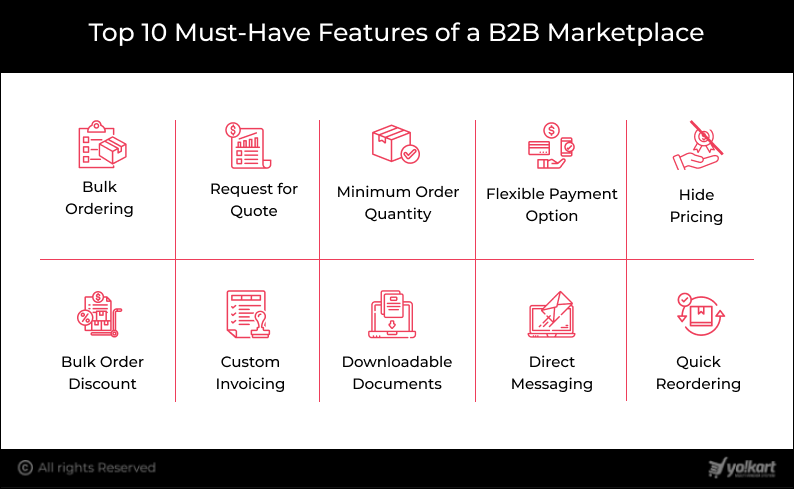
1. Bulk Ordering: B2B orders often require large quantities. The bulk ordering feature enables B2B buyers to place bulk purchases. This feature benefits both buyers and sellers. On the one hand, buyers get more discounts when buying items in large quantities. On the other hand, it leads to higher sales for sellers, allowing them to generate more revenue.
2. Request for Quote (RFQ): Unlike B2C, B2B buyers don’t make purchase decisions immediately with the given buy-now pricing. However, prices can vary significantly depending on order quantity, customization, timeline, and many other factors.
Additionally, making a purchase decision in B2B requires several considerations. The Request for Quote feature also enables buyers to request a quote and sellers to accept, considering all their requirements, and helps them secure the best deal by negotiating the price.
3. Minimum Order Quantity: In B2B, sometimes a fixed associated expense related to production, machinery, or resources that are incurred. The order quantities don’t affect the cost so much, whether the order is placed for 100 or 1000 quantities. The MOQ helps suppliers to manage production costs, streamline operations, and ensure profitability, considering all the associated expenses.
MOQ restricts buyers to place orders at least to the given number. It mandates buyers to make purchases of not less than the quantity defined by the seller. This feature works best for the supplier.
4. Flexible Payment Option: The Flexible payment feature enables payment choices for buyers on the B2B marketplace, allowing them to pay at their convenience, such as in installments or give them a credit term.
B2B trade is conducted in large volumes. Initiating the entire amount at once can affect the financial health of the business. Flexible payment options reduce the friction in the buying process. It helps build a strong customer relationship and provides a competitive advantage.
Sometimes, using flexible payment options, businesses mutually define custom payment terms based on the deliverables, timeline and other aspects to make payment at their convenience.
5. Hide Pricing: Prices on the B2B marketplaces vary significantly depending on several factors. Sometimes, it confuses buyers to finalize the best deal due to its complex or custom pricing structure. In this scenario, the Hide pricing feature is focused on encouraging buyers to proceed with the personalized quotes and discussions in order to grab the best deal based on specific requirements.
6. Bulk Order Discount: A Discount is a kind of incentive or reward that businesses offer to get more sales and generate more revenue. The bulk order discount feature on the B2B marketplace enables sellers to offer discounts to buyers on an increased number of orders.
The discount increases as the orders increase which ultimately offers good profit margins to buyers and drives more sales to sellers.
7. Custom Invoicing: B2B transactions are complex and require customization when invoicing. Unlike B2C transactions, B2B transactions often require custom fields. Therefore, a standard template can’t work for varied business transactions. However, the custom invoicing feature enables businesses, whether sellers or buyers, to share invoices tailored to specific transactions.
8. Downloadable Documents: Several orders on the B2B marketplace required documents. The download document option on the marketplace helps businesses download the documents required. These documents may include certifications, registrations, research papers, test papers, user manuals, guides, agreements or even a simple data sheet containing necessary information.
9. Direct Messaging: Transparent communication and real-time connection are the keys when it comes to handling B2B transactions. Direct messaging enables buyers and sellers on the B2B multi-vendor marketplace. They can interact directly and get a resolution to their queries in real time.
On the one hand, buyers get instant responses to their queries related to the product, its pricing and more to make purchase decisions accordingly. On the other hand, sellers (businesses on the marketplaces) understand and address specific requirements or issues in real time that ultimately increase the chance of converting leads into a loyal customer.
10. Quick Reordering: The Quick Reordering feature enables buyers to place orders faster by making the process straightforward. It eliminates several steps to save time and enhance the overall buying experience. Instead of initiating the process again, the buyer can simply find the order history and reorder in no time.
Explore Out-of-the-box Features of the Best B2B Marketplace Software
Revenue Model: How Does a B2B Marketplace Make Money?
Nailing on the revenue streams is the strategic move. You decide on the strategy for how your marketplace will operate, generate revenue, make profits and sustain in the eCommerce landscape.
Of course, a unique idea that goes beyond what others are following is always great. must always be welcomed. At the same time, one needs to be sure of a revenue model that resonates with your marketplace model and helps you accelerate growth.
Below are a few popular revenue streams that marketplaces commonly follow to make money.
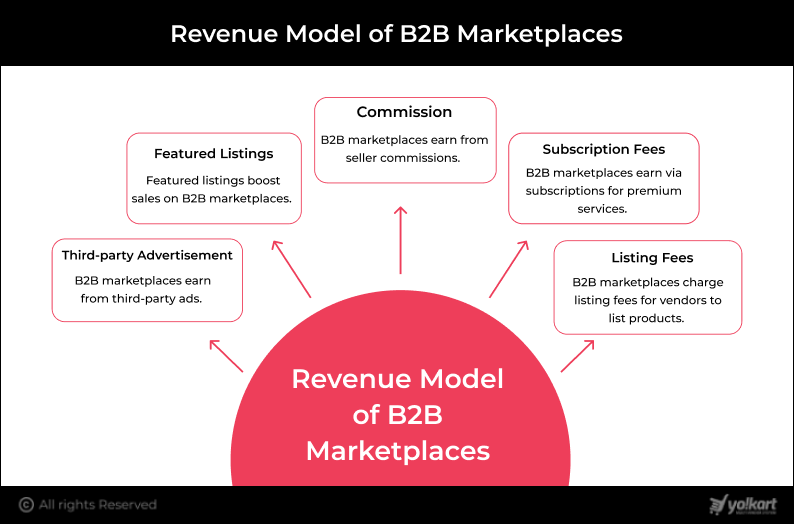
- Commission: A B2B marketplace can charge a commission from the seller/vendor on each sale made via the platform. The commissions can be either a fixed amount or a certain percentage of the selling price. The commission-based revenue model is the most preferred revenue stream. For most marketplaces, a commission-based revenue model is the primary source of revenue generation.
- Subscription Fees: After the commission-based revenue model, the subscription-based revenue model is another prominent revenue source for B2B marketplaces. In this revenue model, the B2B marketplace incurs a monthly, quarterly, or yearly subscription. The marketplace offers premium services to its users for these subscription fees.
| Amazon generated $44 billion in net sales from subscription services in 2024. You can see that a significant percentage of Amazon’s revenue comes from subscriptions. |
- Listing Fees: The B2B marketplaces also charge listing fees. Vendors pay a fee (either a fixed amount or a certain percentage of product price) to list their products on the platform. However, some marketplaces permit free listings and other charge after a certain number of free listings. Listing fee again, about the decision on how much the marketplace is going to charge.
- Featured Listings: A B2B marketplace charges fees from the vendors listed on the platform to promote their store, product categories or individual products on the platform via paid promotions. This type of promotion makes the products appear at the top in search results or often at the top of the page. Featured listing helps vendors to generate more sales by increasing products’ visibility.
- Third-party Advertisement: Third-party advertisement can be another revenue generation stream for the B2B marketplace. In this revenue model, the platform owner allows businesses, not from the platform itself, to run a sponsored ad to promote their product, services, or business on the marketplace by paying charges.
How to Develop a B2B Multi-Vendor Marketplace Easily?
Every business requires the right approach, planning and execution to succeed. Similarly, building a B2B multi-vendor marketplace too. However, many entrepreneurs and business owners don’t know where to start or how to build a thriving B2B multi-vendor marketplace. If you are also planning to build a B2B marketplace, follow these 5 steps given below.
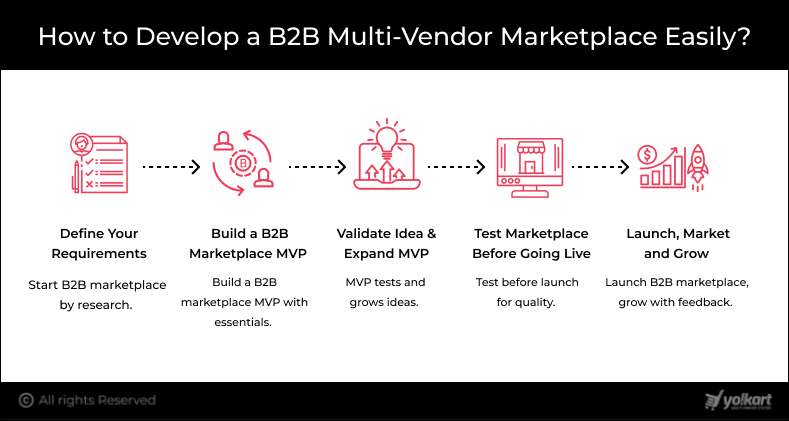
Step 1: Discovery Phase: Define Your B2B Marketplace Requirements
The first step to getting started on your journey to develop a multi-vendor B2B marketplace is to conduct thorough market research.
This process helps in identifying core problems, understanding your target audience, knowing their demographics, finding the right solution, defining the key features, deciding on the business model, and getting an idea of the budget required.
By getting clarity on all the key points and how your marketplace will serve your target market. Now you can define your strategy and streamline the process to avoid unnecessary expenses and time consumption.
Step 2: Development Phase: Build a B2B Marketplace MVP (Minimum Viable Product)
Before you build a full-fledged multi-vendor marketplace, it’s better to develop a marketplace MVP (Minimum Viable Product). It’s kind of an early version of your B2B marketplace with the minimum required features and functionality.
MVP is focused on core functionality rather than comprehensive features. Therefore, it typically takes a fraction of the time and investment, around 10% to 30% of the full-scale B2B multi-vendor marketplace, considering several factors.
Developing a B2B marketplace MVP (Minimum Viable Product) includes:
- Selecting the right tech stack.
- Designing UX/UI for an enhanced user experience.
- Developing necessary features and functionalities such as user profiles, product listings, and a secure transaction process.
- Integrating necessary APIs or third-party tools such as payment gateways, shipping solutions and more.
- Enabling easy checkout and order processing.
Step 3: Idea Validation and Expansion: Validate Idea and Expand MVP Into a Full-Fledged Marketplace
MVP is a great way to validate your idea. It’s introduced to the early adopters to get feedback. It helps you gather valuable data on demand, user experience and marketplace acceptance.
Based on the valuable feedback, suggestions and user demands, the development team implements changes to make the product as seamless as possible. Later, an MVP evolves into a full-fledged marketplace.
Another significant advantage of developing an MVP is that you can scale it as a full-fledged marketplace effortlessly.
| Always be mindful that steady improvement is the key to success. Who doesn’t know about Amazon today? The platform was initially started as an online bookstore. However, later it expanded into an everything store. Moreover, this global eCommerce giant also extends its offerings to cloud infrastructure (AWS – Amazon Web Services) and video streaming, new revenue generation streams. |
Launch a B2B Marketplace MVP at an Affordable Price
Step 4: Quality Assurance: Test Your Full-Fledged Marketplace Before Going Live
Testing a product before it goes live is critical for ensuring quality, reliability, and user satisfaction. This process includes identifying bugs, errors, performance-related challenges and more. At the same time, analyzing whether features are functioning properly or not is also a critical consideration.
In short, testing your marketplace before going live ensures that the solution you introduce is functioning as intended from the very first day. Quality assurance helps you eliminate post-launch customer frustration, avoid costly mistakes, and prevent damage to the brand’s reputation, providing a positive marketplace experience for various user types.
Step 5: Go Live: Launch, Market and Grow Your B2B Multi-vendor Marketplace
Once you have finalized testing your marketplace, the next step is to launch your B2B multi-vendor marketplace, onboard vendors and attract customers.
However, the job is not done yet. Operating an eCommerce platform or any business requires continuous effort. You need to monitor data and iterate based on user feedback.
Additionally, to attract and engage more users, you can plan marketing strategies, run paid campaigns, and follow the latest trends. This is how your marketplace can stand ahead of competitors and help you drive sustainable growth.
Key Challenges When Developing a B2B Marketplace from Scratch
Undoubtedly, building a B2B marketplace from scratch offers more control and helps you tailor the platform based on your personalized needs. However, it also brings several challenges that you can’t ignore when developing a marketplace from scratch.
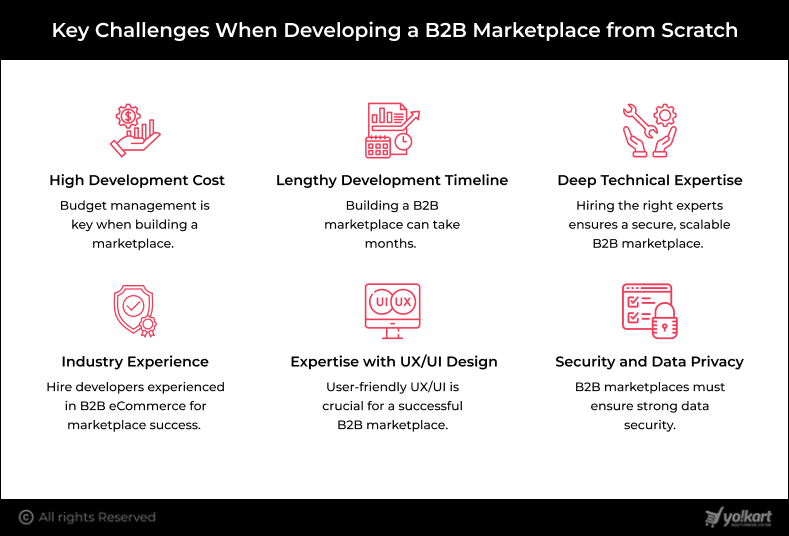
1. High Development Cost
Budget management is the primary challenge when it comes to developing a marketplace from scratch. It requires significant investment in managing experts and resources like skilled developers, designers, project managers, necessary tools and other participants or resources.
2. Custom B2B Marketplace Development Demands More Time
Developing a B2B marketplace from the ground up can take anywhere between 3 to 6 months or more. Sometimes, it may take years. However, factors like the project’s complexity, team size, expertise, availability of resources and more are also among those factors that may cause delays.
3. Need for the Technical Experts
Finding the right technical experts is paramount for custom B2B marketplace development. They can help you develop a secure, scalable, high-quality and high-performing marketplace. In case of a bad hire, you can experience project delay, security vulnerabilities, poor user experience, and lead to project failure.
4. Experience in Developing B2B Marketplace
A developer unfamiliar with the B2B eCommerce industry can’t help you develop a thriving B2B multi-vendor marketplace. Therefore, you need to find experts who have experience in the eCommerce industry, especially those who have built B2B marketplaces. They can surely add value to your project.
5. Intuitive UX/UI Design
Designing a user-friendly and intuitive UX/UI is the primary need for a B2B marketplace. It helps to ensure a seamless experience for different user types. However, most of the businesses fail to find the right UX/UI developers when developing a marketplace from scratch, which ultimately causes poor user experience, higher development costs, damaged brand reputation, lost revenue and more.
6. Security and Data Privacy
For Cyber attacks, marketplaces are the primary targets, especially B2B, where the transactions are initiated in large numbers and more sensitive data is shared. Therefore, developing a secure B2B marketplace and ensuring data security are the primary needs when building a B2B multi-vendor marketplace. Familiarity with security protocols and understanding of privacy controls and network security can help you avoid vulnerabilities.
Yo!Kart B2B is a secure solution that secures data from any breach, attack and threat. It complies with PCI and SSL security standards. From data encryption to ensuring the security of the sensitive data, Yo!Kart can always be the best choice.
Solutions to the Key Challenges Mentioned Above
In the above section of key challenges, you went through several challenges that one may face while developing a B2B multi-vendor marketplace from scratch. Now this section will help you with the right solutions to these challenges.
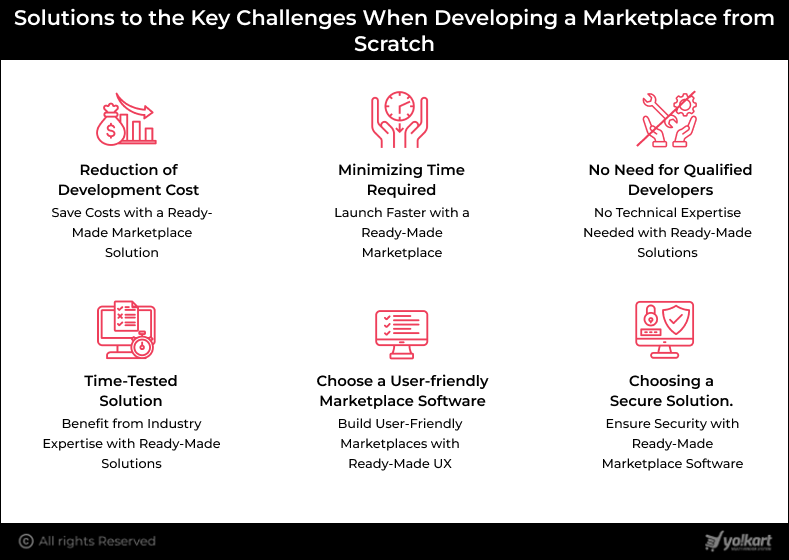
Solution 1 – Reduction of Development Cost
Undoubtedly, developing a marketplace from scratch can cost you more, but what if you can skip the process? Of course, it will save a lot of money.
Now the question may arise: how to skip the process?
However, the most appropriate answer to this question is a readymade solution. Readymade solutions are pre-built software. They support all the necessary features required to integrate when developing a marketplace from scratch, which ultimately requires a lot of expertise and resources, leading to higher development costs. However, by choosing a market-ready solution, you can skip custom development and launch your B2B multi-vendor marketplace cost-effectively.
Solution 2 – Minimizing Time Required
Time consumption is another one of those critical considerations that can’t be skipped if developing a B2B marketplace from scratch. However, when discussing the solution, again, readymade solutions are those options that can drastically reduce time by allowing you to build a fully functional marketplace in just a few weeks instead of months or years.
Solution 3 – Eliminating the Need for Qualified Developers
Of course, development expertise is the most critical requirement when it comes to developing a B2B multi-vendor marketplace from the ground up. However, what makes the right readymade solution the most preferred choice over custom B2B marketplace development is that it can help you skip finding technical experts.
You can operate the marketplace without being an expert. Even though you can customize the solution effortlessly without the need for technical knowledge to tailor it as per your personalized needs, you can use CMS and other available tools.
In the case of extensive customization that demands code-level modifications, technical expertise will be required.
However, you also no longer need to worry about it because a readymade solution like Yo!Kart comes with an option to enable custom development for extensive customization.
Explore How Yo!Kart’s Custom Development Services Work?
Solution 4 – Time-Tested Solution that Requires No Experience
Custom B2B marketplace development requires a better understanding of the industry. However, when you choose a readymade B2B marketplace software, you gain access to a solution that is time-tested and built by a team of experienced experts who have spent years in the B2B industry to develop a solution catering to all requirements of the online B2B transactions.
Solution 5 – Choose a User-friendly Marketplace Software
User experience is paramount when operating an online platform. You can’t engage, retain and drive users or even build brand reputation on a marketplace with unsatisfied user experiences. You need to develop a marketplace that meets users’ expectations. But finding a UX/UI expert is again a challenge.
However, solutions like Yo!Kart are highly intuitive with UX/UI and can help you build a user-friendly B2B marketplace. The experts handling the UX/UI of Yo!Kart are highly experienced and understand the user journey.
Solution 6 – Choosing a Secure B2B Marketplace Solution
Either find a professional if going custom who can help you develop a secure marketplace or you can opt for a readymade B2B multi-vendor marketplace software that safeguards sensitive data and complies with security regulations. A secure marketplace helps you prevent fraud and data breaches by fostering trust and a sense of credibility.
How Much Does It Cost to Develop/Build a B2B Marketplace?
The cost to develop or build a B2B marketplace can vary widely depending several associated factors, such as development approach, marketplace complexity, features required and more. Let’s explore how much does it cost to develop a marketplace from scratch and a cost-effective alternative.
Cost to Develop a Marketplace from Scratch
Developing a B2B marketplace MVP (minimum Viable Product) can cost you anywhere between $30000 – $50000 or more, depending on associated factors. Whereas a full-fledged B2B marketplace will have all necessary features and advanced functionality can cost you up to $200000 or sometimes more.
Custom B2B Marketplace Development Cost Breakdown:
- Phase 1: Research and product discovery: 10-15% of the total budget.
- Phase 2: UX/UI Design: 10-20% of the total budget.
- Phase 3: Phase 3: Minimum Viable Product (MVP) development: typically requires 20% to 40% of the total budget of a full-fledged platform.
- Phase 4: Testing and quality assurance: 10-15% of the total budget.
- Phase 5: Post-launch expansion, optimization and support: 10-20% of the total budget.
Cost to Develop a B2B Marketplace baked in its Complexity:
| Marketplace Type | Timeline | Cost |
| MVP (Minimum Viable Product) | 2 – 4 Months | $30000 – $50000+ |
| Mid-Level Marketplace | 4 – 8 Months | $50000 – $100000+ |
| Advanced and Complex Marketplace | 8 – 12 Months+ | $120000 – $200000+ |
Cost to Build a B2B Marketplace Using a Readymade Solution
Building a B2B marketplace using a readymade solution like Yo!Kart can cost you anywhere between $1249 – $10000. Again, it depends on the readymade solution you choose. However, launching a marketplace with a self-hosted, readymade software like Yo!Kart can cost you starting at $1249. However, the cost can vary depending on your requirements or the package you choose.
On the other hand, if you want to compare the cost of building a marketplace when choosing different readymade solutions, such as SaaS and a self-hosted solution. It’s always advisable to consider the total cost of ownership (TCO) in the long run.
A SaaS (Software-as-a-Service) solution offers lower upfront costs but requires several recurring fees, including transactional charges, making it expensive in the long run. On the other hand, a self-hosted solution gives you greater control and complete product ownership. Additionally, a self-hosted solution is more cost-effective in the long run, making it an ideal selection for businesses of all sizes.
To get more clarity on the pricing between a SaaS and a Self-hosted solution. Let’s compare two solutions, one is Arcadier and the other is Yo!Kart.
Arcadier a one of those SaaS-based marketplace solutions that enable B2B multi-vendor capabilities starting at just $1500/per month. However, Yo!Kart B2B pricing starts at $1249 one-time for a feature-rich B2B marketplace solution.
Cost Comparison Table Between SaaS and Self-Hosted
| Platform | Cost You Today | After 12 Months (1 Year) | After 24 months (2 Years) | After 60 months (5 Years) |
| Arcadier $1500/Month | $1500 | $18000 | $36000 | $90000 |
| Yo!Kart $1249 one-time | $1249 | |||
You can see there is a huge price difference between Arcadier (recurring) and Yo!Kart B2B (One-Time) in the long run. Additionally, by choosing a one-time payment model, you can predict pricing in the future. On the other hand, choosing a solution that comes with a recurring pricing model is unpredictable. Furthermore, a SaaS-based solution also poses several more charges, such as transactional charges, charges for scalability and more.
Build a Thriving B2B Multi-Vendor Marketplace with Yo!Kart
Yo!Kart B2B is a readymade marketplace software that is available under white labeling. The solution allows you to build a marketplace under your brand. What attracts entrepreneurs and businesses alike is that the Yo!Kart team can also help you with custom development requirements. You can either enhance the readymade solution or choose custom development.
However, a significant percentage of entrepreneurs prefer Yo!Kart over custom development because of its self-hosted nature and source code ownership. On the one hand, Yo!Kart’s self-hosted nature offers complete control over the marketplace hosting and server. On the other hand, its source code ownership enables you to modify your platform not only at the CMS level but at the code level too.
In addition, Yo!Kart allows building a feature-rich B2B multi-venor marketplace at just starting at $1249, making it a highly cost-effective choice over developing a marketplace from scratch. Alongside letting you build your marketplace at a lower investment, Yo!Kart also lets you save a lot of time. It doesn’t require months or a year like custom development, but you can simply launch your full-fledged B2B marketplace in a few weeks.
If you are one of those aspiring entrepreneurs, startups or existing businesses planning to develop a B2B marketplace from scratch, Yo!Kart B2B can be the best cost-effective and time-saving option.
Advantages of Developing Your B2B Marketplace with Yo!Kart B2B
Take a look at some of the key advantages offered by Yo!Kart B2B.
- One-Time Payment and a Lifetime License: You just need to pay a one-time licensing fee to get a lifetime license to use Yo!Kart.
- 100% white-Label: You can rebrand the solution completely as your own, as it’s a 100% white-label B2B marketplace software.
- Self-hosted Nature: Yo!Kart B2B is a self-hosted solution that enables you to host the marketplace on your preferred server.
- Fully Customizable: You can modify the software to align with your specific business guidelines and user experiences.
- Easily Scalable: Yo!Kart B2B has been developed with scalability in mind. The solution can support growth and expansion without causing any hurdles.
- Feature-rich Solution: The solution comes with all the necessary features and enables functionality critically required to ensure a seamless B2B trade.
- 20+ Payment Gateways: Yo!Kart understands the importance of an enhanced shopping experience. Therefore, it surprises customers by providing their preferred payment solution.
- Multi-Lingual and Multi-Currency Support: Shifting online means you have the opportunity to trade across borders. Yo!Kart’s multilingual and multi-currency support breaks the barriers and contributes to the marketplace expansion.
- In-built SEO and Marketing Tools: Growing your business without marketing is nearly impossible. Yo!Kart’s advanced SEO and marketing tools help marketplace operators expand their reach, drive more traffic and engagement and achieve much more.
- In-built Reporting and Analytics Tools: Data and insights have always been crucial to planning strategies to drive growth and success. Yo!Kart’s in-built analytics and marketing tools help you streamline data and insights effortlessly.
B2B Marketplaces Launched with Yo!Kart and Team
Yo!Kart and its team have empowered thousands of global businesses by helping them introduce their digital marketplaces. You can explore a few B2B marketplaces launched and empowered by Yo!Kart and the team behind this readymade software. These examples can help you analyze the versatility of Yo!Kart.
- Voyij: A marketplace for travel activities and shopping in Alaska.
View Case Study - UNI Diamonds: World’s first B2B polished diamond trading marketplace.
View Case Study - Bozinga: An American B2B multi-vendor marketplace.
View Case Study - Green Sourcing Hub: A B2B platform focused on sustainable products.
- Rexporta: Georgia-based B2B eCommerce platform selling hardware products from Agriculture, homeware, tools, machinery, and other related industries.
To learn more about Yo!Kart’s vast clientele Click Here
Looking for a Versatile Solution to Develop a Scalable B2B Marketplace?
Final Thought
B2B marketplaces are playing a crucial role in driving growth in the B2B eCommerce industry. They are simplifying the buying and selling process allowing sellers and buyers to achieve their goals. On the one hand, buyers are reaching a wider customer base and gaining access to potential B2B buyers. On the other hand, customers are enjoying a variety of options and grabbing the best deal.
In short, the B2B eCommerce industry is expected to grow at a good pace. Hence, if you are an entrepreneur or a business owner who wants to step into this rapidly evolving industry, you can launch your own B2B multi-vendor marketplace.
In this blog, you have gone through all the key highlights and detailed explanations that one should be aware of before stepping into the B2B eCommerce industry. Alongside that, you have also explored two major marketplace development methods: one is custom B2B marketplace development and the second one is building a marketplace using a market-ready white-label software.
Developing a custom marketplace requires more time and cost. Whereas with a readymade software, you can launch your marketplace quickly at a lower investment. Moreover, choosing a readymade software like Yo!Kart that offers complete control and ownership alongside versatility, you can achieve your desired goals.
FAQs
Q 1. What is B2B eCommerce?
Ans. In B2B eCommerce, two business entities deal together online. One acts as a buyer and another is a seller. Buyers generally place orders in bulk and sellers accept and fulfill orders.
Q 2. What is a B2B multi-vendor marketplace?
Ans. A B2B multi-vendor marketplace is a digital platform that connects B2B buyers with sellers. It comes with all the necessary features and enables functionalities that are essentially required for a seamless marketplace experience.
Q 3. Is Yo!Kart B2B a dedicated B2B marketplace software?
Ans. Yes, Yo!Kart B2B is a dedicated B2B multi-vendor marketplace software. It supports all the necessary features required for a fully operational B2B eCommerce platform.
Q 4. What is the difference between a B2B and B2C multi-vendor marketplace?
Ans. The primary difference between B2B and B2C multi-vendor marketplaces is B2B marketplace enables transactions between two businesses, whereas a B2C marketplace allows selling products directly to customers means vendors (businesses) on the platform directly interact with the end users.
The B2B transactions are often high in volume and businesses order products in bulk. However, B2C transactions are smaller in size, and customers can even place an order for a single quantity.
Q 5. What makes Yo!Kart a better choice even over custom development?
Ans. Custom Development means gaining complete control over the marketplace. Yo!Kart also offers complete control over the platform. Even from hosting to customization and scalability and source code ownership, Yo!Kart lets you gain a custom-like experience with a readymade solution at lower costs and minimum possible time.
Q 6. How to launch a B2B marketplace?
Ans. To launch a B2B marketplace, what you need to do is to define your requirements that include your target audience, business model, features and other critical aspects. Once you have finalized the requirements, in the next step you need to choose the right approach (Between develop and build). Suppose you are proceeding with a readymade solution. It is recommended to choose the solution that is self-hosted and available with a one-time pricing model and then launch your B2B marketplace after customization.
Q 7. Is Yo!Kart a fully customizable solution?
Ans. Yo!Kart is a fully customizable solution. You can tailor the solution to align with your specific requirements effortlessly.
Q 8. Is developing a B2B marketplace from scratch is expensive than launching with a readymade solution?
Ans. Yes, developing a B2B marketplace from scratch is more expensive than launching using a readymade solution. On the one hand, developing a marketplace can cost you over $100000. On the other hand, launching a marketplace using a readymade like Yo!Kart can cost you starting at $1249.
Q 9. Which is the best white-label B2B marketplace software?
Ans. Yo!Kart B2B is the best white-label B2B marketplace software. The solution comes with all the necessary features and allows you to build a B2B marketplace under your brand without any restrictions.
Q 10. How can I secure my B2B marketplace?
Ans. Find a solution that comes with multi-layer security, such as using Secure Sockets Layer (SSL) certificates, which encrypt data transmitted, comply with PCI, enable 2FA (2-Factor Authentication), adhere to relevant data protection laws, GDPR compliance and much more.
The post B2B Marketplace Development: Everything You Need to Know appeared first on YoKart Blog.
]]>The post How to Choose the Best B2B eCommerce Software appeared first on YoKart Blog.
]]>B2B operations are more complex than B2C or any other. Not choosing the right solution can be a threat to your marketplace idea. Further, it may lead to operational inefficiencies, reputational damage, revenue loss, and even marketplace failure.
In this craft, you will get to know how to choose the best B2B eCommerce software that can meet your requirements and users’ expectations, including sellers and buyers. However, before we dive deeper into exploring the blog, let’s take a look at some of the stats that are inspiring entrepreneurs and startups to build their own online marketplaces.
The B2B industry is evolving at a good pace, and the growth is primarily driven by online marketplaces. According to a report, the global B2B eCommerce market is expected to be worth approximately $32.1 trillion by the end of 2025 and is expected to double by 2030, reaching $62.2 trillion.
According to statistics, the online B2B industry has great potential and your business can thrive if you build a platform that can perfectly align with B2B transactional needs.
Table of Contents
- What is B2B Marketplace Software?
- Top 20 Essential Features to Look for in the Best B2B Marketplace Software
- Factors to Consider When Choosing a B2B Marketplace Software
- How to Choose the Best B2B Marketplace Software: Easy Steps to Follow
- Top 10 B2B eCommerce Software Solutions Available
- How is Yo!Kart The Best B2B Marketplace Software for You?
- Benefits of Choosing Yo!Kart to Launch Your B2B Marketplace
- Conclusion
- FAQs
What is B2B Marketplace Software?
A B2B marketplace software is a readymade solution that helps entrepreneurs and business owners launch their own eCommerce platform. The software comes with a comprehensive set of features that are essentially required to ensure seamless B2B operations. It enables transactions between two business entities online by connecting different participants on the marketplace. These participants can be manufacturers, distributors, wholesalers, retailers and other businesses, including marketplace operators (Admins) who take care of operational aspects. What makes a B2B marketplace software different from any other solution is that it facilitates the selling and purchasing of products in bulk and handles a large volume of transactions, making the trade seamless and efficient.
Top 20 Essential Features to Look for in the Best B2B Marketplace Software
B2B marketplace operations are complex. At the same time, it requires some unique features and functionality to ensure hassle-free buying and selling on the platform. Below are the top 20 essential features that you can’t ignore when choosing a B2B marketplace software.
- Request for Quote (RFQ)
- Bulk Ordering and Volume Discount
- Minimum Order Quantity
- Flexible Payment Option (Partial Payment)
- Hide Pricing
- Custom Invoicing
- Downloadable Documents
- Direct Buyer-Seller Communication
- Advanced Search and Filter
- Multiple Payment Options
- Data Analytics & Reporting
- Multi-Language and Multi-Currency Support
- Tax Management
- Catalog Management
- Inventory Management
- Order Management
- SEO and Marketing
- Quick Reordering
- Simplified Registration and Onboarding
- Content Management System
1. Request for Quote (RFQ)
Unlike B2C, B2B customers don’t make an instant purchase decision with the listed price. As they deal in big numbers, a small discount can cause a significant difference when finalizing the deal. That’s the reason a B2B marketplace requires the Request for Quote feature. Instead of Buy Now or Add to Cart, the B2B buyers get an option to Request a Quote from sellers.
This essential feature enables them to negotiate pricing and grab the best deal. Using an RFQ (Request for Quote), a buyer can either send a request to an individual seller or to all, mentioning the price. On the other hand, a seller can either accept the same deal or counteroffer. In short, this feature enables a price negotiation option for both user types.
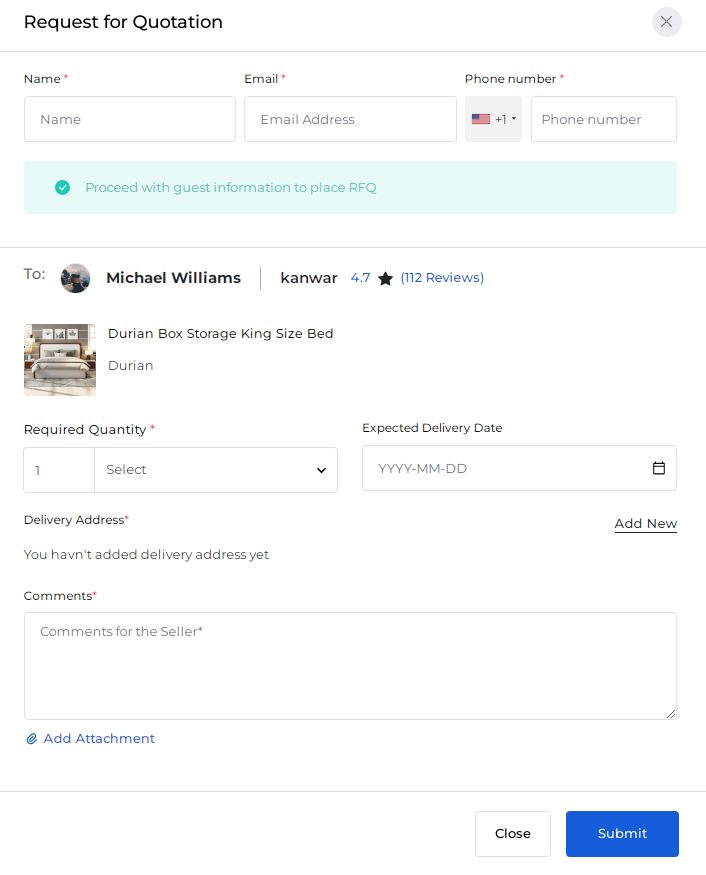
Image: Yo!Kart B2B
2. Bulk Ordering and Volume Discount
B2B customers purchase items in large quantities. The Bulk Ordering feature enables them to make purchases in desired numbers. Compared to buying an individual item, ordering them in large numbers reduces costs through volume discounts. Buyers can see a clear price difference on the increased numbers, which are mostly mentioned on the product page.
The image below from Alibaba demonstrates how bulk ordering and bulk order discounts work.
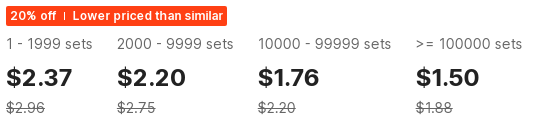
3. Minimum Order Quantity
This feature also sounds similar to the bulk order, but it’s not exactly the same. However, the primary difference is that bulk ordering is a buyer-specific feature that indirectly works for sellers.
On the other hand, the minimum order quantity feature is a seller-specific feature that allows sellers to restrict a buyer from placing an order by minimum order volume according to their preference and business strategy.
In short, this feature is used to set a quantity that the buyer must meet to place an order. Sellers set MOQs to ensure profitability, cover production and logistics costs, and others.
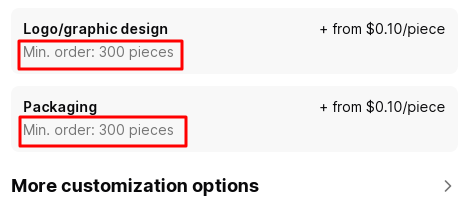
4. Flexible Payment Option (Partial Payment)
B2B transactions are handled differently compared to B2C or any other business model. Therefore, they require flexible payment options. Similarly, when operating an online B2B marketplace, a feature for flexible payment options is necessary.
Flexibility in making payments helps businesses manage cash flow, reduce financial friction as they deal with a large volume. This feature eases managing the payment flow by enabling partial payment options, allowing buyers to make payments in installments as mutually agreed. It’s an important feature for buyers to maintain liquidity and business flow.
5. Hide Pricing
The hide pricing feature is again an important feature for an online B2B marketplace. To manage pricing differences on the platform and encourage buyer-seller interaction to discuss pricing based on personalized needs, this feature is significant.
The hide pricing option allows the marketplace to enable the Request for Quote/Send Enquiry instead of allowing them to place an order with the current pricing. The buyer and seller can directly interact and discuss personalized pricing based on specific business dealings. However, the marketplace can enable both of these features together, allowing buyers to either buy the product at the same price mentioned or request a quote.
6. Custom Invoicing
Business-to-business transactions require customized billing. One can’t manage invoicing via standard or general invoices. A B2B marketplace software supporting Custom Invoicing allows businesses to share invoices based on payment terms, order type, unique requirements, and others.
7. Downloadable Documents
In an online B2B marketplace, the ability to download documents is crucial. There are several products and types of transactions that require additional documents, such as White papers, certificates, research papers, case studies, ebooks, guides, brochures and other technical documents.
The upload and download document features in the B2B marketplace software allow associated users to upload and download documents based on their specific requirements and preferences.
Looking for a Feature-rich B2B Marketplace Software?
8. Direct Buyer-Seller Communication
Direct Buyer-Seller communication option benefits in many ways. It fosters effective communication by allowing both users to discuss business deals with each other directly and get a fast resolution. On an online B2B marketplace, buyers and sellers can discuss pricing, customization requirements, and other topics. Ultimately, direct buyer-seller communication on the platform helps build trust and enhances the overall online buying experience.
9. Advanced Search and Filter
Mostly, the first interaction of a buyer begins with searching for a product on an online marketplace. The best B2B marketplace software comes with an advanced search and filtering option that allows buyers to search and filter products from a large number of available options. This practice helps them find the product that exactly matches their needs. A buyer can use several filters based on product category, pricing, size, type, feature, and many more to minimize search results to find more precise results.
10. Multiple Payment Options
Multiple payment options on the marketplace enhance the overall shopping experience and help build a loyal customer base. These options allow buyers to initiate payment using their preferred payment option, such as debit card, credit card, digital wallets, net banking, and more.
Additionally, the marketplace also allows buyers to place an order on COD or the buy now and pay later option. However, these two payment options are not so feasible when it comes to handling B2B transactions.
11. Data Analytics & Reporting
Data and insights play a crucial role in growing your business. A robust B2B marketplace software offers advanced data analytics and reporting tools, allowing access to valuable insights and marketplace performance.
Whether you are an admin or seller on the platform, by analyzing data and performance, you can plan further strategies and grow your marketplace or business by making informed decisions.
12. Multi-Language and Multi-Currency Support
The best multi-vendor B2B marketplace software comes with multi-lingual and multi-currency support. These features ultimately break the geographical barriers and allow the marketplace to expand its reach without worrying about language and currency barriers. Users on the platform can interact in their own regional language and make payments using their own currency, making the shopping experience seamless.
13. Tax Management
Tax management is a critical consideration when operating a marketplace, especially across different regions. Because taxes vary region-wise. To ensure compliance with tax laws, minimize errors, save time and, of course, automate the process, an online B2B marketplace requires the right tax management tool to manage the entire tax cycle. The tool automates tax deductions, managing tax obligations for the marketplace operators, sellers and others if required.
14. Catalog Management
The catalog management system in B2B marketplace software helps in organizing, maintaining and updating product details systematically. A product catalog contains complete product details, including product category, description, image, pricing and more.
The ultimate goal of a product catalog is to provide a list of products to customers so that they can easily navigate and find the product. A well-managed product catalog enhances the overall buying experience of the customers. At the same time, it also helps sellers to manage product information and inventory effortlessly.
15. Inventory Management
Proper inventory management is crucial to maintaining the supply chain without interruption. The inventory management tool on the marketplace helps sellers keep track, control and maintain their stock, preventing stockouts and ensuring they meet buyers’ demand. However, in B2B trade, businesses get orders and ensure delivery accordingly.
16. Order Management
An order management system is crucial to streamline orders. From order placement to ensure delivery at the doorsteps, it helps you keep track during the entire order cycle. The process of managing orders includes capturing orders, verifying payment, syncing with inventory, managing order fulfillment, providing real-time updates and maintaining data.
17. SEO and Marketing
The role of SEO and marketing tools begins post-marketplace launch. You need to attract buyers and sellers on the marketplace. SEO and marketing tools on an online marketplace help you drive organic and paid traffic. They help you enhance your online visibility and search results on targeted keywords.
18. Quick Reordering
Quick reordering features enable buyers to place orders quickly. It simplified the reordering process by eliminating multiple steps. Based on previous orders, a buyer can simply add quantity and place an order simply by choosing the mode of payment. Moreover, this feature encourages repeat purchases and enhances the overall buying experience on the b2b marketplace.
19. Simplified Registration and Onboarding
A simple and easy registration process improves user experience in the first interaction. Therefore, an easy and streamlined registration, whether it’s a sellers or buyers, is paramount to attract and encourage more users. In addition, a straightforward onboarding process also allows sellers or vendors to join and start selling products on the marketplace effortlessly.
20. Content Management System
The best B2B marketplace software comes with a powerful content management system. It allows the admin to customize the look and feel of the marketplace by tailoring the platform to foster a personalized experience. CMS enables the admin to create, manage, and publish all types of digital content without the need for coding expertise.
Factors to Consider When Choosing a B2B Marketplace Software
Not all the marketplace software offers the same level of control, access and tools to manage operations and transactions. In addition, pricing model, third-party integration capabilities, and technical support are also notable considerations that can’t be ignored. Therefore, be careful when choosing a B2B marketplace software. It’s not a decision that you can change on the very next day. Below are a few key considerations you should be mindful of when selecting the software.
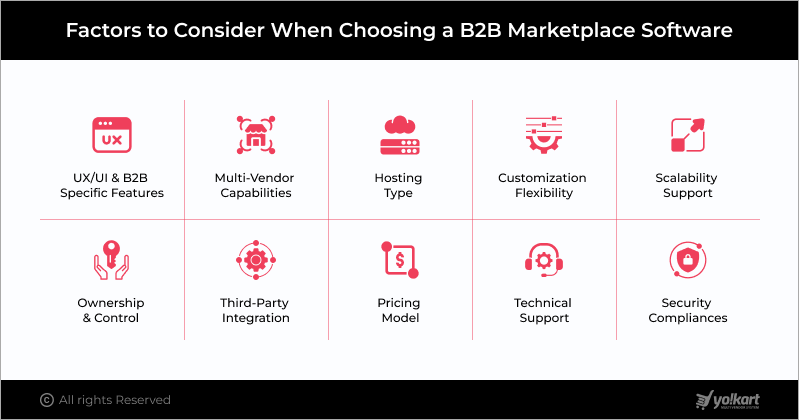
- UX/UI and B2B Specific Features for an Enhanced Experience
User experience always matters the most. It’s about how a user navigates and interacts with the marketplace. A user-friendly UX/UI offers easy navigation and enables the marketplace users to play their roles seamlessly. Therefore, look for a marketplace software with an intuitive user interface that can enhance the overall marketplace experience for its different user types.
Additionally, when operating a B2B marketplace, it’s crucial to look for a platform that comes with B2B specific features. These features also ensure seamless transitions and enhance overall user experience.
- Multi-Vendor Capabilities to Meet Users’ Demand
Look for software that is inherently a multi-vendor solution when building a marketplace. Enabling multi-vendor functionality in software via third-party apps that are not specifically designed for multi-vendor use can present several challenges, limitations, and performance-related issues.
Moreover, users on the platform can experience a lack of features and functionality when performing their roles. In addition, it will cost you more than a dedicated one. Overall, it’s essential to consider software that is specifically designed for multi-vendor use.
- Hosting Type to Gain Better Control Over the Data and Platform
There are primarily two types of B2B marketplace software available. One is hosted (Cloud Hosted) and the second one is self-hosted (On-Premise).
A cloud-based software is hosted and managed by the service provider. They manage the hosting, server and other maintenance costs. That ultimately requires lower upfront costs. However, in the long run, a hosted software can cost you more as your growing business’s demand increases. In addition, what makes the decision straightforward is that you don’t gain complete control over data and platform when you opt for a hosted solution.
However, a self-hosted B2B marketplace software offers complete control over your data and the platform. You just need to manage the server and hosting. Initially, the upfront costs of choosing a self-hosted solution are higher. However, in the long run, it’s a cost-saving decision. A self-hosted solution lets you host the platform on your preferred server, offering complete control.
- Customization Flexibility to Tailor the Platform for Personalized Needs
Every business is unique and has distinct requirements. A customizable B2B marketplace software allows businesses to tailor the platform to their specific requirements. It offers complete control over the user experience by allowing the marketplace operator to customize the marketplace according to the users’ preferences and demands. Therefore, choose a fully customizable marketplace software.
- Scalability Support to Meet the Growing Demand of Your Business
A scalable marketplace software supports growth and expansion. It allows businesses to grow without worrying about infrastructure, performance and other operational issues. Select a software that can handle a growing number of users, listings, transactions and others without any performance degradation.
Build A Fully Customizable and Scalable B2B Multi-Vendor Marketplace
- Licensing Type to Determine the Level of Ownership and Control
Ownership and control are always critical considerations when selecting a marketplace software to launch an eCommerce platform. You need to confirm the level of ownership and control offered. Otherwise, you can experience a lot of hurdles and barriers when growing or demanding additional implementations.
Several SaaS-based solutions limit your ability to access data, customize the platform, develop architecture to support growth and more. They also require higher packages and recurring fees. On the other hand, self-hosted software provides complete control by offering you access to the source code.
- Third-Party Integration Compatibility to Enable Additional Functionality and Services
Third-party integration capability is paramount to look for when choosing a marketplace software. There are a number of essential services and functionalities that you can’t enable without integrating your marketplace with APIs and third-party tools. A marketplace software compatible with third-party APIs and tools lets you enable services and functionality via integration without developing from scratch.
- Pricing Model that is Cost-Saving in the Long Run
Considering the pricing model is again crucial to help you make a decision on the kind of solution to choose. The marketplace software industry primarily follows two pricing models.
One is that they charge a recurring fee monthly or yearly based on packages and offerings. SaaS-based marketplace solutions are a prominent example of this pricing model. Another one is a one-time payment model. In this pricing model, the marketplace operator pays a one-time fee to own the software. Self-hosted solutions like Yo!Kart is a leading example of it.
However, it is recommended to choose a marketplace software that is available at a one-time payment model, as it lets you predict the final cost of the solution.
- Technical Support to Get Immediate Support and Resolution
Technical support from the same team behind the software is crucial to ensure. It is one of those factors that you must consider. Technical support helps you with setup and installation, deal performance, functionality and other workflow-related concerns. What makes seeking technical support from the same team behind the software is that they understand the fundamentals and can help you quickly address and resolve unexpected issues that might be time-consuming for others.
- Security Compliance to Build Trust Among Users
When dealing online, data security and protection are always challenging. Make sure the B2B marketplace software you are selecting complies with security standards and follows all the necessary security measures. Undoubtedly, to protect data and sensitive information, it’s important to choose a secure marketplace software. It helps businesses build trust and a loyal customer base.
You need to look for:
- Compliance with PCI DSS
- Industry Standard Data encryption
- General Data Protection Regulation (GDPR Compliance)
- Multi-Factor Authentication
- Secure payment processing
How to Choose the Best B2B Marketplace Software: Easy Steps to Follow:
A brilliant idea of building a marketplace is only the blueprint. The execution of your concept to transform it into reality requires the right tool. Similarly, when you are planning to build a B2B marketplace, it’s crucial to choose the right software. Even if your idea is flawless, without choosing the right tool, you can’t drive success and achieve goals. In this section, you will explore the steps on how to choose the best B2B marketplace software.
1. Define Your Requirements
The first and foremost step before you start looking for the best B2B marketplace software is to define your requirements. It requires thorough market research, analyzing competitors, identifying market gaps, following trends and more. This will help you clearly define your requirements, including budget, timeline, technical aspects, business model and more.
2. Prioritize B2B Specific Must-Have Features
Finalize the list of features required in your B2B marketplace software. This will help you choose the solution that can perfectly align with your specific needs. Additionally, always prefer a dedicated marketplace software over enabling multi-vendor features via third-party app integrations.
Find the Right Software for Your Marketplace with Multi-vendor B2B Capabilities
3. Evaluate Key Considerations
In the above section, you have explored all the factors that must be evaluated when deciding on a B2B marketplace software. Let’s take a look at these undeniable considerations:
- Look for an intuitive and user-friendly UX/UI.
- A dedicated platform inherently built to operate a multi-vendor marketplace.
- Prefer a self-hosted solution over a hosted one. It offers complete control and access to data and the marketplace infrastructure.
- Always choose a B2B marketplace that is flexible with customization.
- Scalability is one of those crucial factors that you can’t overlook. It helps you grow and expand your business without worrying about the marketplace performance-related challenges.
- Prioritize the solution that offers more control and access.
- Enabling desired features and functionality by accessing code can be more expensive and time-consuming. Therefore, select a solution that is compatible with third-party integrations to enable required features and functionality.
- Avoid opting for a solution that charges monthly or recurring fees.
- It is paramount to choose a solution that prioritizes relationships and offers technical support without any interruption or at additional costs.
- Select a marketplace software that follows industry-standard security measures.
4. Shortlist and Finalize the Right eCommerce Software
Once you have finalized all the above steps, the next step is to shortlist and choose the eCommerce software that best fits your requirements and expectations.
Top 10 B2B eCommerce Software Solutions Available
| Software | Hosting Type | Dedicated B2B Multi-Vendor | Source Code Ownership | Pricing Model | G2 Ratings Out of 5 |
| Yo!Kart B2B | Self-Hosted | ✓ | ✓ | One-time | 4.6 |
| Arcadier | Hosted (SaaS-Based) | ✓ | ✗ | Recurring (Subscription Fee) | 4.3 |
| PrestaShop | Self-Hosted | ✗ | ✓ | Free, Recurring cost for Extended features | 4.3 |
| Pepperi | Hosted (SaaS-Based) | ✗ | ✗ | Recurring (Subscription Fee) | 4.4 |
| Shopify Plus | Hosted (SaaS-Based) | ✗ | ✗ | Recurring (Subscription Fee) | 4.4 |
| Adobe Commerce | Both Hosted and Self-Hosted | ✗ | ✓ | Free or Recurring (Subscription Fee) | 4.0 |
| BigCommerce | Hosted (SaaS-Based) | ✗ | ✗ | Recurring (Subscription Fee) | 4.2 |
OroCommerce | Both Hosted and Self-Hosted | ✓ | ✓ | Dynamic Pricing based on the number of admins, GMV and other | 4.3 |
VirtoCommerce | Both Self-Hosted (Open Source and Hosted (SaaS/PaaS) | ✗ | ✓/✗ | Recurring (Subscription Fee) | 4.7 |
| Wix | Hosted (SaaS-Based) | ✗ | ✗ | Recurring (Subscription Fee) | 4.2 |
In the above comparison, you have explored the top 10 B2B eCommerce software, each with different hosting types, offerings, pricing models and ratings. You can decide on a solution that is perfectly aligned with your specific needs. Additionally, you can also explore case studies, testimonials and clientele before choosing anyone.
However, it is recommended to prefer a readymade solution like Yo!Kart that offers complete control over your platform with no recurring charges. Additionally, there are several more benefits of choosing Yo!Kart that you can explore below.
| Post Launch Suggestion for You: Launch, Market, Monitor and Implement Feedback After selecting the best eCommerce software that is most suitable and solve your purpose. Now it’s time to promote your platform. Plan several marketing strategies, run paid campaigns in order to attract more sellers and buyers. However, your responsibility is more than just promotion. Additionally, after your platform is live, always keep an eye on data and metrics, implement feedback, and follow trends to keep your marketplace thriving. |
How is Yo!Kart The Best B2B Marketplace Software for You?
Launching an online marketplace can be an exciting and profitable adventure. At the same time, choosing the right readymade marketplace software is a critical decision. Many entrepreneurs and startups fail to find the right solution, which ultimately leads to potential losses and future challenges.
However, if you are looking for the best B2B eCommerce software that comes with all the essential features and multi-vendor support, Yo!Kart B2B can be one of the most acceptable options. The solution has been developed specifically to cater to B2B requirements, ensuring seamless transactions on the marketplace.
Yo!Kart B2B has an intuitive and user-friendly UX/UI that offers an enhanced marketplace experience for different user types. It’s also a 100% white-label B2B marketplace software. Businesses can operate their own marketplace under their brand name without building a platform from scratch.
Benefits of Choosing Yo!Kart to Launch Your B2B Marketplace
Yo!Kart helps you launch your marketplace with confidence without worrying about any kind of limitations and hidden charges. Alongside all the features you need for a fully functional B2B marketplace, Yo!Kart comes with zero regrets and offers maximum returns. Let’s explore why choosing Yo!Kart is a wise decision.
- Cost-Effective, Transparent and Predictable Pricing
Unlike SaaS-based solutions, Yo!Kart’s license is available at a one-time payment. You don’t need to pay any recurring or transactional charges. The solution allows you to predict the pricing to build your marketplace. Additionally, Yo!Kart’s one-time payment and a lifetime license to use the solution without any additional cost also make it cost-effective in the long run.
- Fully Customizable and Scalable Architecture
Yo!Kart is designed to be flexible with customization. The marketplace operator can implement customization as per their personalized needs. They can modify look and feel, navigation, workflow and other features using its robust content management system or by accessing source code.
In addition, the solution has been built with scalability in mind. Hence, Yo!Kart supports scalability without compromising its performance. Your marketplace launch with Yo!Kart B2B can easily handle an increased number of users, listings and transactions.
- White-Label, Source Code Ownership and Control
What makes Yo!Kart B2B the most preferred solution among a large number of available options is its source code ownership. It offers a similar level of access and control one gets by developing a marketplace from scratch. From modifying the marketplace using CMS to implementing code-level changes, everything is possible with Yo!Kart with no restriction.
Additionally, Yo!Kart is entirely a white-level B2B marketplace which means it also offers complete control over the branding. You can update the logo, domain, and other aspects related to the brand and branding.
- A Robust Marketplace Solution and Native Mobile Apps
Yo!Kart is a ready-to-launch marketplace software that allows you to launch your eCommerce platform quickly and effortlessly. It provides a complete ecosystem required to operate a B2B multi-vendor marketplace alongside native mobile apps.
Yo!Kart offers buyer mobile apps for Android and iOS users. Therefore, by launching your marketplace with the software, you can also provide an enhanced shopping experience for buyers by allowing them to place orders using their preferred device.
- Enhanced User Experience and User Feedback
Yo!kart has separate dashboards for Admins, sellers and buyers, especially designed for ease of operations. From simplifying marketplace management to offering an enhanced online shopping experience, the software is the best choice for entrepreneurs, startups, SMBs and enterprise-level businesses.
Furthermore, Yo!Kart’s users often appreciate its support and instant resolutions. Once you get started with Yo!Kart, you experience peace of mind. The expert behind Yo!Kart should always be available to deal with any unexpected issues promptly. In addition, our dedicated project manager makes the journey more seamless.
Launch Your Own B2B Multi-Vendor Marketplace with Yo!Kart
Conclusion
A readymade marketplace solution gives you a quick start. It provides a pre-built platform that comes with all essential features like vendor management, product catalog, payments, and customer accounts. Unlike building from scratch, a readymade solution saves time, reduces development costs, minimizes risks and offers much more. However, your decision to select the software must align with your business goals, budget, and growth plans.
In this blog, you have been through all the essential features required when operating a B2B marketplace software, factors that you can’t miss when selecting the solution and the steps to choose the best marketplace software. In addition, you have explored how Yo!Kart B2B can be the best fit for your purpose if you are planning to launch a multi-vendor B2B marketplace software.
FAQs
Q 1. What is readymade B2B marketplace software?
Ans. A readymade B2B marketplace software is a pre-built solution designed to launch and operate your online multi-vendor B2B marketplaces without developing everything from scratch. This type of Solution helps you save time, money and resources. Furthermore, readymade solutions are time-tested, which means you don’t need to worry about a lack of features and functionality.
Q 2. Which is more cost-saving: SaaS or license-based marketplace software?
Ans. SaaS-based solutions are good for short-term projects but may become costly with commissions and recurring fees. Licensed software offers lifetime ownership, making it more economical in the long run. In addition, SaaS-based solutions limit your control and access and are restricted by the pricing tiers. On the other hand, a self-hosted solution like Yo!Kart offers complete control and access over the platform at a one-time payment.
Q 3. Can I customize my marketplace after I choose Yo!Kart?
Ans. Yes, Yo!Kart is a fully customizable marketplace software that allows you to tailor the platform as per your personalized needs and brand guidelines.
Q 4. How much does it cost to build a marketplace using a readymade solution?
Ans. Costs vary depending on the solution you choose, the features you are looking for, the flexibility and control you want and much more.
However, if you develop a marketplace from scratch, it may cost you anywhere between $30000 – $200000 or more. Choosing a SaaS-based solution can cost you a monthly recurring fee anywhere from $200 to over $5,000. On the other hand, with a readymade solution like Yo!Kart, you can launch your marketplace for just $1499 with a lifetime license at a one-time payment.
Q 5. Is Yo!Kart a suitable marketplace software for startups?
Ans. Yes, Yo!Kart is a startup-friendly marketplace software that offers affordable packages, scalability, and features designed to launch a marketplace quickly while supporting future growth. It offers complete flexibility and ownership by offering an experience similar to a marketplace built from scratch. Yo!Kart is highly flexible with customization. It also provides source code ownership, making it an ideal selection for startups seeking complete control and ownership over the platform without any restrictions.
The post How to Choose the Best B2B eCommerce Software appeared first on YoKart Blog.
]]>The post Best White-Label B2B Marketplace Software appeared first on YoKart Blog.
]]>Although the journey of making online B2B dealings seamless wasn’t that simple, B2B commerce is more complex than B2C or any other. However, thanks to marketplaces for bringing innovative solutions, leading the B2B eCommerce industry and making online trade seamless. These marketplaces include Alibaba, Amazon Business, Rakuten, eWorldTrade, Walmart, eBay, and IndiaMART.
Let’s take a look at some stats of the B2B eCommerce Industry.
It is expected that about 80% of B2B sales interactions will be conducted online via digital platforms by the end of 2025, which was about 13% only in 2019.
This report indicates that it’s the right time for businesses looking for an opportunity in this ever-growing eCommerce industry to build their own B2B marketplaces, but how? The answer to this question is, choose the best White-Label Marketplace Software if you are looking for a time and cost-saving solution.
In this blog, you will explore the best white-label B2B marketplace software in 2026 that aspiring entrepreneurs and business owners will increasingly adopt to build their thriving B2B eCommerce platform.
Table of Contents
What is White-label B2B Marketplace Software?
White-label B2B (Business-to-Business) marketplace software is a readymade solution that allows you to launch a B2B eCommerce platform. The software lets you rebrand the platform as your own. It allows you to decide and modify branding elements like domain, logo, UX/UI, graphics and others without any restrictions.
A white-label marketplace software today can bring more for startups and entrepreneurs at an affordable price. From supporting out-of-the-box features to enabling necessary functionality and services, the solution comes with everything required for a fully operational B2B marketplace.
What makes white-label marketplace software more reliable is :
- White-label solutions are flexible with customization.
- They are easily scalable, support growth and expansion.
- White-label marketplace software solutions are often time-tested. The team behind these solutions follows trends, demand, and preferences.
- They always bring more features and functionalities than developing a solution from scratch initially.
- White-label software solutions are more cost-effective than custom development.
10 Must-Have Features of White-Label B2B Marketplace Software
B2B marketplaces require different features and functionality than B2C, as their operations and transactions are distinct. Below are a few essential features that one should not ignore when choosing a white-label B2B marketplace software.
1. Bulk Ordering: Both parties dealing on a B2B marketplace are businesses. Therefore, they deal in large quantities. The Bulk Ordering feature allows businesses to place orders in bulk, which saves their time and streamlines the ordering process.
2. Request for Quote (RFQ): The Request for Quote feature allows buyers to request pricing for a personalized deal. The submitted request becomes visible to the relevant sellers, who review and can either accept, reject or raise a counteroffer. The RFQ doesn’t close until an appropriate action is taken. In short, the request for quote feature allows businesses to negotiate pricing and grab the best deal.
3. Custom Pricing: Unlike B2C, the price of B2B products varies due to several associated factors, such as order quantity, payment type, buyer, relationship, opportunity in the future and more. The custom pricing feature allows vendors to offer prices based on their interests and the business’s strategy.
4. Hide Pricing: Hide pricing is an optional feature on the B2B marketplace. Mostly managed by the Admin. This feature is used to hide pricing in order to encourage buyers and sellers to discuss pricing based on various business terms and aspects.
5. Part Payment Option: B2B transactions incur large amounts. Making a full payment at once can be challenging for buyers. The part payment feature provides an option for buyers to make partial payment (in installments), offering financial stability. This feature is essential to manage cash flow for buyers and sellers, especially when dealing with high-volume transactions.
6. Bulk Order Discount: The Bulk Order Discount feature enables vendors on the marketplace to give discounts on the total order quantity. The discount often increases with the increasing order volume and value. The vendor can set different discount tiers.
7. Direct Messaging: B2B trade requires clear and transparent communication. The direct messaging feature enables buyers and sellers to communicate with each other directly in order to discuss business terms, conditions, deals, and more.
8. Upload/Download Document: Not all, but there are several industries or products that require supporting documents to trade in B2B. The upload/Download document option is helpful for both buyers and sellers. On the one hand, sellers can upload supporting documents such as certificates, research papers, user manuals, inspection reports, trade certificates and more. On the other hand, buyers can download the documents required.
9. SEO and Marketing Tools: For marketplace operators, it’s important to drive more traffic, engagement and potential customers. Advanced SEO and marketing tools help improve online visibility, attract customers and achieve sustainable growth. These tools allow the marketplace to plan and implement several effective marketing strategies.
On the other hand, vendors on the platform also utilize marketing tools to promote their inventory and increase their visibility in search results.
10. Advanced Reporting and Analytics Tools: Tracking performance and analyzing data is crucial to making an informed decision in a marketplace. An advanced reporting and analytics tool provides valuable insights and information on the B2B marketplace.
Want to Explore the Out-of-the-box Features of the Best B2B Marketplace Software?
5 Things to Consider When Choosing White-Label B2B Marketplace Software
Building a B2B eCommerce marketplace using a white-label marketplace software brings several advantages. However, to achieve them, what you need is the right software. Let’s explore the top 5 key considerations crucial when choosing a white-label marketplace software:
1. Customizable Solution: Customizability is the primary need for an eCommerce platform when building using white-label software. Whether you want to rebrand the solution as your own, align it with customers’ needs, or tailor the platform as per your brand’s guidelines, all you need to do is customization. Therefore, always choose a software that is flexible with customization.
2. Scalability Support: A white-label marketplace software supporting growth and expansion can help you save money required to handle increased user traffic, orders, and transactions without affecting marketplace performance. Additionally, it helps the marketplace stay current in this ever-changing world.
3. Hosting Type: A marketplace software requires a server to host. This server is the back-end infrastructure that stores files, data, and all related information that are important for the marketplace to become accessible for internet users.
Most of the white-label marketplace software available in the market is either hosted or self-hosted. Compared to a hosted software (shared server), a self-hosted software offers more control, flexibility and access. Therefore, it is advisable to choose a self-hosted white-label software if the option is available and aligns with your marketplace needs.
4. Control and Ownership: When opting for a white-label marketplace software, it’s better to explore and understand the level of control and ownership you are offered. Initially, it doesn’t cause any trouble. In case not gaining complete control and ownership over the software can cause disruption in the future. The software provider can restrict your access, limit customization, cost you extra when scaling, compromise with data security and much more.
5. Payment Model: White-label marketplace software today operates primarily on two payment models. One is a one-time cost and another recurring.
When choosing a solution available with a one-time payment, you pay once in a lifetime for the software. On the other hand, the software operates on a recurring payment model, charging you monthly, quarterly or yearly. In addition, access to the software is also restricted by the pricing tiers.
Top White-Label B2B Marketplace Software
1. Yo!Kart B2B

Overview:
Yo!Kart B2B is the best white-label marketplace software to launch your own B2B multi-vendor eCommerce platform. It lets you bring manufacturers, distributors, wholesalers and other businesses together on a digital platform to enable trade between two individual business entities.
If you are an entrepreneur, a startup or an existing business owner who is planning to step into this thriving eCommerce industry by launching your own B2B marketplace software, choosing Yo!Kart B2B can help you drive growth and success.
The software comes with all the essential features and support functionality required to ensure a seamless trade between businesses. Its intuitive and user-friendly UX/UI helps you enhance the overall marketplace experience.
In addition, this future-proof solution is fully customizable, easily scalable, self-hosted and popularly recognized for providing source code ownership that ultimately gives you complete control and ownership over your marketplace.
Pros
- Yo!Kart is a Dedicated and 100% white-label B2B multi-vendor marketplace software.
- One-time payment, available at a one-time payment model, with no recurring cost required.
- Provides source code ownership, you can modify the code and implement required updates. It gives you complete control and access over the marketplace.
- Self-hosted, Yo!Kart B2B allows you to host the platform on your preferred server.
- Fully customizable, you can tailor the platform to your specific needs.
- Easily scalable and future-proof, it supports expansion and growth.
- Comes with 20+ payment gateways and other essential pre-integrated APIs.
- Multi-lingual and multi-currency support. You operate your platform globally without worrying about languages and currencies.
- Provides free technical support to help deal with any unexpected bugs and errors.
- You are assigned a dedicated project manager to guide you throughout your journey with Yo!kart B2B.
Cons
- Yo!Kart has a steep learning curve due to its vast and extensive features and functionality.
- The host himself manages the server and hosting.
Pricing
- Yo!Kart B2B pricing starts at $1249, offering lifetime access and source code ownership.
G2 Rating
- 4.6 out of 5
Build Your Own B2B Marketplace Using the Best White-label Software
2. Shopify Plus

Overview:
Shopify is a leading SaaS-based solution for single-vendor online stores worldwide. Regardless, when it comes to building a robust and feature-rich B2B multi-vendor marketplace, Shopify lacks. However, Shopify has designed Shopify Plus to operate a single-vendor store as a marketplace, gaining more flexibility, control and access.
Shopify Plus is an enterprise-level solution that enables businesses to handle high-volume transactions. However, it’s not a native multi-vendor solution. You can enable functionality via third-party app integrations. These third-party apps transform a Shopify Plus store into a B2B eCommerce platform by allowing multiple sellers to list and sell products.
Yo!Kart and Mirakl are better options to build a b2b eCommerce platform than Shopify Plus.
Pros
- Best suited for single-vendor online stores.
- Shopify Plus can handle increased traffic and large-volume transactions.
- It provides a wholesale channel for B2B transactions.
- Shopify Plus offers more flexibility when customizing and scaling to support personalization, growth and expansion.
Cons
- Shopify Plus is not a dedicated B2B multi-vendor marketplace solution.
- The dependency on third-party applications is more.
- Shopify Plus is available at higher pricing plans and is not ideal for businesses with a lower initial budget.
- Recurring fees are required on a monthly, quarterly or yearly basis.
- Switching from Shopify Plus to another marketplace software can be difficult.
Pricing
- $2,300/ month when billing for 3 years.
- $2,500/month when billing for 1 year.
G2 Review
- 4.4 out of 5
3. Salesforce

Overview:
Salesforce is a cloud-based marketplace software, primarily known for building CRM (Customer Relationship Management). However, if you are looking to build a multi-vendor B2B marketplace software, Salesforce can help. It can be extended as a multi-vendor third-party app available on the Salesforce AppExchange.
Salesforce enables B2B capabilities through features like custom pricing, bulk ordering, reordering, account management, and more, making the platform easier to handle B2B transactions.
Being a customizable marketplace solution, it caters to unique businesses’ demands and allows you to offer an enhanced experience to the users. Alongside the advantages, there are several disadvantages that you can experience, such as higher operational costs, need for technical expertise, performance-related challenges and more.
Pros
- Allows integrations with third-party applications.
- Scalable infrastructure, the marketplace supports growth and expansion.
- Comes with advanced analytics and promotional tools.
Cons
- Not inherently a multi-vendor marketplace software.
- Expensive for startups and mid-sized businesses.
- Required technical expertise when doing additional customization and updates.
- You can encounter performance-related issues sometimes.
- Limit customization and addition of new features due to its SaaS nature.
Pricing
- $25 -$100 monthly or 1–2% of GMV (Gross Merchandise Value)
G2 Review
- 4.4 out of 5
4. Virto Commerce

Overview:
Virto Commerce provides an opportunity for B2B businesses to drive more revenue and success by establishing their own online eCommerce platform. However, operating a fully functional B2B multi-vendor marketplace using Virto Commerce requires custom development.
Virto Commerce is a headless eCommerce solution that allows businesses to tailor their storefront based on their personalized needs, customers’ interests, experiences, and preferences without affecting the back-end functionality. This solution is ideal for B2B businesses and can handle their complex demand.
In addition, being an open source eCommerce software, Virto Commerce allows extensive customization by modifying the source code, built on .NET, APIs-first approach. One can easily customize to build a tailored B2B marketplace.
Pros
- It allows businesses to tailor the platform to their specific needs.
- Virto Commerce supports growth and expansion. Businesses can scale easily as they grow.
- Its headless approach separates front-end from the back-end by allowing them to customize the front-end without affecting the back-end functionality.
Cons
- Virto Commerce is not a dedicated multi-vendor marketplace solution.
- Heavily relies on custom development when it comes to enabling out-of-the-box b2b marketplace features.
- It can cost more. Not ideal for small and mid-sized businesses.
- Steep learning curve.
Pricing
- Custom quotes only
G2 Review
- 4.7 out of 5
5. OroCommerce

Overview:
OroCommerce is an open-source eCommerce software. The solution is especially built to launch B2B eCommerce platforms. It brings all the essential features and functionality necessary to operate a B2B platform and cater to its complex needs. Alongside all the eCommerce functionality, OroCommerce also supports its own CRM and CMS in order to streamline data and manage content.
However, when it comes to enabling multi-vendor marketplace features, you need to choose the OroMarketplace module. This module helps transform a simple OroStore into a thriving marketplace.
What makes selecting OroCommerce a tough call is that the solution has a steeper learning curve; you must be an expert or proper training is needed to operate. In addition, pricing transparency is also important, which is missing on its official page, which ultimately causes confusion when it comes to decide the cost to build an eCommerce platform with OroCommerce.
Pros
- Supports out-of-the-box B2B marketplace features.
- It allows for extensive customization and integration with other systems.
- OroCommerce includes a CRM (OroCRM) to manage data and provide valuable insights.
Cons
- Steep learning curve, you can encounter challenges when operating or implementing customizations.
- Customizing a platform with OroCommerce can cost you more than a readymade B2B software like Yo!Kart.
- Some users have reported data loss. Therefore, handling and ensuring data security can be a challenge.
- The solution can take more time when launching a platform that requires additional customization.
Pricing
- Pricing is based on your business needs and growth metrics.
- OroCloud Hosting
- Gross Merchandise Value (GMV)
- Number of Admin Users
G2 Review
- 4.3 out of 5
Launch an eCommerce Platform Using Self-Hosted Software
6. BigCommerce

Overview:
BigCommerce is a SaaS-based eCommerce solution. It is primarily known for building a single-vendor store for B2C. BigCommerce is not inherently built for a B2B multi-vendor marketplace.
However, BigCommerce poses some limitations when it comes to true B2B multi-vendor marketplace software. B2B functionality is not its core, as BigCommerce is not a dedicated one, but it can be transformed.
Designed for a single-vendor store, BigCommerce is one of the ideal solutions for businesses selling their own products. On the other hand, to extend multi-vendor functionality, allowing multiple sellers to sell products requires third-party apps like Webkul.
Pros
- Offers a wide range of features required to handle B2B transactions.
- BigCommerce does not charge transaction fees on its paid plans.
- It provides a scalable infrastructure to support growth and expansion.
Cons
- Monthly or yearly recurring fees are incurred when choosing BigCommerce.
- You may encounter challenges when customizing its templates and coding expertise is required for extensive customization.
- Not inherently built for a multi-vendor B2B marketplace, it may lack some features and functionality.
- BigCommerce can cost more for growing businesses as its pricing plans are tailored to annual revenue and sales.
- Some users have reported potential disruptions and performance-related issues when integrating third-party apps to enable B2B multi-vendor functionality in an existing online store.
Pricing
- Not disclosed on the official website, need to request a quote.
G2 Review
- 4.2 out of 5
7. Arcadier

Overview:
Arcadier is another popular white-label B2B multi-vendor marketplace software. It’s a SaaS-based solution that is primarily designed to create and manage multi-vendor marketplaces. However, Arcadier is not a dedicated B2B software, but it supports features that are essentially required for B2B operations, such as bulk ordering, custom pricing, private catalogue and more.
Arcadier offers a headless commerce approach that decouples the front-end from the backend, making it more flexible when customizing. This user-friendly marketplace solution also supports growth and expansion which makes it suitable for businesses seeking scalability.
Apart from headless support, some users have reported issues with Arcadier when customizing. It may cause difficulty when implementing complex and unique requirements.
Pros
- Arcadier inherently comes with multi-vendor support.
- In-built B2B marketplace features that makes the software a preferred choice for B2B marketplace.
- Arcadier is flexible with customization. It allows you to rebrand the marketplace as your own.
- It’s a user-friendly marketplace software.
- Arcadier comes with multi-lingual support, making it a good choice when reaching a wider audience.
Cons
- Some users reported that Arcadier poses some hidden costs associated with additional features and functionality.
- Higher subscription fees compared to other similar solutions.
- You may encounter challenges when requiring customer support.
Pricing
- Starts at monthly $1500 if billed annually.
- $2500 monthly with a 24-month contract term + $5000 one-time setup fees if looking for a self-hosted solution and flexibility with customization.
G2 Review
- 4.3 out of 5
8. Pepperi

Overview:
Pepperi is a B2B eCommerce solution, especially designed for manufacturers, brands, wholesalers and distributors. The software can help you build an eCommerce platform that can easily handle complex B2B requirements. Pepperi’s out-of-the-box features and functionalities minimize the reliance on third-party applications.
However, Pepperi isn’t solely a dedicated B2B multi-vendor marketplace software; it offers strong multi-vendor capabilities that allow multiple sellers to create their separate storefronts and sell products on a single platform. On the other hand, buyers can also access different types of product catalogs, pricing, and more.
Pepperi is built to speed up ordering and improve accuracy. In fact, it’s an excellent choice for single-vendor B2B businesses that want enterprise-level control.
Pros
- Pepperi offers a wide range of functionalities required to ensure seamless B2B operations.
- It provides native mobile and web apps for B2B eCommerce buyers.
- Pepperi offers integration options with ERP and CRM systems.
Cons
- Pepperi is more expensive than many other B2B marketplace solutions.
- Configuring the back-end is complex and requires technical expertise.
- It may lack some features when looking for advanced and extensive.
Pricing
- Starts at $500 – $1500.
- Multi-vendor solution is available at a custom quote only.
G2 Review
- 4.4 out of 5
9. Adobe Commerce (Previously Magento)

Overview:
Adobe Commerce, formerly known as Magento, is an open-source eCommerce solution. Initially, it was built for B2C, but now it allows businesses to build B2B eCommerce platforms. It offers a wide range of features and functionality to create and manage an online store effortlessly, whether it’s a B2B or B2C.
To operate a multi-vendor marketplace with Adobe Commerce, you can integrate third-party extensions with the software. This integration enables multi-vendor features and functionality such as separate dashboards, product management, order management, reporting capabilities and more.
However, Adobe Commerce’s reliance on third-party extensions to enable B2B functionality can cause several complexities, challenges and performance-related issues.
Pros
- Adobe Commerce is flexible with customization.
- It can easily handle a large volume of transactions and traffic, making it the preferred choice for enterprises.
- You can easily integrate third-party extensions to enable core B2B features.
Cons
- Managing a B2B marketplace built with Adobe Commerce requires developers’ support.
- It can cost you higher. However, it is suitable for enterprises.
- You can encounter several performance-related issues.
- Heavily relies on third-party integration to enable B2B multi-vendor functionality.
Pricing
- Custom quotes only
G2 Review
- 4.0 out of 5
Build Your Own Amazon Business, Alibaba and Rakuten
10. Spryker

Overview:
Spryker is another popular option you can opt for in your B2B marketplace. This software lets you offer a personalized experience due to its modular architecture and headless characteristics. With a strong focus on B2B, Spryker has been recognized as one of the leading solutions in the eCommerce space.
In addition, its API-first design allows seamless integration with other systems, making the solution suitable for different types of businesses. You can easily transform an existing B2B store into a standalone marketplace with Spryker. The solution gives you the flexibility to add and remove features according to your specific needs.
Pros
- The platform can easily adapt to changing business needs.
- Offers flexibility with customization.
- Spryker offers tailored B2B features.
Cons
- Technical expertise is required to operate or modify a marketplace built with Spryker.
- It may lack some multi-vendor features. However, you can add through custom development.
- Higher expenses are barriers for entrepreneurs and startups with a lower budget.
- Customizing and scaling a marketplace built with Spyker can cost you higher.
Pricing
- Not Disclosed
G2 Review
- 4.4 out of 5
Final Thought
The B2B eCommerce industry is evolving rapidly. For entrepreneurs, startups and business owners looking for business opportunities in this ever-growing digital space, building an online B2B multi-vendor marketplace is the right decision.
However, considering the fact, building a full-fledged B2B multi-vendor marketplace from scratch is not easy. It is a highly expensive and time-consuming adventure. At the same time, developing a marketplace from scratch will bring several more hurdles, causing frustration and additional expenditure.
Therefore, choosing white-label B2B marketplace software can be a smart move to kick-start your eCommerce journey. You can choose the right solution that perfectly aligns with your marketplace needs and launch your own marketplace.
FAQs
Q 1. What is white-label B2B marketplace software?
Ans. A white-label B2B marketplace software is a readymade solution that allows you to build and rebrand an online marketplace as your own. This type of software comes with all the necessary features and functionality required to operate a B2B marketplace.
Q 2. Why choose Yo!Kart B2B to launch your b2b marketplace?
Ans. Choosing a dedicated B2B marketplace software like Yo!Kart B2B will bring you several advantages:
- Yo!Kart B2B supports all the features required for B2B marketplace operations.
- You will never encounter any performance-related challenges that one often experiences when transforming a store into a B2B marketplace through third-party integrations.
- Yo!Kart B2B is a time-tested and future-proof multi-vendor marketplace software. The solution has empowered a large number of global marketplaces.
- By Choosing Yo!Kart, you can launch the marketplace faster and save time and resources.
- With Yo!Kart, you can avail a lifetime license to use the software without any recurring fees.
- Yo!Kart offers free technical support and provides a dedicated project manager to help you handle any unexpected issues.
- This readymade marketplace software is 100% white-label; you can completely rebrand it as your own.
- It provides you with source code ownership, which means you gain complete control over the marketplace.
- Yo!Kart B2B is also a self-hosted platform that allows you to host it on your server.
- It doesn’t charge any kind of recurring fees, whether monthly, quarterly or yearly.
Q 3. How much does it cost to launch a B2B multi-vendor marketplace?
Ans. The cost to launch a marketplace varies depending on your approach. Primarily, there are two popular ways to launch a marketplace. Either you can choose a readymade solution or build your marketplace from scratch.
Building a marketplace from scratch can cost you anywhere from $20,000 to $1,00,000 or more.
When choosing a readymade, again, you will get two popular options. One is SaaS (Software-as-a-Service) that costs you monthly anywhere between $200 – $5000 or more, including other transactional charges.
The cost of Shopify Plus, a popular SaaS-based solution, starts at $ $2,300/month when billed for 3 years and $2,500/month when billed for 1 year.
However, when it comes to choosing the most cost-saving approach, businesses often choose a self-hosted solution that is available at a one-time payment model. Initial investment seems higher, but in the long run, they are cost-effective.
Yo!Kart B2B, a self-hosted readymade solution, lets you launch a B2B marketplace starting at $1249 one-time cost. You only pay once in a lifetime. No recurring transactions or subscription fees are needed to build.
Whether you are choosing a SaaS-based solution, a self-hosted solution, or building from scratch.
Q 4. Which type of white-label B2B marketplace software is more suitable — self-hosted or hosted?
Ans. The selection between a hosted and a self-hosted B2B marketplace software varies depending on one’s requirements and expectations, such as the level of control, access, data security, cost and others.
Initially, choosing a hosted software can cost you less and be easier to set up, but at the same time, it offers less control and access. However, managing a hosted platform in the long run can cost you more than a self-hosted one.
On the other hand, a self-hosted software initially requires an infrastructure (back-end server) and hosting to host the platform on your preferred server, which may seem costlier for a few months. However, it offers greater control over your data, platform, source code and more. In addition, managing a self-hosted eCommerce platform in the long run must be a cost-saving decision.
The post Best White-Label B2B Marketplace Software appeared first on YoKart Blog.
]]>The post The Key Differences Between Local and Global B2B Marketplaces appeared first on YoKart Blog.
]]>In today’s interconnected world, B2B marketplaces play a crucial role in streamlining trade between businesses. But not all B2B platforms are created equal. Depending on their geographical focus, these marketplaces fall into two broad categories: local B2B marketplaces and global B2B marketplaces.
The B2B eCommerce market is growing increasingly, with the market size expected to grow to $57,578.97 billion by 2030, presenting a lucrative business opportunity for businesses targeting the industry.
Whether you’re a business looking to expand operations or a startup evaluating marketplace models, understanding the core differences between local and global B2B marketplaces can influence your strategy, scalability, and ROI.
Table of Contents
- What is a Local B2B Marketplace?
- What is a Global B2B Marketplace?
- Key Differences Between Local and Global B2B Marketplaces
- Popular Local and Global B2B Marketplaces
- Choosing the Best B2B Marketplace Model to Launch Your Business
- Build a Future-Ready B2B Marketplace: Features and Considerations
- Conclusion
- FAQs
What is a Local B2B Marketplace?
A local B2B marketplace connects businesses within a specific region, city, or country. These platforms cater to localized trade needs, language preferences, taxation rules, and delivery logistics. Examples include IndiaMART (India), ThomasNet (USA), or region-specific agricultural or industrial platforms.
Key Characteristics:
- Operate within a defined geographic boundary
- Offer local language and currency support
- Deal with domestic regulations and taxes
- Faster shipping and customer support
Pros:
- Easy to establish trust
- Lower operational cost
- Familiar legal and tax environment
- Tailored to local customer preferences
Cons:
- Limited reach and scalability
- Less exposure to international demand
What is a Global B2B Marketplace?
A global B2B marketplace connects buyers and suppliers from around the world. These platforms, like Alibaba, Amazon Business, or GlobalSources, facilitate cross-border trade and often support multiple languages, currencies, and logistics providers.
Key Characteristics:
- Operate across multiple countries and continents
- Support international shipping and customs
- Offer global payment gateways and multi-currency pricing
- Require compliance with international trade laws
Pros:
- Access to a global customer base
- Potential for massive scalability
- More opportunities for product diversification
Cons:
- Complex logistics and compliance
- Cultural and language barriers
- Higher costs related to shipping and taxes
Popular Local and Global B2B Marketplaces
Understanding who the top players are in each space gives you insight into market dynamics, user expectations, and competitive benchmarks.
1. Popular Local B2B Marketplaces
| Marketplace Name | Region/Country | Key Highlights |
| IndiaMART | India | One of India’s largest B2B platforms serving SMEs |
| ThomasNet | USA | Industrial product sourcing for North American businesses |
| Made-in-China (Domestic Version) | China | Local version serving the domestic B2B sector |
| Kompass | France & Europe | B2B directory focused on European trade |
Local B2B marketplaces usually tailor their services to national regulations, localized payment gateways, and industry-specific needs. They excel in creating trust and speed within their geographic focus.
2. Popular Global B2B Marketplaces
| Marketplace Name | Headquarters | Key Highlights |
| Alibaba | China | The world’s largest global B2B marketplace for trade and sourcing |
| Amazon Business | USA | B2B variant of Amazon with global presence and logistics |
| GlobalSources | Hong Kong | Strong in consumer electronics and manufacturing sectors |
| DHgate | China | Cross-border eCommerce with a focus on small orders |
These global players handle multi-currency, international shipping, and global compliance, making them attractive for exporters and global buyers. However, building trust and standing out on such platforms can be challenging due to saturation.
Launch a Powerful B2B Marketplace Inspired by the Industry Leaders
Key Differences Between Local and Global B2B Marketplaces
While both local and global B2B marketplaces serve the fundamental purpose of connecting businesses for trade, the scope, operational complexity, and scalability differ significantly between the two models.
A local B2B marketplace focuses on connecting suppliers and buyers within a specific geographic boundary, such as a country, state, or city. It’s ideal for businesses that want to build strong regional networks, ensure quick deliveries, and navigate less complex regulatory environments.
On the other hand, a global B2B marketplace opens up cross-border trade opportunities. It enables suppliers to reach a worldwide customer base and allows buyers to access a broader range of products and pricing options. However, operating a global B2B marketplace also brings challenges such as compliance with international trade laws, managing global logistics, and overcoming language and currency barriers.
From logistics and payment methods to scalability and compliance, the table below highlights the key differences to help you determine which model suits your business best:
| Aspect | Local B2B Marketplace | Global B2B Marketplace |
| Target Audience | Domestic buyers and suppliers | International buyers and suppliers |
| Currency & Language | Local currency and native language | Multi-currency and multilingual |
| Logistics | Faster local deliveries | International shipping, customs, and freight |
| Regulatory Compliance | Local tax laws and business norms | Global trade regulations and international taxes |
| Trust & Verification | Easier due to local proximity | More complex, often includes third-party checks |
| Market Reach | Limited to country/region | Worldwide exposure |
| Cost of Operation | Lower cost and simpler logistics | Higher due to cross-border compliance |
| Scalability | Great for niche markets or initial growth | Ideal for large-scale expansion and exports |
Choosing the Best B2B Marketplace Model to Launch Your Business
Choosing between a local and global B2B marketplace model depends on your business goals, target audience, operational capacity, and long-term vision.
- If your primary focus is on serving domestic buyers, building strong regional partnerships, and reducing shipping and compliance complexity, then a local B2B marketplace is a smart starting point. This model works well for small and medium enterprises (SMEs), wholesalers, and niche suppliers who want to build brand trust in their home market.
- On the other hand, if you aim to connect with international buyers, explore export opportunities, or scale your offerings across borders, then launching a global B2B marketplace is the way to go. This model is ideal for manufacturers, exporters, and large enterprises ready to handle multi-currency payments, global logistics, and cross-border regulations.
Launch a Scalable B2B Marketplace Tailored to Your Business Requirements
Build a Future-Ready B2B Marketplace: Features and Considerations
If you’re planning to launch a B2B marketplace, whether focused on local trade or global commerce, it’s important to start with a platform that supports your business model from day one.
The needs of B2B eCommerce differ significantly from B2C. Features like bulk ordering, request-for-quote (RFQ), supplier verification, and flexible shipping/tax configurations are essential. Additionally, depending on your target market, your B2B marketplace may need to support multiple currencies, languages, and region-specific compliance standards.
Things to Consider Before Choosing a B2B Marketplace Solution:
- Scalability: Can the platform grow with your business, from local operations to international expansion?
- Flexibility: Does it allow for custom workflows and industry-specific needs?
- Vendor Management: Does it support multi-vendor operations with individual seller dashboards?
- B2B Features: Are B2B-specific tools like MOQ (Minimum Order Quantity), bulk pricing, and quote management included?
- Mobile & SEO Readiness: Is the marketplace optimized for mobile users and search engines?
A Practical and Scalable Solution: Yo!Kart
When it comes to launching a feature-rich B2B marketplace, whether local or global, Yo!Kart stands out as a purpose-built platform designed to build multi-vendor B2B eCommerce marketplaces across several niches. It comes equipped with an extensive suite of built-in functionalities such as multi-vendor support, RFQ (Request-for-Quote) workflows, multilingual and multi-currency capabilities, flexible tax/shipping configurations, and advanced vendor management tools, tailored specifically for B2B marketplaces.
What sets Yo!Kart apart is its high level of customizability and scalability, allowing businesses to adapt the B2B marketplace to industry-specific workflows, branding requirements, or compliance regulations. Whether you’re looking to implement bulk pricing, MOQ (Minimum Order Quantity), or region-specific integrations, the system is built to scale alongside your business growth.
Here’s why you should choose Yo!Kart to build a B2B marketplace:
- 100% white labeling capabilities
- Self-hosted solution with lifetime ownership
- One-time payment with no recurring charges
- Highly scalable and customizable
- Built with future-readiness in mind
- 1 year of free technical support post-purchase
For startups, SMBs, or enterprises exploring opportunities in the B2B space, Yo!Kart offers a balanced combination of ease of use, robust functionality, and future-proof architecture. It eliminates the need for building from scratch while still providing the flexibility to evolve, making it a dependable foundation for any B2B marketplace.
Schedule a One-on-One Demo Session to Know More About Yo!Kart
Conclusion
Both local and global B2B marketplaces serve critical roles in today’s digital trade ecosystem. By understanding the key differences, businesses can better align their strategies to meet customer expectations, streamline operations, and drive long-term growth.
Whether you’re looking to start small or scale globally, choosing the right B2B marketplace model is a strategic decision that can make or break your success.
FAQs
1. What is the difference between a local and global B2B marketplace?
Ans. A local B2B marketplace facilitates trade between businesses within a specific region or country, while a global B2B marketplace connects buyers and sellers across international borders. Key differences include language, currency, shipping logistics, and regulatory compliance.
2. Which is better: building a local or a global B2B marketplace?
Ans. There’s no one-size-fits-all answer. A local B2B platform is better for businesses targeting a domestic audience with simplified logistics, while a global B2B marketplace is ideal for those aiming to scale internationally and reach a broader customer base.
3. Can I start with a local B2B marketplace and expand globally later?
Ans. Yes. Many businesses start locally to build brand trust and operational stability, then scale globally as demand and resources grow. Choosing a scalable B2B eCommerce marketplace software like Yo!Kart makes this transition easier to build and expand your B2B marketplace business with essential features integrated from the beginning.
4. What features are essential in a B2B marketplace platform?
Ans. Key features include:
- Multi-vendor support
- Request-for-quote (RFQ) system
- Bulk pricing and MOQ settings
- Multi-currency and multilingual capabilities
- Secure payment and logistics integration
These features are especially important for both local and global B2B eCommerce marketplaces.
5. Is Yo!Kart suitable for building a B2B marketplace?
Ans. Yes, Yo!Kart is a well-suited, purpose-built B2B eCommerce marketplace software for building a B2B marketplace. It’s designed with B2B-specific features like multi-vendor support, RFQ (Request for Quote) workflows, bulk pricing, MOQ (Minimum Order Quantity), and supplier verification. The platform also supports multilingual, multi-currency setups and offers high customization flexibility, making it ideal for businesses targeting both local and global B2B markets.
6. How do I choose the right B2B marketplace model for my business?
Ans. Start by analyzing your target market, product type, shipping capabilities, and long-term goals. If you’re focused on regional trade, go for a local B2B marketplace. If you want to reach global buyers and manage exports, opt for a global B2B platform.
7. What are some examples of local and global B2B marketplaces?
Ans. 1. Local B2B marketplaces: IndiaMART (India), ThomasNet (USA), Kompass (Europe)
2. Global B2B marketplaces: Alibaba, Global Sources, Amazon Business
The post The Key Differences Between Local and Global B2B Marketplaces appeared first on YoKart Blog.
]]>