The post Yo!Kart vs BigCommerce: Which is an Ideal Option to Build a Multi-Vendor Marketplace appeared first on YoKart Blog.
]]>Do you want to know which platform is best to build a multi-vendor marketplace platform between Yo!Kart and BigCommerce?
That’s alright! This blog will help you find the ideal option. However, before we start with Yo!Kart vs BigCommerce, let’s take a look at the stats on the advantages of building a multi-vendor marketplace.
The rise of the Internet and the adoption of online shopping have revolutionized the eCommerce landscape. According to Statista, the global retail eCommerce sales were $6 trillion in 2024 and are expected to surpass $8 trillion by 2028.
However, when discovering the key growth drivers, multi-vendor marketplaces like Amazon, eBay and Etsy are at the top. They are leading the industry, fueling eCommerce growth and acting as its success drivers.
Therefore, entrepreneurs and business owners looking for growth and success can build multi-vendor marketplaces. It can be an exciting adventure because they can help them leverage the benefits of this rapidly growing eCommerce industry. However, choosing the best multi-vendor marketplace software can be challenging, especially when it comes to selecting between Yo!Kart and BigCommerce.
Both platforms are popular and capable of building a feature-rich platform. Considering which one is an ideal option for building a multi-vendor marketplace requires in-depth analysis and comparison. But don’t worry, to help you overcome this challenge, we have crafted this comparison blog.
In this informative blog, you will go through all the key considerations of two popular marketplace solutions, Yo!Kart and BigCommerce to find the best multi-vendor marketplace software.
Table of Contents
- Overview of Yo!Kart and BigCommerce
- Yo!Kart: A Dedicated Multi-Vendor Marketplace Software
- Key Comparison Between Yo!Kart and BigCommerce
- BigCommerce: Rely on Third-Party Apps for Multi-Vendor Features
- Build Your Multi-Vendor Marketplace Platform with Yo!Kart
- Why is Yo!Kart The Best Alternative to BigCommerce?
- Final Thought
- FAQs
Overview of Yo!Kart and BigCommerce
Both eCommerce software are known for catering to different needs. However, to decide on any one as one of the best for building a multi-vendor marketplace platform requires several considerations. Let’s begin with an overview of Yo!Kart and BigCommerce.
Yo!Kart: A Dedicated Multi-Vendor Marketplace Software

Yo!Kart is a purpose-built multi-vendor marketplace software. It is an independent software that comes with a self-hosted advantage. You can own the software and host it on your preferred server. It doesn’t rely on third-party integration or apps for its multi-features. Yo!Kart’s in-built features are tailored to multi-vendor marketplaces, making it a feature-rich multi-vendor software. In addition, entrepreneurs and businesses who want to launch their marketplace quickly can choose Yo!Kart as a readymade solution. It allows businesses to launch a multi-vendor marketplace within a few days and weeks.
Key highlights of Yo!Kart:
- Readymade software with in-built multi-vendor functionality
- Lifetime license with one-time payment
- Advanced vendor management and commission systems
- Native mobile apps
- Multiple payment gateways
- Fully customizable and scalable
BigCommerce: Rely on Third-Party Apps for Multi-Vendor Features

BigCommerce is primarily known for building a single-vendor store. It is a SaaS-based eCommerce solution. However, to make the platform operational as a multi-vendor marketplace, BigCommerce requires third-party integrations or apps. It doesn’t inherently offer built-in multi-vendor features. To transform a BigCommerce store into a multi-vendor marketplace, businesses rely on third-party apps like Marketplacer. By integrating such apps with BigCommerce, you can allow third-party sellers to list and sell products as a multi-vendor marketplace.
Key highlights of BigCommerce:
- Cloud-based solution
- Drag-and-drop page builder
- Third-party app ecosystem
- Primarily scalable for growing single-vendor stores
- Subscription-based pricing model
| Suggestion: According to the overview of Yo!Kart and BigCommerce, Yo!Kart is a dedicated multi-vendor marketplace platform and BigCommerce is dedicatedly built for the single-vendor store. However, by integrating BigCommerce with third-party apps, one can transform a single-vendor store into a multi-vendor store. |
Key Comparison Between Yo!Kart and BigCommerce
Below comparison between Yo!Kart and BigCommerce will help you comprehend which is the best multi-vendor marketplace solution for you. We have gone through all the essentials that are must for building and operating a fully functional multi-vendor marketplace. Let’s explore each of them in detail to make an informed decision:
- Multi-Vendor Features and Functionality
- Hosting Type – Self-Hosted vs Cloud-Based
- Which Platform is more flexible with Customization
- Which Platform is Cost-Saving in the Long Run
- Which Platform Can Perfectly Align with Your Growing Business’s Needs
- Yo!Kart VS BigCommerce: Which Platform Offers Greater Control and Ownership
- Reviews and Ratings on Trusted Platforms
Yo!Kart VS BigCommerce: Multi-Vendor Features and Functionality
Multi-vendor features required to operate, manage and grow your platform with multiple sellers. Although Yo!Kart and BigCommerce both allow you to build a multi-vendor marketplace. But do they support all the multi-vendor marketplace features? Let’s explore how they differ in their approaches and capabilities:
- Yo!Kart: Yo!Kart is a purpose-built multi-vendor marketplace, so most essential features are available in-built and reduce its third-party dependencies, making the platform capable enough to handle multi-vendor marketplace needs.
- BigCommerce: It is not natively a multi-vendor platform but can enable multi-vendor features and functionality through third-party integration. As it is not a dedicated solution, it may cause several difficulties when operating a multi-vendor marketplace.
Let’s Explore the Multi-Vendor Features of Yo!Kart and BigCommerce in the Table Below:
| Feature | Yo!Kart | BigCommerce |
| Vendor Management System | Built-in | Third-party integration |
| Product Catalog Management | Built-in | Third-party integration |
| Commission Management | Built-in | Third-party integration |
| Order Management System | Built-in | Third-party integration |
| Shipping Management | Built-in and Third-party Integration | Third-party integration |
| Tax Management | Built-in and Third-party Integration | Built-in (Basic) and Third-party Integration |
| Multi-Currency & Multi-Language | Built-in | Built-in |
| Marketing and SEO Tools | Built-in | Built-in |
| Suggestion: From vendor management to product management, order management to commission management, and shipping management totax management, Yo!Kart provides all essential multi-vendor features by default. However, BigCommerce relies on third-party integration for most of its multi-vendor features. Therefore, Yo!Kart can be more appropriate when building a multi-vendor marketplace than BigCommerce. |
Build a Multi-Vendor Marketplace Using a Dedicated Software
Yo!Kart VS BigCommerce: Hosting Type – Self-Hosted vs Cloud-Based
The hosting type refers to the virtual space to store software data, files and make the solution available to its users using the internet. Each hosting type is different and offers distinct levels of control, security, performance, cost and more. Let’s explore the hosting type of Yo!Kart and BigCommerce:
- Yo!Kart: It is a self-hosted multi-vendor marketplace software.
- BigCommerce: It is a SaaS or Cloud-based solution.
What’s the difference?
Hosting Preference:
- A self-hosted software allows you to host the platform on your preferred server.
- A cloud-hosted solution is a pre-hosted solution in which files and data are distributed across multiple servers.
Control over the Software
- A self-hosted software provides more control.
- A cloud-based solution like BigCommerce offers less control over the platform.
Security
- Data is stored on your servers which makes it more secure and reduces the reliance on third-party security measures.
- Data is stored on a third-party server and the software provider takes care of its security. However, it can be a potential threat to your data privacy.
Performance and Availability
- On-premises software can offer faster response times and reduced latency, as it is located on a dedicated server.
- You can experience performance disruptions and downtime with cloud-based solutions due to several reasons including technical glitches, internet connectivity, power supply and others.
Flexibility
- A self-hosted software offers more flexibility in customization and third-party integration, as you have access to the source code.
- Although hosted platforms are also customizable, code-level customization and integration can be challenging.
Vendor Lock-in
- With self-hosted software, you don’t need to worry about terms and conditions. You can avoid vendor lock-in as you are not bound by the provider’s terms and conditions.
- Many businesses experience that the cost of switching to a different solution is very high. Especially when they are heavily reliant on a cloud service provider. The software provider limits their flexibility and negotiation power.
| Suggestion: Choosing self-hosted software can offer greater control, better data privacy, performance, no vendor lock-in and more. Unlike a SaaS-based solution, they don’t limit access, control, etc. Therefore, Yo!Kart can be an ideal choice for you. |
Yo!Kart VS BigCommerce: Which Platform is more flexible with Customization
Customization is an important aspect. It helps businesses craft a personalized experience for their customers. Whether you are launching a marketplace by developing from scratch or launching using a readymade solution, customization flexibility is paramount to tailor the platform according to the requirements.
- Yo!Kart: It offers complete flexibility in customization. You can customize the platform’s design and functionality. Yo!Kart’s extensive customization flexibility allows businesses to tailor the platform to meet unique needs by making code-level customization.
- BigCommerce: BigCommerce is also a customizable solution. However, the platform doesn’t natively offer multi-vendor features. Therefore, tailoring the platform to specific multi-vendor requirements can be challenging.
What’s the Difference:
- Yo!Kart offers source code ownership that enables businesses to do extensive customization by accessing the source code.
- BigCommerce can limit the customization as it doesn’t provide access to the source code. In addition, the platform is not crafted as a multi-vendor marketplace, so customizing the platform according to the multi-vendor requirements can be tough.
| Suggestion: Yo!Kart offers more flexibility in customization than BigCommerce. Providing source code ownership, Yo!Kart offers code-level customization. On the other hand, BigCommerce is limited when customizing due to its cloud-based nature. |
Yo!Kart VS BigCommerce: Which Platform is Cost-Saving in the Long Run
Pricing directly impacts your initial investment, profitability, savings, and many more. Therefore, the consideration of the pricing model is important when choosing a readymade multi-vendor marketplace software or a SaaS-based solution. Yo!Kart and BigCommerce both support different pricing models. However, when selecting any one of them, then the consideration of every single $ is important.
- Yo!Kart: Yo!Kart is available with a one-time payment option. In a one-time payment model, you pay license fees once in a lifetime, and you don’t need to pay any recurring, subscription or hidden fees in the future.
Web App Packages of Yo!Kart

Web+Mobile App Packages of Yo!Kart

- BigCommerce: BigCommerce supports a recurring and subscription-based pricing model. In a recurring and subscription-based pricing model, you pay monthly or yearly recurring charges, as the name suggests.
BigCommerce Packages

What’s the Difference:
To help you understand how you can save money in the long run, you need to explore the differences between the one-time payment model and the recurring or subscription-based pricing model.
Let’s make it clearer to you. Here, we have selected the most popular package of both platforms:
- GoQuick is Yo!Kart’s popular package available at $1249 one-time.
- Pro is BigCommerce’s popular package that costs $399/Month.
| Platform | Cost You Today | After 5 Years | After 10 Years | After 20 Years |
| BigCommerce Pro At $399/Month | $399 | $23940 | $47880 | $95760 |
| Yo!Kart’s GoQuick $1249 one-time | $1249 | $1249 | $1249 | $1249 |
| Suggestion: The one-time payment model is more cost-saving than the recurring or subscription-based model. Initially, Yo!Kart seemed to be expensive due to its one-time payment model. However, in the long run, it is very cost-effective and can help you save lots of money in the future. |
Choose a Cost-Saving Multi-Vendor Marketplace Solution
Yo!Kart VS BigCommerce: Which Platform Can Perfectly Align with Your Growing Business’s Needs
Scalable marketplace software means getting a solution that can handle the increased number of transactions, traffic, listings, load, and more without any performance degradation. It allows businesses to expand their platform according to the growing business needs.
- Yo!Kart: It is a fully scalable multi-vendor marketplace software.
- BigCommerce: It also supports scalability.
What’s the Difference:
Control and Freedom
- Yo!Kart is a self-hosted platform which means users own and manage the infrastructure of the software, including servers, databases and more. It provides complete control and freedom when scaling your marketplace.
- BigCommerce supports a SaaS-based model where the platform’s infrastructure is managed by the service provider, meaning you don’t hold complete control over the platform.
Dependency when Scaling
- With Yo!Kart, you hold the ownership to the source code which means you can expand your marketplace by accessing the source code.
- With BigCommerce, code-level scalability depends on the services provider, infrastructure and the selected plan. You cannot directly do whatever is needed.
Cost Considerations
- With Yo!Kart, you can expand your platform using your resources which gives freedom to choose the cost-effective one.
- The dependency on a service provider can cost you more when scaling a SaaS-based solution like BigCommerce.
| Suggestion: With Yo!Kart, you get complete freedom and it doesn’t come with additional charges. However, with BigCommerce, it is hard to gain complete control over the platform and it may cost you more than a self-hosted multi-vendor marketplace software. |
Yo!Kart VS BigCommerce: Which Platform Offers Greater Control and Ownership
Control and ownership over your platform means the access and authority that an individual holds. You can ask a few questions to make sure of the level of control and ownership you have. These questions may include:
- Whether I own the product entirely or have access only?
- Will I get a license to access the source code?
- Can I modify the software as per your business needs?
- Is the software flexible with customization?
- Do I need permission when scaling the marketplace?
- Does the software have hidden costs?
- Is the solution cost-saving in the long run?
- Can I do code-level customization?
However, there can be several more questions depending on your marketplace needs, business model, revenue model and more that you can ask either to the software provider or by yourself to get clarity.
- Yo!Kart: Yo!Kart provides complete control and ownership over your marketplace.
- BigCommerce: It offers access, not ownership. However, the level of access depends on your selected package.
How Yo!Kart Offers Greater Control Than BigCommerce
Source Code Ownership
- With Yo!Kart, you own the source code which means you can access and modify the code.
- BigCommerce is a cloud-based solution that doesn’t provide source code ownership.
Control Over the Infrastructure
- Yo!Kart allows you to host your marketplace on your own server which gives you full control over the platform’s infrastructure.
- BigCommerce is a hosted software that limits your control.
| Suggestion: Yo!Kart offers greater control and ownership than BigCommerce due to source code accessibility and its self-hosted nature. On the other hand, BigCommerce is a cloud-based solution that can limit your control and ownership over the marketplace. |
Yo!Kart VS BigCommerce: Reviews and Ratings on Trusted Platforms
It is always advisable to check ratings and reviews before you choose multi-vendor marketplace software. It helps you make an informed decision. When you check ratings or reviews on trusted platforms, it helps you understand and identify real-world challenges and decide whether the software aligns with your marketplace needs or not.
In other words, by doing proper market research, checking ratings and reviews, one can save money, avoid unexpected issues, frustration and disappointments. Software Suggest, GoodFirms, Capterra and G2 are popular platforms in the industry where you can check ratings and reviews of Yo!Kart and BigCommerce:
| Platform | Yo!Kart’s Ratings | BigCommerce’s Ratings |
| Software Suggest | 4.8/5 | 4.8/5 |
| GoodFirms | 4.8/5 | 3.8/5 |
| Capterra | 4.2/5 | 4.4/5 |
| G2 | 4.6/5 | 4.2/5 |
Review for Yo!Kart on G2

Review for BigCommerce on G2:

Build Your Multi-Vendor Marketplace Platform with Yo!Kart
If you are looking for a BigCommerce alternative to build a multi-vendor marketplace that can easily scale with your growing business’s needs, offers flexibility in customization, provides complete control and saves money in the long run, Yo!Kart is the ideal choice. The software has all the essential in-built multi-vendor features that allow you to operate and manage your marketplace.
Yo!Kart’s robust architecture and intuitive design offer an enhanced experience to its users. In addition, its advanced marketing tools, multilingual and multi-currency support empower businesses to build and grow a global multi-vendor marketplace.
No Matter whether you want to launch a B2B, B2C or C2C marketplace, with Yo!Kart, you can choose any business model to leverage the benefits of this growing eCommerce landscape. The platform also provides the opportunity to generate revenue from multiple revenue streams such as listing fees, commission on sale, advertising, sponsored ads and more.
Why is Yo!Kart The Best Alternative to BigCommerce?
However, both platforms can help you operate a multi-vendor marketplace. But which one of the platforms can perfectly align with your business’s needs requires several considerations. Let’s explore key aspects in the table below that one should not ignore when selecting between Yo!Kart and BigCommerce:
| Aspects | Yo!Kart | BigCommerce |
| Platform Type | Self-Hosted | SaaS (cloud-based) |
| Dedicated For | Multi-Vendor | Single-Vendor |
| Multi-Vendor Functionality | In-built | Third-party Integration Requires |
| Pricing Model | One-time | Recurring or Subscription-based |
| Ownership | Complete | Depends on the Package |
| Customization | Fully Customizable | Limited due to SaaS Restrictions |
| Scalability | Highly Scalable | Scalable on Additional Cost |
| Multilingual Support | In-built | Third-Party Integration Required |
| Vendor Dashboard | By Default | Third-Party Integration Required |
| Third-Party Integration Support |  |
|
| Payment Gateways | Multiple | Multiple |
| Upgrades and Maintenance | Controlled by Owner | Controlled by Provider |
| Source Code Ownership | |
X |
| Third-Party Dependency | Lower | Higher |
| Built-in Marketing Tools | |
X |
| Licensing Type | Lifetime | Subscription Monthly/Yearly |
| Mobile App | |
|
| Best Suited for | Startups, SMEs and Enterprises | Startups and SMEs |
| Suggestion: As you can see Yo!Kart is a clear winner when comparing key aspects of the marketplace solution. Therefore, if you are looking for a BigCommerce alternative, there are several reasons to choose Yo!Kart. |
Build a Feature-rich Multi-Vendor Marketplace with Yo!Kart
Final Thought
When it comes to launching a multi-vendor platform, many businesses face the dilemma of selecting between a self-hosted and a SaaS-based solution (Yo!Kart and BigCommerce). While BigCommerce is a leading SaaS-based eCommerce solution, Yo!Kart is a purpose-built, self-hosted platform designed specifically for building and launching multi-vendor marketplaces.
Multi-vendor marketplaces require unique features and functionalities to become fully operational. Unlike single-vendor stores, they don’t have just two types of participants, including an individual seller and buyers. A feature-rich multi-vendor marketplace requires robust dedicated dashboards for Admins, sellers and buyers so that they can easily manage their roles and responsibilities. Yo!Kart comes with all the essential features to make the marketplace easily accessible to all its participants.
FAQs
Q 1. Which is the best BigCommerce alternative?
Ans. If you are looking for the best multi-vendor marketplace software, then Yo!Kart can be the best BigCommerce alternative. You can launch a fully customizable and scalable marketplace with Yo!Kart.
Q 2. Can I migrate my BigCommerce store to Yo!Kart?
Ans. Yes, Yo!Kart supports data migration from platforms like BigCommerce. You can transfer product data, vendor information and customer records.
Q 3. Does Yo!Kart provide mobile apps for Android and iOS?
Ans. Yes, Yo!Kart offers native Android and iOS mobile apps for both buyers.
Q 4. How secure is Yo!Kart for handling transactions and vendor data?
Ans. Yo!Kart implements enterprise-grade security protocols, SSL encryption, and PCI-compliant payment gateway integrations. Therefore, Yo!Kart is a highly secure and reliable multi-vendor marketplace software.
Q 5. Can I customize the Yo!Kart tailored to my business needs?
Ans. Yes, Yo!Kart is a fully customizable multi-vendor marketplace software. You can tailor its front-end, back-end, workflows, and features to best suit your business and its target audience.
Q 6. Is BigCommerce a dedicated multi-vendor marketplace solution?
Ans. No, BigCommerce is not a dedicated multi-vendor marketplace solution. However, you can transform your single-vendor platform into a multi-vendor platform by integrating BigCommerce with third-party apps.
Q 7. Which is a dedicated multi-vendor marketplace software?
Ans. Yo!Kart is a dedicated multi-vendor marketplace software that allows entrepreneurs and business owners to build a feature-rich marketplace. It comes with all the essential in-built features required for a fully functional multi-vendor eCommerce platform.
Q 8. What is a multi-vendor marketplace platform?
Ans. A multi-vendor marketplace is a platform that connects buyers with multiple sellers. Buyers get access to a large number of products. On the other hand, sellers get access to a large customer base.
Q 9. Is Yo!Kart a reliable choice to build a multi-vendor marketplace?
Ans. Yo!Kart has empowered thousands of global businesses by helping them build and launch their multi-vendor marketplaces. With this popular readymade solution, you can launch a global and feature-rich platform. No matter whether you are one of the startups, SMBs, or enterprises, Yo!Kart can help you lead the industry.
Let’s explore Yo!Kart’s Clientele to explore more about how it has empowered them.
The post Yo!Kart vs BigCommerce: Which is an Ideal Option to Build a Multi-Vendor Marketplace appeared first on YoKart Blog.
]]>The post CS-Cart Vs Sharetribe VS Yo!Kart – Which is the Best eCommerce Solution? appeared first on YoKart Blog.
]]>In this blog, we discuss three leading eCommerce marketplace software – that have gained traction globally, for their robust solutions: Sharetribe, CS-Cart, and Yo!Kart multivendor software. Fast forward your decision making process, as we take you through detailed nuances of the eCommerce entrepreneurial journey – that will be key to success in this exciting and competitive domain.
Overview of Yo!kart, Cs-Cart and Sharetribe
There can be many ways to approach the solution of a problem. Yo!Kart, CS-Cart,and Shartribe represent three distinct perspectives to start building your eCommerce platform. Let’s find out.
Yo!Kart
A self hosted solution, Yo!Kart multivendor software, leverages the best of reliability, market leading features, and affordability, all encapsulated in a package that makes it easy for entrepreneurs to get started with an eCommerce platform – right off the bat.
Yo!Kart is available for a lifetime of use with a one-time payment option. Affordability is higher, considering that all required inclusions are offered by default.
CS-Cart
CS-Cart has emerged as a popular eCommerce marketplace software after it was used by an Indian eCommerce platform, Shopclues. Even though the business has migrated since then – it was testament to robust virtues of CS-Cart, propelling it as a popular choice in the industry for startups.
CS-Cart is also self hosted and comes with annual subscription plans.
Sharetribe
Sharetribe is a SaaS based multivendor marketplace solution. This means that it is hosted, and one needs to just sign up and start using it straight away. However, like most SaaS solutions, the solution comes with recurring changes in the form of monthly subscription fee.
Read these differences in the table below:
| Parameter | Yo!Kart | CS-Cart | Sharetribe |
| Hosting | Self-Hosted | Self-Hosted | Hosted (SaaS-based) |
| Multi vendor support | By Default | By Default | By Default |
| Pricing model | One-time Cost for License | Recurring charges for Subscription | Recurring charges for Subscription |
| Technical skills requirement | Low | Medium | Low-Medium |
| Customization Support | In-house | Community support | Provides a directory of freelancers/agencies |
| Scalable | Yes | Yes | Yes |
| Dedicated B2B solution | Yes | No | No |
| Suited For | SMBs and Large businesses | Large Businesses | SMBs |
Breaking Down the Pricing: Yo!Kart, Cs-Cart and Sharetribe
Before moving on with knowing more about the solutions, let’s discuss their pricing. Notably, all the three solutions offer incremental deliverables in their offered packages. Moreover, Yo!Kart offers additional services apart from the solution itself. Also note that with the exception of the Hobby package for Sharetribe and the Standard package for CS-Cart – all packages include a Whitelabel solution.
| Price Package | Yo!Kart | CS-Cart | Sharetribe |
| Option 1 | GoQuick $1249/one-time only |
Standard $1250/year | Build $0/month |
| Whitelabel WebApp, All Yo!Kart features, Tech Support | WebApp (Not Whitelabel), Basic Features, Customer Care | Test Marketplace (WebApp), Test Users Only upto 50. | |
| Option 2 (Option 1 + More) |
GoQuick Boost $2499/one-time only |
Plus $3150/year | Onboard $139*/month |
| WebApp, Mobile Apps, All Yo!Kart features, Tech Support, Marketing services | WebApp, Mobile Apps, incremental features, Customer Care | Live Marketplace with Custom Domain, Content Management (No transactions) | |
| Option 3 (Option 2 + More) |
GoCustom $6249/one-time only |
Ultimate $6950/year | Launch $249*/month |
| WebApp, Custom Design (9 pages), Marketing Services, Tech Support | WebApps, Mobile Apps, Multiple storefronts & Warehouses, Customer Care | Live Transactions, Payment processing. (No Customization Features) | |
| Option 4 (Option 3 + More) |
GoCustom Prime QUOTE | -NA- | Extend $369*/month |
| WebApp, Mobile apps, Tech Support, Marketing Services, All Yo!Kart features + Custom Feaures Development | Code Customizations, pre-integrations, CLI interface, and more flexibility. |
*Discounted prices available for yearly billing
Launch your eCommerce Business at Affordable Cost
Features That Set Them Apart: Yo!Kart, Cs-Cart and Sharetribe
From the outset, eCommerce may seem a simple endeavor – a buyer browses for a product and completes the purchase, the seller ships the product to the buyer’s chosen address. Contrary to these initial impressions, there is a lot happening under the “hood” of an eCommerce business to make the whole mechanism work seamlessly – meeting expectations of the users of today.
These features are needed for all platform participants to perform their intended roles in the marketplace.
Let’s see what all these solutions have to offer.
| Feature | Yo!Kart GoQuick $1249/Lifetime *Pay Once, Own Forever |
CS-Cart Standard $1250/Annual |
Sharetribe |
| For The Business | |||
|---|---|---|---|
| Whitelabel | Yes | No | Yes |
| Free Technical Support | 6 months | 45 days | No |
| Documentation | Detailed | Low | Detailed |
| For The Marketplace Operator | |||
| Advance Vendor Restrictions | Yes | Paid Add on | Yes |
| Category Commissions | Yes | No | No |
| Subscription Module | Yes | Yes | No |
| Affiliate Module | Yes | Paid Add On | No |
| Admin Control Over Product Database Or Admin Added Products | Yes | No | Yes |
| Pre-integrated Payment Gateways | Yes | Yes | Yes |
| Product Tags | Yes | Paid Add On | No |
| Inbuilt Blogging Module | Yes | Paid Add On | No |
| Single Page Workflows | Yes | No | No |
| WYSIWYG Drag and Drop Editor | No | Yes | No |
| Design Themes | Custom (Paid) | Yes (limited) | No |
| Invite Only user log in | No | No | Yes |
| For Vendors | |||
| Marketing Features For Vendors | Yes | No | Yes |
| Multi-Cart Checkout | Yes | No | Yes |
| Booking/Rental Support | Paid | No | Yes |
| Stickers/Labels | Yes (Product/Shop/Product category) | No | No |
| Cross Selling (Bestsellers/On Sale) | Yes | Paid Add On | No |
| Shopify Storefront Import | Yes | Paid Add On | No |
| For Buyers | |||
| Advanced Search | Comprehensive by Default | Some Features are Paid | Some Features are Missing |
| Sellers Rating | Yes | Paid Add On | Yes |
| Product Reviews | Paid | Paid Add On | Yes |
| Social Log In/ OTP Log In | Yes/Yes | Paid Add On/Paid Add On | Yes/No |
| Checkout | Easy | Complicated | Easy |
Leverage Market Impact of a Feature-rich Platform
Third Party Ratings
Credible third party sources have a systematic approach to analyze and rate software for their target audience. The effectiveness of these ratings has in fact, established the credibility of these sources. Listed below are the ratings of these three eCommerce marketplace software.
| Rating Platform | Yo!Kart Rating | CS-Cart Rating | Sharetribe Rating |
| TrustRadius | 8.5/10 | 8.6/10 | No Reviews and Ratings |
| Trustpilot | 4.2/5 | 3.6/5 | 4.6/5 |
| Software Suggest | 4.9/5 | 4.8/5 | No Reviews and Ratings |
| Goodfirms | 4.8/5 | 5/5 *Based on one single review only |
No Reviews and Ratings |
Suggested Read: Know why Yo!kart is more value-driven and reliable than CS-Cart
A Comprehensive Comparison: Yo!Kart, Cs-Cart and Sharetribe
The reason these solutions are popular is because they cover essential bases for eCommerce marketplace platforms. In certain specific scenarios you can pick one of these over the other two.
For instance, if you are planning to avail a hosted solution, don’t want scale to multiple users from the start, and recurring charges are not going to add up to the overheads in the long run, Sharetribe might be a better choice.
Likewise, for a generic eCommerce business idea, that is restricted to B2C transactions, requires limited features, and needs to connect operations from multiple warehouses from a single platform, CS-Cart offers a multiple-storefront feature in its Ultimate pack, priced at $6950. Yo!Kart Multivendor software does not offer this feature by default, as it recommends going for custom eCommerce solution in GoCustom prime package to cover such needs comprehensively.
For all other needs, eCommerce businesses require a solution which leverages transparency and brings in predictability. Overheads are minimized and calculable. Performance is robust. Shopping experience is modern and appealing while still being efficient for vendors and marketplace operators. Features are included covering minutest of needs of an eCommerce business. Moreover, platform customization is reliable, convenient, and available throughout the lifecycle of your business. That is where we have Yo!Kart – that not just ticks the right boxes, but offers a complete peace of mind to businesses of all sizes and scopes.
Yo!Kart – The Complete Package
Yo!Kart benefits from more than two decades of eCommerce expertise – FATbit Technologies, the company which has developed the Yo!Kart multivendor solution, has been delivering custom eCommerce solutions to a global clientele since 2004. Significantly, it offers holistic solutions in form of readymade software, services, and consultation. Yo!Kart, since its launch in 2015, gets the edge because of this comprehensive business outlook.
Furthermore, by working for a diverse clientele, FATbit understands that no two eCommerce platforms are completely alike, and dynamism is the name of the game. Yo!Kart, the common thread in eCommerce requirements, gives a competitive advantage while still giving versatility to fulfill diverse requirements. It can power e-marketplaces based on multiple popular business models i.e. B2B2C, P2P, D2C, and others.
However, in B2B eCommerce, the buyers are businesses, and they need entirely different sales process, when compared to end-buyers. Hence, FATbit offers an exclusive B2B software i.e. Yo!Kart B2B for this specific purpose. This solution is built to host B2B commerce between businesses like manufacturers, distributors, brand resellers, and others.
Both Yo!Kart and Yo!Kart B2B are built with the Yo!Kart-advantage, which is inclusive of the following benefits:
- The self-hosted solutions offers all features as advertised transparently on the official website. None of those are Paid add-on rather all are offered by default.
- The price for the packages are as advertised, and there are no hidden charges thereafter.
- The multivendor ecommerce software are built to be readymade solutions – all essential ecommerce features are included, covering minutest of eCommerce business scenarios. Popular business APIs and payment gateways are offered pre-integrated.
- Yo!Kart solutions are built to enthrall buyers with pleasing and intuitive UI. UX is predictable and made with extensive user psychoanalysis, leveraging user-empathy. Work flows are logic-driven adding predictability and efficiency to operations – enhancing effectiveness, and reducing man-hours.
- For more specific business needs, Yo!Kart solutions offer in-house customization, facilitating reliability and ease for your platform while also saving unpredictable third-party involvement in the development of your project.
These advantages form the crux of over 5000+ eCommerce businesses that rely on Yo!Kart- powered platforms to be the engine for growth in the competitive eCommerce ecosystem.
The post CS-Cart Vs Sharetribe VS Yo!Kart – Which is the Best eCommerce Solution? appeared first on YoKart Blog.
]]>The post Yo!Kart – Best Multi Vendor Marketplace Solution Recognized By Top Magazines & Publications appeared first on YoKart Blog.
]]>Embarking on your eCommerce business journey means navigating multiple unknowns. To start with, how would you build your eCommerce platform, the most crucial cog in the wheel of your business?
A new business is creating a start from nothing. You have a passion, a dream, and maybe a mental roadmap. But, to breathe life into this dream, you need a dynamic platform that is purpose-built around your requirements – a go-to option that finds instant traction with your target users. However, with multiple multi-vendor eCommerce solutions available to build your platform, how will you know which one you can trust with your dream project?
The answer lies in credible third-party sources. Top software analysts, critics, and other sources of authority leverage a systematic approach to analyze the value addition of software to users – and the software ecosystem itself. Based on this, they post software reviews and comparisons on their domains. Transparent and well-judged reviews have sustained their popularity over a period of time – propelling their credibility.
In this post, let’s discuss the most credible sources on the internet that vouch for Yo!Kart, the best multi-vendor marketplace software. Know what is the reason that makes Yo!Kart stands out as the most trusted multi-vendor ecommerce solution to power your dream entrepreneurial project.
YoKart is a Popular & Feature-packed Multi Vendor Marketplace Solution
Cloudways is one of the trusted hosting companies, renowned for providing robust technological infrastructure solutions. Given its operative industry, it has reliable expertise in the analysis of web apps. Based on their analysis, they publish informative articles for their diverse user base.
For Yo!Kart Cloudways’ analysis highlighted the impressive features offered by the best multi-vendor ecommerce solution. It lists some key features, especially considering their relevance to holistic eCommerce experiences. Additionally, Yo!Kart’s pricing model is also a key differentiator that sets the solution apart from a large number of available multi-vendor eCommerce solutions. It offers a lifetime license to use the software at a one-time payment with no hidden, recurring or transactional charges.
Another key observation highlighted by Cloudways is Yo!Kart’s contemporary UI/UX. This multi-vendor eCommerce solution offers an enhanced user experience, which has been the cornerstone for businesses looking for an intuitive and user-friendly multi-vendor marketplace software.
Earns its Place on the List of the Best Multi-vendor eCommerce Marketplace Solutions by Ecommerce CEO
With diverse marketing and business development experience, Darren DeMatas is the force behind eCommerce CEO. Via his publication, he aims to offer hype-free business advice to entrepreneurs – helping them to start and scale their undertakings.
Regarding Yo!Kart, the eCommerce CEO has given emphasis to multiple virtues that the marketplace software offers. In a blog of 11 multivendor eCommerce platforms, Yo!Kart stands out with its extensive attention to detail in giving businesses an ecosystem to thrive in the eCommerce industry.
eCommerce CEO credits the overall capability of Yo!Kart to build a comprehensive online multivendor marketplace. By default, the multi-vendor marketplace solution offers all the necessary features and functionalities required for a fully operational multi-vendor marketplace. There are pre-integrated business APIs to enhance eCommerce capabilities for marketplace operators.
An eCommerce business demands extensive operations from the operators and the sellers. eCommerce CEO emphasizes the capabilities of Yo!Kart to offer efficient eCommerce operations leveraging logic-driven system workflows and elucidative information at key points. Apart from building engagement, this significantly reduces man hours, enhances the utilization of full system potential, and results in other benefits that allow a business to be competitive.
Further, some key features offered by Yo!Kart for different participants on the marketplace are dedicated user panels, support for digital products, separate vendor storefronts, extensive reports, marketing features, and others.
Build a Feature-Rich Multi-Vendor Marketplace
Acknowledged as one of the Premier Multi-vendor Marketplace Solutions by Popupsmart
Popupsmart is an e-publication led by a team of dynamic cross-team professionals who operate both individually and collectively to publish content that is trusted globally for a variety of IT verticals.
As pointed out by the Popupsmart team in their blog, Yo!Kart is the best multi vendor ecommerce solution, suitable for businesses of all sizes. Alongside its versatility, Yo!Kart allows businesses to launch a multi-vendor marketplace with key eCommerce underpinnings, such as giving owners complete control over the platform, offering all the necessary features, offering multiple payment gateways and much more. Moreover, the solution has found use in multiple industry niches simply because of these extensive features that cater to multiple use cases.
Furthermore, Popupsmart mentions multiple support paraphernalia with Yo!Kart, which complements the solution, like 100% white-labeling, 1 year of free technical support, flexible payment terms, flexibility when customizing or scaling the marketplace, native mobile apps to offer an enhanced online shopping experience for buyers, and others.
Recognized as one of the Top Multi-vendor Marketplace Solutions by Influencer Marketing Hub
Born out of an ingenious idea of a teen entrepreneur, Influencer Marketing Hub has carved a unique space for itself in the e-publication industry, leveraging authentic reviews with effective marketing strategies.
In a blog listing the Top 5 solutions to build an online multi-vendor marketplace, the publication highlights Yo!Kart’s extensive capabilities that give businesses of all sizes a competitive advantage. Apart from operational and marketing features, Yo!Kart also has the versatility to give businesses a flexible start. It is customizable and tested for seamless scalability.
This top multi-vendor eCommerce solution allows businesses to build a marketplace tailored to their specific business requirements without any limitations. Even Yo!Kart’s source code ownership enables extensive customization by accessing its source code. Furthermore, when it comes to scalability, Yo!Kart becomes one of the best multi-vendor marketplace software that supports growth and expansion at no additional costs.
CedCommerce Includes YoKart in its lineup of Top-rated Multi-vendor Marketplace Solutions
CedCommerce offers eCommerce solutions and web development services for businesses to grow their online presence and augment their sales. The company posts insightful posts for its audience.
In its article on the top 10 multivendor platforms, CedCommerce emphasizes the holistic benefits of Yo!Kart including its versatility to adapt to multiple business models. Whether it’s B2C (Business-to-Consumer), B2B (Business-to-Business), C2C (Customer-to-Customer) or any other, with Yo!Kart, you can operate, manage and grow your multi-vendor marketplace effortlessly.
Moreover, Yo!Kart’s flexibility with supporting multiple revenue streams enables marketplace owners to mould their business around numerous revenue streams. The article also lists multiple key features like PWA availability, digital products support, single-page checkout, abandoned cart management, and more that suggest Yo!Kart is the best multi-vendor eCommerce software.
Additionally, CedCommerce points out the availability of the purpose-built Yo!Kart B2B to build marketplaces for B2B users. The solution is dedicatedly designed to ease B2B trade. It supports all the necessary features and enables functionality that is crucial for B2B transactions.
Explore Yo!Kart’s Out-of-the-Box Features with a Personalized Demo
Featured in a List of Top 10 Multi-Vendor Marketplace Software by SoftwareWorld
SoftwareWorld is dedicated to software reviews, catering to diverse industries. It offers extensive reviews by meticulously and conscientiously comparing solutions that have gained exceptional traction within the industry. Via such reviews, it assists businesses in finding the perfect fit for their needs. On the other hand, businesses also trust this third-party platform and prefer it.
In its comprehensive review of the top 10 multi-vendor marketplace solutions, SoftwareWorld highlights the readymade capability of Yo!Kart to power the contemporary marketplace platform. It explains how Yo!Kart is a time-tested multi-vendor eCommerce solution that allows entrepreneurs, startups or business owners to launch and grow their marketplace effortlessly.
Moreover, the compact source code makes it integration-compatible with diverse tools. Yo!Kart is fully compatible with APIs or third-party tools integrations. One can easily integrate an external tool to enable extensive functionality without the need for custom development.
SoftwareWorld also points to the significance of a seamless UI/UX – that makes Yo!Kart-powered platforms easy to use for platform participants at all levels.
Next-Cart Reviews YoKart, A Turnkey Marketplace Software
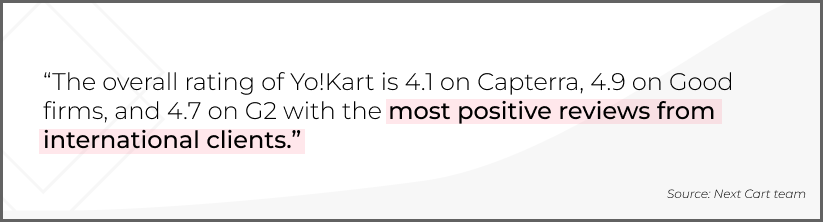
Next-Cart is a leading data migration solutions platform that offers re-platforming services between various eCommerce platforms. They have leveraged their experience of working with popular eCommerce solutions available in the market and compiled an article reviewing the best solutions.
While the article highlights the extensive feature list of Yo!Kart, much like other reviews mentioned above in this blog, also goes on to highlight the intuitive mobile apps for iOS and Android that offer signature Yo!Kart experience via high-performing robust systems.
In short, according to the Next Cart, Yo!Kart is one of the best multi-vendor eCommerce software that allows businesses to build and operate their feature-rich and user-friendly multi-vendor eCommerce marketplace. Yo!Kart’s portfolio of 5000+ global clientele – comprising small businesses to Fortune 500 enterprises also certifies how this multi-vendor eCommerce solution is gaining popularity and becoming a leading =one in the eCommerce industry.
Suggested Read: Read the full review of Yo!Kart by Next-Cart
Virto Commerce Recognizes YoKart as one of the Best Multi-Vendor Marketplace Software
Virto Commerce is an eCommerce development company, focused on providing B2B eCommerce solutions for Enterprises.
In its article on the best multi-vendor solution in the market, the team has highlighted the emphasis of Yo!Kart to provide users with pleasing experiences. The solution achieves this with user empathy-driven UX, and minimalist UI leveraging the sophistication of simplicity.
Moreover, it allows businesses to get started with its affordably priced starter packages, which effectively offer the same solution as the higher ones, making it a prudent choice for startups and SMBs. Likewise, enterprises or businesses with extensive needs have the option of customization services and a flexible core engine of Yo!Kart.
Moreover, its one-time pricing model for a lifetime license also attracts businesses to choose Yo!Kart to build their multi-vendor marketplace.
Get Robust Mobile Apps for IOS And Android Users
eCommerce Platforms Prominently Features YoKart as Best Multi-vendor Marketplace Solutions
eCommerce Platforms is a trusted source for transparent reviews on software. The e-publication has expertise in the eCommerce domain and is a reliable source for its readers for detailed and transparent reviews.
In its extensive review of Yo!Kart, eCommerce Platforms has explained why Yo!Kart continues to be a favored choice of businesses of all sizes globally. The review lists key features and pre-integrations that are pivotal to eCommerce success. According to the review by the eCommerce Platform, Yo!Kart is the best multi-vendor eCommerce solution that offers everything that one expects when building a fully functional marketplace.
Moreover, it highlights the testing that the solution has gone through to give businesses peace of mind with a robust system.
To Sum it Up
In conclusion, when you are planning to start your eCommerce venture, you will ideally want the integral components to fit in seamlessly like pieces in a jigsaw puzzle. Amongst others, the selection of an eCommerce solution plays a crucial role in your business success.
To find the best multi-vendor marketplace solution available for your business, credible third-party sources such as top e-magazines and publications offer transparent analysis and reviews of different software solutions. These reviews are invaluable in helping entrepreneurs make an informed decision. While we have compiled some of the many reviews to give you a holistic analysis, these are not the only reviews of the solution. Many more top publications, like Forbes have also listed Yo!Kart as the best multi-vendor eCommerce solution.
Hence, the recognition by reputable sources reinforces its credibility and makes Yo!Kart a top multi-vendor marketplace software for turning your dream marketplace project into a reality.
Launch Your eCommerce Marketplace Today
FAQs
Q 1. Is Yo!Kart the best multi-vendor eCommerce solution?
Ans. Yes, Yo!Kart is in the list of one of the best multi-vendor eCommerce solutions that allow you to launch and operate a feature-rich multi-vendor marketplace. It supports all the necessary features and functionality required to manage and operate a multi-vendor marketplace. Moreover, Yo!Kart enables customization and supports scalability which makes the solution a preferred choice among a large number of readymade marketplace solutions.
Q 2. How much does it cost to build a multi-vendor marketplace with Yo!Kart?
Ans. Building a multi-vendor marketplace with Yo!Kart can cost you starting at $499. However, Yo!Kart offers different packages; you can choose any one that best suits your specific marketplace requirements. Explore Yo!Kart Packages
Q 3. Is Yo!Kart a white-label multi-vendor eCommerce solution?
Ans. Yes, Yo!Kart is a 100% white-label solution. You can rebrand the solution as your own without any restrictions.
Q 4. Does Yo!Kart offer complete control and ownership?
Ans. Yes, with Yo!Kart, you gain complete control and access to the solution. The solution provides source code ownership that ultimately gives a similar level of control and ownership as one gets when developing a marketplace from scratch.
Q 6. Is Yo!Kart a self-hosted multi-vendor eCommerce solution?
Ans. Yes, Yo!Kart is a self-hosted multi-vendor eCommerce solution that allows you to host the platform on your preferred server.
Q 7. Does Yo!Kart charge a recurring or any transactional charges?
Ans. No, Yo!Kart doesn’t charge any recurring fees or transactional charges at all. The solution is available at a one-time payment. You need to pay once in a lifetime when choosing Yo!Kart.
Q 8. How much does it require to build a multi-vendor marketplace with Yo!Kart?
Ans. Building a multi-vendor marketplace with Yo!Kart requires a few weeks. Sometimes you can launch a marketplace even within a week. On the other hand, sometimes it may take a month, depending on your specific requirements. However, the solution is readymade, hence it doesn’t cause any delay.
The post Yo!Kart – Best Multi Vendor Marketplace Solution Recognized By Top Magazines & Publications appeared first on YoKart Blog.
]]>The post Yo!Kart V10 – Enhanced Shipping & Payments, Easy Data Migration, and Improved UI/UX appeared first on YoKart Blog.
]]>Yo!Kart has broken new ground as a robust multi-vendor marketplace software with its spectacular capabilities to build and manage eCommerce marketplaces. We are excited to announce the V10 release of Yo!Kart that can add new dimensions to your eCommerce businesses.
From data migration, listing digital products, offering discounts and coupons, streamlining payments and shipping, and defining review parameters, the new version will offer a truly dynamic selling and buying experience. Here’s what to expect in this release in more detail:
New Features
In Yo!Kart V10, business owners now get a unified workspace that connects all the dots of an eCommerce business: seamless shipping, hassle-free data migration, smooth payments, customizable product ribbons, and badges, offering a better interface for sellers and buyers. Let’s check out all the new features Yo!Kart V10 is bringing to enable eCommerce entrepreneurs to serve even better.
Data Migration from Shopify to Yo!Kart
Data Migration from Shopify is now supported in Yo!Kart V10. Admin and sellers can transfer all of their important data including products, customers, orders, sellers, and entities related to them from Shopify to Yo!Kart automatically, accurately, and securely. The software ensures no downtime on the current store, proper data transfer, and dedicated support during and after the migration to Yo!Kart.
Admin Shipped Product Listing Page
Admin can see the list of the sellers who have shipped the Master Products themselves. The master products that are shipped by the admin are also displayed on the listing page. Shipping profiles linked with the products can also be viewed by the admin.
Listing of Digital Products
Sellers/admins can add the preview (audio/video) of digital products like eBooks where buyers can view the sample/preview to get an idea of the product before making the purchasing decision. This trending feature of eCommerce is now available in Yo!Kart V10 by integrating JW Player plugin that gives your store an edge with increased conversion rates and efficient customer experience eventually reducing product returns.
Sellers and admins also have this option to attach the latest updates to the digital products with the orders that are already placed. Enabling this will send an update to the buyers who have already placed their orders.
Product Ribbons
Admin can create product ribbons (colored labels over product photos) for the products that require a spotlight. These ribbons make it easier for the customers to find the products they would truly love and help you to put your store’s best foot forward. Admins will have full control over these ribbons and can monitor and adjust everything from the dashboard.
Product Badges
Yo!Kart V10 comes with product badges which are textual and graphical labels used to highlight items in the store to draw the user’s attention immediately. These badges can be used to tap into powerful psychological triggers such as scarcity, social proof, and urgency to boost sales. The product badges are created by the admin and are of two types – manual and automatic.
Manual badges are needed to be linked with the shop/product by the seller which can with er be done directly or by requesting the admin. Automatic badges are automatically linked with the shop/product if it fulfills the conditions defined by the admin while creating the badge such as ratings, order cancellation rates, order completion rates, and many more.
Have a Walk-Through of all the latest features in Yo!Kart V10
Payment Gateways
With already more than 20 payment gateways integrated into Yo!Kart, Version 10 comes pre-integrated with 4 new payment gateways – Mollie, Payfast, YoCo, and QNB to streamline the sales conversion funnel even more efficiently. These multiple payment gateways ensure that your business is able to collect and disburse payments safely in any corner of the globe.
Additionally, multiple payment gateways would not only satisfy the choice of customers who have a couple of selected payment gateways in their mind but would also serve as a backup when there is downtime in any of the payment gateways. There will be no hindrance in continuing your business with multiple payment gateways that can fill each other’s gaps.
Shipping APIs
With ShipStation and AfterShip already integrated into Yo!Kart, the new version comes pre-integrated with 3 more shipping APIs – Shiprocket, EasyPost, and ShipEngine. The multiple shipping APIs allow you to compare shipping rates across all carriers and choose the best fit.
Reduced checkout abandonment, automatically validating addresses, real-time tracking, less time spent on tedious shipping tasks, and increased efficiency are some of the benefits offering a powerful competitive advantage for your eCommerce platform.
Rating/Reviews
Admin can now define new review/rating parameters at the time of creating a new product category. Additionally, the product, seller, and shipping can be reviewed and rated separately to have more transparency. Buyers can view the separate ratings for every parameter and not based on the average of all the ratings to make an informed decision.
Missing Product Information
There are around 20 parameters defined under the product/inventory module which are to be filled by the admin/seller before listing a product. Failing to fill in all these details of the product will prevent the product from displaying on the front end.
Enhancements
The enhancements and upgrades in Yo!Kart V10 include:
Performance Updates
– Enhanced/updated cache mechanism to make your system optimized and enables you to perform the action quickly.
– Dashboard segregation has been executed at the code level which again enhances the functionality of the system and ensures optimum utilization of resources.
User Experience and Enhancements
– Buyers do not need to set passwords for their accounts, they can register and log in via OTP.
– Fresh and new UI/UX for front end and admin dashboard.
– A help text section has been added on the Admin side for the majority of the Primary Pages explaining the steps and impacts associated with functionalities. It appears on the right side of a page at the Admin’s end.
– A sorting feature has been introduced on the listing pages to perform bi-directional sorting operations.
Alert & Suggestion Text Bar (Admin)
An alert and suggestion bar has been introduced at Admin’s end to display the necessary information to be kept in mind (as a warning/recommendation) while filling/configuring the details related to that module or submodule.
Tax Module Enhancements
Introduced new form fields while setting up Tax rules in order to handle various to-from workflows.
Stripe Connect Enhancements
– The seller onboarding workflow has been updated to a Stripe-hosted platform personalized page.
– Added payout delay settings under the Admin.
– Updated the payment page to the stripe-hosted solution.
– Removed the saved card functionality.
– Enhanced support for EU countries.
Excited to Learn More About Yo!Kart V10
Product Addition Enhancements
– Single Page Flow: Every detail related to a Product can be filled/managed in one go and Admin/Seller does not have to go through multiple tabs.
– Language-specific flow
– Product-specific Options Linking at the Inventory level: Once you have created a product, linked options to it, and then, added the inventory details for all the variants, you cannot go back to the Product Form and link more options to that product. However, you can add more option values for the options that have already been added to that product.
Inventory Form Enhancements
– Updated the inventory addition workflow.
– Once a seller configures product-related details, the system will automatically generate product variants listing depending upon the linked Options’ permutation and combination for that Product. But this will be the case when the Product options combinations count is below 20. If this count is greater than 20 then the user has to manually configure the Product inventories.
– The seller can add additional files while completing a digital order.
Theme and Font Enhancements
– Included Google Font feature in the system facilitating the user experience.
– Enhanced the color theme module with preview options.
Shipping Module Enhancements
– Option for Sellers to configure their own shipping APIs in the Dashboard.
– Option for Sellers to use manual rates with shipping API (Admin configured/Seller configured).
– Option for Sellers to use preferred API regardless of Admin’s side settings.
Note: We have proper documentation for the Shipping module covering multiple case-based scenarios.
User Management Module Enhancements
Admin now can create users in the Platform.
GDPR Enhancements
– Users can set their cookie preferences that can be used by the system based on their consent.
– Guest user data is stored in cookies while registered user data is stored in the database.
– Added management of functional, statistical, and personalization cookies.
Reports Enhancements
- Sales
– Sales over time
– Products
– Product Variants
– Shops
– Customers - Users
– Buyers
– Sellers
– Affiliates
– Advertisers - Financials
– Earnings
– Profit by-products
– Preferred payment methods
– Payout
– Transactions - Subscription
– By plan
– By seller - Discount Coupons
Listing Page Enhancements
– Added maps listing view for Products containing the Shop details and Price details corresponding to the Products available in this Shop.
– Added map view for all Shop listing pages.
– Option to increase the price of a product based on dates (Price Surge – Managed under the Admin>Promotions>Special Price Module).
UI/UX Enhancements
– User experience improved for All Categories page and Seller’s Shop page.
– Intensified the use of SVG sprite images (Vector-based) and grouped its management in a more easy way.
– Increased the number of layouts for Categories, Products, Banner, Brands, etc.
– Comparison of different sellers’ prices on the Product Detail page offering more options to the buyers.
Get a Free Personalized Run-Through of Yo!Kart V10
Over to You!
The core user experience remains the highest priority for us here at Yo!Kart and along with the latest features, this release tackles a bunch of enhancements. That’s all from us for now! We’ll be back again with all the updates that our team is working on currently.Until then, connect with us to have a chat about anything you might want to know about Yo!Kart V10. We’re all ears.
The post Yo!Kart V10 – Enhanced Shipping & Payments, Easy Data Migration, and Improved UI/UX appeared first on YoKart Blog.
]]>The post Introducing Yo!Kart B2B – eCommerce Marketplace Software Purpose-built For Modern B2B Needs appeared first on YoKart Blog.
]]>B2B eCommerce was slow, to begin with, but accelerating digitization of commerce, evolving consumer behavior and expectations have opened up opportunities in B2B as well.
Ecommerce revolves around the buyer. In B2B’s case though, the buyers are businesses, which emphasize ROI, long-term value, and negotiable purchases relying on analysis-driven decisions.
Legacy Commerce platforms are insufficient for B2B needs. FATbit realizes this, and with the experience of working with B2B clients over the years, it has now developed a turnkey solution that exclusively facilitates B2B eCommerce.
Introducing, Yo!Kart B2B V1.0: A purpose-built platform to drive seamless B2B eCommerce with an emphasis on facilitating business interactions online – identical to the way they take place in the real world.
The solution has been developed by deep insight into the evolving eCommerce landscape, emerging B2B eCommerce opportunities, and team Yo!Kart’s expertise in successfully delivering online B2B marketplaces over the years.
Yo!Kart B2B – The Encore Of 2015 By The Same Team!
Since its inception, Yo!Kart has powered 2000+ online marketplaces in 50+ countries. The marketplace software has been used to create marketplaces in niches like Grocery, Liquor, Fashion, and more.
Many amongst these Yo!Kart-powered marketplaces were custom developed to operate in the B2B space. Notably, top-end online B2B marketplaces like UNI diamonds, Bozinga, and more.
Recognizing the growing need for turnkey solutions in the B2B industry, the team at Yo!Kart use its expertise of in-depth analysis of B2B eCommerce and its underpinnings that drive success in the space.
Based on the analysis, the team has devised a path to create a scalable B2B marketplace solution specifically for distributors, manufacturers, wholesalers, service providers, and other businesses to conduct sales effortlessly. Fittingly, precise marketplace platform functionalities were earmarked to foster key B2B business requirements. The result has taken shape in the form Yo!Kart B2B.
With the same development ethos and a result-driven approach, the software aims to emulate the success achieved by the team since 2015 – with yet another product that plugs the market gap with precise purpose-driven functionalities.
Entrepreneurs or enterprises considering launching an online B2B marketplace, YoKart B2B offers key B2B eCommerce features out of the box.
Yo!Kart B2B – Perfect Solution For Distributors, Wholesalers, Manufacturers & Service Providers
Yo!Kart B2B – Fostering eCommerce Amongst Businesses Sans Complexities
The B2B ecosystem is unique where the core factors driving the business vary vastly from B2C. Yet some underlying principles of eCommerce success remain constant. Yo!Kart B2B is built with features that assist buyers to source their needs with all tools necessary to make informed and value-driven decisions in a seamless ecosystem.
Likewise, sellers get to cater to the buyers’ requirements, and marketplace owners can manage with higher operational efficiency, market the B2B marketplace effectively, and foster their brand image with a contemporary platform. No wonder, Yo!Kart B2B is among the best B2B eCommerce platforms.
Discussed below are key requirements of B2B eCommerce and how Yo!Kart B2B fulfills the requirements:
B2B eCommerce Requirement #1: Higher Volume Transactions
Volumes are key to the value proposition of a product in a business transaction both for the buyers as well as the sellers. Because of higher revenue generated from higher quantity purchase requirements, manufacturers, distributors, or other sellers can negotiate the selling price of their products. Likewise, buyers would want a lower price for a higher quantity purchase for higher profit margins on their purchase investment.
Negotiations, thus, are key to business transactions. Listed below are Yo!Kart B2B features that assist in the negotiation process;
RFQ Module
Yo!Kart B2B features an intuitive RFQ module inbuilt out of the box that facilitates seamless two-way negotiations between the buyers and sellers.
Buyer-seller Direct Communication: To assist the buyers further in the negotiation process, the software allows direct chat conversations with the buyers. Furthermore, to lend transparency to the process, these chat conversations can be monitored by the admin of the marketplace.
Hide Product Prices: Keeping the product cost open to negotiations could mean the sellers may not want to display the prices on the marketplaces. Yo!Kart B2B lets sellers hide the prices of the products on the marketplace.
Minimum Order Quantity: Sellers also have the option to restrict the sale of products to a minimum order quantity. This can help them to set the product prices competitively, while also considering the minimum logistic costs.
Bulk Price Discounts: The sellers can further encourage volume purchases by offering discounts on bulk orders.
Watch the intuitive B2B Ecommerce marketplace software in action
B2B eCommerce Requirement #2: Offering Both Services And Products
Business procurements may not entail finished products. Services may be required by buyers alongside the products. Additionally, services may be required for product maintenance, installation, or other needs for the buyers (businesses) themselves or their customers.
Offering services and products can broaden the scope of the B2B marketplace. More sellers can be onboarded. And buyers’ options increase with the availability of both on a single platform.
Yo!Kart B2B based marketplaces allow the sellers to list both services and products on the marketplace with the following features:
Services Listed Bundled With The Products: This allows the buyers to purchase the services along with the products. It can also be done in the same shopping cart.
Services Listed Independently: This allows sellers that provide services exclusively offer them to the buyers. The buyers’ options further increase with services available exclusively from the sellers.
B2B eCommerce Requirement #3: Features That Form The Backbone Of eCommerce Success
Along with the B2B-specific features mentioned above, Yo!Kart B2B also shares virtues with the B2C offering.
APIs pre-integrated: It comes with multiple pre-integrated business APIs to streamline eCommerce operations, and multiple payment gateways.
User-friendly Design & Functionality: The software also offers a seamless UX/UI and features like one-click reorder, marketing tools for the admin, and more to maximize conversions.
Moreover, the software is also self-hosted and license-based. It is available in all-inclusive packages starting from just $1499.
B2B eCommerce Requirement #4: Reliable, Efficient After-sales Support
As soon as the marketplace commences its operations and business transactions start to take place on it, buyers start relying on it for their requirements. Unlike in B2C, procurement in B2B follows a longer sales cycle and the dependence on procurement channels impacts business operations driving the business fortunes, both short term and long term.
The B2B marketplace needs to offer seamless eCommerce, ironing out any impediments or including identified business-specific enhancements.
Thus, efficient and reliable after-sales services are key to success in online B2B eCommerce.
B2B eCommerce Requirement #5: Scalability, Fewer Overheads, And Long Term Viability
As discussed, B2B transactions are often of high value. As the business scales, more sellers mean more products.
Moreover, cost competitiveness drives the B2B space with companies pushing supply chain advantages, higher volumes, and other strategies to leverage that extra bit of advantage over competitors.
Yo!Kart B2B is scalable and supports unlimited addition of products and services. It levies no hidden or transaction costs securing competitiveness and long-term viability for the marketplace owner and the sellers.
These are some of the key features of Yo!Kart B2B that are suitable for almost all the B2B eCommerce business models. Furthermore, the solution has an extensive feature list to provide businesses with a contemporary online B2B marketplace –
Explore Yo!Kart B2B Complete Feature List
Deliveries Of Yo!Kart B2B Has Commenced
The B2B marketplace software is available right off the bat. Any customization services needed are also available from an in-house Agile team.
Start Your B2B Marketplace with Yo!Kart B2B Platform
The post Introducing Yo!Kart B2B – eCommerce Marketplace Software Purpose-built For Modern B2B Needs appeared first on YoKart Blog.
]]>The post Introducing Yo!Kart’s Value-based Tiered Pricing Model- New Plans For Businesses at Any Stage of Growth appeared first on YoKart Blog.
]]>Since our inception, we’ve interacted with several business prospects and understood that each business has its unique marketplace requirements. For instance, while some startups require an MVP for eCommerce with core marketplace functionalities, other businesses need a fully personalized multi-vendor store to reflect their brands’ USP. This experience gathered over the years has helped us build/improve our offerings to the clients’.
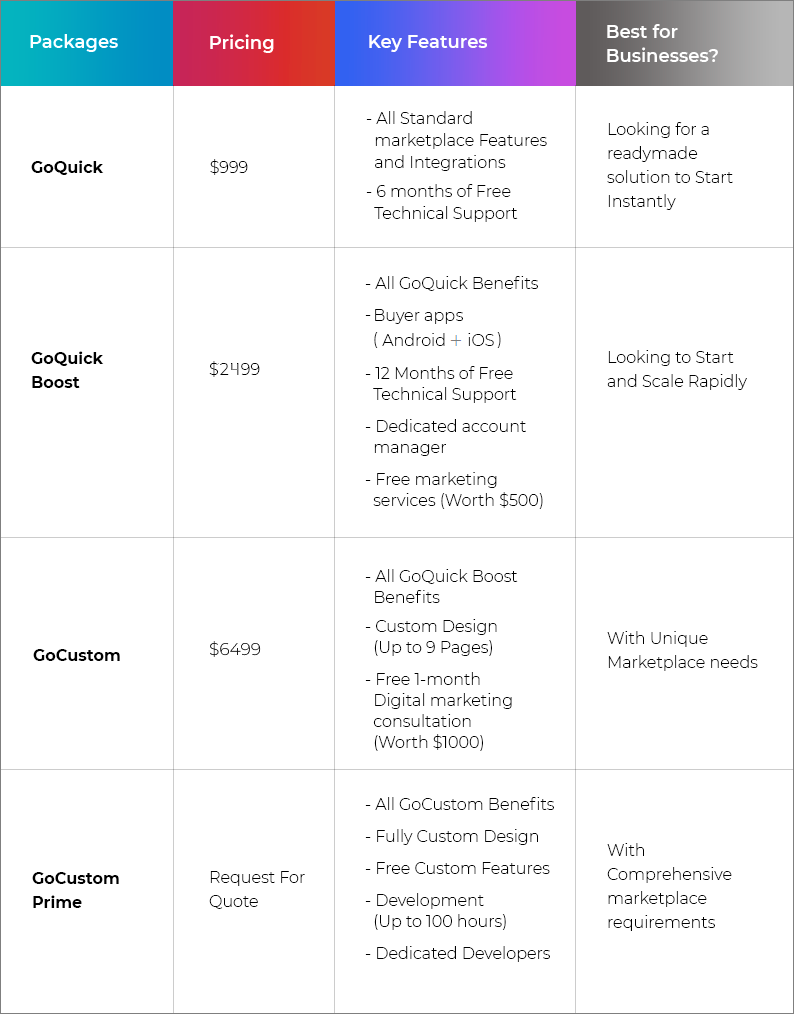
Today, we are excited to announce the entirely reimagined Yo!Kart Pricing Packages, designed to offer more control, flexibility, and value to businesses at any stage of growth. The new pricing model is intended to reflect our transparent business practices and to help startups, as well as enterprises, launch their online marketplace successfully.
The new pricing model is a step in the right direction to cater to all our clients. We have designed four unique all-inclusive pricing plans for every stage of your business.
Key Takeaways:
- Unique pricing plans with inclusive benefits tailored for all marketplace needs.
- To meet our clients‘ growing mobile commerce demands, Buyer mobile apps (Android + iOS) are now part of packages.
- Focus on providing more personalized technical assistance with dedicated account managers and up to 12 months of free support.
- Feature segmentation to ensure transparency in all plans.
- For the successful launch of your online marketplace, we are giving Free digital marketing services like Google analytics & search console setup, keyword research, meta tags optimization, business profiles creation, and more – included inside new pricing plans (All Plans except GoQuick. T&C apply).
Here are the Pricing Packages:
Frequently Asked Questions:
Q1. What will happen after I place the direct order?
Once you’ve placed the direct order, you will receive an order confirmation on your registered email within 2-12 hours on business days. Next, the sales team member will coordinate with you to configure your account setup in the project management system (PMS) and to set up server-side scripting. Afterward, a project manager is assigned to coordinate and streamline script installation on your choice of server. You will also receive complete documentation and up to 1-year of free technical support for any bugs and errors found in the system.
Q2. I have purchased the GoQuick/GoQuick Boost Package but now I wish to upgrade it?
If you wish to upgrade your existing plan to either GoCustom or GoCustom Prime within 3 months of your purchase, the price applicable will be the total cost minus the previously paid fee for the existing plan. For upgrading after 3 months of your purchase, the existing pricing structure is applicable.
Q3. I have directly ordered the GoQuick/GoQuick Boost Package but I need more features?
After you place the order and you require additional marketplace features, you can coordinate with the assigned project manager for the same. We provide customization services to integrate new features, incorporate design modification, and add third-party APIs to the existing solution at a fee.
Q4. Can I buy apps separately with the GoQuick Package?
Yes. We offer readymade buyer mobile apps for both Android and iOS platforms. Plus, if you want, you can also order a separate seller app as per your business needs. Contact our team for more details.
Q5. What digital marketing services will you provide in GoQuick Boost & Other Packages?
We provide 30-days of free digital marketing consultation for all plans except GoQuick. Our digital marketing services include:
- Google Analytics & Google Search Console account set up
- Account setup on Google My Business
- Keyword research
- Meta Tags optimization
- Business profiles creation and more
Q6. Will I get an account manager in the GoQuick package?
Yes. Once you’ve purchased the plan and shared the required information with the sales team member, a project manager will be assigned to coordinate and deploy the marketplace on your choice of server.
Q7. What is design customization in the GoCustom package?
Under the GoCustom plan we deliver the following design customization services:
- Tailored homepage design
- Custom design for eight inner pages, including login/sign up page, seller registration page, product listing page, and others
- Design modifications on programming scripts as per your business requirements
- Changes to user dashboard to match with the redesigned inner pages
You will receive exclusive rights to these custom designs and non-exclusive rights to default Yo!Kart features.
Q8. Will I get the source code if I buy any of the Packages?
All Yo!Kart packages come with lifetime ownership and complete access to source code (excluding framework) so you can customize your marketplace and scale rapidly.
Q9. Can design and functionality customization be done on GoQuick packages?
The GoQuick Plan comes with a default design and features. If you wish to customize the design or make operational increments, you can either opt for a higher package or avail of our customization services at an additional cost.
Still have queries on the Yo!Kart Pricing Plan and Deliverables?
The post Introducing Yo!Kart’s Value-based Tiered Pricing Model- New Plans For Businesses at Any Stage of Growth appeared first on YoKart Blog.
]]>The post Yo!Kart Releases V9.3 to Personalize Shopping Experiences & Automate Payouts, Taxes & Shipping appeared first on YoKart Blog.
]]>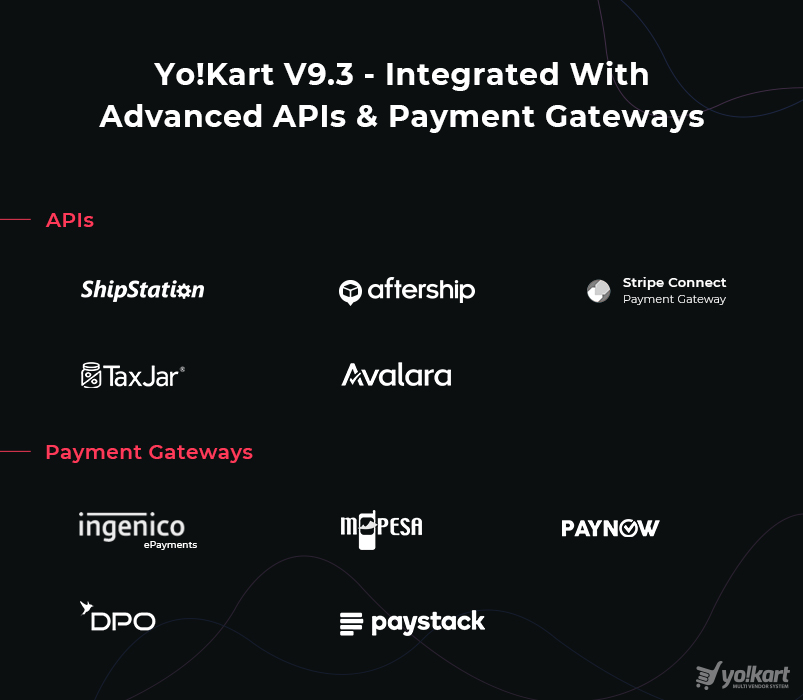
Table of Content
New Features & Functionalities
Every entrepreneur’s first priority is to capture the market; automating business operations and streamlining the process comes later. In Yo!Kart V9.3, our development team focused on adding features/functionalities to automate payouts, taxes, shipping management and streamline the work for marketplace business owners.
ShipStation API – One of the biggest pain points of the admin/seller is to manage the logistics and post-order process. Though the shipment is managed by third-party vendors; the logistics support flow is a difficult task to manage for the admin. To make the process easy for sellers as well as admin, ShipStation Shipping API has been integrated into the Yo!Kart system allowing eCommerce marketplace website to:
- Fetch live rates from shipping carriers configured
- Create shipping labels & generate tracking numbers for orders from shipping carriers configured
- Create shipping orders from shipping carriers configured
AfterShip Tracking API – Another woe for an eCommerce marketplace owner is to provide tracking information to the end-users. Consumer trends have changed and people like to stay updated about the whereabouts of their order. Your eCommerce marketplace must be equipped to provide tracking information to the customers. AfterShip Tracking API is now integrated with Yo!Kart, which will allow admin & buyers to:
- Track orders with shipping orders created outside ShipStation API. Admin will have to add tracking numbers manually and share tracking URLs.
- Map ShipStation carriers to AfterShip carriers, in order to track shipping orders generated via ShipStation.
- If ShipStation API is not enabled then the admin can add tracking numbers along with the shipping carrier to track shipments.
Stripe Connect for Split Payments – For an online marketplace owner, managing the payment process manually such as withdrawal requests, seller payouts, & refunds is a time & effort consuming task especially if you are operating globally. To make online payments & seller payouts facile, Stripe Connect is integrated with Yo!Kart multi-vendor platform. Stripe connect allows an online marketplace to:
- Automatically create customers’ profiles at stripe accounts along with saving their cards. Cards for a user can be managed from the Saved card section on the buyer dashboard.
- Split the charged order amount in real-time between multiple sellers and admin.
- Refund the amount to the buyer and create reverse charges for sellers & admin in-case of refund requests
- If discount coupons or reward points are used, then the system will generate a new transaction from the admin’s account to credit sellers in equal proportions. These transactions will be reversed in case of a refund/cancellation in addition to the original order transaction.
*If the admin chooses Stripe Connect as the preferred payment gateway, wallet & other payment gateways will be automatically disabled.
Tax Management API – TaxJar API/ Avalara API – If your eCommerce marketplace is catering to the global audience or multi regions, then assigning taxes to different states according to their tax rules and then assigning products to the tax bracket is strenuous. TaxJar API and Avalara API are essential integration for global business owners. With pre-integration of TaxJar & Avalara APIs, Yo!Kart is now capable of:
- Real-time tax rates are fetched based on categories imported and assigned to products.
- Nexus is not handled in the API and shall be an SDNEL customization for clients.
*Through API the process is automated, we do have a manual tax module integrated into the system.
Location services – Personalization has become the first priority to attract customers, entrepreneurs have been struggling to provide personalization with the features integrated into Yo!Kart. With these location services, the admin can ensure personalization by:
- Manageable Geo-Location setting for the admin to turn on/off this setting.
- Set the product listing & search on the platform based on the following
– List/Search products by delivery address
– List/Search products by radius in kilometers
– List/Search products based on pickup/current location
- Products that are not available for a location will have a tag displaying “Not available for your location”. Add to cart functionality will not be available for products that are not available at a location.
Pickup – BOPIS (Buy Online & Pick in store) became a popular way of receiving online orders during the pandemic when essential products were bought online. We understood the growing trends and evolved our solution to reach market demand. Following functionalities are incorporated into Yo!Kart:
- Admin can define their fulfillment method (Ship only, pickup only, both) in the settings module.
- The seller can define their fulfillment method (Ship only, pickup only, both) in the settings module.
- Admin/Seller can define multiple pickup addresses and time slots
*With Yo!kart platform, you can enable your customers to pay at the store for pickup orders
Invoicing Module – One reason why the majority of the population did not prefer shopping online was because of the transparency of the transaction involved. Invoicing provides transparency to the customers about the order they have placed. Invoicing modules are especially important for b2b eCommerce marketplaces. Yo!Kart is integrated with the Invoicing module which has:
- New seller tax invoice module with manageable
– Invoice number
– Management to display tax categories on the invoice
– Management to add mandatory government information on invoices
Engaging Checkout Experience – The checkout process has to be seamless to reduce the number of abandoned carts. The checkout must be optimized according to the user’s journey. Our team has analyzed the online shopping behavior trends to get a hold of the perfect checkout module that will minimize the abandoned cart rate. Yo!Kart has added these additional features to the checkout module:
- New cart page for buyers to select the fulfillment method between ‘Ship’ & ‘Pickup’
- Buyers can also add items to the ‘Save for later’ list. These items will always stay in the cart and will be available for checkout. Buyers will have to be a registered user to use this functionality.
- The system shall show errors/warnings on products based on their fulfillment method. Buyers can resolve these warnings or continue the checkout process.
- All payment gateways that do not require a redirection are now accessed in the checkout module rather than navigating to a new page.
- A new order confirmation page with order details.
Payment Gateway Integrations – Yo!Kart in its endeavor to reach global entrepreneurs has integrated 3 new payment gateways to serve clients from the Democratic Republic of Congo (DRC), Egypt, Ghana, Kenya, Lesotho, Mozambique, and Tanzania. Yo!Kart is now pre-integrated with mPesa, Paynow & DPO payment gateways along with other 17 payment gateways.
Get a First-hand experience of the new features of Yo!Kart V9.3
Enhancements
Even though the team has added new features/modules to automate the processes, the earlier manual processes like the tax modules and shipping modules are still available in the system. We have enhanced the existing features to make them upgraded according to the trends.
SEO Enhancements
- New module for Image alt tags optimization
- Schema code management
- Upgraded URL rewriting with canonical & 301 redirects
- Added Google Webmaster verification process in the admin panel
- Added Bing Webmaster verification process in the admin panel
- URL rewriting based on the website’s language
Tax Module Enhancements
- New enhanced tax module that can support single vs combined tax structures.
- Taxes can be defined based on locations.
- The seller cannot edit tax but can view tax profiles/rates in the tax category section on the dashboard and add a new product form.
General Enhancements
- Added PayPal payment gateway to support pay by PayPal account or card
- Updated Stripe payment gateway for 2 factor authentications to support EU countries
- Seller/Admin can add Category from the product form
- Seller/Admin can add the brand from the product form
- Append language code to slug setting
- Fixed product without option and adding an option with inventory
- Hot Jar integration
- Setting to manage product price is inclusive or exclusive of tax
- Import-export sheet updates
- PHP 7.4 compatibility
Security & Performance Enhancements
- S3 bucket compatibility
- CDN compatibility
- Security Headers for clickjacking, XSS, and MIME types.
- SQL query optimization
UI/UX Related Enhancements
- Manageability to use a mega menu or a hamburger menu on the navigation section on the homepage.
- Manageability between left & top display for search/listing filters
- Sellers are by default redirected to the inventory management page when clicking on the products menu in the dashboard.
- Admin catalog & seller products have been split between two separate tabs
Advanced Search Module
- Manageable setting to choose between regular or advanced search module
- Advanced search module will display the following
- Related products with the associated categories
- Related brands according to the search string
- Related categories according to the search string
- Search history
- The system will redirect to the brand page if the search string matches a brand.
Conclusion
2020 has been the year for transformation in consumer behavior and trends, due to the pandemic, people have adopted digital much faster than predicted. We are dedicated to providing the best thus incorporating the changes to our system for automation. With Yo!Kart V9.3 a multivendor marketplace software, we are looking forward to more success for our clients.
In case you have a feature upgrade suggestion for us to include in YoKart, feel free to mention that in the comment section below.
The post Yo!Kart Releases V9.3 to Personalize Shopping Experiences & Automate Payouts, Taxes & Shipping appeared first on YoKart Blog.
]]>The post Yo!Kart vs Shopify Multi-Vendor Marketplace Platform: Key Differences appeared first on YoKart Blog.
]]>Investing in eCommerce is a wise choice since the eCommerce industry has grown exponentially in recent years with the increasing number and sales of online businesses. By the end of 2020, there will be 2.05 billion online shoppers across the globe, according to Statista. This explains why businesses and entrepreneurs are so keen to launch an online store.
But the problem is, since there is no entry barrier to this field and the number of competitors is huge, many store owners have to shut down their business after a couple of months because it is difficult to survive in an oversaturated market like eCommerce.

It is wiser for store owners to quickly realize that it’s very hard to survive with just an eCommerce store. What they need is an online store that can support hundreds of vendors and thousands of products, in other words, a multi-vendor marketplace.
A multi-vendor marketplace is an eCommerce platform that allows multiple vendors to register and sell their products from an individual storefront. Multi-vendor stores provide shoppers with a huge list of products to choose from and sellers with a bigger base of customers. While the multi-vendor marketplace has the technical capabilities to support many sellers simultaneously, the regular online store only supports one seller.
Considering the significance and the benefits of multi-vendor marketplaces for sellers, buyers and owners, we know that choosing a suitable platform to build multi-vendor marketplaces is of great importance. In this article, we will discuss a comparison between Yo!Kart and Shopify Multivendor, another competitor in the multi-vendor industry. In case you missed the first part, check out our Yo!Kart and Cs-Cart multi-vendor comparison.
Since this is a highly detailed comparison of Yo!Kart and Shopify, here’s a quick table of contents to walk you through what we will be covering:
Table Of Content:
What is Shopify?
What is Yo!Kart?
Pricing
Features
3rd Party Integration
Customizability
Support
Why Yo!Kart is the Best Alternative to Shopify Multivendor – Overview
What is Shopify Multivendor?
Shopify is a Software as a service (SaaS)-based eCommerce platform that helps you create an online store without extensive hardware set-up. It has a third-party Multi-Vendor Marketplace application by Webkul to convert your eCommerce store into a fully functional multi-vendor marketplace.
The Shopify Multi-Vendor plugin allows you to add unlimited vendors, products, and sync products from other eCommerce stores.
What is Yo!Kart?
Unlike Shopify multivendor system, Yo!Kart is a License-based eCommerce multivendor platform that provides complete control to the business owner to build a marketplace. It helps eCommerce startups, existing online vendors, and retailers to launch a multivendor store successfully. With all the features required for a successful multi-vendor marketplace, Yo!Kart soon became the platform of choice for many merchants thanks to its easier setup and implementation process, powerful reporting tools, SEO features, and expert assistance.
Being a standalone multivendor eCommerce platform, Yo!Kart is undoubtedly among the best alternatives to Shopify Multivendor.
Yo!Kart and Shopify Multivendor – Break-into-pieces Comparison
Pricing
Shopify pricing includes three main plans ranging from $29/month to $299/month. The cheapest one is Basic Shopify, which gives you all the basic eCommerce functions. This plan is suitable for starting a business. The next plan, “Shopify” comes at $79/month and has everything you need to grow your business with some additional features. And the most expensive plan, “Advanced Shopify”, comes with advanced eCommerce features. This plan is suitable for medium and large-scale businesses to grow without limit. Besides the cost of setting up a Shopify store, you will need to pay $10 – $45/month for the Multi-Vendor Marketplace app. All the plans include a 14-day trial.
Yo!Kart doesn’t charge you monthly as Shopify does. Instead, it comes with one-time packages starting from $1249 Plan (GoQuick). They offer 4 unique multivendor marketplace packages tailored to meet your marketplace business needs. All the packages are self-hosted and include free installation, zero transaction fee, and a lifetime license. You can pick a plan best suited for you.
In addition, Yo!Kart offers digital marketing services free for 1 month. Their experts will help you launch a custom marketing plan with your own content marketing strategies, competitive analysis, and website traffic generation techniques, among others.In the short term, Shopify Multivendor Marketplace might be cheaper than Yo!Kart but in a long-term scenario, Yo!Kart offers a more reasonable pricing policy and that gives you another reason to consider it as an alternative to Shopify Multivendor.
Features
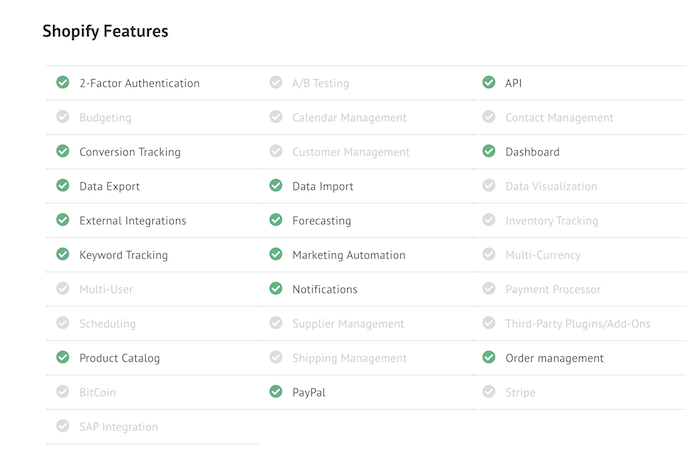
If you use Shopify, the Multi-Vendor Marketplace plugin is a great tool to convert your store into a marketplace. It offers a variety of multi-vendor features such as 2-Factor Authentication, Conversion Tracking, Product Catalog, Marketing Automation, Order Management, External Integrations, and more.
In addition, Shopify also has many additional feature apps.
- Payment Methods such as Stripe Connect for split payment between Admin and Seller
- Auction for Sellers
- Mobile App for Customers
- Shipping methods such as Australia Post, Canada Post, EComm Express, AirSpeed, UPS, FedEx, Vamaship, Bluedart available for Sellers
- Allow “Store Pick Up”
- Sync your Seller products from their own eCommerce store (Shopify, Prestashop, Etsy, WooCommerce)
- Sellers on Vacation? Now update the Customer about the same using this app.
- Customers asking questions to Sellers directly
- Admin can assign badges to sellers
- Booking can be added with Products.
- Membership plan for Sellers
- Favorite Product/Seller
- Multi-vendor API
- Admin Staff (can add staff member)
- Commission Management: It’s the admin share in the seller’s order.
- Global Commission: Applied on all the sellers
- Individual Commission for Seller: If an admin wants a different commission rate for individual sellers then he/she can do it with an individual commission. Also, the commission can be either a fixed amount or percentage-wise for global as well as individual commission.
Please note that you have to pay a certain amount to have these Feature Apps on your website.
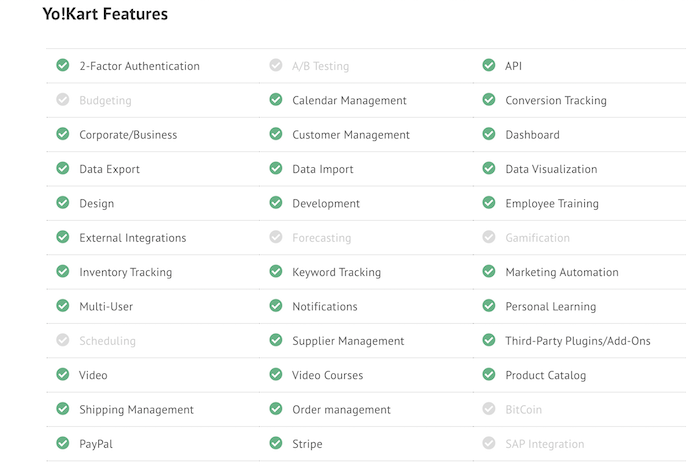
It seems like in the game of multi-vendor features, Yo!Kart has been leading this round by offering more features than Shopify does. It also offers robust reporting, with real-time tracking to see how your sales are going. Periodical reporting is included to help merchants notice market trends and tailor their offerings accordingly.
Yo!Kart also has an inbuilt CMS to get your customers hooked up to your website through regular blogs or postings. Plus, it includes some notable marketing features like PPC advertisements, Affiliate modules, social media sharing, and many more.
Above are the highlighted features that Yo!Kart offers. You can check a more detailed list of multivendor eCommerce features on Yo!Kart website.
Other notable features of Yo!Kart includes:
- Catalog System and Private Products
- PPC Modules for Sellers
- Stripe Connect for Vendor Payouts
- Easy Order Management
- Multilingual with RTL Support
- Custom Push Notifications
- Easy Product Comparison
- Pre-integrated with QuickBooks, TaxJar, Avalara, ShipStation, etc.
3rd Party Integration
An eCommerce store hardly runs independently of other tools because they are crucial for the success of the business. These tools may include ERP systems, order management systems, tax tools, shipping platforms, optimization tools, and many more
Since Shopify is SaaS-based, Shopify store owners are tied to using SaaS APIs for integration with existing business systems. It is not always possible to integrate an eCommerce store with all of your existing business applications because the APIs are limited. Unfortunately, there would be no technical support available from Shopify support teams. Our suggestion is that you should have the right team in place, as any integration on the SaaS approach will require development time.
With License-based multivendor eCommerce platforms like Yo!Kart, owners have the luxury to get custom integrations generated for the eCommerce store to incorporate existing business system applications seamlessly. Yo!Kart can be integrated with almost any API. It also comes pre-integrated with Paypal, Stripe Connect, Google Analytics, ShipStation, Taxjar, Avalara and other popular third-party applications.
Customizability
Shopify is best known for its huge library of themes and plugins. It offers over 70 themes including paid and free ones to choose from for your eCommerce store. You can modify colors, language strings, and more either by yourself or you can work with a Shopify development company to customize the front end. Even better, you can buy a theme that meets your needs out of the box.
On the other hand, Yo!Kart has a dedicated team that delivers additional customization. You can customize your website however you want, but it requires some technical experience. Yo!Kart comes with a wide range of templates that go with your specific niche (fashion, electronics, furniture, sports, and grocery) perfectly. These ready-to-use themes & intuitive designs will bring a satisfying user experience making shopping a pleasant experience. In short, Yo!Kart makes it easy for business owners to target the right audience. This is a big plus for Yo!Kart over Shopify Multivendor Plugin in this round.
Support
Besides the basic support such as FAQs, blogs, Documents, Tutorials, the biggest advantage of Yo!Kart support is that it offers FREE 12-months technical support for all Yo!Kart packages to resolve any bugs/errors found in the system. You can also opt for paid technical support after 12 months if you want. Please note that the 12-month Free Technical Support becomes invalid for those who have done any customization in Yo!Kart script either on their own or through any 3rd party.
There is no technical support for the Shopify Marketplace apps. However, you can still use all the support from Shopify for eCommerce stores. Shopify provides help via various channels. including phone, email, and live chat. Plus, you can also go to its community forum, help center, business courses, and video tutorials. Other than that, you can hire professional Shopify experts to ensure optimal problem resolution and seamless business operation.
Client Reviews
Let’s go through a review on Capterra where the user stated that he switched from Shopify to Yo!Kart multi-vendor eCommerce platform. He mentioned that he switched because Shopify’s multi-vendor system is not as powerful as Yo!Kart.
Check the complete review here.
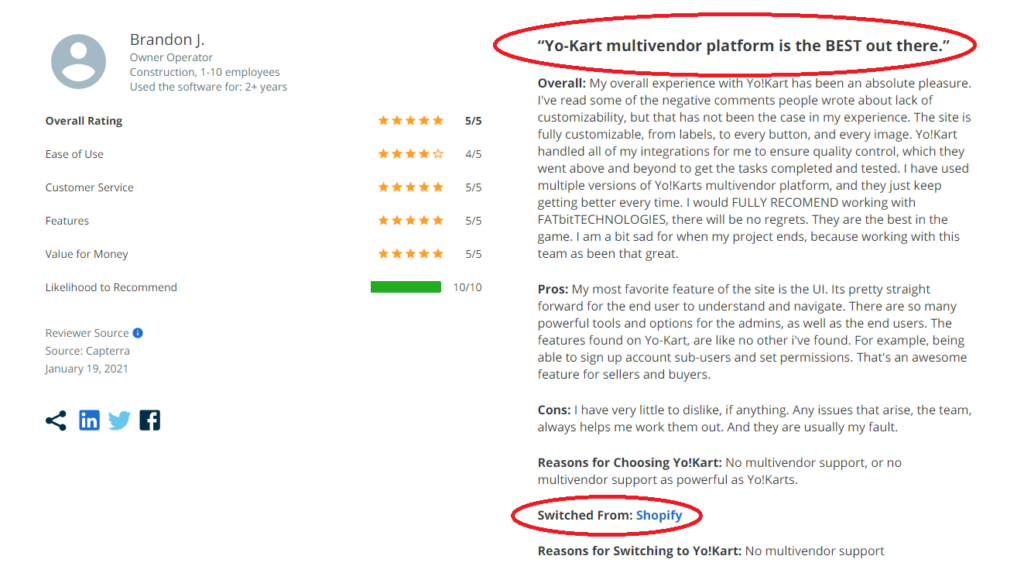
Conclusion
To sum up, Yo!Kart has surpassed Shopify in the game of Multi-Vendor. Yo!Kart has all the necessary features for a multi-vendor marketplace, most of which are additionally charged in the Shopify Plans. Yo!Kart’s all-in-one package for $1249 is not bad. Other than that, the report can amazingly predict trends, and the frontend has plenty of features for buyers to play around with.
The only limit of Yo!Kart is that it is not a platform for beginners. In other words, you can customize this design however you want, but it requires some technical skills to modify the design to something new.
In contrast, Shopify could be the best platform for beginners to create a beautiful website without mad technical experience. But in the multi-vendor game, Shopify could not be an optimal solution for merchants to choose from, as it still lacks some important features for a multi-vendor marketplace. That means you have to pay extra for the additional applications on your website. In case you want to migrate your current website to Yo!Kart, we highly recommend using LitExtension, a shopping cart migration expert. You can migrate all of your data including products, customers, orders to the target site quickly, seamlessly, and at a reasonable price too. Also, a FREE DEMO is available if you want to know how the migration works.
We hope that this article will help you choose a suitable platform for your marketplace. Trusted by 2000+ eCommerce businesses across different niches such as Liquor Marketplace, Groceries, B2B Wholesale, Diamond B2B Trading, and more, Yo!Kart is a popular destination to start a multi-vendor marketplace and undoubtedly the best alternative to Shopify Multivendor. Should you have any other questions, please reach out via the support center.
Frequently Asked Questions:
Q1. Which is the best alternative to Shopify Multivendor Platform?
Yo!Kart is the leading alternative to Shopify multivendor platform. Unlike Shopify that uses multi-vendor plugins built by third-party developers to convert its e-commerce store into a marketplace, Yo!Kart is inherently designed as a multivendor platform. Plus, it is self-hosted, scalable, and highly customizable solution.
Q2. How many people use Shopify?
There are over 1.7 million businesses currently around the globe that use Shopify to empower their eCommerce operations. While these numbers are great, it is interesting to note that very few businesses rely on Shopify for their multi-vendor marketplace needs.
Q3. How many people use Yo!Kart?
Currently, there are over 2000 marketplaces powered by Yo!Kart and the number has been growing continuously. Several entrepreneurs, as well as Fortune 500 companies, trust Yo!Kart to start their online marketplace.
Q4. Is Shopify a multi-vendor platform?
No, Shopify isn’t a standalone multi-vendor platform. It is a SaaS-based eCommerce platform that allows you to set up and start an online store. Further, you may install third-party multi-vendor plugins to convert your Shopify store into a multi-vendor marketplace but this charges extra per month.
Q5. Does Shopify have multi-vendor apps?
Yes, there are multi-vendor apps from various third-party service providers listed in the Shopify plugin library.
Q6. What is the pricing difference between Yo!Kart and Shopify?
There is a big difference on the pricing front. For instance, Yo!Kart base package is priced at $1249 – a one-time license fee while Shopify plans range from $29 to $299/month with an additional fee for several integrations or plugins required.
The post Yo!Kart vs Shopify Multi-Vendor Marketplace Platform: Key Differences appeared first on YoKart Blog.
]]>The post Yo!Kart Latest Version Release: Enhanced Features, Efficient Functionality and More Value appeared first on YoKart Blog.
]]>There has been an unending debate between marketers regarding whether eCommerce has changed consumer behaviour or consumer behaviour is affecting the eCommerce industry trends. When eCommerce was in its nascent stage, it affected consumer behaviour and moulded the behaviour to adopt eCommerce widely. Since eCommerce has become popular the consumer behaviour is shaping the trends of the eCommerce industry.
Yo!Kart is a leading solution among online marketplace platforms. Ever since its inception, we have aimed to constantly improve the product and add the latest functionalities that ensure client satisfaction. Our list of global clients and billion-dollar startups accredits our product performance.
The Yo!Kart team is always ready to deliver customer-first forward-thinking eCommerce solutions and recent upgrades are another step towards adding more value for the clients. Let’s take a look at recent improvements.
New and Enhanced Features
1. Multilingual Functionality
MSN language API integrated for automatic detection and real-time text translation in mobile, desktop and web applications. It supports more than 60 languages.
2. Progressive Web Apps (PWA) compliance
PWA compliance improves user experience, reduces loading time and allows offline browsing on the current page.
3. Facebook Pixel integration
Added Facebook Pixel code in third-party API settings to track and configure the following events in the system:
- Add To Cart
- Add To WishList
- Contact Us
- Customize Product
- Initiate Checkout
- Purchase
- Search
- View Content
- Newsletter Subscription
New Plugin options under system settings in the Admin console
1. For the Multicurrency module
Integrated Fixer API plugin to fetch real-time currency values from live APIs.
Up to 1000 requests/month for currency conversion are free beyond which a subscription plan is required.
2. For Google feeds API
Integrated Google shopping feed within the product catalog to easily manage your ad campaign.
3. For Paypal Payout
Sellers can request payouts via PayPal accounts. Admin can approve the requests to pay via PayPal. Up to 5000 payments at once!
4. Abandoned Cart option
To increase the rate of conversion, minimizing the rate of abandoned carts is essential. Yo!Kart allows the admin to easily manage these abandoned carts by the console.
- Admin can view ‘Abandoned Cart’ option under ‘Orders’ in the admin console
- Admin can view items in-cart that have been abandoned by users
- Admin can view items that have been deleted from the cart by users
- Admin can generate and share discount coupon notifications
- Admin can view reports for the above information
Check the new & Enhanced Features of Yo!Kart Version 9.2
New Features for Mobile Buyer App
Our mobile app features have also been enhanced after keeping the mobile users in mind. These features and functionality will ensure personalized experience to the users of the eCommerce marketplace.
- Deep Linking
- Shop Collections
- Shop Social Linking
- Theme Management
- Voice Search
- Shop Listing
Check Complete Yo!Kart Buyer App Features
Fixes
1. UI Fixes
- Displayed order id as invoice number for subscription orders.
- Fixed Safari Browser layout issue.
- Added shop name when viewing the shop report listing.
- Hide the “save search” button if no record is found after applying filters on the shop page product search.
- Changed the “no record found” design for product search listing on the shop or global search.
- Updated action buttons to icons in the admin console
- Fixed display for “Add review” button as it should not be displayed on the product detail page if that item is not bought by a logged in user.
2. Functional Updates and Code Fixes
- Reordered email notifications for orders and cancellations
- Added shipping information in the vendor order email.
- Fixed error on the withdrawing amount from affiliate account using bank pay option
- Fixed multiple requests that are placed from my credits section. Added a limit on the wallet amount.
- Fixed same product to be added as add-on product on the product detail page
- Fixed deleted categories that were displaying in the home page category collections
- Fixed multiple reporting of the same shop by the same user.
- Fixed display for RTL supported languages.
- Removed return option on digital products.
- Fixed entry for zero when adding inventory.
- Restricted keyword searches up to 80 characters.
- Fixed price range slider to validate min/max price.
Highlights
- Option to select between Wishlist/favorite management in system settings for Admin
- A new setting to choose whether the discount should be applied before or after-tax evaluations.
- Added consolidated/single tax setting in the system.
- Redesigned “Buy Together” products module to enhance the user experience
- Single master setting to manage header and footer for email templates.
- Added ‘Send Test Email’ button on email templates for admin to easily view changes
- Search filters data now loaded via ajax call, improving overall performance
Conclusion
Ever since the inception, our team has worked to enhance the product to provide better features and functionality. We closely monitor the product and the marketing trend to bring enhancement to the platform.
In case you have a feature upgrade suggestion for us to include in YoKart, feel free to mention that in the comment section below
Get a Free Personalized Demo of Yo!Kart
The post Yo!Kart Latest Version Release: Enhanced Features, Efficient Functionality and More Value appeared first on YoKart Blog.
]]>The post 50 Reasons To Choose Yo!Kart To Start eCommerce Marketplace appeared first on YoKart Blog.
]]>In our mission to enable eCommerce entrepreneurs, we channelized our efforts in specific areas to add value for startups, SMBs, and large enterprises. To share more on how Yo!Kart multi-vendor can benefit entrepreneurs, we would like to share 50 reasons to choose Yo!Kart.
1. Inherently Multi-vendor
The multi-vendor solution makes no use of plugins to maintain integrity which makes it appropriate for enterprise use as well. To further extend the capabilities of Yo!Kart, you don’t have to worry about it’s dependency on 3rd party applications. The freedom to customize Yo!Kart strictly as per your business requirement makes the multi-vendor platform significantly different from other SaaS-based eCommerce solutions.
2. Perfect for Different Sizes of Businesses
Yo!Kart can satisfy the business requirements of startups, SMBs, and large enterprises. The online marketplace solution offers many important features at competitive pricing which makes it popular among startups. We invest a lot of time to make Yo!Kart reliable and suitable to meet the growing demands of large enterprises as well. As of 2019, multiple billion-dollar enterprises have selected Yo!Kart for reliability and customized it to suit their business requirements.
3. Trusted by Many Ecommerce Entrepreneurs
Yo!Kart has been in the market for the past many years. Since the launch of Yo!Kart in 2015, the multi-vendor marketplace solution has earned the trust of more than 2000 entrepreneurs and billion-dollar organizations alike. Here are a few examples:
- Tours & Activities: Voyij
- B2B Diamond Trading: UNI Diamonds
- Meal Kits/Grocery: Loconomy
- Furniture: Fdx Online
- Multi-vendor Grocery: Superlivery
- Auto industry: eWheelers
- Kids Accessories: Tiger Parrot
- Ecommerce marketplace: Global Africa Shop
- Pharmacy: Boot
- Community Marketplace: Due Dash
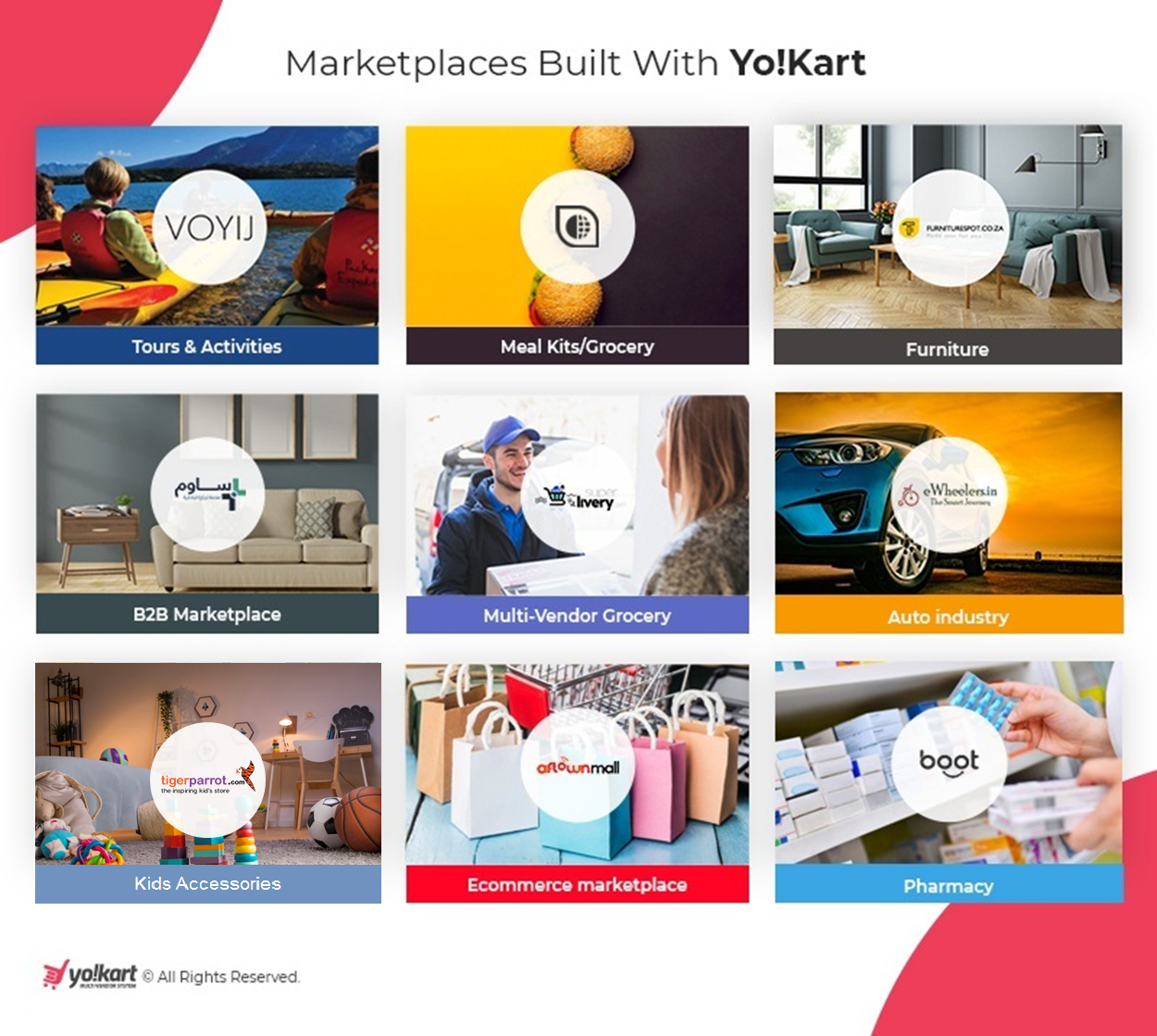
4. Self-Hosted Solution
Yo!Kart is a self-hosted solution which means you get the added benefits such as complete control over different aspects of infrastructure, better security, flexibility to improve the up-time, and more.
5. Open-Source Technology Stack
Our products are developed on Linux, Apache, MySQL, and PHP (LAMP) stack. As each component within the LAMP stack is open source, developers from all around the world contribute towards making the LAMP stack as one of the most secure, stable, and affordable.
6. Get Full Source Code
The startup ecosystem is dynamic and to survive in the eCommerce sphere, consistent changes in your multivendor eCommerce website are inevitable. To reduce your dependability on the solution provider, we offer you full source code to extend Yo!Kart as per your requirements. We also provide technical documentation to help you or your team understand different functions and classes used in Yo!Kart.
7. Fully Customizable
As the multi-vendor platform is scalable through customization, different 3rd-party applications can also be integrated to add features. The framework documentation can help you extend the online marketplace with ease and save time in the process. We advise that client’s development team members should have at least three years of web development experience working on MVC architecture.
8. Hire Yo!Kart Product Team
Yo!Kart is developed using a custom framework. If the need to extend Yo!Kart ever arises, we give you complete framework documentation. If you don’t have an in-house web development team, you can hire our experienced team members for design and development.
9. One Time Payment
Unlike other eCommerce marketplace solutions, Yo!Kart does not charge you any recurring fees be it monthly or commission behind each article you sell. The cost of the selected package is to be paid once and the license lasts a lifetime.
10. One-on-One Online Demo
Our sales representative provides a one-on-one online demo to help you explore the comprehensive platform and showcase the end-to-end user journey. They also answer questions shared by you to help you make an informed decision.
11. On-Site Demo
Our representative can visit your office location to provide a better understanding of our product’s features & functionalities. For more information, visit on-site demo.
12. Reliable Performance
The usual success rate or pass percentage for such eCommerce software is below 98%. As more lines of code are added, the rate drops even further to about 95%. Whereas Yo!Kart has a 100% success rate. 1000+ tests conducted in an automated environment for 1 million products and 250 concurrent users to achieve the success rate. Our quality assurance team members had a zeal to achieve nothing but the best.
13. Intuitive User Interface
The user interface has been designed keeping in mind different users and their requirements. For admin to get more work done in less time and to manage the revenue and sales, Yo!Kart offers an informative eCommerce dashboard to provide insights on important key performance indicators (KPIs). For sellers, the most important aspect is to manage product orders and delivery. Information on these two KPIs can be easily accessed through the vendor dashboard.
14. Progressive Web Apps
A progressive web app combines the features provided by most modern web browsers with an exceptional mobile app experience. A PWA runs on a browser but gives the experience of a native mobile app. No installation, better performance, seamless offline usage and enhanced conversions are some of the key benefits of progressive web apps. Considering the importance of PWAs, Yokart has become PWA compliant providing us with a competitive edge over other eCommerce platform solutions.
15. User-Friendly Android and iOS Buyer Apps
It has become important for an eCommerce business to have a mobile app to satisfy the growing demands of millennials and Gen Z. Yo!Kart has separate Android and iOS apps for buyers. The apps are designed for maximum conversion and profitability.
Yo!Kart iOS App
16. Sell Digital Products with Yo!Kart
Entrepreneurs can expand their business by enabling the vendors to sell digital products such as ebooks, videos, and more on their multivendor website.
17. Multilingual
With Yo!Kart, you can launch your online marketplace in the area of your preference. The multilingual and multi-currency capability enables eCommerce entrepreneurs to provide a localized viewing experience.
To increase the global reach of any eCommerce multi-vendor business, Yo!Kart has been integrated with MSN Azure Language translation API supporting 60+ languages to solidify the multilingual functionality. Additionally, Yo!Kart supports the right-to-left design flip which is essential for Arab countries.
18. Multi-Currency
An eCommerce multi-vendor website should be configured to bill customers in the currency of their choice.
In YoKart multi-vendor, the prices can be displayed in different currencies. With the help of the Currency Converter API, real-time currency conversion values are fetched from live API’s. The marketplace owner can accept payments in any regional currency selected in the payment gateway
19. Elastic Search
It is imperative to design the search functionality of an eCommerce website in order to correctly retrieve an item the user is looking for. Yokart is configured for the elastic search to improve conversion and retention by providing the highest level of relevancy and flexibility.
20. Product Catalog System
Yo!Kart has a catalog system in place which brings ease in product management for website admin and vendor. Other benefits include standardization of content, no duplicate product information, and better admin control over the platform.
21. Ease in Vendor Management
The marketplace owner can easily manage what vendors can change through manageable settings. In Yo!Kart, the admin can enable or disable certain features or options for the vendor.
22. Search Engine Friendly
Throughout Yo!Kart, there are fields at relevant places that make it easier for the website admin to optimize content for search engines. Other features that help in improving SEO friendliness are URL rewriting, meta tags management, manageable robots.txt, Google Tag Manager integration, sitemap (HTML and XML), and more.
23. 3rd Party Integrations
QuickBooks, MailChimp, Google Maps, AWeber, Google Analytics, Engagespot desktop push notifications, and ShipStation are some of many third-party integrations that are included in Yo!Kart.
24. Paypal Payouts
Paypal Payout integration makes you accept any payments instantly. With this integration the sellers can request payouts via it and thereof, admins can approve the requests to pay via PayPal. The integration provides the quickest and effortless way for payment transactions from anywhere around the globe.
25. 15 Pre-Integrated Payment Gateways
To enable an entrepreneur to sell across all continents, Yo!Kart comes integrated with payment gateways supported in areas such as Australia, Austria, Belgium, Canada, Denmark, Finland, France, Germany, Hong Kong, Ireland, Italy, Japan, Luxembourg, Netherlands, New Zealand, Norway, Portugal, Singapore, Spain, Sweden, Switzerland, United Kingdom, United States, United Arab Emirates, Egypt, Saudi Arabia, Jordan, Lebanon, Qatar and, and more.
Yo!Kart offers 15 payment gateways such as Authorize.Net, PayPal, PayU Money, CCAvenue, Omise, Citrus, Khipu, PayTM, Razorpay, Amazon, Stripe, 2Checkout, PayFort, PayU Biz, and Braintree. Furthermore, the multi-vendor platform offers cash on delivery (COD) and bank transfer payment option.
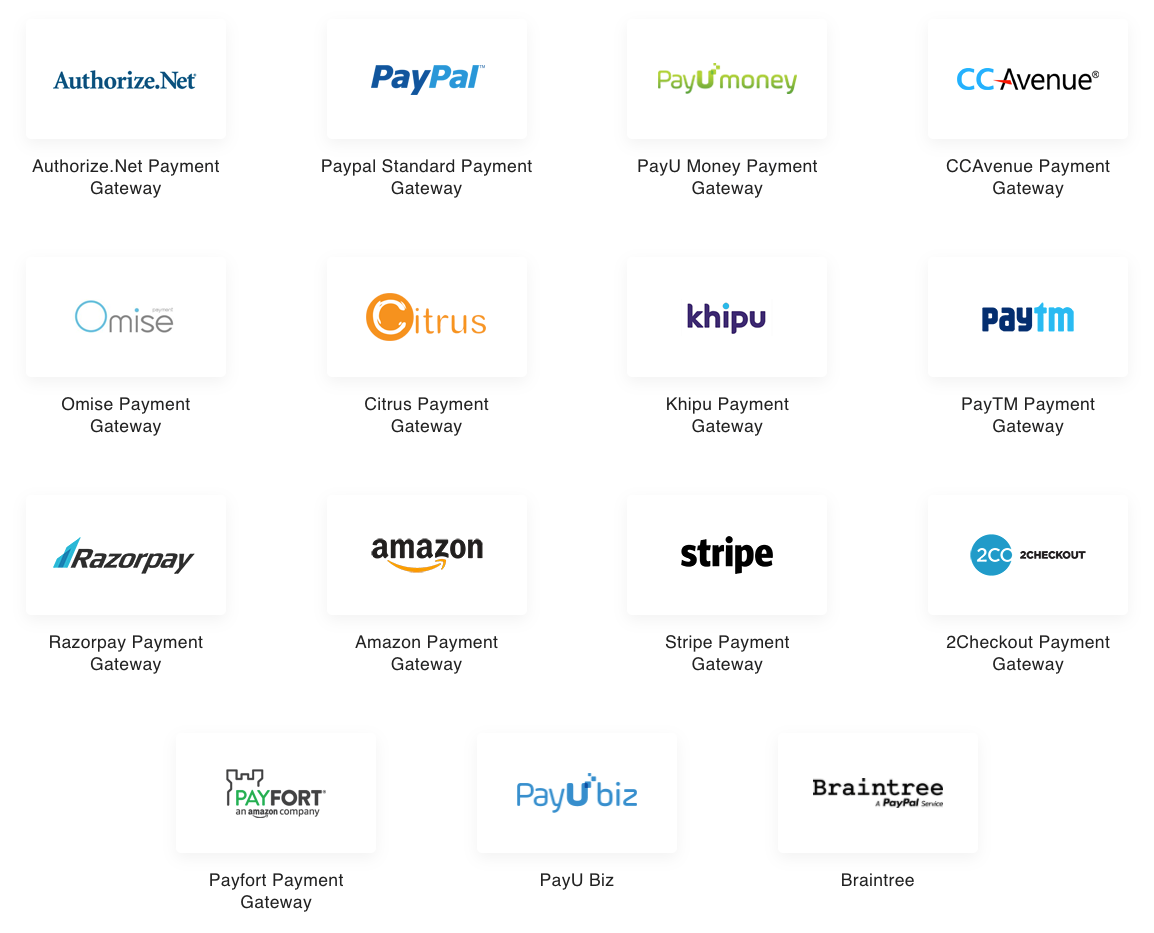
Note: Any payment gateway of your choice can be easily integrated with Yo!Kart under customization.
26. Virtual Wallet
Virtual wallets are a convenient option to pay instantaneously. It also helps in simplifying the process for cashback and discount points. Using this feature, buyers can earn reward points on events such as birthdays and purchases.
27. Affiliate Module
Through the affiliate module, the eCommerce marketplace owner can increase the user base with the help of affiliates. Yo!Kart offers flexibility to the owner by giving an option to set commission based on different product categories.
28. With Yo!Kart, you don’t need Addons
Staying true to our values, we offer a solution that is tuned for startups and SMBs. In each package, we offer a complete set of features such as multiple payment gateways, blog management, PPC module, catalog management, and more.
29. Inbuilt Analytics features
Yo!Kart offers a robust reporting feature that provides relevant and accurate information. Furthermore, Google Analytics is also integrated into Yo!Kart can fetch data to give you an eCommerce dashboard with important insights.
30. Facebook Pixel
To target your customers more accurately and efficiently, Yo!Kart is integrated with the facebook pixel. The integration allows you to understand how customers behave on your website, ability to build custom audiences for relevant engagement on the website and target high value customers. Configure and trace the events like AddtoCart/Wishlist, Contact Us, IntiateCheckout etc.
31. Abandoned Cart Management
In order to minimize the cart abandonment rate and improve the conversions, this feature in Yo!Kart allows the admins to view details in the admin console. To recover these, the admins can generate discount coupons and the admins can also view the items that have been deleted from the cart by the users.
32. Tax Management
A big challenge for the eCommerce business owner is managing tax. Understanding the aspects of the sales tax can be a daunting and time consuming task. Yokart allows the sellers to enter the tax category information and the cost is adjusted accordingly. For advanced tax management, the admins can use Intuit’s QuickBooks.
33. Multiple Streams to Generate Revenue
Yo!Kart multi-vendor offers you an ample number of revenue generation streams for a better return on investment. The number of revenue streams available with Yo!Kart multivendor are – commissions, subscriptions, advertisements, featured listings, and affiliate partnership.
34. Monetization Options
Yo!Kart offers multiple options to monetize your online marketplace. Depending on your monetization strategy, you can set order commissions, allow the seller to register at no additional cost or subscribe to a package to list products, and earn through PPC with banner advertisements.
35. A Range of Ecommerce Services
To enable an eCommerce entrepreneur to add value, we offer a range of services such as design, development, migration, payment gateway integration, online marketing, catalog management, and more. To learn more, visit our eCommerce services webpage.
36. Free Digital Marketing Services
After an online marketplace is launched, reaching the target audience is the most challenging part. When you buy Yo!Kart Multivendor, to start your marketplace, we provide free digital marketing services worth $500 for free. The digital marketing service includes setting up Google Console, Google Analytics, Google My Business, business profiles on top 10 citations or listing websites, content marketing, social media marketing plan, and many more.
37. Migrate to Yo!Kart
Using the bulk import and export feature, entrepreneurs can move their data to Yo!Kart from most ecommerce platforms. Furthermore, the import or export feature works for all languages.
Migrate Your Multivendor eCommerce Marketplace to Yo!Kart
38. Free Technical Support
The first few months are crucial for the growth of your online marketplace. Yo!Kart has been tested with a 100% success rate which is essential for stability. To stay true to our commitment to enabling startups, we provide an additional one-year free technical support if any glitches are found.
39. Multiple Support Channels
While our project management software, Bizixx, is the primary mode of communication, we have a presence on different channels like skype, email, social media, phone, and more.
40. Flexible Payment Plans
With Yo!Kart multi-vendor, you do not have to pay the entire amount upfront. Yo!Kart offers flexibility to make payment in milestones for our GoCustom packages. Just need to pay a nominal upfront amount and the rest in parts, Learn more.
41. Free Installation
We do not charge anything extra from our clients to install Yo!Kart on their server hosting space.
42. Post-Launch Support
We invest significant time to understand your requirements and enable you to make an informed decision. After the delivery of the project, we provide you post-sales support which is free up to a certain number of hours.
43. Post-Sales Transparency
Yo!Kart team strives to provide transparency at every stage. Not only a dedicated project manager is assigned to you, but we also report each detail on our project management system (PMS). Using our PMS, you can easily check the current status and due date of the project.
44. Free .store Domain Name
A free “.store” domain name is beneficial for an eCommerce website. There are comparatively fewer eCommerce marketplaces operating with a “.store” domain name which improves the chances of you getting the desired name.
45. Client-Centered Agreements
To add value for our clients, we are open to a non-disclosure agreement (NDA) as well as the non-competition clause in the NDA.
46. Social Proofing
Yo!Kart has been in the industry for many years and has been recognized by many authoritative online publications. We have been featured in many prominent websites like Telegraph UK, Forbes, Inc., Entrepreneur, and more.
Features that make Yo!Kart an Award Winning Multi-vendor Platform
47. Transparent Refund Policy
Yo!Kart provides 30 days money-back guarantee. We only deduct 4% payment gateway transaction fee and effort exhausted (number of hours x 15 USD) in the process.
48. Educational Content
We have YouTube screencasts, informative blogs, online demo, and more which will give you a fair idea of the working of the system. While we are constantly adding more, the available educational content can help you make an informed decision.
49. Referral Commission to Partners
It is a great time to be a part of the eCommerce ecosystem when specialized marketplaces are in great demand. We welcome partners, who support the startup ecosystem, by giving a certain percentage of the commission behind each sale of Yo!Kart system. The following chart elaborates the commission percentage:
| PACKAGE | COMMISSION %age |
| GoQuick Packages | |
| Above $999 USD | 20% |
| Less than $999 USD | 10% |
| For Custom Requirements | |
| If the total value of orders in a year exceeds $10,000 USD | 5% |
| If the total value of orders in a year exceeds $20,000 USD | 7.5% |
| If the total value of orders in a year exceeds $30,000 USD | 10% |
| If the total value of orders in a year exceeds $50,000 USD | 12.5% |
50. Release Cycle
To keep up with changing times, we release timely updates in Yo!Kart. We introduce new features, enhance existing features, and optimize the performance of the system with each release.
As the eCommerce ecosystem continues to evolve, the Yo!Kart team updates the system after every few months. We continue to invest our time to improve the reliability and scalability of Yo!Kart while maintaining our fundamental belief in serving with a smile
Want An Expert to give you a Virtual Tour of Yo!Kart
The post 50 Reasons To Choose Yo!Kart To Start eCommerce Marketplace appeared first on YoKart Blog.
]]>